Dirty Dancing 1987: How Patrick Swayze Made the Summer Movie That Never Gets Old
Three days from now marks 39 years since Dirty Dancing opened in American theaters on August 21, 1987. The distributor barely tried to sell it. Vestron Pictures, a small company built on home video distribution, treated it as a throwaway summer release — low budget, no recognizable stars, a period romance set in 1963. The film made $214 million. Nobody, least of all the people who made it, expected that.
Dirty Dancing 1987: The Film Nobody Believed In
Before Dirty Dancing opened, it came within inches of going straight to videocassette. Vestron Pictures saw it primarily as a product for the rental market. The theatrical release was almost an afterthought — minimal marketing, limited screens, no conventional star power. Even after early test screenings generated positive buzz, the studio hedged its bets and scheduled it as a summer dump release against bigger competition.
The film was shot in 44 days at Mountain Lake Lodge in rural Virginia — not the Catskills of the story, but close enough for the cameras. Writers and producers wanted a more recognizable location, but a $6 million budget settled the argument quickly. Mountain Lake Lodge stood in for the fictional Kellerman’s Mountain House in the Catskill Mountains of New York. Nobody watching the film can tell the difference.
The Retro Almanac
A monthly roundup of "on this day" highlights from that month, decades back — plus first dibs on new retro merch drops. No spam, just the good stuff.
Eleanor Bergstein, who wrote the screenplay and co-produced the film, had been trying to get the project made for years. The story came directly from her own life — she was a passionate mambo dancer who spent summers at resorts in the Catskills in the early 1960s. The class tensions between resort guests and working-class entertainers she observed on those dance floors were real. Most studios passed. Vestron picked it up almost by accident, and for once, an accident worked out.
How the Lake Lift Actually Happened
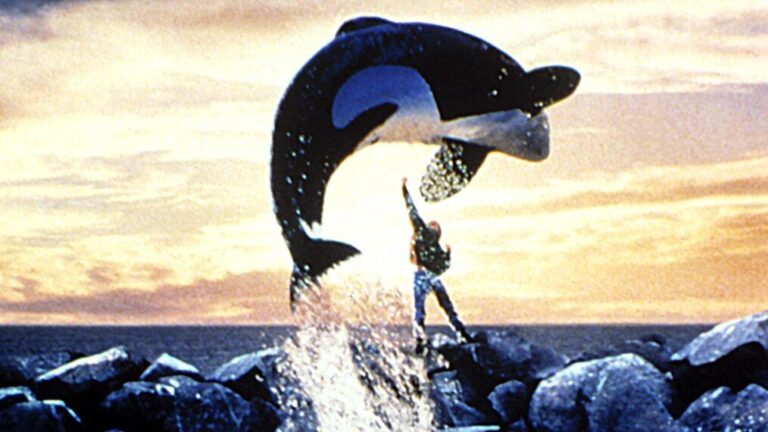
The film’s most iconic image — Johnny lifting Baby above his head in the middle of a lake while water streams from her outstretched arms — was a rehearsal shot that made it into the final cut. The scene has a narrative function: Baby can’t nail the move on dry land, so Johnny takes her into the water to lower the psychological stakes. The physical stakes, it turned out, were considerably higher.
Mountain Lake’s water temperature during filming was around 44°F. Jennifer Grey and Patrick Swayze spent hours in that water. Swayze was managing a significant knee injury throughout the entire production — a condition that required surgery after filming wrapped — and still had to repeatedly lift Grey overhead in frigid conditions without showing any strain. Every time you watch that scene, you’re watching an athlete work through real pain with a smile on his face.
The lift was choreographed by Kenny Ortega, who had worked with Michael Jackson on the “Beat It” music video and understood that great dance sequences in film need emotional stakes, not just technical skill. He built the entire finale so that the lift paid off weeks of failed attempts. The move doesn’t work as spectacle; it works as a resolution.

Patrick Swayze Almost Wasn’t Johnny Castle
Casting Johnny Castle was harder than the finished film makes it look. The role required someone who could dance at a professional level, carry a dramatic scene, and project the kind of physical confidence that makes the class-crossing romance believable. Several names were considered before production began. The role required a dancer who could act, not an actor who could learn to dance — a shorter list than anyone expected.
Swayze had dance training from childhood and had worked on Broadway before moving into film. His physicality was genuine. But the studio was nervous about his leading-man status — he wasn’t a proven box-office name in 1987. Swayze reportedly wrote a letter to director Emile Ardolino making the case for why he was the right person for the part. He got it. Looking at the finished film, it is impossible to imagine anyone else in the role.
Jennifer Grey had just finished Footloose (1984) — she had a small part — and more prominently Ferris Bueller’s Day Off (1986), where she played the older sister Jeanie. Grey and Swayze had also worked together on Red Dawn (1984), meaning the on-screen chemistry audiences assumed was magic had a real foundation in prior collaboration. Grey threw herself into the dance training. The final performance is not stunt work.
The Song That Won an Oscar
“(I’ve Had) The Time of My Life” was written specifically for the film’s finale by Franke Previte, John DeNicola, and Donald Markowitz. Bill Medley of the Righteous Brothers and Jennifer Warnes recorded it. The song won the Academy Award for Best Original Song and the Grammy Award for Best Pop Performance by a Duo or Group with Vocal in 1988. It has been a fixture of wedding receptions for four decades and shows no sign of stopping.
Less widely known: Patrick Swayze sang one of the film’s other featured tracks himself. “She’s Like the Wind,” which plays over a key emotional scene in the film, was written by Swayze and Stacy Widelitz. Swayze had been writing and performing music for years and pushed hard to include the song on the soundtrack album. It peaked at number 16 on the Billboard Hot 100 in 1988. He was the dancer, the leading man, and the recording artist all in one production.
The Dirty Dancing soundtrack sold over 11 million copies worldwide and spent 18 weeks at number one on the Billboard 200. For a film that opened with minimal marketing, the music did what no advertising campaign could: it kept audiences talking and returning. RCA Records’ soundtrack became one of the best-selling albums of the entire decade, comparable to what Purple Rain had done three years earlier for a different soundtrack-driven film.
Nobody Puts Baby in a Corner
The line was not ad-libbed. “Nobody puts Baby in a corner” is scripted, deliberate, and placed exactly where Eleanor Bergstein intended — the moment Johnny publicly claims Baby in front of her father, collapsing the class barrier the entire film has been building. It works because Swayze delivers it without a hint of irony. He means it, and the audience knows he means it.
The line has since become one of the most quoted movie lines of the 80s. The American Film Institute placed it at number 98 on its list of the 100 greatest movie quotes in 2005 — not bad for a film the studio didn’t believe in. It appears on merchandise, gets referenced in television shows as cultural shorthand, and has become the shorthand for refusing to be underestimated. The reason it lasts is that the emotion behind it was always genuine, not manufactured.
Bergstein has said in interviews that the line captures something specific about the era the film depicts. The early 1960s were a moment when certain women — middle-class, educated, the “nice girls” — were expected to stay precisely where they were put. Johnny’s declaration is a rejection of that arrangement. In 1987, 24 years after the summer depicted in the film, the line landed with exactly the same force.

Jennifer Grey’s Career-Changing Summer
The film made Jennifer Grey a star, and in a strange and painful way, it contributed to her disappearing from movies for years afterward. After Dirty Dancing, Grey had a rhinoplasty procedure. She was dissatisfied with her nose and wanted to change it. The result surprised her: the operation changed her appearance enough that audiences no longer recognized her. She had been a distinctive-looking actor. After the surgery, she looked conventionally attractive — which in Hollywood made her harder to cast, harder to remember.
Grey has spoken about this directly in interviews. “I went in the operating room a celebrity and came out anonymous,” she said in 2010. The surgery was meant to give her more confidence. Instead it cost her the quality — her recognizable face — that had built her career. She continued working in film and television over the following decades, but the cultural moment that Dirty Dancing had given her was gone. It is a genuinely strange footnote to the film’s success story.
Why It Still Works in 2026
The film is set in the summer of 1963, which is a deliberate choice with real meaning. That summer — before the Kennedy assassination, before the full escalation of Vietnam, before the rupture of the later 60s — exists in cultural memory as a specific kind of last-moment. Baby Houseman is heading to university in the fall to study the economics of underdeveloped countries. Her father believes in the Great Society. The world they live in is about to change in ways none of them can predict, and the summer at Kellerman’s is their last uncomplicated summer.
What keeps Dirty Dancing from being simple nostalgia is that it doesn’t pretend the summer was uncomplicated. The resort staff lives in cramped quarters while guests eat three meals a day in a formal dining room. Penny Johnson needs an abortion and can’t afford a competent doctor. The class lines are drawn and enforced, and Baby sees them clearly. The romance is real, but so is the education. That combination — warmth and social honesty at the same time — is rarer in mainstream film than it should be.
On August 21, Dirty Dancing turns 39. Swayze died in 2009, and there is no franchise, no recast, no cinematic universe to extend the original. The film exists, and it holds up the way films hold up when they were made to matter rather than to sell sequels. Three 80s summer films made dance their central argument: Flashdance in 1983, Footloose in 1984, and Dirty Dancing in 1987. Of the three, only Dirty Dancing has never needed a remake to stay relevant. The lift still works. The song still works. The line still works, because the emotion behind it was always real.
Sources
- The Guardian — Dirty Dancing at 30 — Eleanor Bergstein and Jennifer Grey on the film’s 30th anniversary
- Wikipedia — Dirty Dancing — Production history, box office figures, and soundtrack details
- (I’ve Had) The Time of My Life — Wikipedia — Billboard chart position and awards history
- IMDb — Dirty Dancing (1987) — Complete cast, crew, and production information
- Rolling Stone — Dirty Dancing Oral History — Cast and crew reflections on making the film
The Retro Almanac
A monthly roundup of "on this day" highlights from that month, decades back — plus first dibs on new retro merch drops. No spam, just the good stuff.