Flymo Hover Mower: The Floating Lawnmower That Ruled 80s Backyards
Picture this: it’s a Saturday morning in 1987. Your dad’s out back in his weekend uniform — shorts he’s owned since before you were born, knee-high socks, and a polo shirt that’s seen better decades. He yanks a cord, and the orange beast in the shed roars to life. Except this isn’t a regular lawnmower. This thing doesn’t roll across the grass. It floats. Like a tiny hovercraft that somebody strapped blades to and said, “Right, that’ll do for the back garden.”
That was the Flymo. And if you grew up in the UK, Australia, or pretty much anywhere in the Commonwealth during the 1980s and 90s, you knew the sound. That high-pitched whirr, the skirt puffing up as it lifted off the ground, the way your old man could glide it across the lawn like he was piloting some sort of domestic spacecraft. The hover mower was the most genuinely futuristic thing in any suburban household — and nobody even appreciated how wild it was.
Before the Float: When Mowing Was Misery
To understand why the Flymo was such a big deal, you need to appreciate what lawn care looked like before it showed up. Through the 1950s and into the early 1960s, your options were grim. You either had a hand-powered reel mower — the kind that sounded like a dying cricket and needed the upper body strength of a dock worker — or you had a petrol-powered rotary beast that weighed roughly the same as a small motorcycle.
These things were heavy, loud, and about as maneuverable as a shopping trolley with a dodgy wheel. Pushing one uphill was a workout that’d make Jane Fonda’s aerobics tapes look like a gentle stretch. Banks and slopes? Forget it. You either risked your life dragging the thing sideways across a hill, or you just let that bit grow wild and told the neighbors it was “a wildflower meadow.”

The lawn had become a status symbol in postwar suburbia — your grass said something about you as a person, apparently — but the tools for maintaining it hadn’t evolved much since Queen Victoria was knocking about. Something needed to change.
The Swedish Engineer Who Watched Hovercraft TV

In 1959, a British engineer named Sir Christopher Cockerell did something extraordinary. He built a working hovercraft — a vehicle that rode on a cushion of pressurized air, gliding over water and land without wheels, without a hull touching the surface. The SRN1 hovercraft crossed the English Channel that year, and suddenly the future had arrived. It was all over the telly, in the papers, everywhere. The world was obsessed.

Five years later, watching coverage of hovercraft trials from his home in Sweden, an engineer named Karl Dahlman had one of those lightbulb moments that changes everything. If you could float a multi-ton vehicle across the English Channel on a cushion of air, why couldn’t you do the same thing with a lawnmower? Forget wheels. Forget fighting gravity on every slope and bump. Just… float.
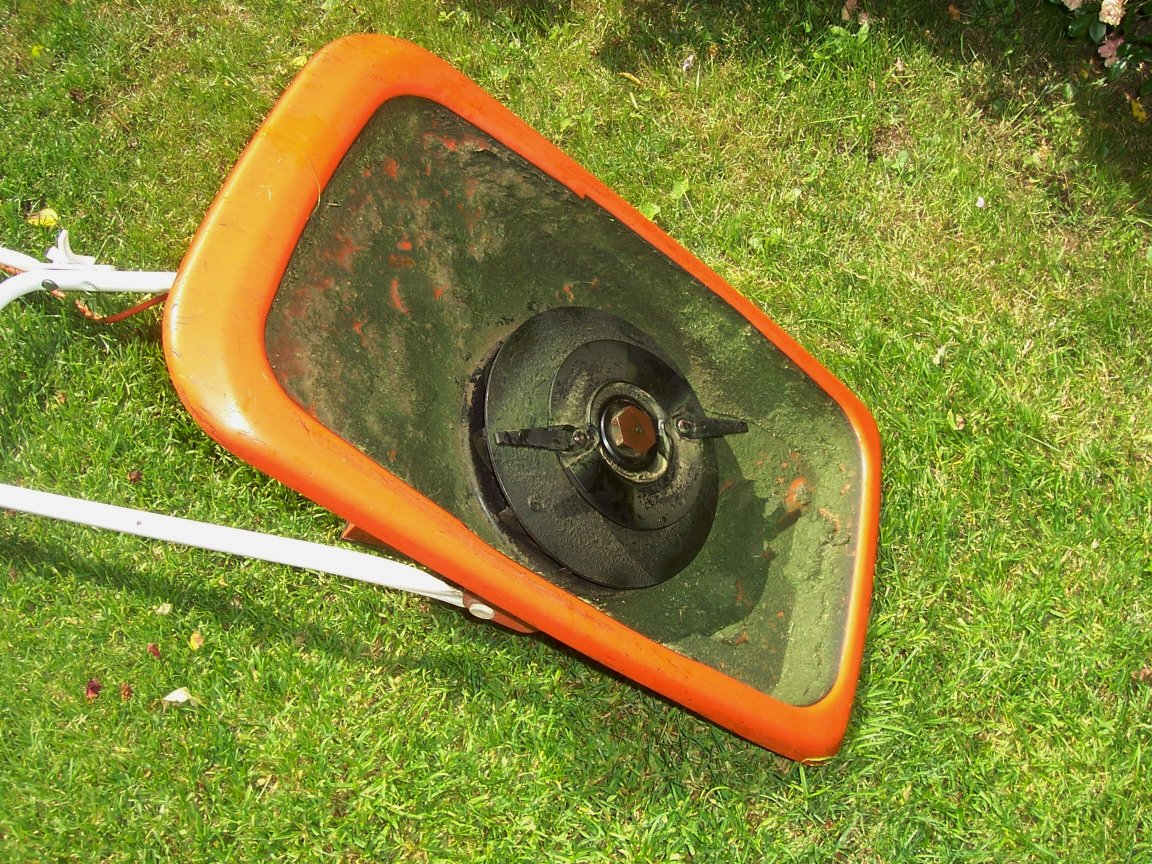
Dahlman built his first prototype in 1964. By 1965, the Flymo was in production, and the first sales season was an immediate hit. The concept was dead simple but brilliantly executed: a lightweight plastic housing shaped like a flying saucer, with rotary cutting blades attached to a fan that blew air downwards. The downward airflow created a cushion of pressurized air beneath the mower, lifting it off the ground. A flexible skirt around the edge kept the air trapped underneath, just like Cockerell’s full-size hovercraft.
The result? A lawnmower that literally hovered. You could push it in any direction with barely any effort. Uphill, downhill, sideways across a slope — the Flymo didn’t care. It had no wheels to dig into soft ground, no heavy engine dragging you around. It was, by any reasonable definition, a piece of space-age technology that had somehow ended up in your dad’s garden shed.
Going Orange: The 1970s and the Brand Takes Off

Through the late 1960s and into the 1970s, Flymo grew fast. The company set up a manufacturing plant at Newton Aycliffe in County Durham, England, which would become the heart of Flymo production for decades. Every single hover mower rolling off the line came from this one factory in the northeast of England — a proper British manufacturing story, even though the invention was Swedish.
In 1977, Flymo made the design choice that would define the brand forever: they went orange. That distinctive, unmistakable burnt-orange color became the Flymo’s signature. You could spot one from three gardens away. It was like the brand equivalent of a DeLorean — you knew exactly what it was the moment you clapped eyes on it.
A year later, in 1978, Swedish appliance giant Electrolux acquired the Flymo brand, folding it into their empire of domestic products. This gave Flymo the corporate muscle to expand internationally, ramp up production, and — critically — invest in the kind of advertising that would burn the brand into the collective memory of an entire generation.

Peak Flymo: The 1980s and 90s Golden Age
If you remember anything about lawn care in the 1980s and 90s, you remember Flymo adverts. They were everywhere. Television, magazines, newspapers, billboards. The advertising was relentless and, honestly, kind of brilliant.
The classic UK campaign featured the tagline “It’s a lot less bovver than a hover” — a pun so magnificently terrible that it could only have been invented by a British advertising agency in the Thatcher era. The ads showed the Flymo effortlessly gliding up steep banks, around flower beds, over bumpy terrain that would’ve destroyed a wheeled mower. The message was clear: this isn’t just a lawnmower, it’s the future of gardening, and the future is surprisingly easy.
In America, Flymo launched with “considerable advertising fanfare” in the early 1980s, generating massive curiosity and attention. Everyone wanted to see the floating lawnmower. But here’s the thing — Americans, with their enormous lawns and riding mowers, never quite took to it the same way. The Flymo was designed for the compact British garden, the postage-stamp lawn, the awkward slopes and borders that defined suburban life in the UK. In American terms, it was like bringing a skateboard to a monster truck rally.
But in Britain? The Flymo dominated. Through the 80s and into the 90s, it was the default lawnmower for millions of households. Saturday mornings across the country were soundtracked by that distinctive hover-mower whine. The Flymo wasn’t just a tool — it was a cultural institution, right up there with Benny Hill, PG Tips, and arguing about whose turn it was to wash the car.
How the Hover Mower Actually Worked (The Science Bit)
Alright, let’s get into the nerdy stuff for a minute, because the engineering behind a hover mower is genuinely clever.
The Flymo’s electric motor drives a rotating blade assembly mounted at the bottom of the housing. Attached to this assembly (or in some models, driven separately) is an impeller fan. When the motor fires up, the blades spin to cut the grass while the fan simultaneously forces air downward at high pressure.
This downward blast of air hits the ground and gets trapped beneath the mower’s dome-shaped housing, which is rimmed with a flexible plastic skirt. The trapped air forms a pressurized cushion — typically only a fraction of an inch thick — that lifts the entire mower body off the lawn. It’s exactly the same principle that lets a 200-ton hovercraft cruise across the Solent at 60 knots, just scaled down to garden size.
The beauty of this design is the near-zero friction. Because the mower isn’t touching the ground, there’s nothing resisting your push. A machine that weighs 8 to 10 kilograms feels almost weightless in operation. You can guide it with one hand. You can push it sideways across a 45-degree slope without the thing sliding downhill. You can swing it around obstacles like you’re wielding a frisbee.
The tradeoff? Hover mowers don’t create those satisfying parallel stripes on your lawn. Because they float rather than roll, there’s no roller to bend the grass in one direction. For the “my lawn looks like Centre Court at Wimbledon” brigade, this was a dealbreaker. For everyone else who just wanted the grass shorter without throwing their back out, it was brilliant.
The Expansion Beyond Hovering

By the 1990s, Flymo was smart enough to know they couldn’t be a one-trick pony forever. The company branched out in two important directions.
First, they launched the Chevron — a wheeled electric mower designed to give those beloved lawn stripes that the hover models couldn’t deliver. It was an admission that not everyone wanted a floating mower, and that’s fine. Some people needed their lines.
Second, and more interesting, Flymo expanded into broader garden tools. The Gardenvac — a combined leaf blower and vacuum — became another smash hit. Suddenly Flymo wasn’t just the hover mower people. They were a full garden tools brand, competing with the likes of Black & Decker and Bosch in the domestic toolkit wars.
In 2006, Electrolux spun off its outdoor products division, and Flymo landed under the Husqvarna Group umbrella — a Swedish company with deep roots in forestry and outdoor power equipment. The heritage was preserved, but the brand was evolving.
Why We Stopped Thinking Hover Mowers Were Cool
Here’s the question that’s been bugging me: when did we stop being amazed by a lawnmower that literally floats on air?
Think about what the Flymo represented. In the 1960s, the hovercraft was the absolute cutting edge of transportation technology. People genuinely believed hovercrafts would replace boats, cars, maybe even trains. They were the future, full stop. And some genius in Sweden figured out how to put that same technology in your garden for forty quid.
A lawnmower that floats on a cushion of air. Read that sentence again. That is objectively insane. If someone described that to you for the first time today, you’d think they were pitching a Kickstarter project that would never deliver. But your dad had one in 1985 and didn’t think twice about it.
The problem was familiarity. The Flymo became so ubiquitous, so everyday, that we forgot how remarkable the technology was. It’s the same thing that happened with microwave ovens — literally cooking food with radiation — and pocket calculators that could do in seconds what would have taken a room full of mathematicians an hour. Futuristic technology becomes boring the moment it works reliably.
There was also a shift in what “high-tech gardening” meant. By the 2010s, the hot thing was robotic mowers — autonomous machines that potter around your lawn on their own while you sit inside watching Netflix. The hover mower suddenly looked old-school, even though the physics behind it is arguably more impressive than a robot that follows a boundary wire.

The Flymo Today: Still Floating After All These Years
Here’s what might surprise you: Flymo still makes hover mowers. Right now, in 2026, you can walk into a Homebase or order online and buy a brand-new Flymo that works on exactly the same principle Karl Dahlman dreamed up in 1964. The models have evolved — they’re lighter, quieter, some are battery-powered instead of corded — but the fundamental concept is unchanged. A fan blows air down, the mower lifts up, and you glide across your lawn like you’re in some sort of suburban sci-fi film.
The Newton Aycliffe factory in County Durham still operates, too. Over sixty years of continuous production from the same site. In an era when manufacturing seems to flee to wherever labor is cheapest, there’s something oddly satisfying about knowing that Flymos are still being built in the same corner of England where they’ve always been built.
Husqvarna, the current parent company, hasn’t abandoned the hover concept either. They’ve invested in the range, keeping it updated while also pushing their robotic mower line. It’s a both-and approach: robots for the tech-obsessed, hovers for the people who appreciate a bit of hands-on, floating-on-air lawn care.
A Love Letter to the Orange Saucer
The Flymo hover mower deserves more respect than it gets. This was a product born from genuine engineering inspiration — a Swedish inventor watching British hovercraft and thinking, “Why not?” It was a piece of technology so good at its job that we took it completely for granted. It dominated British lawns for three decades. Its advertising slogans entered the language. Its distinctive orange became as recognizable as any corporate color in history.
And at its core, the concept is still magnificent. A lawnmower. That floats. On air. Like a tiny hovercraft for your backyard.
If you’ve got one in the shed — an old orange Flymo from the 80s or 90s, maybe inherited from your parents — hold onto it. That’s not just a garden tool. That’s a piece of engineering history. That’s the hovercraft that chose to stay home.
Now if you’ll excuse me, I need to go argue with my neighbor about boundary hedges. Some traditions from the 80s never die.