80s Arcade Games: The Quarter-Fed Religion of Gen X
The first time you walked into a real 80s arcade — humid air, brown carpet, the smell of pizza grease and ozone coming off a hundred CRTs — you understood that this place was not a store. It was a ritual space. You came in with three dollars in quarters and you left when those quarters were gone, your wrist sore, your initials maybe on a screen, your sense of who you were slightly rearranged. That was the trade.
80s arcade games were not just games. They were the first mass-market technology American teenagers controlled with their own hands instead of their parents’, and the arcade itself was the only public space built specifically for them between the playground and the bar. For one loud decade the corner arcade — Aladdin’s Castle, Time-Out, the one tucked beside the Orange Julius — was where Gen X learned competition, social hierarchy, and how to lose with grace. The hardware was Japanese. The culture was strictly American suburban. And every bit of it ran on a quarter.
The Retro Almanac
A monthly roundup of "on this day" highlights from that month, decades back — plus first dibs on new retro merch drops. No spam, just the good stuff.
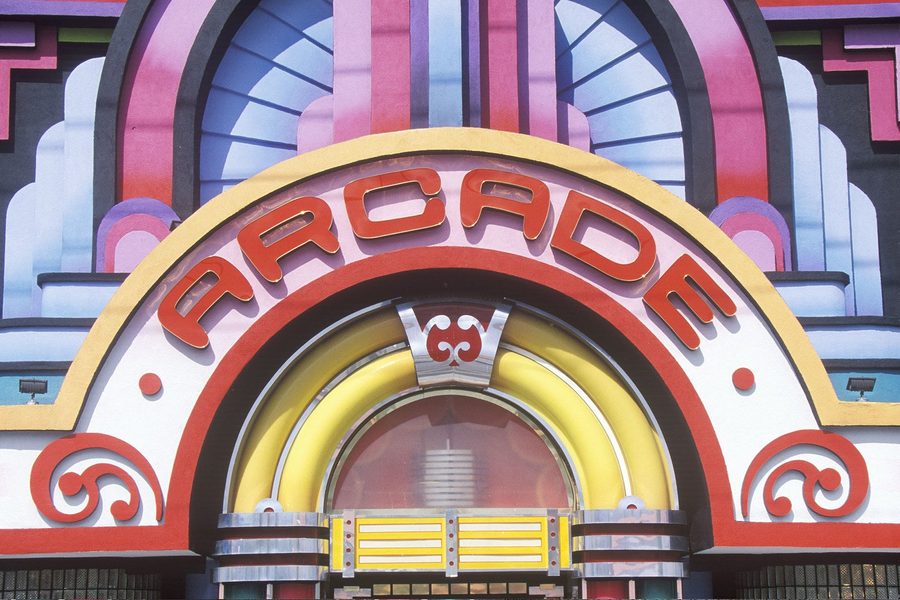
The unmistakable look of an 80s arcade entrance — a marquee built to pull you in from across the parking lot.
When Arcades Became the Cathedrals of Suburbia
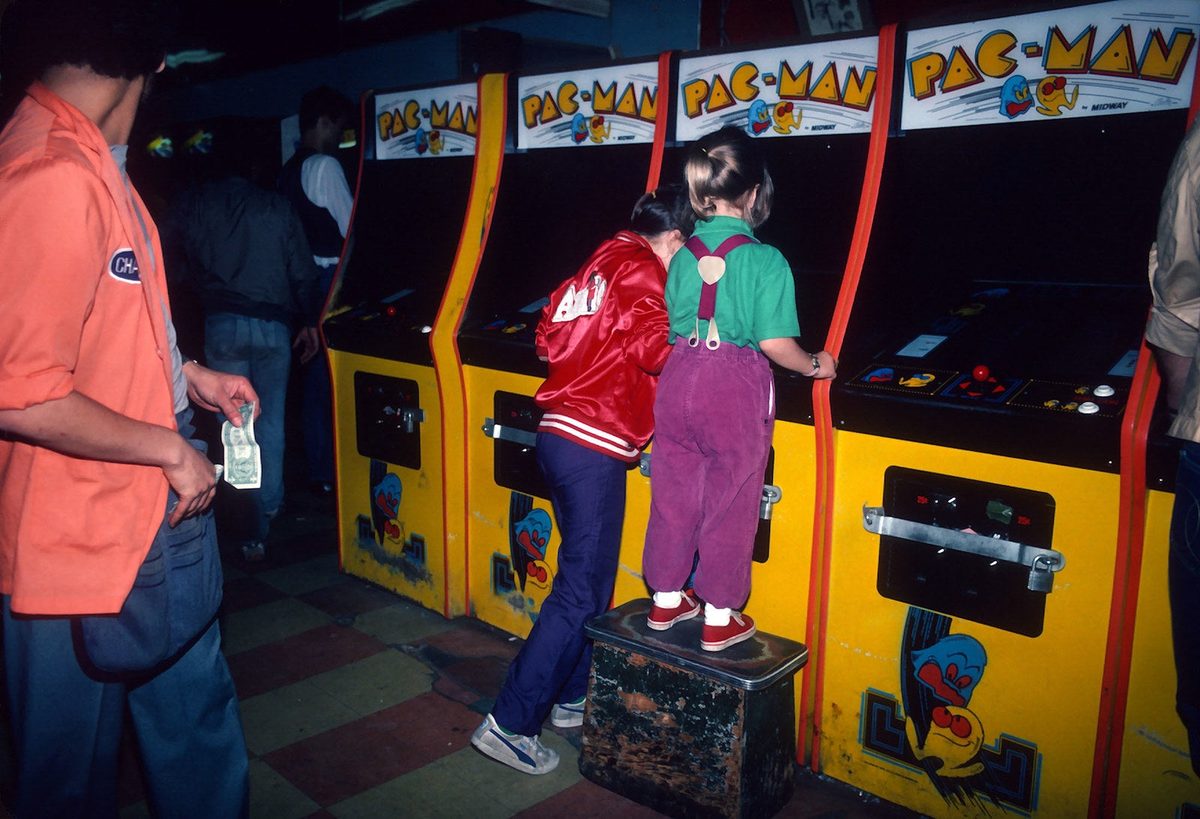
The 80s arcade games boom in the United States started measurably on October 26, 1980, when Namco’s Pac-Man machine landed on American floors through Midway and proceeded to print money in a way the coin-op industry had never seen. By 1982 the arcade industry was pulling in roughly $8 billion a year — more than the film box office and recorded music combined that year. That is not a nostalgia number. That is what the trade press recorded at the time, and what later retrospectives on the arcade industry have confirmed.
Every mall got one. Every strip plaza got one. Bowling alleys carved off space in the lounge for a half-dozen cabinets. Pizza places ringed their walls with them. The arcade became the unofficial extension of the shopping mall and, for kids without driver’s licenses, the closest thing they had to a public square. You met your friends there. You met girls there. You learned who in your neighborhood was actually any good at Defender.
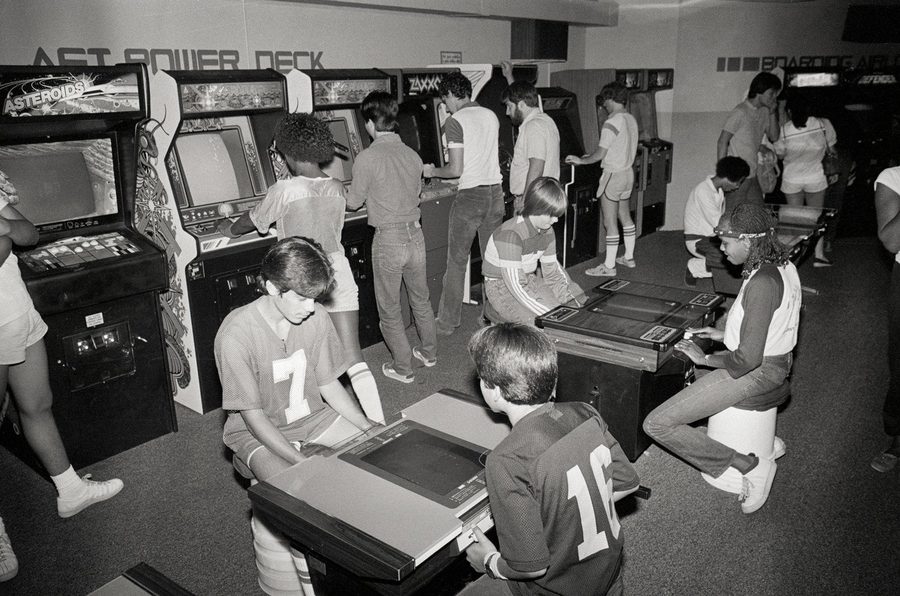
Cocktail tables, Zaxxon, and a row of Asteroids cabinets — the standard 80s arcade floor plan.
The Quarter Was Currency, the High Score Was Status
There was no XP bar in the 80s. There was no save file. You had three lives, and when those three lives were gone you walked away with what you walked away with. The economy was brutal and pure: one quarter, one chance, however long your reflexes held out. A truly elite Galaga or Robotron run could keep a single quarter alive for half an hour while a queue formed behind you. Holding the line was a flex. So was lining up quarters on the bezel — the universal signal that you were next, and that you intended to stay.
High scores were the only social media that mattered. Three letters on a screen everyone in the building could see. Initials carried weight, and certain kids became neighborhood-famous for owning the top slot on a specific cabinet. The first Twin Galaxies scoreboard opened in 1981 in Ottumwa, Iowa — a town so identified with the scene that Life magazine called it the video game capital of the world. That was the era’s MVP system, and a kid in a Midwestern strip-mall arcade could end up ranked on the same board as a touring scorer from California.
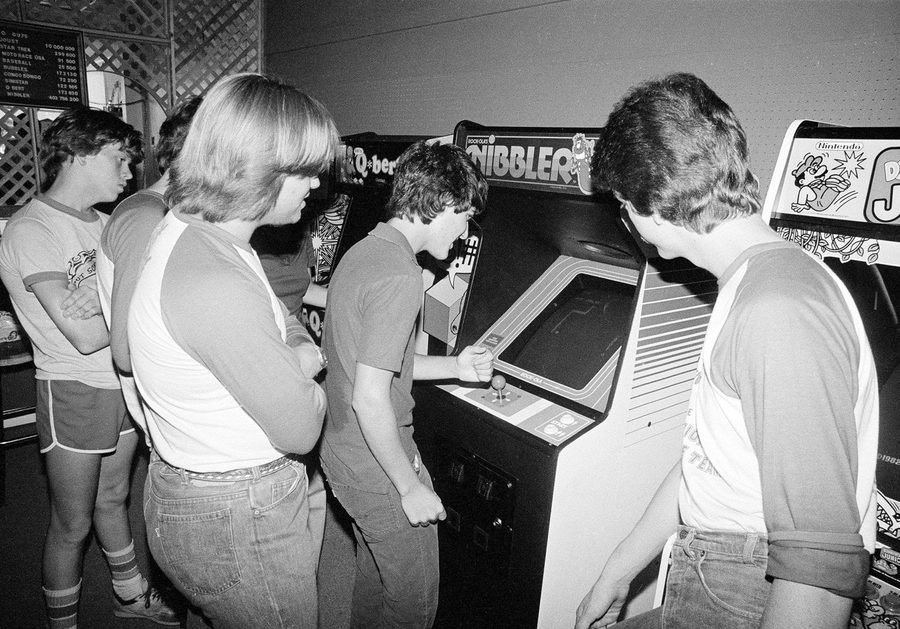
Teenagers around a Nibbler cabinet in Ottumwa, Iowa — the self-declared video game capital of the world, September 1983.
The Cabinet Itself Was the Spectacle
Modern game design is mostly invisible. The cabinet was the opposite. Every machine was a piece of standing furniture, hand-painted side art, a marquee that glowed, a screen sunk under heavy curved glass. Pac-Man’s cabinet was a five-foot yellow obelisk with a chasing-ghost mural along the sides. Tempest had a vector tube that hummed audibly when you stood near it. Tron’s cabinet had a glowing blue floor tile and a four-input control scheme that nobody else dared to copy. Defender’s control panel had so many buttons that the cabinet itself filtered out anyone who wasn’t serious about it.
Different games attracted different tribes. Q*bert and Centipede tended to pull in a mixed crowd. Robotron and Defender selected for the obsessive. The pinball wing — Mr. & Mrs. Pac-Man, Black Knight, Gorgar — had its own subculture entirely, and pinball heads had a way of looking at video game kids like they were tourists. Even the cabinets you laughed at were beautiful. The full pantheon and the games that defined the era are walked through in much more depth in the golden age of 80s arcade legends.
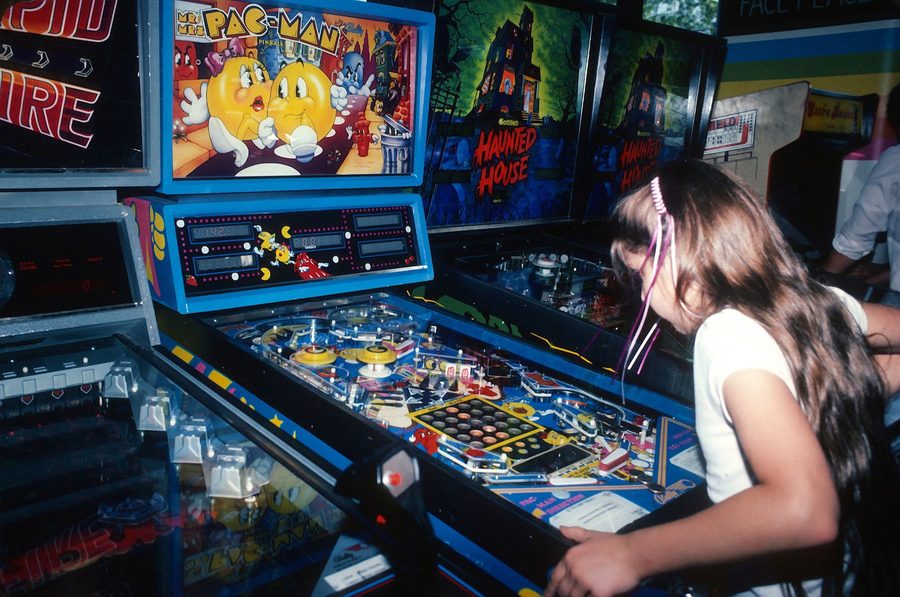
Mr. & Mrs. Pac-Man pinball at a Times Square arcade, June 1982.

A Moral Panic Built Around a Joystick
Like every youth culture worth a damn, the arcade scared adults senseless. Parent-teacher associations held meetings about it. The Surgeon General, C. Everett Koop, said in 1982 that video games were producing aberrations in childhood behavior. Cities passed ordinances banning arcades within a fixed distance of schools. Mesquite, Texas, was sued by Aladdin’s Castle in 1982 after the city tried to bar anyone under 17 from an arcade unaccompanied — a case that made it all the way to the U.S. Supreme Court. Parents argued kids were skipping lunch to feed the machines, gambling without realizing it, neglecting homework. They were right about all of it. The kids did not care.
Nothing about the panic was new. The same arguments had been used against pool halls in the 50s and pinball before that — pinball was actually illegal in New York City until 1976. The arcade was Gen X’s turn to be the public-policy problem. There is a clean line from those city council meetings to today’s screen-time debates, and the same shopping-mall parents who worried about Donkey Kong are now worrying about Fortnite. The technology changes; the panic doesn’t. The kids who grew up inside that panic mostly remember it now as part of the appeal — see what growing up Gen X actually felt like before texting.
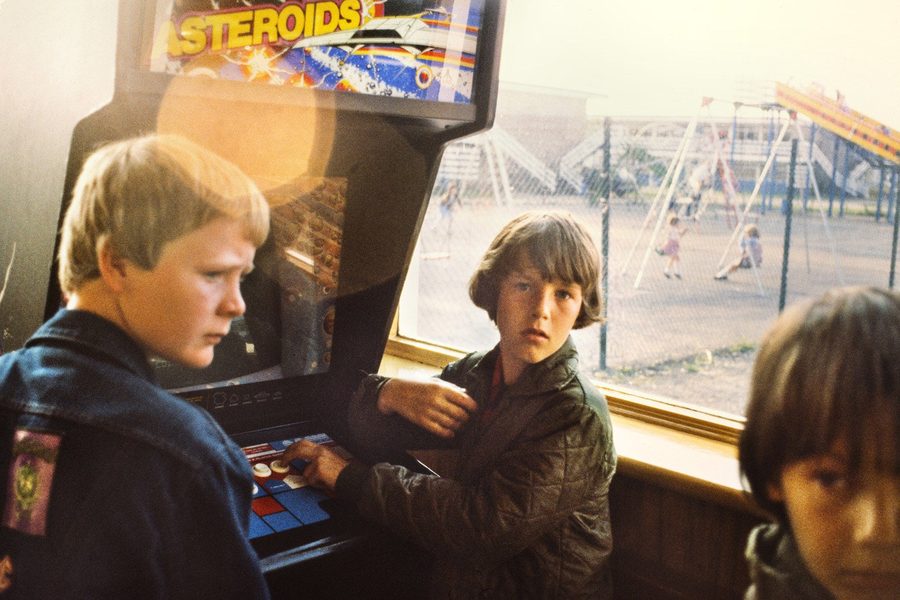
Boys around an Asteroids cabinet at Butlins holiday camp, Skegness, England, August 1982.
The Soundtrack of Bleeps, Bloops, and Beg-for-Quarters
Close your eyes and try to remember a real arcade. What you remember first is the sound. Twenty cabinets playing different attract-mode loops at full volume, the chunk of a quarter dropping, the slap of a flipper button, somebody yelling because their Pole Position run just ended in a wreck. It was the densest information environment most kids encountered all week. You could cross the room blindfolded by sound alone: Pac-Man’s death wail was over there, Donkey Kong’s barrel-tumble loop over here, the click-click of Centipede’s trackball in the corner. Every cabinet shipped its own tiny composition, and a generation of kids memorized them without trying.
That sound design wasn’t an accident. Engineers at Atari, Namco, and Williams understood that attract mode had to pull a kid across the room from forty feet away. The bleeps and bloops were marketing. The fact that they became Gen X’s involuntary memory soundtrack is the long tail of brilliant industrial sound design — the same way an entire generation knows the Windows 95 startup chime without ever having clicked it on purpose. You can still hear those exact attract-mode loops today, by the way, on the Internet Archive’s playable cabinet collection, which preserves the original ROMs and sound chips.
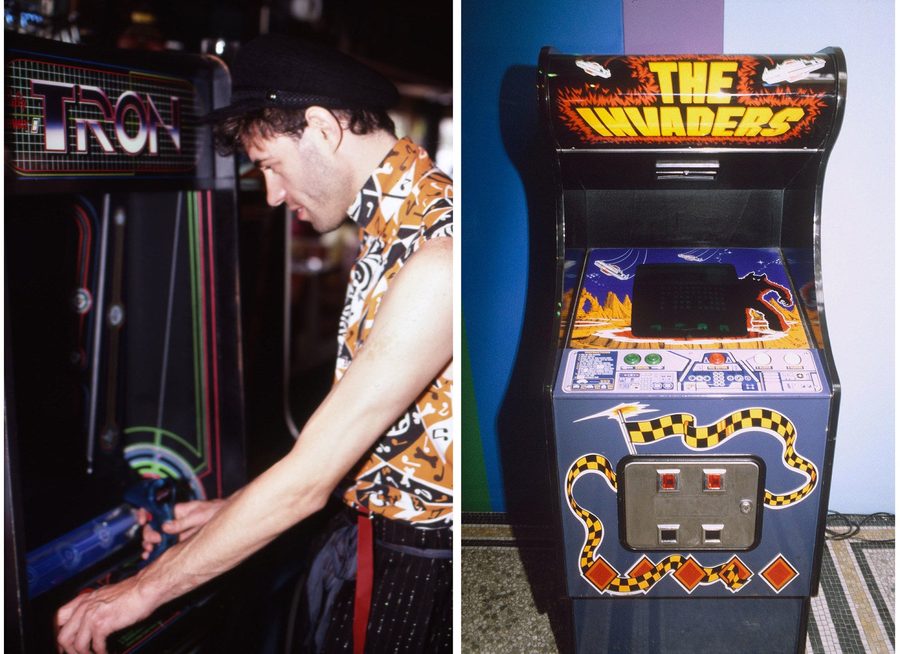
Tron (1982) and a Space Invaders cabinet — two pieces of the standard early-80s arcade lineup.
How the Crash Killed the Arcades (and What Replaced Them)
Then it ended. Not all at once, but fast. The 1983 video game crash — driven mostly by the home console disaster of E.T. on the Atari 2600 and a flood of low-quality cartridges — hit the arcade business by association and by overcapacity. Revenues fell from that $8 billion peak in 1982 to about $2 billion by 1985. What really finished the corner arcade, though, was Nintendo. When the NES rebuilt the home console market and put a real Donkey Kong port in your bedroom for the price of three months of arcade habits, the math stopped working. Why pay a quarter a life when the same game sat plugged into your TV?
Arcades didn’t die, exactly — they got demoted. The good cabinets moved to pizza places and family entertainment venues. The crown jewels of the form — Street Fighter II, NBA Jam, Mortal Kombat — kept the lights on through the 90s but never recaptured the scale of the early 80s. By the time Nintendo’s grey brick handheld changed gaming forever, the cultural center of gravity had clearly moved into the living room and the schoolbus, and the arcade was something you went to on your birthday rather than every Saturday.
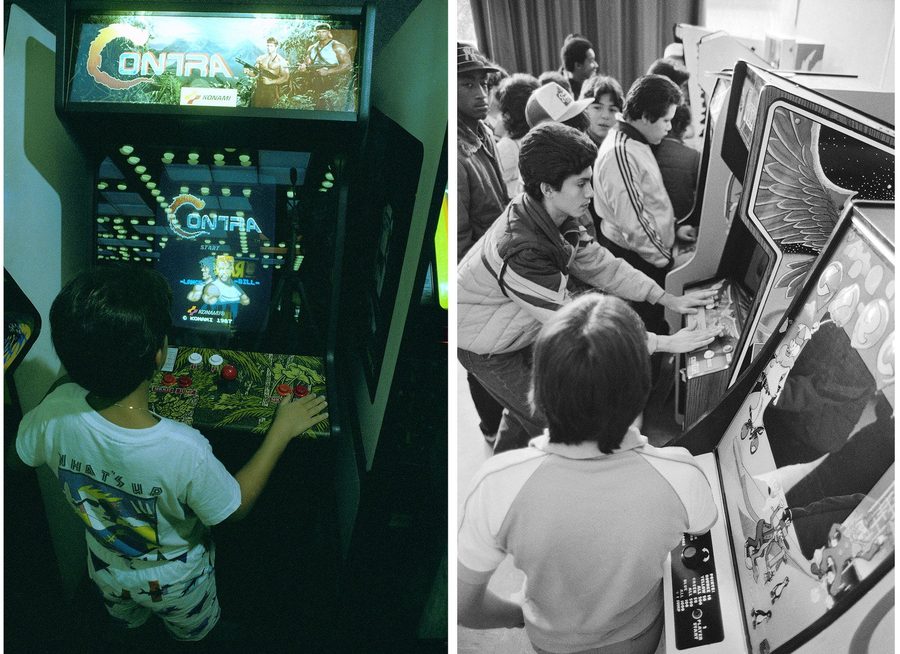
Late-decade arcade culture: a Contra cabinet (1987) and a packed crowd around a competitor.
Why the Quarter Era Still Hits Different
Ask any Gen X kid what their first real social space outside the home was, and the honest answer is often the arcade. Not the school cafeteria. Not the church basement. The corner arcade, with the loud carpet and the cigarette burns on the bezels, where you could be eleven years old and competing with a stranger in his twenties on a Mr. Do! machine and nobody thought it was weird. That kind of cross-generational, low-stakes, high-stimulus public space barely exists in American life anymore. The closest modern equivalent is a coffee shop, and a coffee shop will not let you crowd around a stranger and watch them try to clear level 256.
The reason arcade nostalgia hits harder than most other 80s memories — and 80s nostalgia generally hits hard for a reason — is that you cannot recreate the conditions. Home emulation gives you the game. It cannot give you the room. The room was a fluke of urban planning, demographic timing, and 1980s parenting standards that allowed an unaccompanied ten-year-old to spend four hours in a dark mall basement. None of those inputs exist anymore. The cabinets are still around — some of them are worth a fortune now — but the culture that surrounded them is gone, and the only way to access it now is to remember it.
That, finally, is what the arcade quietly taught everyone who grew up inside it. Things end. The high score eventually rolls over. Somebody always cuts the power. You played your three lives, you put your initials in, and you walked out into the parking lot squinting at the sunlight. The game does not save your progress. You do.

Sources
- Museum of the Game (KLOV) — Pac-Man arcade entry — primary technical and historical reference for the original Pac-Man cabinet
- The Atlantic — The Quiet Rise of Arcades in America — industry revenue and post-crash arcade analysis
- The Washington Post — The Court Considers the Cost of Pinball — coverage of the Aladdin’s Castle v. Mesquite Supreme Court case
- Twin Galaxies — the original arcade score-tracking authority, founded in Ottumwa, Iowa, 1981
- Internet Archive — The Internet Arcade — preserved playable 80s arcade cabinets in the browser
Browse retro and vintage-inspired apparel at the RetroRadical shop →
The Retro Almanac
A monthly roundup of "on this day" highlights from that month, decades back — plus first dibs on new retro merch drops. No spam, just the good stuff.