Matrix Movie 1999: 7 Ways It Changed Cinema Forever
On March 31, 1999, Warner Bros. dropped a movie that didn’t just blow up the box office — it rewired how an entire generation thought about reality, technology, and what movies could be. Twenty-seven years later, The Matrix still hits differently. If you were old enough to see it opening weekend, you remember walking out of that theater in a daze, genuinely unsure if the phone booth you passed on the sidewalk was real.

What Hit Theaters on March 31, 1999
Spring 1999 was already shaping up to be a weird year. Y2K panic was building in the background. Star Wars: Episode I was looming on the horizon. And then Warner Bros. released a cyberpunk action film by two relatively unknown directors — Lilly and Lana Wachowski — that nobody outside the industry had really been tracking. The studio had greenlit it partly on the strength of the Wachowskis’ 1996 debut Bound, and partly because the pitch — essentially “what if humanity lived inside a computer program and didn’t know it?” — was just weird enough to bet on.
The gamble paid off. The Matrix opened to $27.7 million in its first weekend, eventually grossing $467.8 million worldwide on a $63 million budget. It became the highest-grossing Warner Bros. film of 1999 and swept four Academy Awards: Best Visual Effects, Best Film Editing, Best Sound, and Best Sound Effects Editing. But those numbers don’t capture what actually happened in theaters across America that March.


The Cast Nobody Was Expecting
Keanu Reeves as Neo was far from a sure thing. Will Smith passed on the role — he later admitted he “would have messed it up.” Nicolas Cage turned it down due to “family obligations.” The studio pushed for Brad Pitt or Val Kilmer. Leonardo DiCaprio, fresh off Titanic, said no because he didn’t want to do another visual effects-heavy production so soon. Johnny Depp was the Wachowskis’ first choice. In the end, Reeves — who had just come off Devil’s Advocate and The Devil’s Advocate and needed a win — got the role, and it’s impossible to imagine anyone else in it.
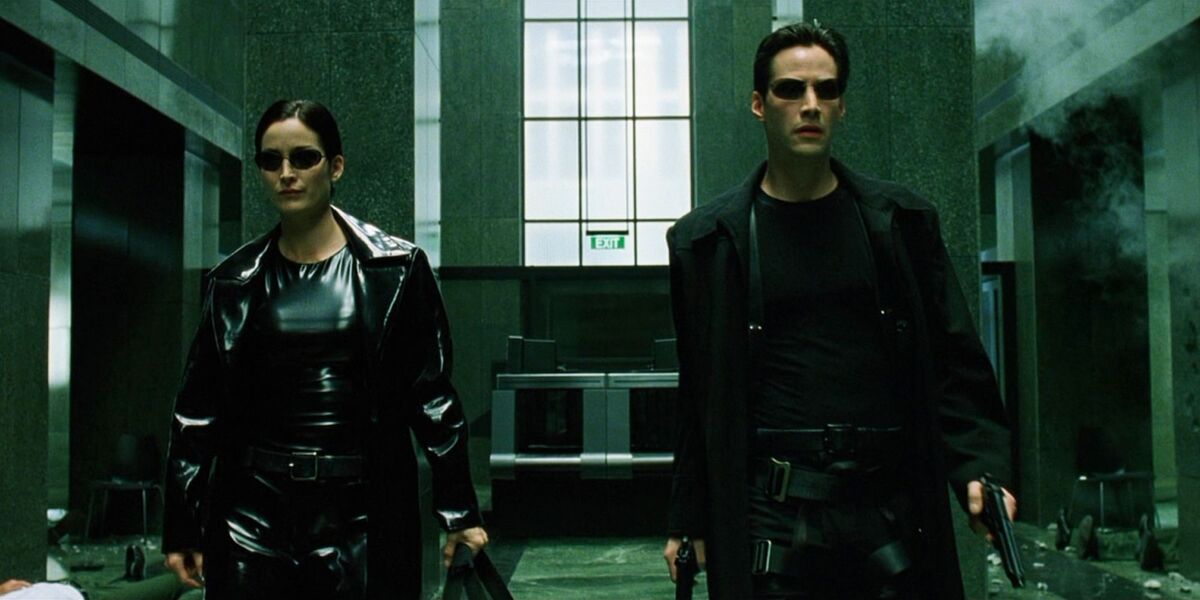
Carrie-Anne Moss as Trinity was equally unexpected. She later said she had “no career before” the film — literally nothing. She went through a three-hour physical test during casting. The Wachowskis had offered the role to Janet Jackson (scheduling conflicts) and Sandra Bullock (turned it down). Laurence Fishburne as Morpheus was inspired by the Neil Gaiman character of the same name from Sandman. And Hugo Weaving as Agent Smith — that clipped, bureaucratic menace — remains one of the most quietly terrifying villain performances of the decade.

Bullet Time Changed Everything
Before March 31, 1999, nobody had seen anything like the “bullet time” effect. The technique involved placing 120 still cameras in an arc around the subject, then stitching the images together to create a sequence where the camera appeared to move through a frozen or ultra-slow-motion moment. The shot of Neo dodging bullets on the rooftop didn’t just look cool — it felt like watching cinema evolve in real time.
Visual effects supervisor John Gaeta and his team at Manex Visual Effects spent nearly two years developing the technique. The cameras had to be precisely calibrated and triggered in rapid sequence. The result was something that had never appeared in a live-action feature film before. Every movie that used a similar effect afterward — and there were hundreds — was paying tribute to that rooftop scene.
“I needed him to be the guy who could be a dweeb, kind of boring, and also be completely badass.” — Lilly Wachowski on casting Keanu Reeves as Neo
The Wachowskis had spent years preparing the cast. Reeves, Fishburne, Moss, and Weaving all trained for four months with martial arts choreographer Yuen Woo-ping, who had just come off Fist of Legend with Jet Li. The wire-fu techniques borrowed from Hong Kong cinema gave the action sequences a weightless, balletic quality that American action movies had never attempted at this scale.

The Philosophy Was Real (and That Was the Point)
What separated The Matrix from every other action blockbuster of 1999 was that it actually had ideas underneath the leather trench coats and sunglasses. The Wachowskis weren’t shy about their influences: Plato’s Allegory of the Cave, Descartes’ evil demon thought experiment, Jean Baudrillard’s Simulacra and Simulation (which appears as a prop in the film, hollowed out to store Neo’s contraband disks), William Gibson’s Neuromancer, and the entire tradition of cyberpunk fiction.
There’s also a heavy dose of Gnosticism — the idea that the material world is an illusion created by a lesser deity, and that true reality lies beyond it. And Buddhist detachment. And Christian messianism (Neo = “One” rearranged; he literally dies and is resurrected). The Wachowskis layered these ideas in just deeply enough that audiences could pick up on them without the film becoming a philosophy lecture.
For Gen X viewers in particular — a generation raised on cyberpunk novels, skepticism of institutions, and the creeping unease that the digital world being built around them might not be entirely trustworthy — the film landed with uncanny precision. It gave a vivid, cinematic shape to anxieties about authenticity and control that had been floating around the culture for years.

The Year That Changed Film
1999 is routinely called one of the greatest years in American cinema history, and The Matrix was a central part of why. Fight Club, American Beauty, Being John Malkovich, Magnolia, Eyes Wide Shut — the studios had greenlit a remarkable run of ambitious, unconventional films, and somehow they all converged in the same twelve months. The Matrix was the one that made the most money, but it also changed the visual grammar of action cinema in ways that are still being felt.
If you were in high school or college in the spring of 1999, you spent weeks afterward debating whether we might actually be living in a simulation. Your philosophy teacher suddenly had something to work with. People started quoting Morpheus at lunch. The red pill/blue pill metaphor entered the cultural lexicon so completely that it’s now used (and misused) constantly, decades later, with people barely remembering where it came from.
The internet was still dial-up for most people. The Matrix arrived just as the web was becoming something people actually used daily — and it captured the latent anxiety of that transition perfectly. Neo’s double life as a corporate drone by day and underground hacker by night resonated with anyone who had ever felt like their online identity was more real than their office self.
Speaking of the early internet shaping culture, check out our piece on WikiWikiWeb 1995 — the first wiki that changed the internet forever, which captures just how raw and revolutionary that era of digital culture really was.

The Soundtrack That Defined the Vibe
Don Davis composed the orchestral score, drawing on electronic textures and dissonant strings to create something genuinely unnerving. But the soundtrack album was where the film’s edge really lived — a collection of industrial, metal, and electronic tracks that felt like the logical endpoint of 1990s alternative culture. Rage Against the Machine’s “Wake Up” closing the credits. Rob Zombie. Propellerheads. Marilyn Manson. Monster Magnet. It was a snapshot of a very specific moment in underground music, and it was perfectly matched to the film’s aesthetic.
The music choices reinforced what the movie was doing thematically: this was not mainstream entertainment trying to be edgy. It was genuinely coming from the margins of 1990s culture — the same culture that had produced Neuromancer, the early web, zine culture, rave culture — and it brought all of that into multiplexes without diluting it.
The YouTube Trailer That Launched a Thousand Theories
The theatrical trailer for The Matrix was unusual for 1999 — it was deliberately cryptic, showing spectacular action while withholding almost all context. “What is the Matrix?” the tagline asked. Nobody outside the production knew the answer. Audiences showed up partly out of sheer curiosity.
What Came After
The Wachowskis returned with two sequels in 2003 — The Matrix Reloaded and The Matrix Revolutions — both shot back-to-back in Australia. The sequels had a rougher reception, partly because the philosophical density got heavier while some of the narrative clarity got lighter. But they expanded the world in ways that the animated anthology The Animatrix (2003) made genuinely fascinating — telling stories set in the Matrix universe across different animation styles and genres.
Lana Wachowski returned solo for The Matrix Resurrections in 2021, a meta-textual follow-up that was more interested in deconstructing the franchise’s legacy than continuing it. It was a strange, sometimes brilliant, deeply personal film that split audiences. But the original? The original never needed a defense.
In 2012, the Library of Congress selected The Matrix for preservation in the National Film Registry, citing its “cultural, historical, and aesthetic significance.” That’s as official a stamp as it gets.

Where You Can Still Feel That Opening Weekend Energy
If you want to understand what it felt like to see The Matrix cold in the spring of 1999, you need to experience the film with as little context as possible — which is harder now than it was then, given that the film has been analyzed, parodied, and referenced so many times that the “what is the Matrix?” question has a well-known answer before most people sit down to watch it. The film holds up on rewatch, but that first viewing — when the question was genuine — was something that generation of moviegoers got to experience exactly once.
For those who remember the Cold War anxiety of the 1980s, the paranoid energy of The Matrix had roots in that earlier era too. We wrote about another pivotal pop culture moment that tapped those same nerves in The Day After 1983: Cold War Paranoia That Defined a Generation — a film that hit American audiences just as hard as The Matrix would sixteen years later, in a completely different way.
And if you want to trace the cultural DNA from the 1990s through the hacker underground to the mainstream, our piece on the 80s pop culture icons who changed everything is a good place to see how the decade that produced The Matrix‘s cast and directors was itself shaped by larger cultural forces.
The Red Pill, 27 Years Later
On March 31, 1999, you could walk into a theater knowing almost nothing about The Matrix and walk out transformed. The film gave Gen X a mirror — not a flattering one, but an honest one — that reflected back anxieties about simulation, control, authenticity, and corporate identity that the generation had been quietly nursing for years.
Keanu Reeves got his career back. The Wachowskis announced themselves as one of the most visually inventive directing teams in American cinema. The action movie would never look the same again. And somewhere out there, Morpheus is still waiting to offer you a choice between two pills.
You already know which one you’d pick.
Sources
- Wikipedia: The Matrix (1999) — production history, cast, box office data
- Box Office Mojo: The Matrix — worldwide gross, opening weekend figures
- Library of Congress National Film Registry — 2012 preservation selection
- The Matrix (1999), directed by Lilly and Lana Wachowski. Warner Bros. Pictures / Village Roadshow Pictures.