On This Day: June 17, 1994 — OJ Simpson’s White Bronco Chase
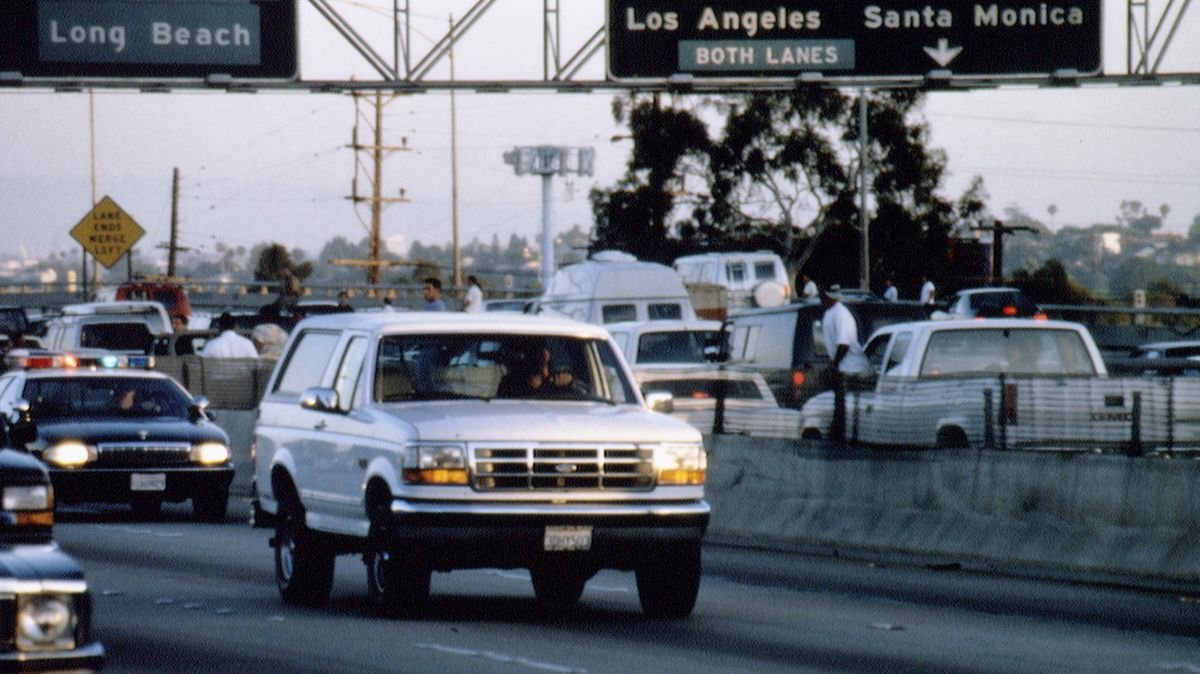
At 6:45 PM Pacific on June 17, 1994, an estimated 95 million people in the United States stopped what they were doing and watched a white Ford Bronco roll down Interstate 405 at 35 miles per hour. Inside it: a 46-year-old Hall of Fame running back, a loaded .357 Magnum, a fake beard, and $8,000 in cash. Behind it: every news helicopter in Southern California and a wedge of police cruisers that had decided the safest plan was to keep their distance. For two hours, the country watched the strangest live broadcast in television history — the OJ Simpson Bronco chase — and then went to bed knowing the 1990s would never feel quite the same again.
The Phone Call That Started the OJ Simpson Bronco Chase
The murders of Nicole Brown Simpson and Ronald Goldman had been discovered five nights earlier, on June 12, 1994, outside Nicole’s Bundy Drive condo. By Friday the 17th, the Los Angeles District Attorney was ready to act. At 1:50 PM, LAPD Commander David Gascon announced that Simpson was a wanted murder suspect. At 3:00 PM, Gil Garcetti made it official: two counts of first-degree murder. Simpson and his lawyer Robert Kardashian had agreed to surrender at 11:00 AM. He never showed.
The Retro Almanac
A monthly roundup of "on this day" highlights from that month, decades back — plus first dibs on new retro merch drops. No spam, just the good stuff.
What he did do, sometime that afternoon, was sit down and write three letters. One went to his mother, one to his children, one labeled “To Whom It May Concern.” Kardashian read the last one on live TV, his hands visibly shaking. Then, around 5:51 PM, Simpson called 911 from a cellphone, somewhere south of Los Angeles, with a gun pressed to his own head. The dispatcher kept him talking. A police technician triangulated the signal. The Bronco was on the 5 freeway near Lake Forest, heading north.
Al Cowlings at the Wheel
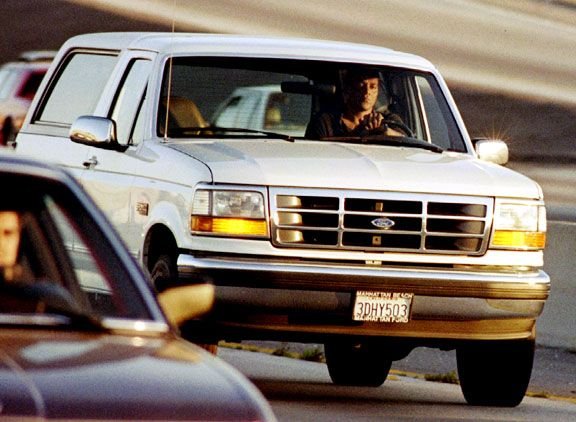
Driving the Bronco was Al Cowlings — known to everyone in football as “A.C.” — Simpson’s best friend since their childhood in Potrero Hill, San Francisco, and his teammate at USC and then with the Buffalo Bills. Cowlings owned the white 1993 Ford Bronco. (Simpson’s was almost identical and would later become evidence in the trial.) He was the last person you would expect to be steering a fugitive down an interstate, which was probably why Simpson called him.
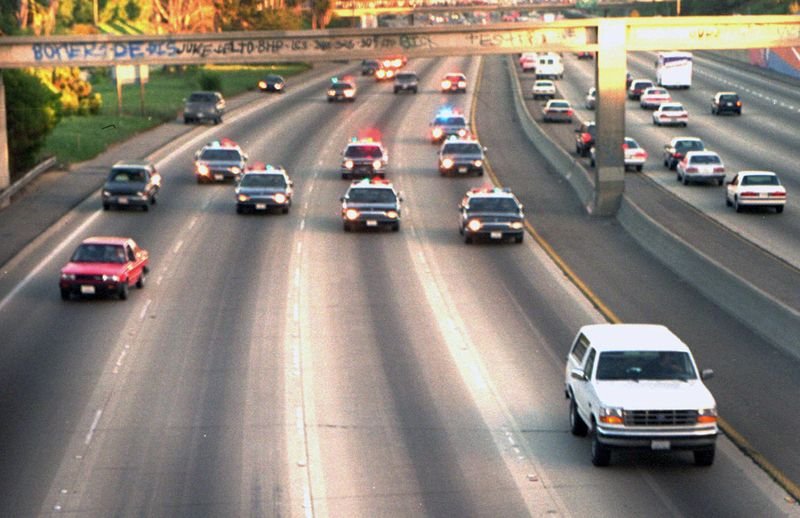
Cowlings told dispatcher Pete Weireter what every officer on the freeway needed to hear: OJ had a gun, OJ wanted to see his mother, and if anyone made a sudden move, OJ was going to use the gun on himself. So the LAPD did something almost unprecedented in a felony pursuit — they backed off. The cruisers formed a respectful escort at a distance of maybe ten car lengths, lights on, sirens off. Nobody wanted to be the cop who startled OJ Simpson into pulling the trigger on national television.
The Slowest 50 Miles in Television History
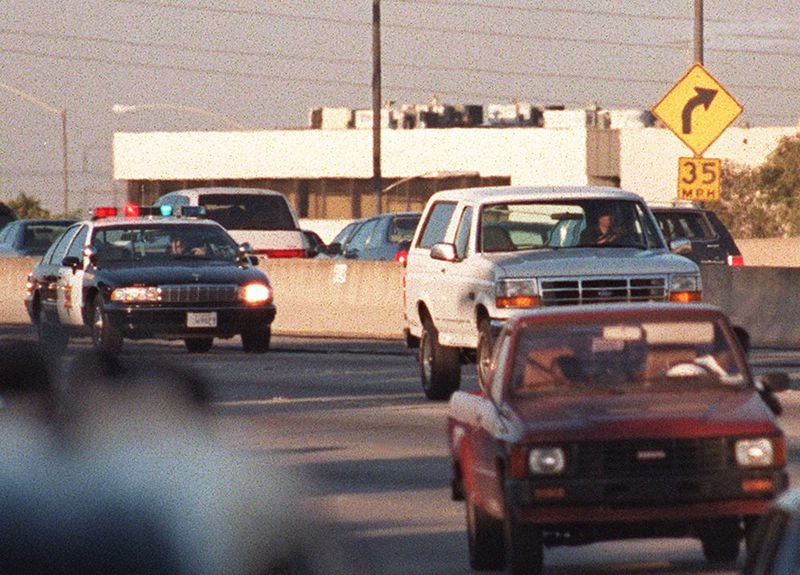
Calling it a chase always felt a little generous. The Bronco averaged about 35 miles per hour for roughly 50 miles, looping up the 5, west on the 91, north on the 405 toward Brentwood. KCBS helicopter pilot Zoey Tur — at the time the highest-paid news pilot in Los Angeles — was the first to find them, and from that moment forward every other chopper in the basin scrambled to catch up. Within fifteen minutes there were nine helicopters circling the Bronco in a tight wagon-wheel formation, all of them broadcasting the same shot to a different network.
The picture itself was almost banal: a clean white SUV, in the right lane, driving the speed limit. There was nothing to see. That’s exactly what made it impossible to look away. Viewers kept watching because something had to happen eventually, and nobody wanted to miss it. Drive-time radio host Larry King would later call it “the longest commercial break in American history.”
How the Bronco Chase Hijacked Game 5 of the NBA Finals
The chase happened to land on the Friday night of Game 5 of the NBA Finals at Madison Square Garden — Patrick Ewing’s Knicks against Hakeem Olajuwon’s Houston Rockets, a 2-2 series. NBC was carrying the game. Within twenty minutes of Tur finding the Bronco, NBC made one of the strangest editorial decisions of the decade: split the screen. The basketball game shrank to a small box in the upper-right corner, while Tom Brokaw narrated the chase from New York and Marv Albert’s commentary on Ewing and Olajuwon was muted entirely.
The Knicks beat the Rockets 91-84 to take a 3-2 series lead. Nobody remembers. The only thing anyone could talk about Monday morning was the Bronco. Houston would win the series in seven games, and Olajuwon would win Finals MVP, but the iconic image of the 1994 NBA Finals isn’t a basketball play — it’s a small inset window beside the right rear quarter panel of a Ford SUV.
“Save the Juice” — The Freeway Becomes a Block Party
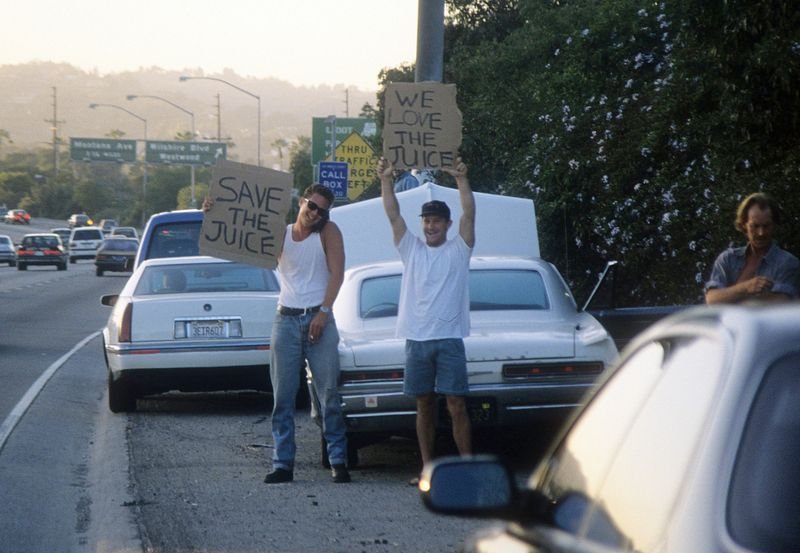
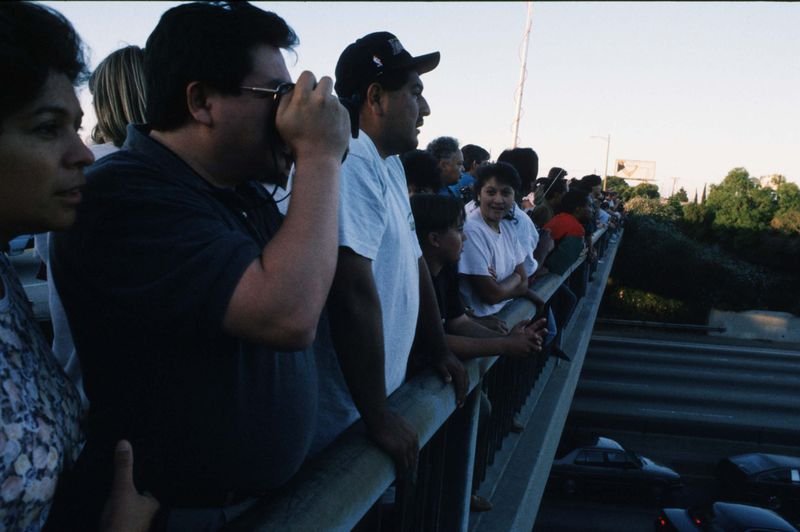
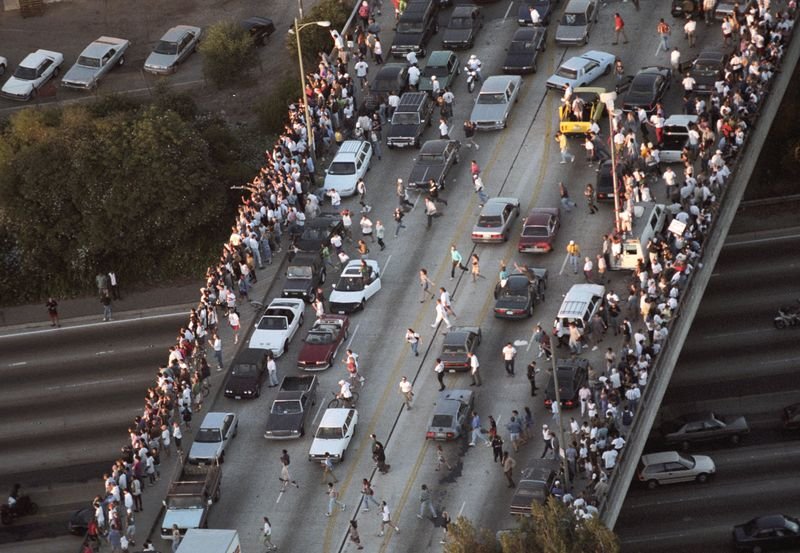
This is the part that still doesn’t make sense if you weren’t there. Within an hour of the broadcast going live, Angelenos started showing up on the route. They climbed over chain-link fences onto the freeway shoulder. They parked on the overpasses and stood five-deep along the railings. They held cardboard signs scrawled in marker: “GO O.J. GO,” “SAVE THE JUICE,” “WE LOVE THE JUICE.” A few people brought beer coolers. One guy reportedly brought a sandwich board.
Nicole Brown Simpson and Ronald Goldman had been murdered five days earlier. The crowd cheering on the suspect, in real time, on television, was the first sign that this case wasn’t going to behave like a normal criminal proceeding. It was the first chapter of what would become the trial of the century, and the country was already picking sides before the Bronco even reached Brentwood. The truth is, half the people on those overpasses didn’t know what they were cheering — they just knew they wanted to be part of it.
The Bronco Arrives at Brentwood
At 7:57 PM, Cowlings turned the Bronco off Sunset Boulevard and into the driveway of Simpson’s Rockingham Avenue estate. He’d been driving for nearly two hours. The lawn was already filling with reporters, neighbors, and a small SWAT contingent that had been hiding in the hedges for the better part of the afternoon. Simpson, still inside the SUV, refused to come out. He wanted to call his mother. He wanted to use the bathroom. He wanted orange juice.
Forty-seven minutes of negotiation followed. Simpson finally stepped out of the Bronco at 8:47 PM holding family photographs in one hand, surrendered the .357 he’d been clutching the whole drive, and was put in the back of a squad car. Inside the Bronco, police found his passport, the fake goatee disguise, the $8,000 cash, and a vial of what was initially reported as poison but turned out to be a sedative. The trial of the century officially began the moment that car door closed.
The Aerial Shot That Defined a Decade
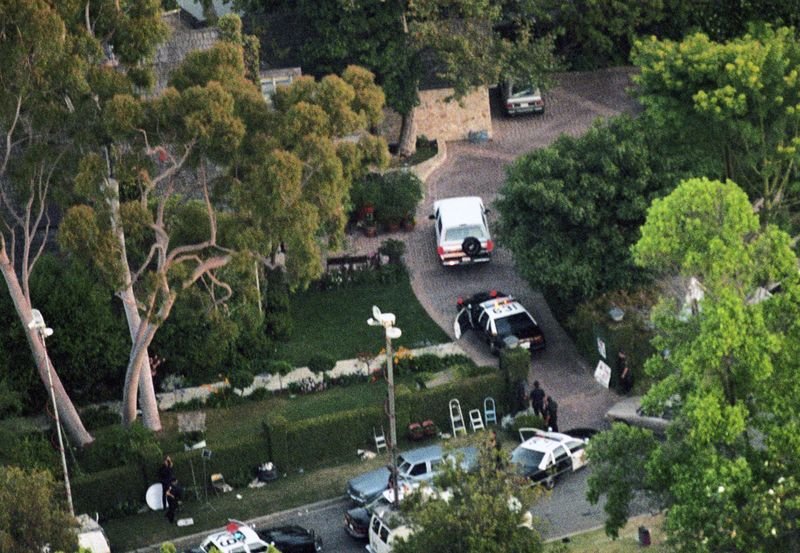
The helicopter shot of the Bronco parked in the brick driveway, ringed by black-and-whites with their light bars flashing, became one of the defining images of the decade. CNN ran it on repeat for 36 hours. Newsweek and Time both put Simpson on the cover of their next issues — Time famously darkened his mugshot, a decision that touched off its own controversy and ultimately became as well-known as the cover itself.
The 1994 chase was the moment American television figured out it could turn an unresolved crisis into a continuous broadcast and hold an audience for hours with almost no new information. CNN had been doing it for fourteen years; the Bronco chase made every other network realize it could too. Cable news as a 24-hour rolling spectacle traces a straight line back to the night Al Cowlings drove up the 405. Reality TV, the OJ trial circus, the Casey Anthony coverage, the Murdaugh coverage, every cable-news manhunt since — all of it was born in a Brentwood driveway at 8:47 PM.
What Happened to the White Bronco?
Al Cowlings’s 1993 Ford Bronco was impounded, processed, and eventually returned. He sold it to former Simpson agent Mike Gilbert and two business partners in 1995 for a reported $75,000. They tried to display it on the road; nobody wanted to be the venue that hosted it. For years the Bronco sat in a storage container in a Los Angeles warehouse. As of 2025, it lives at the Alcatraz East Crime Museum in Pigeon Forge, Tennessee, where you can stand next to the chrome bumper that 95 million people once watched in a single split-screen window.
OJ Simpson was acquitted of the murders on October 3, 1995, found liable in the 1997 civil case, jailed in Nevada from 2008 to 2017 on an unrelated armed robbery conviction, and died of cancer on April 10, 2024, at the age of 76. Before all of that, before the white glove and the bloody sock and Johnnie Cochran’s couplet, he was the Heisman winner, the Hertz pitchman, the smiling face of Naked Gun. If you want the long version of who Simpson was before June 17 turned him into a different kind of icon, our piece on his 80s career as Hollywood’s friendliest crossover athlete picks up that thread.
The Friday Night That Bookended a Wild Sports Week
It’s worth remembering that the chase wasn’t even the biggest sports story of that week — it was the third one. The New York Rangers had won their first Stanley Cup in 54 years three nights earlier, on June 14, ending one of the cruelest droughts in pro sports. (We covered the Mark Messier guarantee game earlier this week.) Arnold Palmer was finishing his last U.S. Open at Oakmont. The 1994 World Cup had just kicked off at Soldier Field. By any normal measure, June 17 should have been a sports highlight reel. Instead, it became something stranger — the day sports television had to admit that something else mattered more.
Why the OJ Simpson Bronco Chase Still Matters
The chase has been parodied, restaged, and re-edited so many times — by Seinfeld, by The Simpsons, by every late-night comedian working in the summer of 1994 — that it can feel like a punchline. Strip away the memes and what’s left is the moment America discovered it would rather watch a slow Ford SUV than a Finals game, a moon landing, or the news. Thirty-two years later, the country still hasn’t really come down from it.
If you were old enough to be near a television that Friday, you remember exactly where you were. If you weren’t, that’s fine — the chase has been preserved better than almost anything else from the 90s. Pull up the NBC News flashback above, or queue up the original ABC7 broadcast. Two hours of nothing happening, watched by 95 million people, on the night the modern media circus was born.
Sources
- HISTORY — O.J. Simpson leads L.A. police on a low-speed chase, June 17, 1994 — Date-anchored summary of the pursuit and arrest.
- Wikipedia — White Bronco chase — Timeline, route, viewership figures, and aftermath.
- Sports Illustrated — How the Bronco chase interrupted Game 5 of the 1994 NBA Finals — NBC split-screen broadcast and final score.
- ABC7 Los Angeles — Timeline of the white Bronco chase — Minute-by-minute account from press conference to surrender.
- CBS News — Helicopter cameraman Jeff Mailes recalls the chase 25 years later — Aerial broadcast logistics and the nine-helicopter formation.
The Retro Almanac
A monthly roundup of "on this day" highlights from that month, decades back — plus first dibs on new retro merch drops. No spam, just the good stuff.