On This Day: June 18, 1983 — Sally Ride Becomes First American Woman in Space
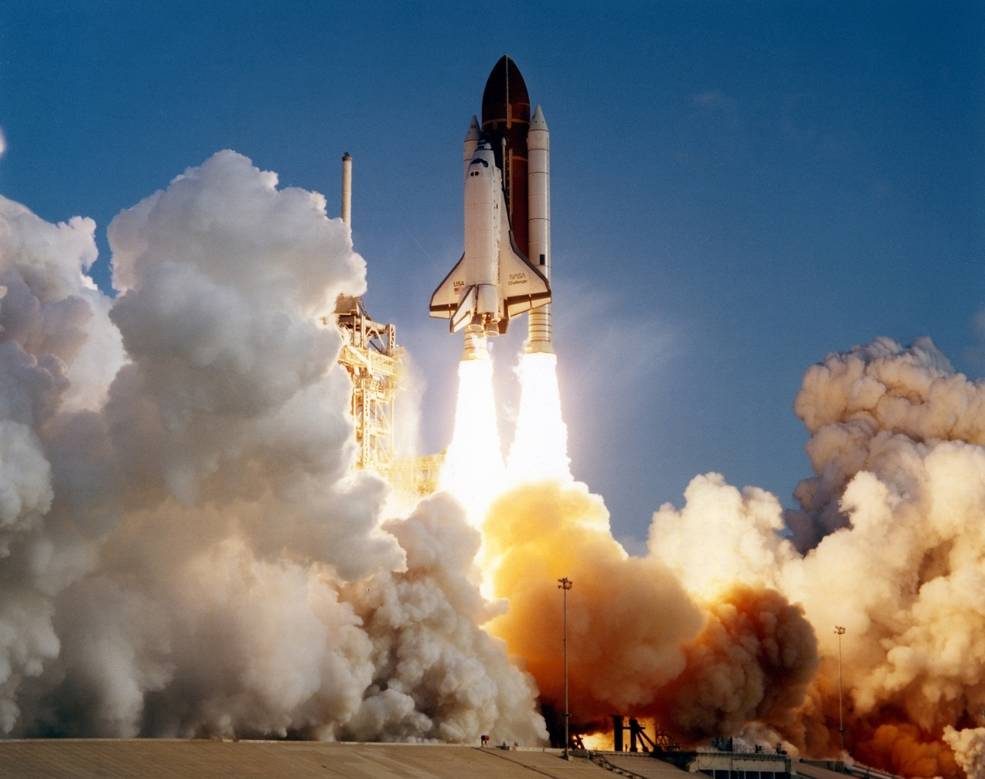
At 7:33 a.m. Eastern on June 18, 1983, Space Shuttle Challenger thundered off Pad 39A with a 32-year-old Stanford physicist sitting on the middeck. Twenty years and two days after Valentina Tereshkova orbited Earth alone in Vostok 6, the United States finally caught up. Sally Ride had become the first American woman in space, and a half-million people had driven into Brevard County, Florida just to watch her go.
How Sally Ride Went From Stanford Physicist to the Space Shuttle
Sally Kristen Ride was finishing her PhD on X-ray emissions from interstellar gas when she saw the notice in the Stanford student paper. NASA was opening Astronaut Group 8 — the first class that would fly the Space Shuttle, and the first that would accept women. She mailed in an application alongside roughly 8,000 other hopefuls. A year later, she was one of 35 selected, and one of six women in the group.
The Retro Almanac
A monthly roundup of "on this day" highlights from that month, decades back — plus first dibs on new retro merch drops. No spam, just the good stuff.
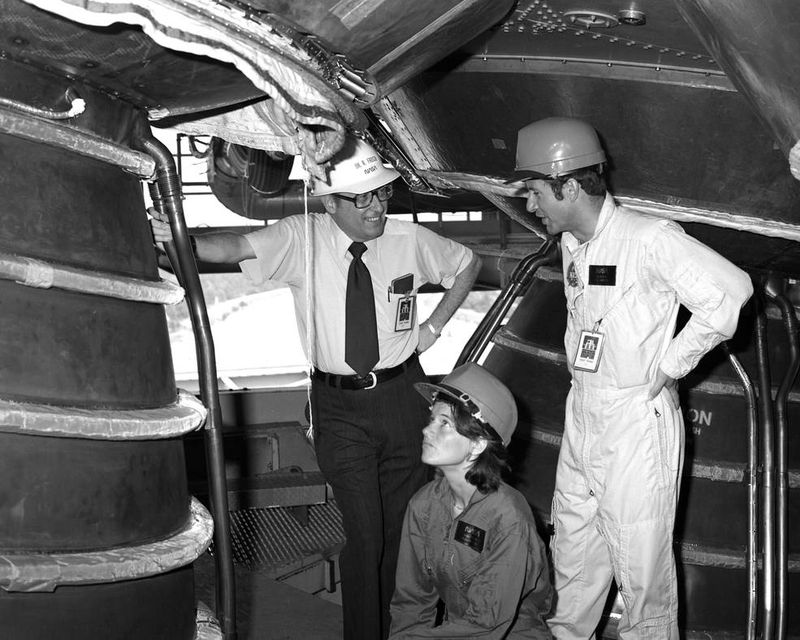
Before STS-7 she worked the consoles for STS-2 and STS-3 as CAPCOM — the voice on the ground that talks directly to the orbiter. She also helped develop the procedures for operating the Canadian-built Remote Manipulator System, the shuttle’s robotic arm. By the time NASA announced the STS-7 crew on April 30, 1982, she had logged more hours with the arm than almost anyone in the office. That expertise is exactly why she was tapped for the mission’s most technically demanding payload.
The Reporters Lost Their Minds
The pre-flight press conference in May 1983 went off the rails almost immediately. A reporter asked whether spaceflight would “affect your reproductive organs.” Another wanted to know whether she would cry when something went wrong in orbit. Johnny Carson built a bit around her on The Tonight Show. Engineers inside NASA reportedly proposed packing 100 tampons for a six-day mission and asked her to help design a “makeup kit” for use in microgravity.
Ride handled all of it with the same flat affect she used on the comm loop. When the questions got dumb, she just answered the next one. Her standard line afterward, which she repeated in dozens of interviews over the next decade, was that she did not come to NASA to be a woman in space. She came to be an astronaut. That distinction mattered to her until the day she died.
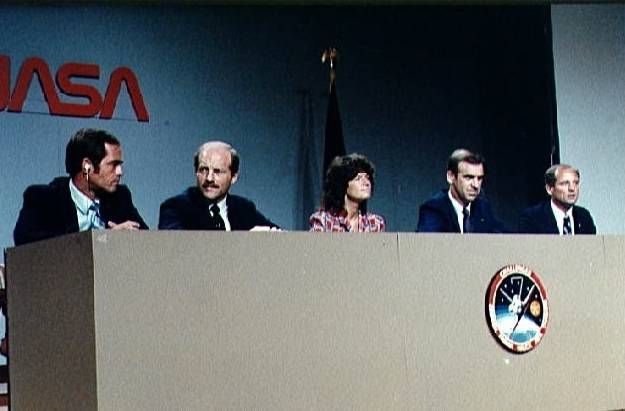
The Crew That Climbed Aboard Challenger
STS-7 was the largest crew flown to that point in spaceflight history — five people in a single vehicle. Robert Crippen sat in the commander’s seat, a Navy test pilot who had flown the very first shuttle mission, STS-1, two years earlier. Crippen would become the first person to fly the shuttle twice. Frederick “Rick” Hauck served as pilot. John Fabian and Sally Ride were the mission specialists. Norman Thagard, a physician-astronaut, was added in January 1983 specifically to study space motion sickness, which had hit roughly half of all shuttle fliers up to that point.
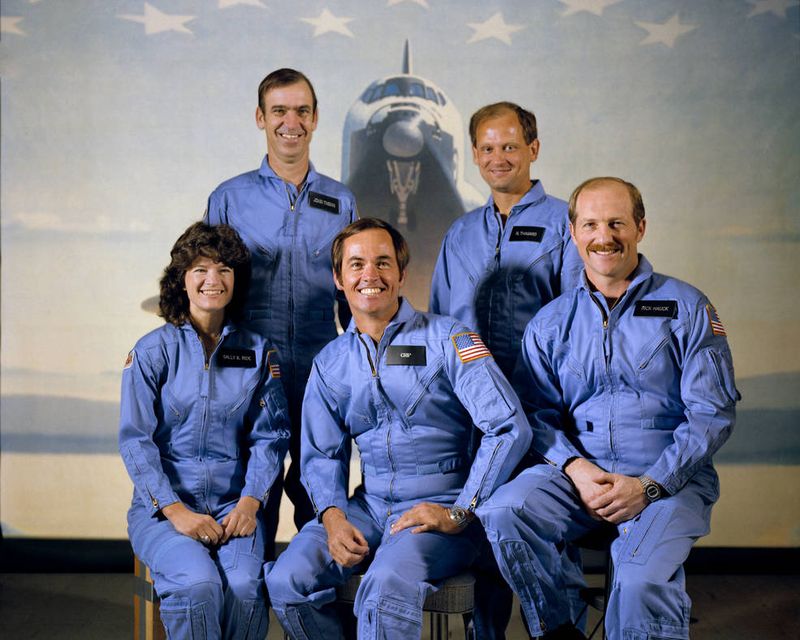
The four men on the crew defended Ride hard in the press whenever a reporter tried to pit them against her. Crippen in particular said publicly that she was on the mission because she was the best person in the office to fly the arm, full stop. None of the gendered framing came from inside the crew. It came from the people watching them.
Six Days of Real Work, Not a Publicity Tour
NASA could have given Ride a light flight. They didn’t. STS-7 was, at the time, the most ambitious shuttle mission ever flown. The crew deployed two commercial communications satellites — Anik C2 for Telesat Canada and Palapa B1 for Indonesia. Both were spin-stabilized payloads kicked out of the cargo bay on the second and third days of the flight. Then came the headline experiment.
On flight day five, Ride used the Canadarm to lift the German-built Shuttle Pallet Satellite (SPAS-01) out of the bay, deploy it as a free-flying platform, and then retrieve it later in the mission. It was the first time a satellite had ever been deployed and recaptured by the shuttle. While SPAS-01 floated free, it took the now-famous photographs of Challenger in orbit — the first sharp, full-frame pictures of an American orbiter against the curve of the planet. Those pictures got printed on classroom posters for the next 20 years.
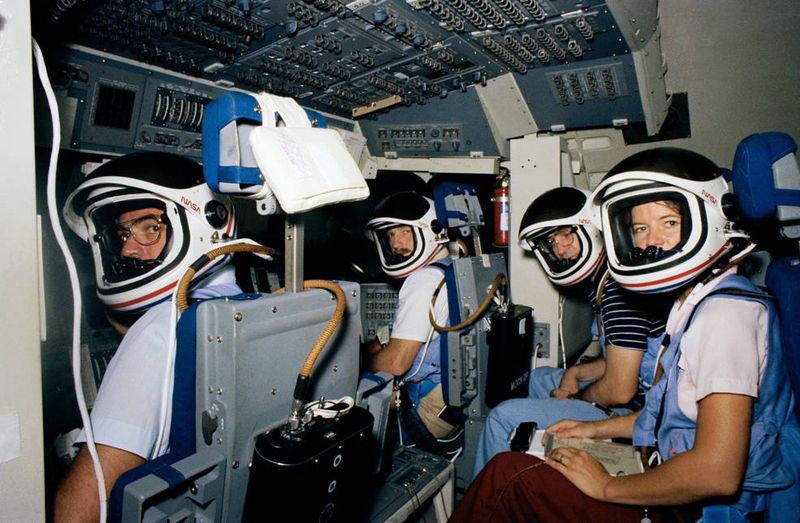
Life on Orbit Was Strange and Funny
Ride described the cabin as smelling like a workshop — solder, plastic, and reheated food. The shuttle’s middeck was tight enough that the five of them had to stagger their movements just to avoid kicking each other in the face. She slept strapped into a sleeping bag on the wall. Her toolkit floated wherever she left it. Her hair, in zero G, did the thing every kid would later imitate with their fingers.
One small detail says a lot about the mood on board: the crew patch she helped design featured an outline of the shuttle against a starfield with everyone’s name around the edge — no asterisks, no special call-out for her. The patch treated the crew as five astronauts. That was the whole point.
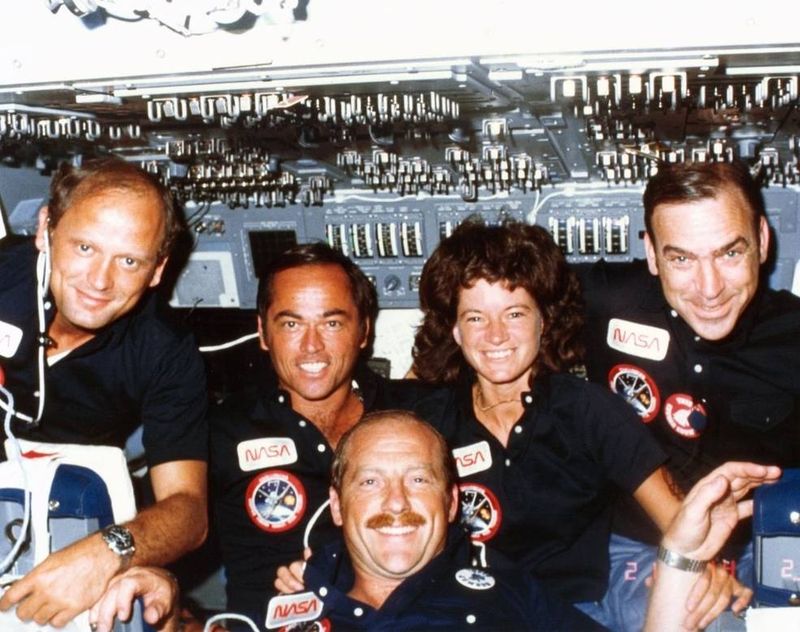
The Landing That Wasn’t Supposed to Be in California
STS-7 was meant to be the first shuttle to land at Kennedy Space Center, finishing the flight where it started. The weather refused. Low clouds rolled in over Florida on June 24, and Mission Control rerouted Challenger to Edwards Air Force Base in California — the same dry lakebed where Chuck Yeager had broken the sound barrier 36 years earlier. Crippen put the orbiter down at Runway 15 after six days, two hours, and 23 minutes in space.
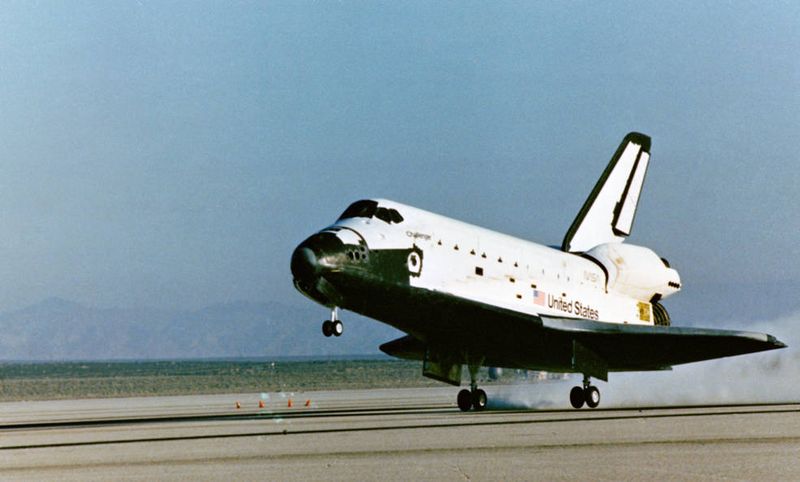
The post-landing press conference was the one most Americans actually remember. A reporter asked Ride which part of the mission she had enjoyed most. Without missing a beat she said, “The one thing I’ll probably remember most about the flight is that it was fun. In fact, I’m sure it was the most fun I’ll ever have in my life.” Most accounts of her have leaned hard on her composure. That sentence is the closest she ever came in public to admitting how much she had loved it.
What She Did After She Came Down
Ride flew a second mission, STS-41-G, in October 1984, this time with Kathryn Sullivan, who became the first American woman to walk in space. She was assigned to a third flight when Challenger broke apart on January 28, 1986, killing teacher Christa McAuliffe and six other crewmates. The shuttle program froze, and Ride was named to the Rogers Commission investigating the disaster. Her quiet investigative work there — including a key conversation with engineer Roger Boisjoly that helped surface the O-ring problem to the public — is now considered one of the most consequential contributions to the inquiry.
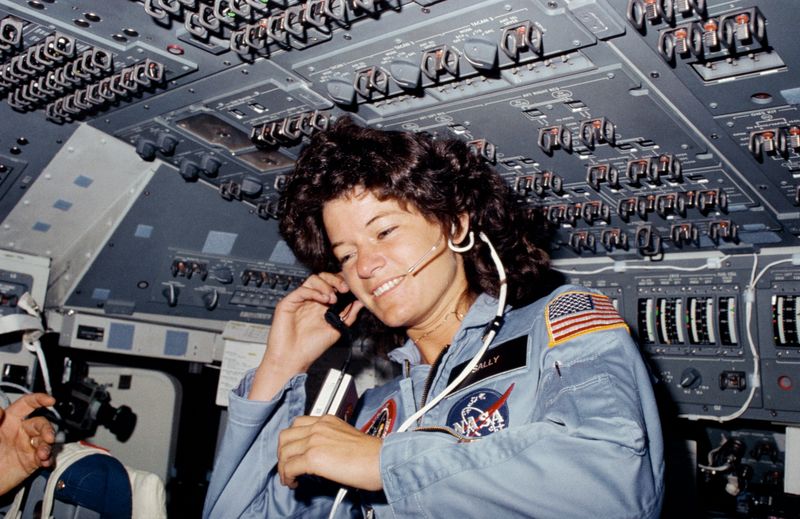
She left NASA in 1987, spent two years at Stanford’s Center for International Security and Arms Control, and then took a physics professorship at UC San Diego. In 2001 she co-founded Sally Ride Science with her partner Tam O’Shaughnessy, focusing on STEM programs aimed at middle-school girls. She served on the Columbia Accident Investigation Board in 2003 — the only person ever to sit on both shuttle disaster panels.
The Story That Didn’t Come Out Until 2012
Ride died of pancreatic cancer on July 23, 2012, at age 61. Her obituary, written by her own family, identified Tam O’Shaughnessy as her partner of 27 years. It was the first time most of the public learned that Ride had been in a long-term relationship with a woman. She had been married briefly to fellow astronaut Steve Hawley from 1982 to 1987 — Hawley was supportive, and they parted as friends — but her real life was with O’Shaughnessy. NASA had never asked. She had never told.
The disclosure made her, in retrospect, also the first known LGBTQ astronaut to have flown in space. Friends who had known for decades said she had wanted to spend her career being judged on the same terms as any other astronaut — not as a symbol of anything. By the end, she got to be both.
Why the First American Woman in Space Still Matters
By the time Ride flew, the Soviet Union had already put two women in orbit. American spaceflight had spent 22 years as a men-only club, and the gap had become embarrassing. STS-7 closed it in six minutes of ascent. Within a decade, women were flying so regularly that the press stopped counting. Eileen Collins commanded a shuttle in 1999. Peggy Whitson commanded the International Space Station in 2007. Christina Koch flew the first all-woman spacewalk in 2019. None of those women had to answer questions about reproductive organs on the way up.
June 18, 1983 was a Saturday. Pioneer 10 had crossed Neptune’s orbit and left the planetary solar system just five days earlier. The Soviet space program was preparing the long-duration missions that would lead to Mir’s first crew three years later. American spaceflight, after the long quiet between Apollo and the shuttle, was suddenly the most interesting thing on television again. Sally Ride didn’t ask to be the symbol of any of that. She just flew the arm better than anyone else in the office, and showed up for work on the right Saturday morning.
The Numbers from STS-7
For people who want the dry facts: launch on June 18, 1983 at 7:33:00 a.m. EDT. Landing on June 24, 1983 at 6:57 a.m. PDT. Orbital altitude around 296 kilometers. Orbits completed: 98. Distance traveled: roughly 4.2 million kilometers. Crew: five. Payloads deployed: three (Anik C2, Palapa B1, SPAS-01). Payloads retrieved: one (SPAS-01). Cost of the flight in 1983 dollars: about $200 million. Cost in 2026 dollars: roughly $620 million. A bargain by modern launch standards, and a flight that paved the way for the in-orbit satellite repair missions that followed in 1984.
If you want a closing image to hold onto: at the welcome-home reception at Johnson Space Center, somebody handed Ride a t-shirt that read, “Ride, Sally Ride.” She put it on over her flight suit and laughed for the first time on camera since landing. The song was Wilson Pickett’s. The line, suddenly, was about a Stanford physicist who had spent the previous week deploying satellites at 17,500 miles an hour.
Sources
- Sally Ride – First American Woman in Space — NASA History — Official NASA history office account of STS-7 and Ride’s selection
- 40 Years Ago: STS-7 and the Flight of Sally Ride — NASA — Detailed mission timeline and crew operations
- Sally Ride — Wikipedia — Biography, post-NASA career, and disclosure of personal life
- STS-7 — Wikipedia — Mission specifications, payload, and crew details
- Sally Ride — National Air and Space Museum — Smithsonian feature on her career
- 40 years ago, Sally Ride became the first American woman in space — NPR — Retrospective from 2023 anniversary coverage
- Sally Ride becomes the first American woman in space — HISTORY.com — This Day in History entry for June 18, 1983
The Retro Almanac
A monthly roundup of "on this day" highlights from that month, decades back — plus first dibs on new retro merch drops. No spam, just the good stuff.