On This Day: October 15, 1997 — ThrustSSC Breaks the Sound Barrier on Land
At 10:30 a.m. on October 15, 1997, a jet-black car shaped like a dart tore across Nevada’s Black Rock Desert and did something no wheeled vehicle had ever officially done: it went faster than sound. Twice, in opposite directions, within the mandatory one-hour window. The sonic booms rattled windows and set off car alarms in the nearest town, 13 miles away. When the dust settled, RAF Wing Commander Andy Green had driven ThrustSSC to 763.035 mph — Mach 1.016 — and claimed a World Land Speed Record that, almost three decades later, still stands unbroken.

A six-year chase on a shoestring budget
The man behind the project was Richard Noble, who already held the land speed record himself — he’d set it in 1983 driving Thrust2 to 633 mph. Not satisfied with merely fast, Noble spent the next six years chasing something that sounded closer to science fiction: a car that could break the sound barrier on solid ground, something no one had ever managed outside an aircraft.
The Retro Almanac
A monthly roundup of "on this day" highlights from that month, decades back — plus first dibs on new retro merch drops. No spam, just the good stuff.
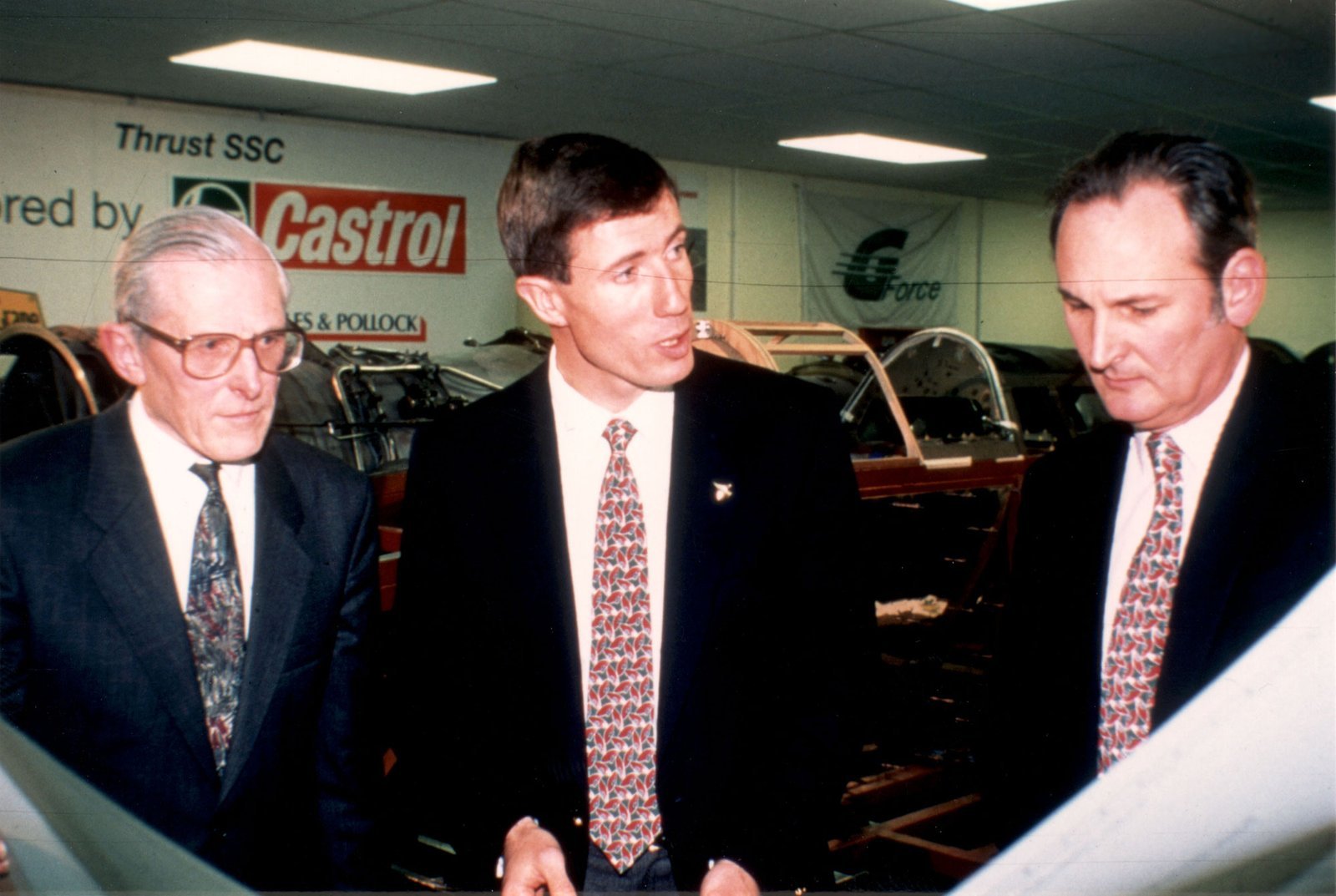
The numbers behind the project were almost comically lean. Noble’s team ran on roughly £500,000 of total sponsorship and donations — pocket change next to the £25 million McLaren was spending on Formula 1 that same year. The project’s first real backing was a £40,000 check from Castrol. Engineers Glynne Bowsher, Ron Ayers, and Jeremy Bliss worked alongside Noble out of a workshop in Coventry, England, designing a 16.5-meter, 10.6-tonne vehicle around two secondhand Rolls-Royce Spey turbofan engines — the same engines that powered British F-4 Phantom fighter jets. Together they produced more than 110,000 horsepower, the rough equivalent of a thousand Ford Escorts, and burned through 18 liters of fuel every second at full throttle.
Finding a driver brave enough to sit in it
Sitting a human being inside a car designed to go supersonic required someone comfortable with risk most people can’t even picture. The team screened 32 applicants over six months before settling on Andy Green, an RAF fighter pilot with the reflexes and training to handle a vehicle that could, in theory, come apart at the seams if anything went even slightly wrong at three-quarters the speed of sound. Insurance companies, strangely enough, rated ThrustSSC the same as an ordinary family car.
The team arrived at Black Rock Desert — a vast, dry lakebed in Nevada that had hosted land speed attempts for years — in the fall of 1997, racing against a shrinking window of stable weather. Two days before the record run, on October 13, Green and the car had already brushed up against history. Run 62 clocked Mach 1.007, the first supersonic pass of the week, but a damaged brake parachute — torched by 40-foot afterburner flames — caused an overrun. Run 63 hit Mach 1.000 but missed the FIA’s mandatory return-run window by just 49.5 seconds. They’d broken the sound barrier, technically, but not in a way anyone could put in the record books.

October 15: the run that counted
Two days later, they got it right. On Run 66, Green sent ThrustSSC south through the measured mile at Mach 1.020, trailing a visible shockwave that kicked up a wall of desert dust behind the car. The official, FIA-audited average across both directions came out to 1,227.985 km/h (763.035 mph) for the flying mile and 1,223.657 km/h (760.345 mph) for the flying kilometre — comfortably supersonic both ways, inside the time window, under official observation. ThrustSSC became the first and, to this day, the only land vehicle to officially break the sound barrier.
The timing carried its own strange poetry: the record fell exactly 50 years and one day after Chuck Yeager became the first person to break the sound barrier in the air, piloting the Bell X-1 on October 14, 1947.
The shockwave itself made the news in nearby Gerlach, Nevada — population a few hundred. Witnesses reported it knocked pictures off walls, triggered the schoolhouse sprinklers, and set off a chorus of car alarms. A microlight aircraft flying desert surveillance near the track reported a crack “like a shotgun” and a jolt of turbulence as the shockwave hit it mid-air.

The celebration — and a record that never moved again
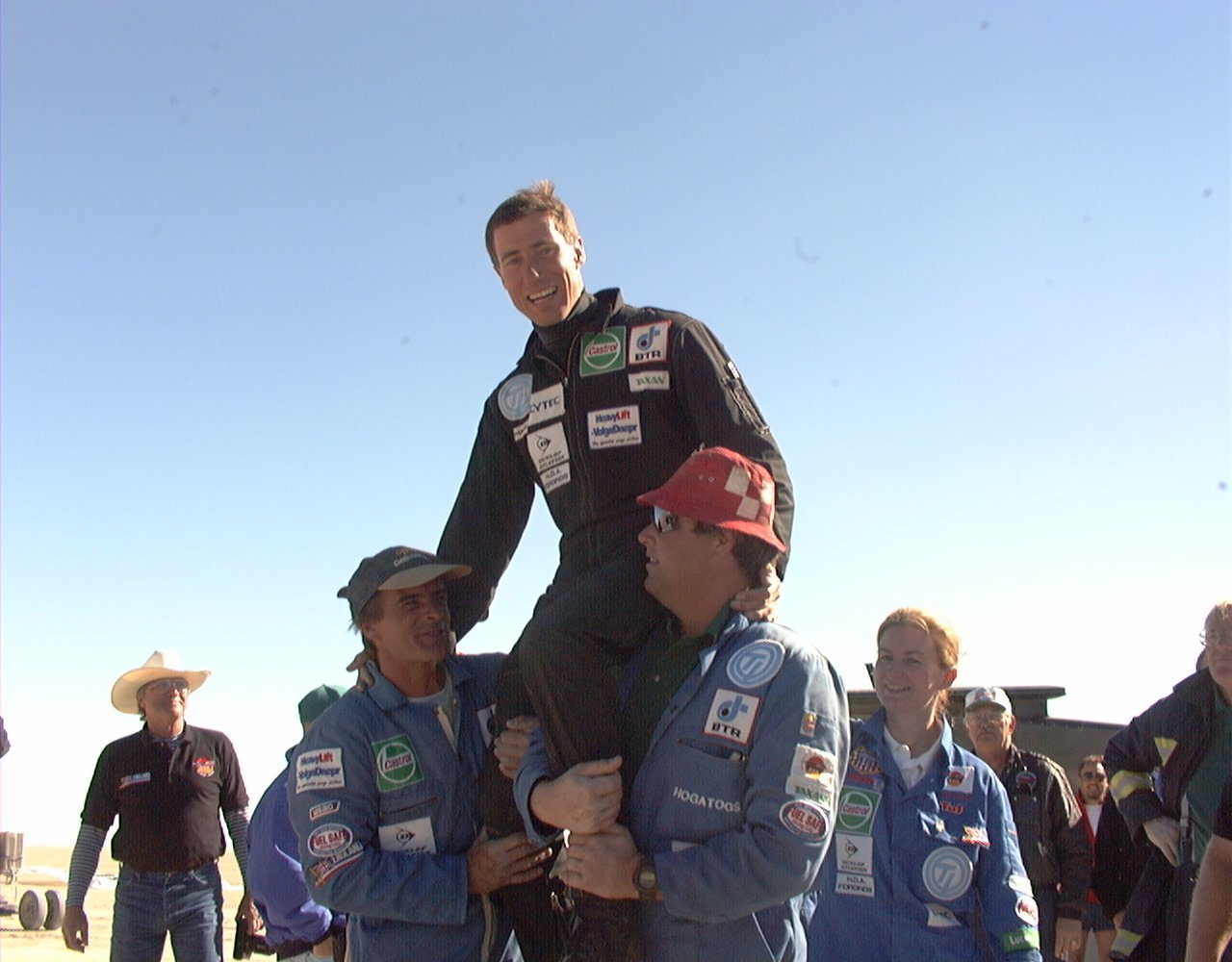
Back at the pits, the crew hoisted Green onto their shoulders in front of the assembled press. Among those offering congratulations was Craig Breedlove, the American land speed legend whose own record attempts had helped define the sport decades earlier — a passing of the torch between eras of the same obsession.
Nearly 30 years later, nobody has gone faster on land. Several teams have announced supersonic follow-up attempts over the years — including proposals to use more modern Eurofighter Typhoon engines or even rocket power — but none have matched ThrustSSC’s run. Both Noble’s record-setting ThrustSSC and his earlier Thrust2 are now permanently on display at the Coventry Transport Museum’s Land Speed Record Gallery, a lean British engineering project that beat budgets ten times its size to do something literally no one on wheels had ever done before.
Love the retro era? Browse our shop for vintage finds, retro clothing, and 80s/90s nostalgia gear.
The Retro Almanac
A monthly roundup of "on this day" highlights from that month, decades back — plus first dibs on new retro merch drops. No spam, just the good stuff.