Speak & Spell: The Revolutionary 1978 Toy That Changed Everything
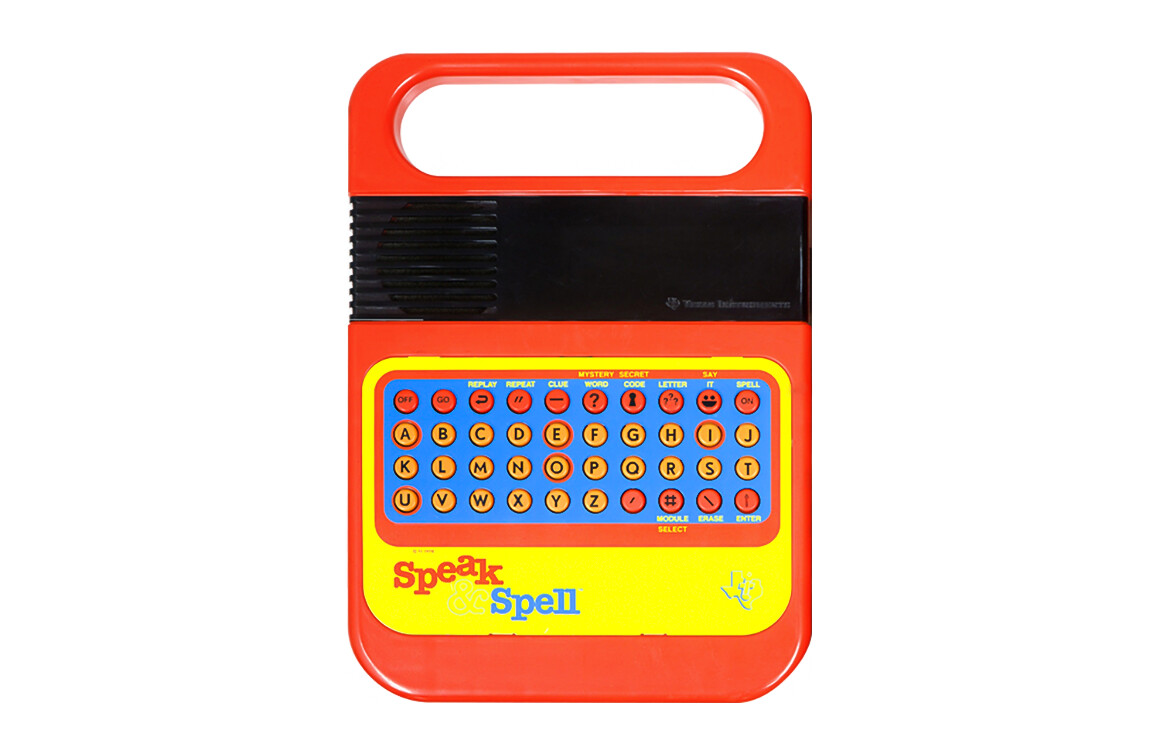
Picture this: it’s 1978, and you walk into a toy store to find something that looks like it came straight from a sci-fi movie. The Speak & Spell from Texas Instruments wasn’t just another toy—it was a glimpse into the future of electronic learning, wrapped in bright yellow plastic and armed with a voice that would soon become iconic.
This revolutionary device didn’t just teach kids how to spell; it fundamentally changed how we thought about educational technology. Before the Speak & Spell, talking toys relied on tapes or records. This little marvel introduced the world to digital speech synthesis, making it one of the first truly electronic learning companions.
The Birth of a Revolutionary Learning Tool
The Speak & Spell emerged from Texas Instruments’ research into speech synthesis technology during the mid-1970s. Paul Breedlove led a small team of engineers who received an initial budget of just $25,000 to create something that had never existed before—a portable device that could speak words clearly without using any recorded media.
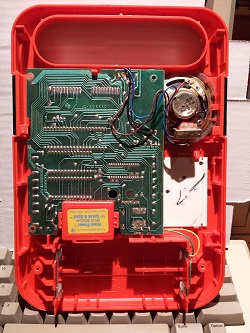
The team’s breakthrough came through TI’s innovative Solid State Speech technology, which stored entire words in digital format. This was revolutionary for its time, especially when most “talking” toys still relied on mechanical phonograph mechanisms or tape cassettes. The TMC0280 linear predictive coding speech synthesizer at the heart of the device could produce remarkably clear speech using digital compression techniques.
When Texas Instruments unveiled the Speak & Spell at the summer Consumer Electronics Show in June 1978, it immediately captured attention. Here was an electronic device that not only displayed words on a screen but could actually pronounce them with that distinctive, slightly robotic voice that became synonymous with early electronic speech.
How the Magic Worked
The Speak & Spell packed sophisticated technology into a surprisingly compact package. The device featured an alphanumeric LED display that showed words letter by letter, a full QWERTY keyboard for input, and most importantly, that groundbreaking speech synthesizer chip that could pronounce over 200 commonly misspelled words.
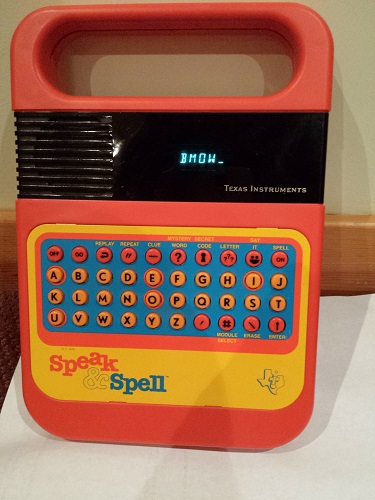
What made this toy special wasn’t just its ability to talk—it was how it talked. The linear predictive coding system analyzed human speech patterns and recreated them digitally, producing that distinctive electronic voice that managed to be both clearly understandable and unmistakably artificial. This technology would later become fundamental to modern voice synthesis systems.
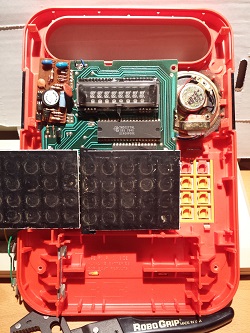
The original unit came with built-in games including Mystery Word, Secret Code, and Letter games, but the real innovation lay in its expandable cartridge system. Additional ROM modules could be inserted through the battery compartment, providing new word libraries and games. This modular approach made the Speak & Spell one of the first handheld electronic devices to use interchangeable game cartridges.
From Toy Store to Movie Stardom
The Speak & Spell’s most famous moment came in 1982 when Steven Spielberg featured it prominently in “E.T. the Extra-Terrestrial.” In the film, the stranded alien uses a modified Speak & Spell as a key component in his makeshift communication device to “phone home.” This appearance cemented the toy’s place in popular culture and demonstrated how advanced its technology seemed, even to Hollywood’s imagination.
The movie connection wasn’t just a clever product placement—it reflected how genuinely futuristic the Speak & Spell appeared to audiences. Its electronic voice and digital display made it a perfect prop for a story about alien technology, highlighting how far ahead of its time this educational toy really was.
This pop culture moment helped boost sales significantly and introduced the Speak & Spell to children who might not have encountered it otherwise. The association with E.T. also reinforced the device’s image as something special and almost magical, which wasn’t far from the truth given its innovative technology.
Impact on Educational Technology
The Speak & Spell’s influence extended far beyond entertainment value. It pioneered several concepts that became standard in educational technology: interactive learning, immediate feedback, self-paced instruction, and multimedia integration. Teachers and parents quickly recognized its potential as a learning tool that could provide one-on-one instruction without requiring constant supervision.
The device taught children aged 7 and up to spell and pronounce words correctly, using positive reinforcement and engaging gameplay. When a child spelled a word correctly, the Speak & Spell would offer encouragement. Mistakes were met with patient correction and the opportunity to try again. This approach to computer-assisted learning became a template for countless educational software programs that followed.
More importantly, the Speak & Spell demonstrated that electronic devices could make learning fun and engaging. It showed that technology didn’t have to be intimidating or purely functional—it could be approachable, entertaining, and genuinely helpful for developing essential skills.
The Speak & Series Success
Building on the original’s success, Texas Instruments expanded the concept into a complete learning series. Speak & Read followed in 1980, focusing on phonics and reading skills, while Speak & Math tackled arithmetic problems with the same engaging electronic voice. Each device used similar technology but targeted different educational areas.
The Speak & Read challenged children to identify letters, sounds, and words, using the same speech synthesis technology to provide audio feedback. Speak & Math presented mathematical problems and could even “speak” numbers, making it easier for children to understand numerical concepts through both visual and auditory learning.
This expansion demonstrated Texas Instruments’ commitment to the educational market and showed how versatile the core technology could be. The entire series became popular in schools as well as homes, providing teachers with new tools for individualized instruction and giving parents confidence that their children were learning while playing.
Technical Innovation That Changed Everything
What many people didn’t realize while playing with their Speak & Spell was that they were experiencing a genuine technological breakthrough. The device contained the first single-chip digital signal processing (DSP) system ever created for consumer products. This innovation would eventually revolutionize telecommunications, audio processing, and countless other industries.
The speech synthesis technology developed for the Speak & Spell directly contributed to advances in text-to-speech systems, voice recognition, and digital audio processing. The compression algorithms and speech coding techniques pioneered in this toy became foundational technologies for everything from cell phones to computer voice assistants.
In 2009, the IEEE recognized the Speak & Spell as a milestone achievement in electrical engineering, acknowledging its role in advancing digital signal processing technology. This recognition highlighted how a simple educational toy had contributed to fundamental advances in electronic communication and computing.
Legacy and Lasting Influence
The Speak & Spell’s influence can be seen in virtually every modern educational technology device. From talking children’s books to language learning apps, the concept of combining visual, auditory, and interactive elements in educational tools traces directly back to this pioneering toy. Its approach to making learning engaging and self-directed became the standard for educational software design.
Modern speech synthesis technology, while far more sophisticated, still follows principles established by the Speak & Spell team. The device proved that electronic speech could be both functional and appealing, paving the way for voice assistants like Siri, Alexa, and Google Assistant that millions of people use daily.
For many Gen Xers and early Millennials, the Speak & Spell represents their first meaningful interaction with computer technology. It demonstrated that computers could be friendly, helpful, and fun—a lesson that influenced an entire generation’s relationship with technology. The toy helped demystify electronic devices and showed children that they could master and enjoy technological tools.
Looking back, the Speak & Spell stands as a remarkable example of how innovative thinking can transform simple concepts into revolutionary products. What started as an experiment in speech synthesis became a cultural icon that influenced both entertainment and education. Its distinctive voice and bright design remain instantly recognizable decades later, testament to the lasting impact of truly groundbreaking design and engineering.
The next time you ask your smart speaker a question or use voice navigation in your car, remember that the technology traces its roots back to a yellow plastic educational toy that dared to give children their first taste of the digital future. The Speak & Spell didn’t just teach spelling—it taught an entire generation that technology could be a friendly, helpful companion in learning and life.
Whether you remember the satisfying click of its keys or that unforgettable electronic voice asking you to “spell MYSTERY,” the Speak & Spell remains a cherished piece of 1980s childhood that happened to change the world. In an era when we take talking devices for granted, it’s worth remembering the little yellow toy that started it all—proving that sometimes the most revolutionary innovations come wrapped in the most unassuming packages.
For collectors and nostalgic adults, vintage Speak & Spell units remain highly sought after, not just as toys but as important artifacts of technological history. Each working unit represents a piece of the digital revolution, a tangible reminder of the moment when machines first learned to speak and children first learned that technology could be their friend.