80s Workout Videos: When Fitness Met Fashion and Changed Everything
The number that ends every conversation about 80s workout videos is 17 million — that’s how many copies of Jane Fonda’s first VHS tape sold between 1982 and the end of the decade, more than any home video ever recorded at the time. It wasn’t a movie. It wasn’t a music special. It was a 90-minute aerobics class shot in a Beverly Hills studio, sold for $59.95, and it changed what middle America did at 6 a.m. before work.
The story isn’t really about exercise. It’s about a cassette format that finally let Americans bring a celebrity into their living room, a clothing aesthetic that escaped from dance class into the mall, and a generation of women who decided the gym wasn’t doing it for them anyway. Three things collided around 1982 and the country never quite went back.
The Beverly Hills Studio That Started It
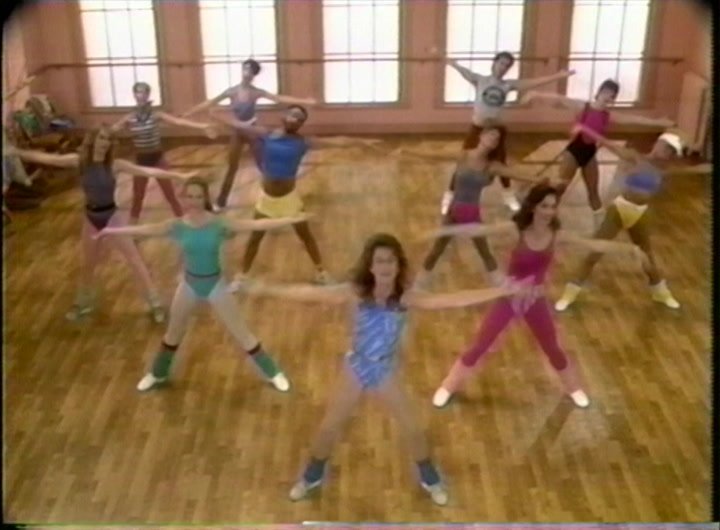
Before the tape, there was the studio. Jane Fonda opened Workout on Robertson Boulevard in Beverly Hills in 1979, partly to fund the political activism that had cratered her acting career and partly because she had broken her foot filming The China Syndrome and couldn’t keep going to ballet class. A dancer named Leni Cazden had been teaching a routine that mixed ballet warm-ups with calisthenics and pop music, and Fonda turned it into the studio’s signature class. The waiting lists were brutal. Suzanne Somers showed up. So did Barbra Streisand.
The Retro Almanac
A monthly roundup of "on this day" highlights from that month, decades back — plus first dibs on new retro merch drops. No spam, just the good stuff.
The video was Fonda’s editor’s idea — Steve Schragis at Karl Lorimar Home Video pitched it as a way to bring the class to women who couldn’t fly to L.A. Fonda hated the first cut. She thought she looked stiff. She made them reshoot her opening segment three times before signing off. The original 1982 tape sits on Internet Archive now, and what’s startling is how unglamorous it actually looks — flat lighting, a small group of dancers, Fonda counting reps in a striped leotard while sweat ran down her neck. There was no script doctor, no studio audience, no laugh track. Just a routine.
Why VHS Was the Real Revolution
None of this would have mattered without the VCR. In 1980, only about 1 percent of U.S. households owned one. By 1985 that number had jumped past 20 percent, and by the decade’s end the VCR was in two-thirds of American living rooms. Fonda happened to release the right product at the moment the hardware finally caught up. People who had spent ten years renting Star Wars from the corner video store suddenly had a reason to own a tape.
This is also why the home video industry treated the workout tape like a controlled substance. Karl Lorimar locked in exclusive distribution and refused to release it for rental, only sale. If you wanted to do the Fonda class at home, you had to commit. Each $59.95 tape carried a margin a Hollywood studio would weep for, and within four years the VHS workout category had grown into a $300 million market. Cassettes were the entire delivery system. The same tape stack that held a copy of the cassette format that changed how a decade listened to music was now stacking workout VHS next to Top Gun.

The Spandex Uniform Becomes a Wardrobe
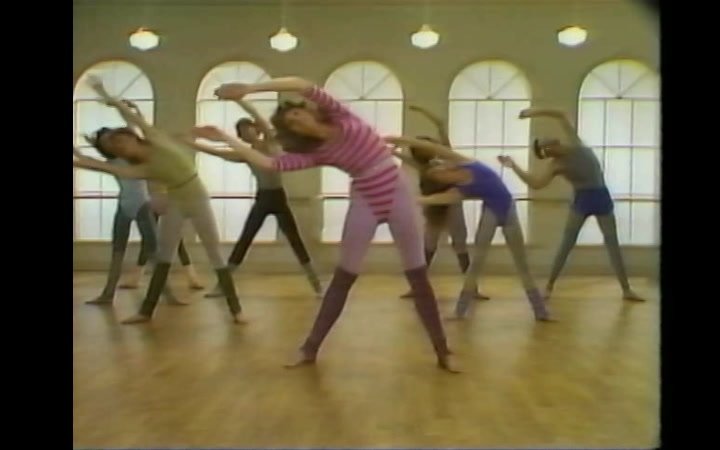
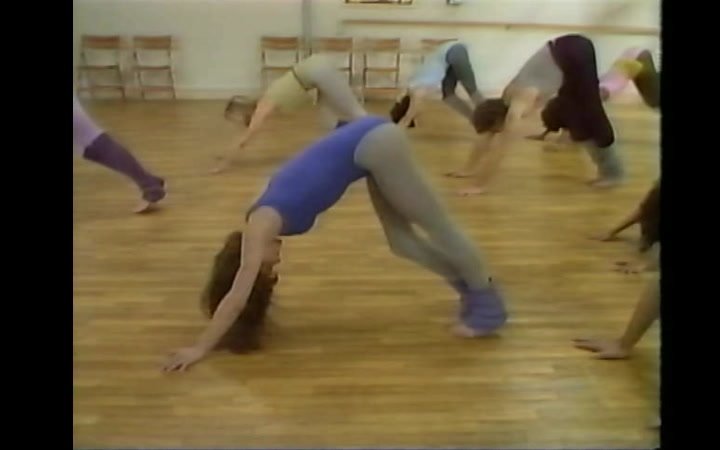
You cannot separate the fitness boom from the clothing. DuPont had been making Lycra since 1959, but the polymer didn’t escape the swimsuit and ski-suit market until the early 80s, when Norma Kamali and Donna Karan started pulling it into ready-to-wear. The leotard, the legging, the leg warmer, the cropped sweatshirt with the cut neckline — they were dance studio gear that walked into Macy’s and refused to leave.
Fonda did not invent the look. She wore it on a tape that sold 17 million copies, and that was enough. The striped leotard from the cover became one of those images that stops being a photograph and starts being a logo. Within two years you could buy a knockoff at every regional department store. The 80s had a habit of turning subculture into mall display — the same dynamic made Miami Vice the defining 80s style template the second Crockett rolled up his blazer sleeves. The workout video did the same thing for women’s casual wear, except faster.
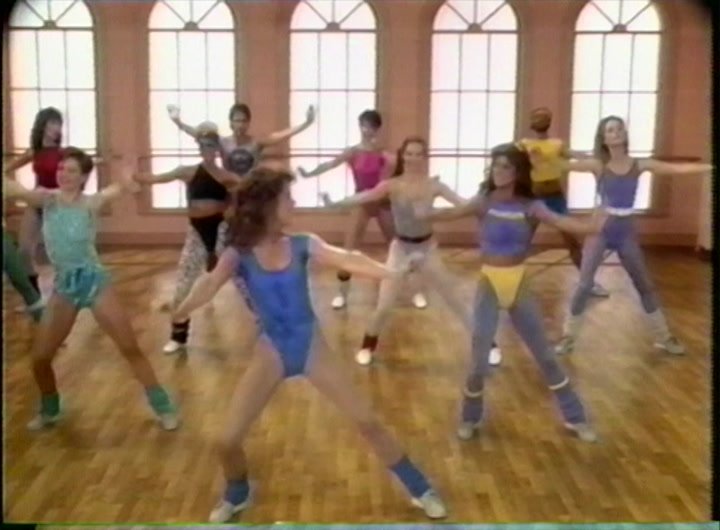
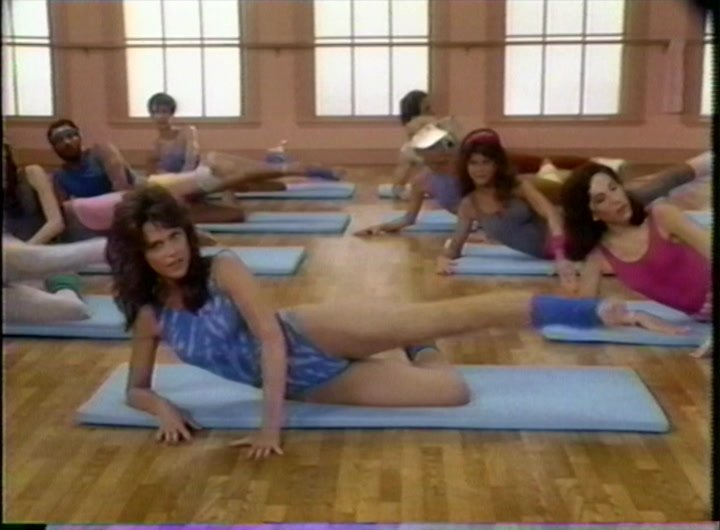
By 1986 the look had gotten louder. The leotards in Fonda’s New Workout tape are neon, cut high on the hip, and stacked over patterned tights in colors that did not exist in 1981. The aesthetic moved a step every year for the rest of the decade.
Richard Simmons Built a Different Kind of Empire
If Fonda sold the fantasy of looking like a movie star, Richard Simmons sold something messier and probably more honest. Sweatin’ to the Oldies dropped in 1988 with a deceptively simple format: Simmons in red satin shorts and a striped tank, leading a circle of regular-sized people through a routine set to Motown and doo-wop hits the audience had grown up with. No skinny dancers. No mirrors. Just a room of people who wanted to move.
The original 1988 Sweatin’ to the Oldies tape moved over a million copies on direct-response TV alone, and four sequels followed through 1996. Simmons financed early production himself because every network had passed. He had spent the previous decade running Slimmons, his Beverly Hills studio that took clients no other gym would book — people who weighed 400 pounds, people coming off eating disorders, people who had been laughed out of aerobics classes.
His tape was the first major workout product designed around the idea that the at-home customer was probably not built like the on-screen instructor. That sounds obvious now. In 1988, it was a marketing gamble. The reason it worked is the same reason the 80s have refused to fade from collective memory — Simmons paired exercise with songs people already had emotional muscle memory for, and the workout became a vehicle for the songs rather than the other way around.
Jazzercise Got There First, Quietly
The footnote that gets erased in most tellings is Judi Sheppard Missett, a Chicago-trained jazz dancer who started teaching what she called Jazzercise in Evanston in 1969. By the time Fonda’s tape hit shelves, Missett had 1,100 certified instructors running classes in church basements and YWCAs across the country and a 1982 video that, according to NPR’s reporting on her career, was the first exercise video to go gold.
Jazzercise’s revenue passed $100 million a year in the late 80s — bigger than Domino’s Pizza for a stretch — and the format quietly trained the franchise economics that every boutique fitness chain copied later, including SoulCycle and Barry’s Bootcamp. Missett never crossed into celebrity, but she invented the infrastructure Fonda’s tape was about to plug into. Without 1,100 women already showing up for choreographed dance fitness, the 1982 video would have looked like a strange import from L.A.
The Part Nobody Likes to Remember
The same decade that gave women aerobics classes also gave them the diet shake, the cabbage soup diet, and Susan Powter screaming at the camera. The workout video boom rode shotgun with a diet-culture wave that, looking back, did real damage. Fonda has publicly acknowledged that she was actively bulimic for much of the period during which she sold tens of millions of fitness tapes — a fact she did not disclose at the time and that she has discussed with painful candor in the years since.
Simmons spent most of his on-camera career pushing back on the same culture, refusing to coach toward a weight number and insisting his clients move because it felt better, not because the scale demanded it. Both extremes coexisted inside the same VHS aisle. Anyone who grew up renting these tapes in the late 80s lived through both messages without ever being told they conflicted.
Why the Tapes Won’t Die
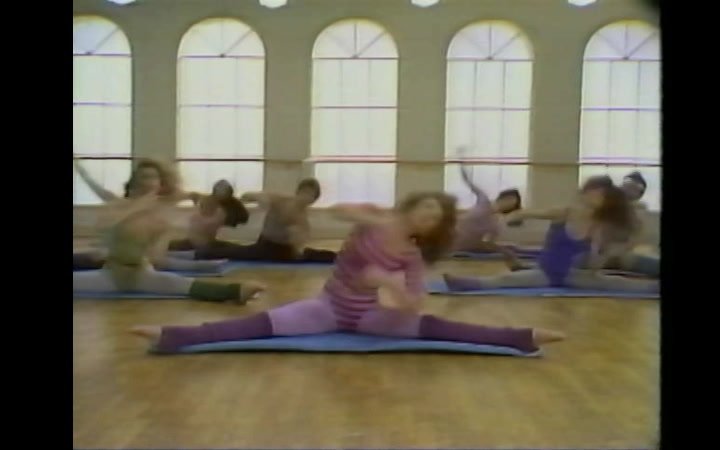
The streaming era should have killed the workout video category. It did not. Peloton, Apple Fitness+, Obé, and dozens of YouTube channels are running the exact format Fonda’s tape pioneered — instructor in a styled studio, music synced to choreography, viewer on the floor at home. The hardware switched from VHS to a tablet. The product is identical. The leg warmers came back too, periodically, with an irony tax attached.
You can argue the entire $14 billion at-home connected-fitness market is a direct extension of one Beverly Hills tape that someone almost didn’t release. The reason it endures is the same reason it worked in 1982 — a body wants to move, a person wants to watch someone count for them, and a video makes both cheap. Everything since has just been a different distribution method for the same idea. The aerobics class never really left. It just stopped wearing the striped leotard.
Sources
- Internet Archive — Workout Starring Jane Fonda (1982 Karl Home Video VHS preservation)
- NPR — How Judi Sheppard Missett built Jazzercise into a fitness empire
- IMDb — Richard Simmons: Sweatin’ to the Oldies (1988)
- Parade — Jane Fonda’s First Workout Video, 34 Years Later
- Inc. Magazine — Jazzercise, 50 Years and $100 Million in Revenue Later
- Internet Archive — Jane Fonda’s New Workout (1986 VHS preservation)
- Wikipedia — Jane Fonda’s Workout reference page
Browse retro and vintage-inspired apparel at the RetroRadical shop →
The Retro Almanac
A monthly roundup of "on this day" highlights from that month, decades back — plus first dibs on new retro merch drops. No spam, just the good stuff.