|

Falklands War 1982: 8 Defining Moments That Changed Everything

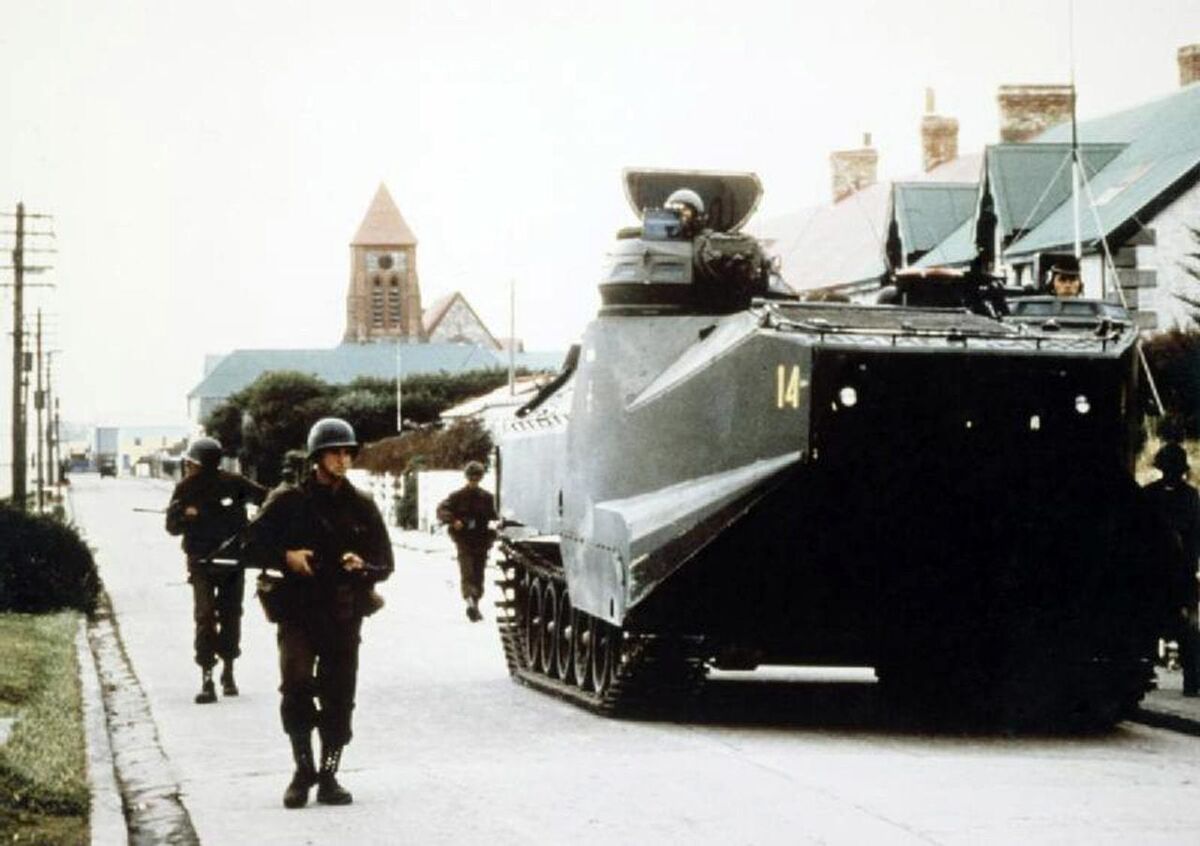
Forty-four years ago today, a column of Argentine amphibious vehicles rolled into the streets of Stanley — a quiet, wind-battered capital that most of the world had never heard of. By nightfall on April 2, 1982, the Falkland Islands were under Argentine military occupation, and the clock was ticking on one of the most unlikely, dramatic, and consequential wars of the twentieth century. Seventy-four days later, it was over — but nothing about Britain, Argentina, or Margaret Thatcher would ever be quite the same.

A Junta’s Desperate Gamble

By early 1982, Argentina’s military government was in serious trouble. General Leopoldo Galtieri had seized power in a coup in December 1981, inheriting an economy in freefall — inflation running at over 100%, mass unemployment, and a population that had spent years living in fear of the junta’s notorious “dirty war,” in which an estimated 10,000 to 30,000 dissidents, activists, and ordinary citizens had been “disappeared.” The streets were growing restless. Galtieri needed a distraction.

The Falkland Islands — Las Islas Malvinas in Spanish — had been disputed territory for a century and a half. Argentina had always maintained that the islands, seized by Britain in 1833, were rightfully Argentine. Sovereignty negotiations between London and Buenos Aires had dragged on through the 1970s without resolution. For the junta, the islands represented something more than real estate: they were a symbol of national humiliation and an opportunity. A quick, bloodless seizure, they calculated, would unite the country, generate a nationalist frenzy, and force Britain — which had been quietly signaling its waning interest in the remote outpost — to negotiate.

The signs that Britain wasn’t paying close attention were real enough. The 1981 Defence Review had earmarked HMS Endurance, the only Royal Navy vessel permanently stationed in the South Atlantic, for the scrap heap. The British Nationality Act of the same year had stripped many Falkland Islanders of full British citizenship. To the junta, these were signals that London didn’t care. They were wrong.


Argentine LVTP-7 amphibious vehicles patrol Port Stanley after the Argentine invasion of the Falkland Islands, April 2, 1982
An Argentine LVTP-7 amphibious vehicle on patrol in Port Stanley, hours after the invasion on April 2, 1982. © Crown copyright / IWM

The Day the Islands Fell

In the pre-dawn hours of April 2, 1982, Argentine special forces — the Buzo Tactico commando unit — slipped ashore near Government House in Stanley. Their orders were to overwhelm the tiny British garrison and present the world with a fait accompli. The defenders consisted of just 85 Royal Marines of Naval Party 8901, a handful of local defence force members, and Rex Hunt, the Governor of the Falklands, who refused to surrender without a fight.

What followed was a brief but fierce engagement. The Royal Marines, massively outnumbered, fought with extraordinary determination. They killed at least one Argentine officer and wounded several others before Hunt finally ordered the ceasefire. The islands fell in under twelve hours. Within days, over 10,000 Argentine troops had been deployed across the islands, and Port Stanley was officially renamed Puerto Argentino.

In London, the news hit like a thunderclap. The House of Commons convened for an emergency Saturday session — a rare occurrence in peacetime. The opposition benches were furious. Even members of Thatcher’s own Conservative party were scathing. The humiliation was total. Britain had lost sovereign territory without firing a meaningful shot.

Britain’s Response: A Task Force Unlike Any Other

What happened next stunned the world. Within 72 hours, the Royal Navy had assembled a task force of extraordinary scale — 127 warships, submarines, and support vessels. Aircraft carriers HMS Hermes and HMS Invincible departed Portsmouth on April 5 to enormous crowds. Civilians lined the quayside, waving Union Jacks, weeping, cheering. It looked, improbably, like a scene from 1940.

The sheer logistics were staggering. The Falklands are 8,000 miles from Britain, at the edge of the world. The US Secretary of State Alexander Haig immediately flew into shuttle diplomacy mode, shuttling between London and Buenos Aires. The joint chiefs of both the British Army and the RAF privately thought the operation was borderline impossible. Even within Cabinet, there was skepticism. But Thatcher had made up her mind on the evening of April 2, in a conversation with First Sea Lord Admiral Henry Leach, who had told her — without equivocation — that the Navy could do it.

Royal Navy Sea Harrier aircraft on CAP mission during the Falklands War 1982
Royal Navy Sea Harriers prepare for a Combat Air Patrol during the Falklands War. The aircraft’s performance against Argentine jets proved decisive. © Crown copyright / IWM

The Sinking of the Belgrano: War’s Point of No Return

As the task force steamed south, diplomacy continued to flicker. The Peruvian government floated a peace plan. The UN Security Council passed Resolution 502, demanding an Argentine withdrawal. But time was running out, and on May 2, the war took its darkest turn.

The Argentine cruiser ARA General Belgrano — a veteran ship that had miraculously survived Pearl Harbor in 1941 as the USS Phoenix — was sailing near the Total Exclusion Zone Britain had declared around the islands. The nuclear submarine HMS Conqueror had been tracking it for thirty hours. On orders from London, Conqueror fired two Mk 8 torpedoes. The Belgrano rolled, burned, and sank in the freezing South Atlantic. Three hundred and twenty-three Argentine sailors went down with her — the single greatest loss of life in the conflict.

ARA General Belgrano listing to port after being struck by HMS Conqueror torpedoes, Falklands War 1982
The ARA General Belgrano lists heavily after being torpedoed by HMS Conqueror, May 2, 1982. The sinking killed 323 Argentine sailors. Press Association photo

HMS Conqueror nuclear submarine alongside HMS Penelope during the Falklands War 1982
HMS Conqueror sails alongside HMS Penelope. Conqueror became the first nuclear submarine in history to sink a warship in combat. © Crown copyright / IWM

The sinking of the Belgrano remains controversial. Critics pointed out the ship was sailing away from the exclusion zone when it was hit. Thatcher’s government defended the decision on grounds that the Belgrano posed a continuing threat. Two days later, Argentina hit back hard: an AM.39 Exocet missile fired from a Super Étendard aircraft slammed into HMS Sheffield, a Type 42 destroyer. Twenty sailors died. Sheffield burned for six days before sinking. Britain was now in a real war, not a colonial policing action.

HMS Sheffield Type 42 destroyer on fire after being hit by Argentine Exocet missile during the Falklands War
HMS Sheffield burns after being struck by an Exocet missile on May 4, 1982. The loss of Sheffield sent shockwaves through the British public. © Crown copyright / IWM

The Land Battle Begins: San Carlos and Goose Green

The British amphibious landings at San Carlos Water on East Falkland began on May 21 — Operation Sutton. Landing craft from HMS Intrepid and Fearless brought ashore Royal Marines and paratroopers in the darkness. Argentine air attacks were fierce and relentless throughout the landing days. HMS Ardent, HMS Antelope, and HMS Coventry were sunk. RFA Sir Galahad was bombed at Bluff Cove with catastrophic results — 48 soldiers killed, many of them Welsh Guardsmen who had no time to disembark. The images of survivors with horrific burns were among the most visceral of the entire war.

British troops landing on Blue Beach San Carlos during Operation Sutton Falklands War 1982
Landing craft approach San Carlos, May 21, 1982. Operation Sutton established the British bridgehead despite ferocious Argentine air attacks. © Crown copyright / IWM

The first major land victory came at Goose Green on May 28-29. 2 Para — the 2nd Battalion of the Parachute Regiment — attacked an Argentine force nearly three times their size. The battle was a grinding, brutal affair fought through the night in freezing rain. Lieutenant Colonel “H” Jones was killed leading his men forward at close quarters; he was posthumously awarded the Victoria Cross. Goose Green fell on May 29, and 1,200 Argentine prisoners were taken — a number that shocked even the British commanders.

The March to Stanley: Mount Longdon and the Final Push

Because the Atlantic Conveyor — a merchant vessel pressed into service — had been sunk by an Exocet with most of the task force’s heavy-lift helicopters aboard, the British infantry had to march. The famous “yomp” across East Falkland — soldiers carrying 80-100 pound packs across trackless bog and mountain in sub-Antarctic winter — became one of the defining images of the war. Forty-five Commando covered 80 miles on foot. Three Para marched from Port San Carlos to Teal Inlet, 45 miles in under three days.

The final battles for Stanley came in the second week of June. Mount Longdon, Two Sisters, and Mount Harriet were assaulted on the night of June 11-12. At Mount Longdon, 3 Para faced some of the heaviest resistance of the war — Argentine snipers and machine gun nests made every yard costly. Sergeant Ian McKay charged a machine gun position to save his men and was killed; he too received the Victoria Cross posthumously. Tumbledown fell on June 13-14. By dawn on June 14, British forces were within sight of Stanley.

Royal Marines 45 Commando yomping across East Falkland towards Port Stanley during the Falklands War 1982
Royal Marines of 45 Commando on the famous “yomp” towards Port Stanley. Marine Peter Robinson carries the Union Jack on his pack — one of the most iconic images of the war. © Crown copyright / IWM

The Surrender: June 14, 1982

At 9 pm local time on June 14, Argentine Brigadier General Mario Menéndez signed the surrender document handed to him by Major General Jeremy Moore. It was a remarkable and unlikely moment. Less than two and a half months after Argentina’s flags had gone up over Stanley, they came down again. Over 11,000 Argentine prisoners were taken — many of them poorly trained teenage conscripts who had been suffering terribly in the freezing winter conditions, ill-fed and ill-equipped by a military command that had grossly underestimated British resolve.

Argentine prisoners of war after the surrender at Port Stanley, Falklands War June 1982
Argentine prisoners wait to hand in their weapons at Port Stanley after the June 14 surrender. Many were young conscripts with minimal training. © Crown copyright / IWM

Two hundred and fifty-five British military personnel died in the conflict. Three Falkland Islands civilians were killed. Argentine losses were 649 killed, with 323 of those on the Belgrano alone. The war’s human cost was seared into both nations’ histories.

The Aftermath: Two Countries Transformed

The Falklands War’s political consequences were enormous — and in some ways, more lasting than its military outcome.

In Argentina, the junta collapsed almost immediately. Galtieri resigned within days of the surrender. The defeat discredited the military government so thoroughly that Argentina’s return to democracy — which had seemed distant in early 1982 — became inevitable. Elections were held in 1983, and Raúl Alfonsín became the country’s first civilian president in nearly a decade. The war had accomplished the exact opposite of what the junta intended. Instead of saving the regime, the adventure destroyed it.

In Britain, the effect was equally transformative, if in entirely the opposite direction. Margaret Thatcher had been, in early 1982, one of the most unpopular prime ministers in modern British history. The economy was struggling, unemployment was rising, and her own party was restless. The Falklands changed everything. The “Iron Lady” image — which had been something of a political burden — became, overnight, a source of genuine public admiration. When the task force returned to Portsmouth and Southampton, the scenes were extraordinary. HMS Invincible and HMS Hermes sailed home to jubilant crowds.

HMS Invincible returns to Portsmouth after Falklands War victory 1982 with Sea Harriers and Sea King helicopters on deck
HMS Invincible returns home to triumphant celebrations, 1982. Sea Harriers and Sea King helicopters line the flight deck. © Crown copyright / IWM

The “Falklands Factor” was credited — though debated by historians — with Thatcher’s landslide election victory in 1983. Whether you credit the war itself or the economic recovery that was simultaneously underway, her second term began with a parliamentary majority of 144 seats. She would go on to win a third election in 1987, reshaping British politics for a generation.

The war also had profound consequences for how Britain saw itself. It triggered a rethink of defence priorities — the very cuts that had arguably emboldened Argentina were reversed. HMS Endurance stayed in service. The Falklands garrison was dramatically strengthened. A new airfield at Mount Pleasant, opened in 1985, made the islands far more defensible. The sovereignty dispute was never resolved — Argentina maintains its claim to this day, referring to the islands as Las Malvinas — but the practical reality of British administration became unshakeable.

A War That Shaped a Decade

For Gen X, the Falklands War was one of those events that lodged in childhood memory in a particular way — half-comprehended news bulletins, parents looking worried, strange names being learned: Goose Green, San Carlos, Tumbledown. For those old enough to follow it closely, it was a geopolitical education in real time, a reminder that wars — real ones, with ships sinking and soldiers dying — were not confined to history books or Vietnam-era films. They could happen now, over remote islands most people couldn’t find on a map, and they could change everything.

The parallels to other mid-century conflicts were everywhere. A democratic nation going to war to defend a principle. A military dictator gambling on foreign adventure to survive domestic crisis. The courage of ordinary soldiers pressed into extraordinary circumstances. The fog of war, the political calculations, the human cost.

The Falklands War lasted 74 days. Its consequences have lasted a lifetime.

For more Cold War-era history that shaped the 1980s, read about how “The Day After” captured Cold War paranoia in 1983 and Reagan’s “Star Wars” SDI speech that changed the Cold War forever. Also read our piece on the Reagan assassination attempt in 1981, another defining moment of the early 80s.

Watch: The Falklands War Day by Day

Sources

  1. Imperial War Museum: A Short History of the Falklands Conflict
  2. Encyclopædia Britannica: Falkland Islands War
  3. BBC History: The Falklands Conflict

Similar Posts

Leave a Reply

Your email address will not be published. Required fields are marked *