The Tracey Ullman Show: The Simpsons Sketch That Started an Empire
Tracey Ullman Simpsons history starts on April 19, 1987, when a scruffy little short called Good Night aired on The Tracey Ullman Show and quietly introduced America to Homer, Marge, Bart, Lisa, and Maggie. Nobody watching Fox that night could have known they were seeing the first minute of what would become the longest-running prime-time scripted series in U.S. television history, but that is exactly what happened.
Gen X remembers the fully formed version: Bartmania shirts, schoolyard catchphrases, parents complaining, and Sunday nights that felt owned by Springfield. What makes the April 19 debut so fun to revisit is how accidental it looks in hindsight. The animation was rough, the family looked a little feral, and the jokes landed in quick commercial-break bursts rather than polished half-hour episodes. Yet the DNA was already there. The family dynamic, the anti-authority streak, the warmth hiding under the sarcasm, and the sense that cartoons could be weird, fast, and a little subversive for prime-time TV were all present from the jump.
That is why this date matters. April 19, 1987 was not just the first appearance of The Simpsons. It was the moment a side gag on a sketch show opened a lane for modern animated comedy, changed Fox forever, and gave Gen X one of its defining cultural touchstones.
Table of Contents
1. Tracey Ullman Simpsons began as almost a throwaway bumper
The first important thing to remember is scale. Good Night was not sold as a major event. It was a short animated bumper tucked inside the third episode of The Tracey Ullman Show. According to Wikisimpsons and the episode listing at IMDb, it aired on April 19, 1987. That tiny slot matters because it explains why the debut feels so different from later franchise launches. There was no giant marketing push, no prestige rollout, and no sense that Fox was unveiling the future. It was just a weird little cartoon dropped into the middle of a variety program.
That accidental quality is part of the legend now. Gen X pop culture is full of moments that arrived before the machine knew what it had. Punk records were pressed for small scenes before becoming mythology. Early arcade hits looked disposable before they ate mall culture alive. The Simpsons fits that same pattern. The family did not enter TV as royalty. They snuck in through the side door.
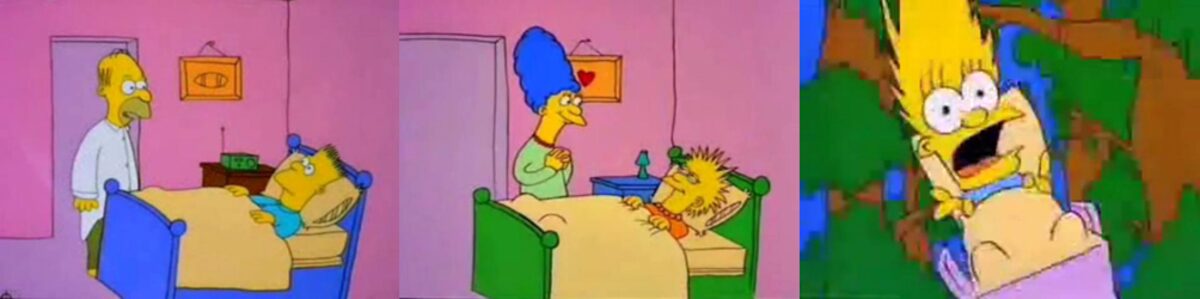
Seen today, Good Night plays like a compressed mission statement. Homer and Marge put the kids to bed, each bedtime phrase backfires, and the entire family ends up piled together in one room. It is domestic comedy stripped to its essence: parents mean well, kids absorb everything too literally, and the household survives on affection more than competence. In under two minutes, the short established the show’s basic superpower. It could mock family life without sounding like it hated families.

2. The rough look made the family unforgettable
People who only know the sleek digital version of Springfield sometimes forget how odd those first designs were. The April 1987 family looked jagged, elastic, and a little off-model even by the standards of 1980s television animation. Matt Groening later said he handed over very basic drawings, expecting the animation house to refine them. Instead, as Britannica’s Matt Groening biography notes, he ended up creating a new family for James L. Brooks and The Tracey Ullman Show in 1987 rather than adapting Life in Hell directly.
That roughness helped more than it hurt. The early Ullman-era Simpsons do not look focus-grouped. They look nervous, handmade, and mischievous. That visual instability matched the humor. You were not supposed to settle into a cuddly Saturday-morning rhythm. You were supposed to feel like this family might say something sharper than the usual network sitcom clan.
For Gen X viewers, that mattered. The late 1980s were full of polished corporate surfaces. Then these yellow weirdos showed up looking like they had been doodled in the margins of a detention notebook. It gave the shorts outlaw energy. Even before Bart became a merchandising empire, the style announced that these characters were not here to behave.

3. Bart already sounded like Gen X trouble
The first short is called Good Night, but the emotional center is really Bart. Homer’s bedtime wordplay, Bart’s confusion, and the whole chain reaction of kid logic tell you exactly where the series would find its comic voltage. Bart was never just a brat. He was a kid who heard adult language, tested it, twisted it, and exposed how flimsy grown-up certainty could be. That is an extremely Gen X kind of hero: skeptical, under-supervised, funny, and always one sentence away from trouble.
Den of Geek’s retrospective on the early shorts points out that the very first spot already had Bart chewing on big questions, even if Homer batted them away with a dumb joke. That tiny exchange matters because it showed the series would not treat kids as decorative props. Bart and Lisa were minds in motion. They worried, interpreted, exaggerated, and misread the world in believable ways. The comedy came from adults failing to control the meaning once words left their mouths.
That became the emotional engine of classic Simpsons writing. The family could be stupid, selfish, lazy, loving, insecure, and unexpectedly wise, sometimes all in the same scene. The first short already hinted at that broader range. It was not just attitude. It was perspective.

4. The shorts taught Fox what animated TV could do
April 19, 1987 also matters because of what it did for Fox. In the late 1980s, Fox was still the upstart network, looking for identity and ways to challenge the older broadcast giants. Britannica’s history of The Simpsons notes that the shorts began on The Tracey Ullman Show in 1987 and expanded into a half-hour series by December 1989, becoming a key part of Fox’s rise. That transformation tells you how much the network learned from those small experiments.
The Ullman shorts proved an animated family could work in a prime-time environment without imitating the gentler rhythms of older cartoon brands. They were faster, more brittle, and more sarcastic. They also fit the commercial rhythm of television beautifully. One short could deliver a full joke burst and leave a strange aftertaste before the ad break. Fox saw that viewers remembered the bits. Then it saw they wanted more.
Without that proof of concept, there is a decent chance prime-time animation stays a novelty longer. Instead, the success of the shorts helped clear a path that later made room for Beavis and Butt-Head, South Park, King of the Hill, Family Guy, and a lot of animated comedy that treated adults as the actual audience. The whole landscape does not begin and end with April 19, 1987, but that date is one of the genuine ignition points.

5. Matt Groening built a new family instead of giving away his old one
One of the best origin-story details is also one of the most revealing. Groening was originally expected to adapt his comic strip Life in Hell, but he worried about losing ownership of those characters. So he quickly improvised a new family, using names from his own relatives and swapping his own name out for Bart, an anagram of “brat.” Britannica summarizes that pivot cleanly, and it is the kind of split-second creative decision pop culture loves because the consequences were so huge.
That choice gives April 19 an extra layer of retro magic. The debut was not merely a successful first appearance. It was the public result of a last-minute swerve. A creator protected one body of work, invented another on the fly, and accidentally changed television. Gen X grew up in a culture obsessed with authenticity, selling out, and keeping control of your thing. This story scratches all of those nerves at once.
It also explains why the Simpsons felt personal from the beginning. Even in crude form, the family had texture. Homer was not a generic sitcom dad. Marge was not just a voice of order. Bart, Lisa, and Maggie were not interchangeable cartoon children. The core unit already felt specific enough to survive expansion. That is rare in tiny shorts. Usually you get one joke and a concept. Here, you got a world seed.

6. The Ullman era preserved the show’s strange edge
When people celebrate The Simpsons, they usually jump straight to the classic half-hour years, and fair enough, because that run is one of the strongest in TV history. But the Ullman shorts deserve their own respect because they preserved the show’s unsettling side. These were not cleanly domesticated characters yet. Their eyes bulged differently. Their movement felt twitchier. The jokes had the compressed nastiness of sketch comedy.
That matters because a lot of long-running franchises lose their weirdness as they get bigger. The early shorts freeze the family in a state where they still feel slightly dangerous. They are cute enough to hold your attention but odd enough to keep you off balance. For Retro Radical readers, that is part of the charm. The Ullman-era Simpsons belong to the same cultural shelf as rough-cut music videos, first-wave cable oddities, and all the stuff that felt a little too sharp for the mainstream until the mainstream swallowed it.
There is also a direct line from those shorts to the moral panic that followed the full series. Adults later complained that Bart was rude, Homer was dumb, and the whole family was corrosive. But the seed of that panic was already visible in 1987. The family made dysfunction funny without pretending dysfunction was glamorous. That was new enough to feel threatening.

7. One April night turned into a permanent nostalgia machine
The final reason April 19 changed TV is the simplest one. It introduced a set of characters who never left. The prime-time series that grew out of the shorts debuted in late 1989, and its cultural footprint has been ridiculous ever since. Catchphrases, school controversies, bootleg shirts, Butterfinger tie-ins, endless guest stars, and decades of arguments over the best era all trace back to the same small debut on The Tracey Ullman Show.
For Gen X, The Simpsons landed at exactly the right moment. It was old enough to feel rebellious in the late 80s, huge enough to dominate the early 90s, and durable enough to become a memory bridge between people who watched the shorts live and people who came in during the golden-age Sunday run. That is why revisiting the debut matters. You are not just looking at prototype animation. You are looking at a culture beginning to reorganize around irony, speed, references, and the idea that cartoons could carry the same satirical load as live action.
If you want to see that future arriving in miniature, watch Good Night again. The shapes are rough, the timing is primitive compared with what came later, and the family still feels like a scribble that escaped the page. But the spark is obvious. On April 19, 1987, television met the Simpsons, and TV has been living with the consequences ever since.

If you like these weird turning-point moments in pop history, Retro Radical has more where that came from, including our look at how disco mutated into new wave, the April 10 release story behind The Secret of My Success, and a reminder of how older tech habits shaped culture in our piece on caller ID and the death of prank calls.
Sources
- IMDb, “Good Night” — episode listing confirming the April 19, 1987 airdate.
- Wikisimpsons, “Good Night” — plot, production, and debut context for the first short.
- Britannica, “The Simpsons” — origins of the shorts and the 1989 expansion into a half-hour series.
- Britannica, “Matt Groening” — Groening’s creation of the Simpson family for The Tracey Ullman Show.
- Den of Geek, “The Simpsons Early Shorts Were Mind-Bending Morality Plays” — retrospective analysis of the tone and importance of the Ullman-era shorts.