KISS Unmasking 1983: The Untold MTV Gamble
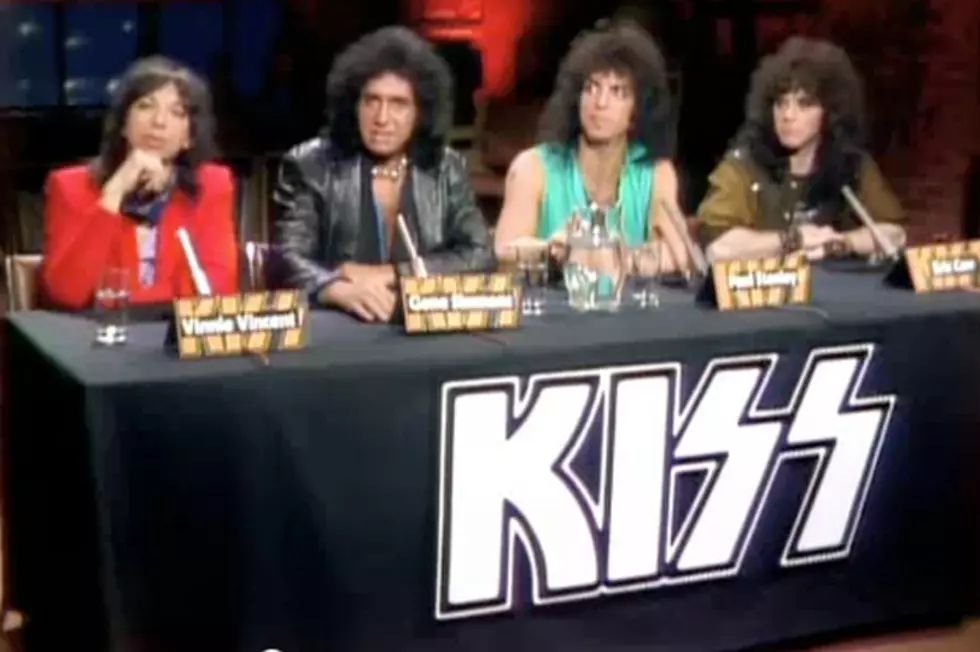
On the night of September 18, 1983, four men sat down at a plain conference table in front of MTV cameras and changed rock history. There were no pyrotechnics, no elaborate stage sets, no fire-breathing stunts. Just four musicians, a fluorescent-lit room, and the weight of a decade-long secret about to be undone. When Gene Simmons, Paul Stanley, Eric Carr, and Vinnie Vincent finally looked directly into the camera — their faces bare, their iconic grease paint gone — the gasp heard around the music world was almost audible.
This was KISS unmasking 1983, the most audacious image pivot in rock history. For ten years, the faces behind the Demon, the Starchild, the Spaceman, and the Catman had been rock’s greatest mystery. Now, in a move born of equal parts desperation and courage, KISS stripped away the mythology to prove something more radical: that the music was good enough to stand on its own.
A Decade Behind the Mask: KISS and the Birth of the Rock Persona
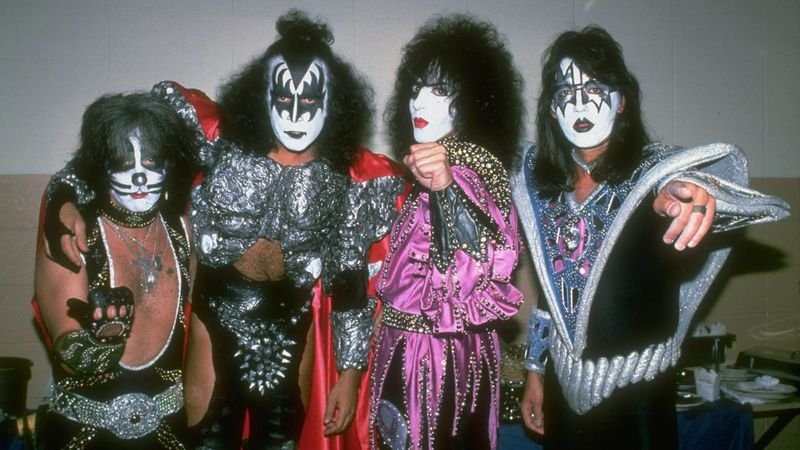
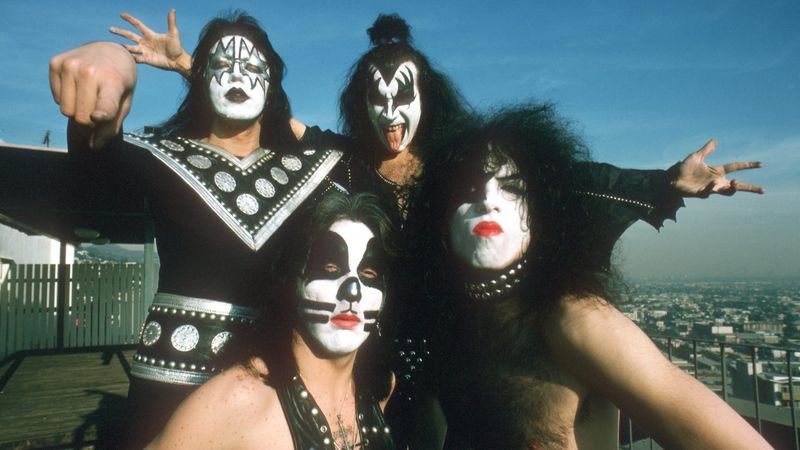
To understand why the unmasking mattered, you need to understand what the masks meant. When KISS formed in New York City in 1973, they were not merely a rock band — they were a concept, a theatrical event disguised as a concert. Gene Simmons (the Demon), Paul Stanley (the Starchild), Ace Frehley (the Spaceman), and Peter Criss (the Catman) built their brand on the premise that their stage personas were as real and essential as the music itself.
The Retro Almanac
A monthly roundup of "on this day" highlights from that month, decades back — plus first dibs on new retro merch drops. No spam, just the good stuff.
The original KISS lineup backstage in the 1970s — the makeup was written into contracts, and no member appeared publicly without it.
From their first show in January 1973 through the arena-conquering peak of the late 1970s, the makeup was non-negotiable. It was written into contracts. Band members would not be photographed without it. The mystique was carefully, almost obsessively maintained. In 1977, when a TV crew filming a documentary accidentally captured Gene Simmons without his makeup, the footage was destroyed. In 1978, when the band appeared in the Marvel Comics superhero special, the legend stated that their real blood was mixed into the red ink used to print the books. The mythology was total.
KISS in full costume on an LA rooftop — the theatrical concept that made the band one of the biggest live draws of the decade.
And commercially, through the mid-1970s, it worked spectacularly. Albums like Destroyer (1976) and Love Gun (1977) went platinum. Their 1977 live album Alive II hit double platinum. Gene Simmons’s fire-breathing routine as the Demon — a stunt he learned from a local magician and debuted in 1973 — became as central to the band’s identity as any song. By any metric, KISS in their prime was one of the biggest rock acts on Earth, sitting comfortably alongside the glam and hair metal bands that would later dominate the Sunset Strip.
Gene Simmons breathing fire during a KISS show — the Demon persona depended entirely on the makeup and the mythology built around it.
When the Grease Paint Started to Crack: The Decline Years (1979–1982)
But empires fall. By the late 1970s and into the early 1980s, cracks were spreading through the KISS machine — and not just in the makeup. Internal tensions, substance abuse issues, and a series of increasingly ill-advised commercial decisions were eroding the band from within.
Dynasty (1979) chased the disco trend with “I Was Made for Lovin’ You” — a song that remains divisive among hardcore fans to this day. Then came the conceptual disaster of Music From “The Elder” (1981), a concept album so far removed from the KISS formula that it alienated their core audience. The album barely cracked the top 75 in the US. Meanwhile, behind the scenes, the original lineup was fracturing.
Peter Criss, the Catman, had been the first to go. His increasing unreliability and personal struggles led to his departure in May 1980. He was replaced by Eric Carr, a gifted and technically superior drummer from Brooklyn who adopted the persona of “the Fox” and wore his own original makeup design. Carr was a team player who brought genuine energy and loyalty to the band — but he was not an original, and the fandom knew it.
Ace Frehley’s exit followed a more tortured trajectory. Already disengaged, the Spaceman barely participated in Music From “The Elder”, contributing little beyond some guitar solos. His face appeared on the cover of 1982’s Creatures of the Night, but he had not played a note on the album — studio musician Vinnie Vincent had handled all the guitar parts. Frehley officially departed in December 1982, and Vincent stepped into the role officially, adopting the character of “the Wiz” — an Egyptian ankh-based makeup design created by Paul Stanley.
The problem was clear. By 1983, only two original members remained: Simmons and Stanley. The makeup that had once signified a unique mystique now felt increasingly like a costume being worn by a tribute band. Creatures of the Night had returned the band to a heavier sound and received decent critical reviews, but it failed to crack the top 40 in the United States. KISS was playing half-empty arenas in markets they once would have sold out in minutes.
The Decision to Unmask: Fear, Logic, and Paul Stanley’s Persuasion
The decision to abandon the makeup did not come easily — particularly for Gene Simmons, who had been the most committed guardian of the KISS mystique. In multiple interviews and in his autobiography, Simmons described his initial reaction to the idea as pure horror.
“I went, ‘What!? That’s sacrilegious! You’re out of your mind. It won’t work.'” — Gene Simmons
It was Paul Stanley who made the case for change. His argument was both practical and philosophical: the band was playing to half-empty arenas. The two members who had helped create the iconic personas were gone. Maintaining the makeup under those circumstances was not protecting a legacy — it was clinging to a costume that no longer fit. Stanley pushed for the band to prove itself as a musical entity, not a theatrical one.
“Let’s prove something to the fans. Let’s go and be a real band without makeup. It was no longer the original images… we needed to take a stand. If we were good enough as a band, we would survive.” — Paul Stanley
Simmons eventually came around, though he later admitted he was “scared stiff” as the moment approached. The band worked through July and August of 1983 at four New York studios — Right Track Recording, The Record Plant, Atlantic Studios, and The Hit Factory — recording what would become their eleventh studio album. Producer Michael James Jackson worked alongside Simmons and Stanley, and the resulting album was titled Lick It Up.
September 18, 1983: The MTV Unmasking
The event itself was deliberately understated — almost bizarrely so, given the magnitude of what was happening. MTV aired a press conference on September 18, 1983, in what the network unceremoniously dumped into the 11 PM Sunday night graveyard slot. There was a panel table, no studio audience, minimal production values. J.J. Jackson, one of MTV’s original five VJs, hosted the segment.
And then KISS — Gene Simmons, Paul Stanley, Eric Carr, and Vinnie Vincent — appeared without a trace of the black, white, and silver greasepaint that had defined them for a decade. Four regular-looking men. No Demon. No Starchild. No Fox. No Wiz. Just musicians.
The MTV special had been carefully timed to coincide with the release of Lick It Up, which hit record stores the same day. The strategy was to make the unmasking itself a news event — a piece of rock theater that would generate press coverage and renewed public curiosity about a band many had written off. In that sense, it worked exactly as intended. The story ran in newspapers and entertainment publications across the country. For the first time in years, people were talking about KISS.
The response was a strange mixture of shock and relief. Longtime KISS Army members had spent years imagining what lay beneath the paint. Now they knew. Simmons, it turned out, looked like a regular person. So did Stanley. Eric Carr had warm, expressive features that the Fox makeup had obscured. Vinnie Vincent had the sharp, angular look of a 1980s rock guitarist. None of them looked like rock gods. All of them looked like musicians who had something to prove.
Lick It Up: The Album That Justified the Gamble
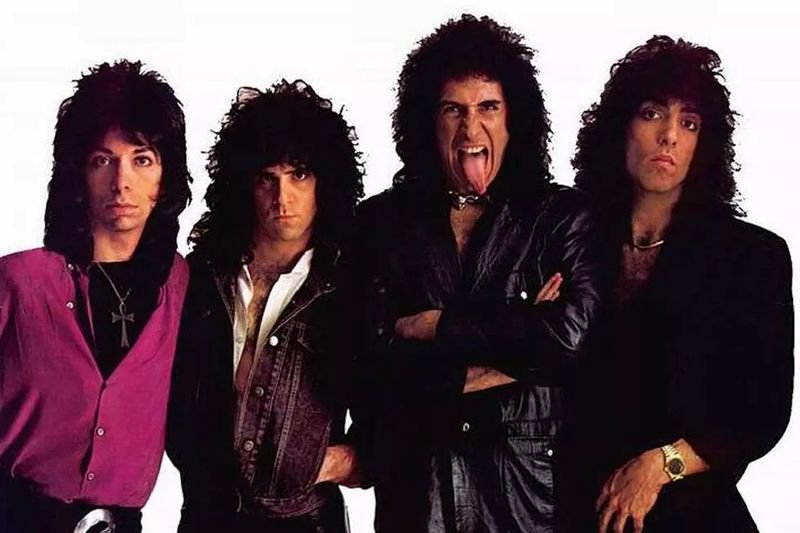
The Lick It Up cover shoot — the first time fans saw Simmons, Stanley, Carr, and Vincent’s real faces on an album sleeve.
The music video for the title track “Lick It Up” premiered alongside the unmasking. Shot in a post-apocalyptic setting complete with scantily clad women and crumbling urban backdrops, it was pure MTV-era excess. And critically, it featured the band without any makeup — making it the first KISS music video to ever show their real faces.
Commercially, Lick It Up was a revelation. After three consecutive albums that had failed to crack the US top 40, the album debuted at #24 on the Billboard 200. It was certified gold in December 1983 — the first KISS album to achieve RIAA certification since 1980’s Unmasked. By 1990, it had gone platinum, crossing the one-million-sales mark in the US alone. Internationally, it reached the top 10 in Sweden, Finland, Norway, and the UK, where it peaked at #7.
Paul Stanley later reflected on what the unmasking had meant for those sales figures: “The only reason why I think people bought Lick It Up more than Creatures of the Night was because we had no makeup on. That was the only reason.” It was a self-deprecating observation, but it contained real insight — the unmasking had made KISS news again, and in the MTV era, being news was everything.
The album’s lineup of Paul Stanley (vocals, rhythm guitar), Gene Simmons (vocals, bass), Eric Carr (drums), and Vinnie Vincent (lead guitar) — plus guest guitarist Rick Derringer on “Exciter” — delivered a harder-edged, more muscular sound than the band had produced since Creatures of the Night. Songs like “Fits Like a Glove,” “A Million to One,” and the title track were radio-friendly without being soft. For the first time in five years, a KISS album sounded like a KISS album.
Life Without the Greasepaint: The Commercial Recovery
The momentum from Lick It Up carried directly into the band’s next phase. Animalize (1984), recorded with new guitarist Mark St. John after Vinnie Vincent was fired following the tour, produced the band’s biggest US chart single of the decade. “Heaven’s on Fire” became an MTV staple, its video — featuring Paul Stanley with flames dancing around his hands — perfectly calibrated for the visual medium.
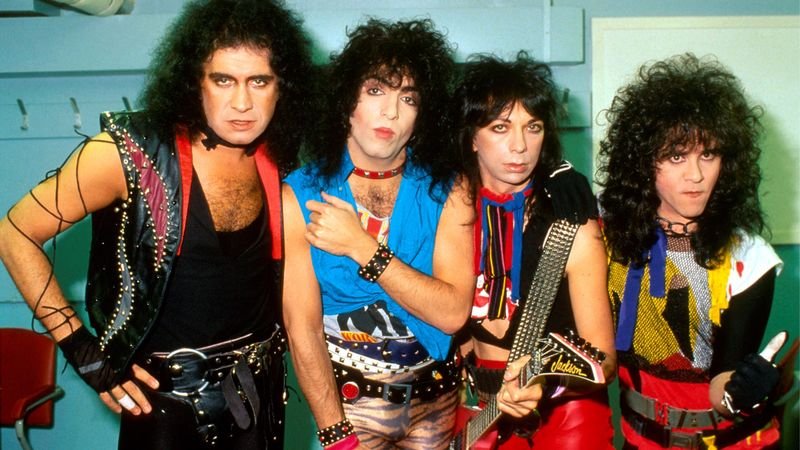
KISS on tour in the mid-1980s — bare-faced, video-ready, and selling more records than they had since the disco years.

Animalize went platinum. Then Asylum (1985) went platinum. Crazy Nights (1987) reached #18 on the Billboard 200 and spawned the title track single, which hit #65 in the US but climbed to #4 in the UK. For a band that had been playing to half-empty arenas in 1983, this was a remarkable commercial rehabilitation — the same kind of second-act reinvention that would later define artists like Bon Jovi as hair metal took over MTV in the mid-80s.
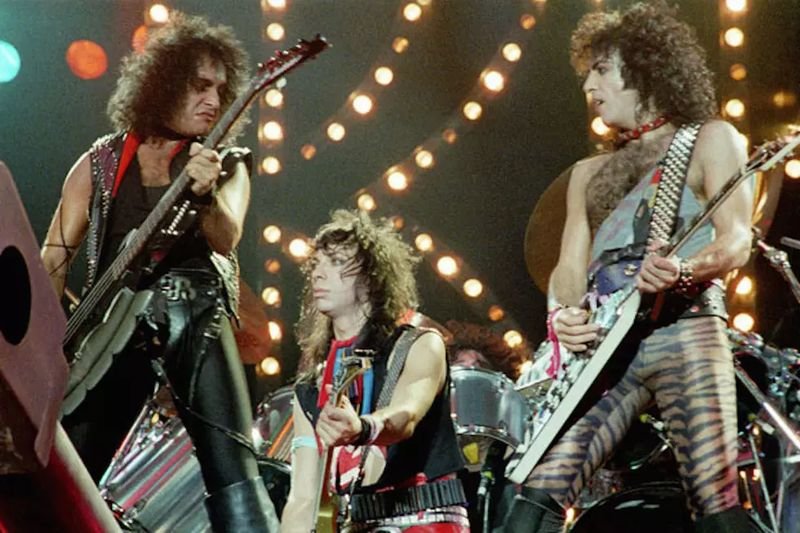
KISS live on the Lick It Up World Tour — the first tour in the band’s history performed entirely without makeup.
The guitar chair continued to evolve. Mark St. John’s tenure lasted only for Animalize before a serious illness forced him to step back. Bruce Kulick, who had filled in during St. John’s illness, became the permanent guitarist and remained with KISS until the 1996 reunion tour. Kulick brought technical versatility and rock credibility that served the band well through their second commercial peak.
The Return of the Masks: 1996 and the Full Circle
The story of the KISS unmasking has one more twist. In 1996, the original four members — Simmons, Stanley, Frehley, and Criss — reunited and put the makeup back on. The Reunion Tour became one of the highest-grossing concert tours of that year, arriving right as the same nostalgia wave that later fueled rock’s post-grunge reckoning was reshaping what audiences wanted from arena shows. The masks that had been cast aside in 1983 as commercial liabilities were now nostalgic gold.
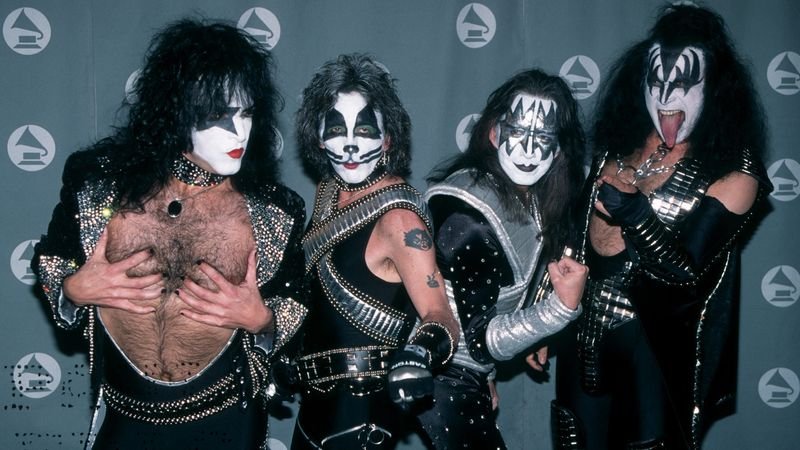
KISS in full makeup at the 1996 Grammy Awards, marking the original lineup’s first public reunion in nearly two decades.
The reunion demonstrated something that the unmasking had perhaps obscured: the original KISS makeup worked because it belonged to specific people with specific personas. Vinnie Vincent’s “Wiz” and Eric Carr’s “Fox” were excellent musicians playing invented characters. Ace Frehley’s Spaceman and Peter Criss’s Catman were cultural archetypes built over years of genuine fan connection.
By 2001, when Criss and Frehley departed again, Simmons and Stanley made the decision to keep the makeup but assign it to their new lineup — Eric Singer donning the Catman paint, Tommy Thayer wearing Frehley’s Spaceman makeup. It was a decision that sparked controversy among purists, but it was also the logical endpoint of the 1983 revelation: the makeup, the band had proved, was a costume. The music was what mattered.
Legacy: Were They Right to Do It?
Forty-plus years after the September 18, 1983 MTV special, the verdict on KISS’s unmasking is clear: it was the right call at the right moment, executed with more courage than the low-key presentation suggested.
Consider the alternative trajectory. Without the unmasking, KISS in 1983 was a band with two original members, declining sales, and an increasingly implausible theatrical concept. The makeup that had once conveyed power and mystery was looking more like desperation with each passing tour. A gradual fade into nostalgia — the fate of many great 1970s rock bands — seemed the most likely outcome.
Instead, Paul Stanley’s gamble produced a second commercial act that lasted through the end of the decade, delivered multiple platinum albums, and maintained KISS’s status as a genuine arena rock draw. The unmasking proved that the band had musical substance behind the spectacle, and it gave them the creative freedom to compete in a new era dominated by MTV visuals rather than live theatrics.
What the 1983 unmasking ultimately revealed was not four ordinary-looking men. It revealed a band willing to risk everything, including their most valuable commercial asset, to survive on their own terms. That kind of institutional courage is rarer in rock history than any amount of greasepaint and fire-breathing — and it’s a big part of why KISS is still touring arenas while most of their theatrical peers packed it in decades ago.
Frequently Asked Questions About the KISS Unmasking 1983
When did KISS unmask for the first time?
KISS publicly revealed their faces for the first time on September 18, 1983, during an MTV press conference broadcast. The event was timed to coincide with the release of their album Lick It Up. Prior to that date, the band had maintained a strict policy of never being photographed or filmed without their signature makeup for over a decade.
Why did KISS take off their makeup in 1983?
The decision was driven by commercial necessity and a changed lineup. Original members Peter Criss and Ace Frehley had both left the band by 1982, which meant only two of the four original personas remained. Sales were declining, arenas were half-empty, and maintaining the makeup with a partially new lineup felt increasingly inauthentic. Paul Stanley argued that removing the makeup would prove the band could stand on musical merit alone. Gene Simmons, who opposed the move initially, was eventually persuaded.
What was the first KISS album without makeup?
Lick It Up, released September 23, 1983, was the first KISS album released without the band wearing makeup. It reached #24 on the US Billboard 200, was certified gold within three months of release, and eventually went platinum — making it one of the band’s most commercially successful albums of the decade.
Was the KISS unmasking on MTV a big event?
The actual broadcast was surprisingly low-key — MTV aired the press conference in the 11 PM Sunday graveyard slot with minimal production. However, the cultural impact was enormous. It generated significant press coverage nationwide and reignited public interest in the band. The combination of the unmasking news event and the simultaneous release of “Lick It Up” (with its makeup-free music video) proved to be a highly effective commercial strategy.
Who was in KISS when they unmasked?
The KISS lineup at the time of the 1983 unmasking was Gene Simmons (bass, vocals), Paul Stanley (guitar, vocals), Eric Carr (drums) — who had replaced Peter Criss in 1980 — and Vinnie Vincent (lead guitar), who had replaced Ace Frehley in December 1982. Both Criss and Frehley had already departed before the unmasking occurred.
Did KISS eventually put the makeup back on?
Yes. In 1996, the original four members — Simmons, Stanley, Frehley, and Criss — reunited for the KISS Reunion Tour and restored the original makeup. The tour was one of the highest-grossing of 1996. After Criss and Frehley departed again in 2001, KISS continued to perform with the makeup, assigning the original character designs to new members: Eric Singer wore the Catman makeup and Tommy Thayer wore the Spaceman makeup through the band’s final End of the Road World Tour, which concluded in 2023.
Sources
- The Day Kiss Finally Removed Their Makeup — Ultimate Classic Rock — details on the September 18, 1983 MTV broadcast.
- Inside a Hair-Metal Meltdown: The Search for Vinnie Vincent — Rolling Stone — background on Vinnie Vincent’s tenure and makeup character.
- Lick It Up — Wikipedia — chart performance and certification history for the 1983 album.
- When KISS Wiped Away Their Iconic Face Paint in 1983, Fans “Hated” the New Look — Biography.com — fan and press reaction to the unmasking.
The Retro Almanac
A monthly roundup of "on this day" highlights from that month, decades back — plus first dibs on new retro merch drops. No spam, just the good stuff.