Public Enemy: 9 Reasons They Changed Hip Hop Forever
In 1988, the FBI’s Assistant Director, Milt Ahlerich, sent a letter to N.W.A.’s record label complaining about a song. The letter is famous — every rap fan knows about it. What gets forgotten is that the rap group whose actual catalog scared federal agents the most was Public Enemy, and Chuck D had been telling anybody who would listen that the FBI had been reading his lyrics for two years already. Public Enemy didn’t just make hip hop political. They made it operational — a loudspeaker pointed at people who never wanted to hear it.
By the time the rap group released their second album in June 1988, they had a 14-piece backing crew, a faux paramilitary unit on stage, and a sound nobody had ever made before. Forty years on, you still can’t write the history of the genre without putting them at the center of it. Here are nine reasons why Public Enemy band remains the most important rap group ever assembled.
The Retro Almanac
A monthly roundup of "on this day" highlights from that month, decades back — plus first dibs on new retro merch drops. No spam, just the good stuff.
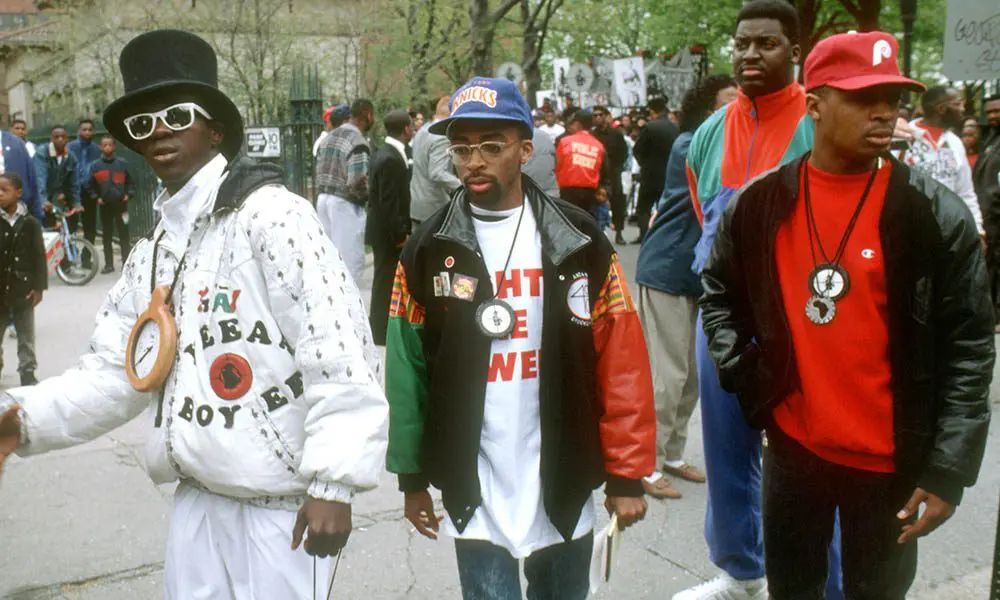
Flavor Flav, Spike Lee, and Chuck D on the Fight the Power video shoot in Bedford-Stuyvesant, April 1989.
They Made the FBI Write About Them
Public Enemy was so politically loaded that the federal government effectively put them in a file cabinet. Chuck D devoted a whole verse on Welcome to the Terrordome to the heat the group was attracting from Washington, and the FBI letter that hit N.W.A.’s label in 1989 was widely understood inside the industry as a shot across the entire conscious-rap bow — Public Enemy included. The S1W security unit that flanked the group on stage wasn’t decoration. They were a visible answer to a real fear.
The truth is, most rap groups before Public Enemy treated the police and the federal government as background noise. Chuck D treated them as a direct audience. That’s the difference between making protest music and making a target out of yourself, and Chuck did it on purpose.
Fight the Power Was Built for Spike Lee — and Almost Sank His Movie
Spike Lee called Chuck D in 1988 and asked for an anthem for Do the Right Thing. He wanted a song so confrontational that Radio Raheem could walk down a Bedford-Stuyvesant street carrying a boombox and the song itself would be a character. What Public Enemy turned in was so abrasive that Motown Records — at the time tied to the soundtrack — refused to release it.
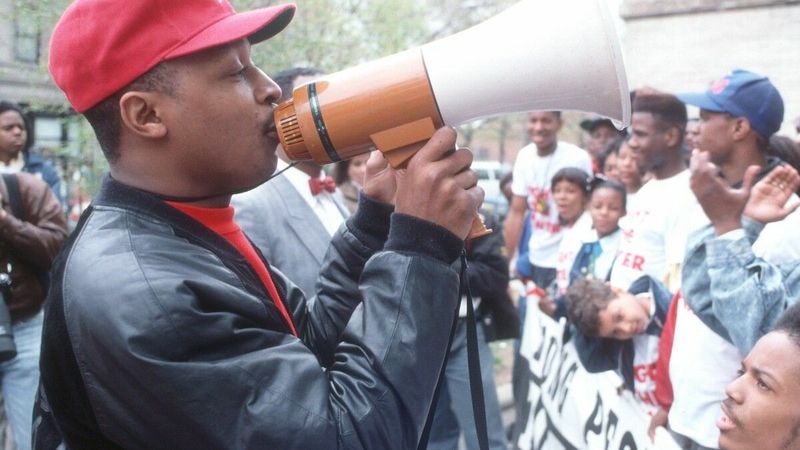
Chuck D leading the rally scene in the Fight the Power video, Brooklyn, April 22, 1989.
Spike directed the music video himself in Brooklyn on April 22, 1989, staging it as a political rally rather than a typical music-video performance. The song would go on to be voted the single of 1989 by The Village Voice’s Pazz & Jop poll, and it is now permanently embedded in the Smithsonian’s collection alongside Radio Raheem’s boombox prop. The Village Voice critics ranked it ahead of every other release that year for a reason — nothing else sounded like it.
Yo! Bum Rush the Show Was the Loudest Debut in Hip Hop
Released in February 1987, the band’s debut album was already heavier than anything Def Jam had put out. Rick Rubin executive produced it. The cover photography came from Glen E. Friedman, the photographer who built the visual identity of skate punk and Beastie Boys. None of this was accidental — Public Enemy was being positioned as the rap group that punk fans would actually respect.
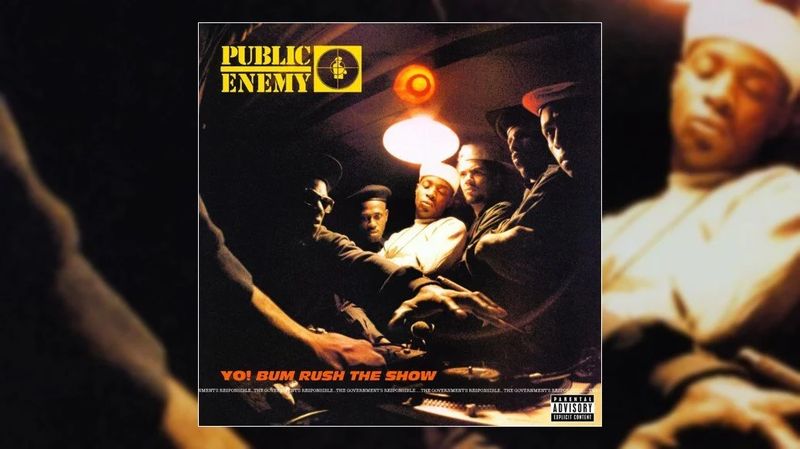
Yo! Bum Rush the Show, 1987 — Public Enemy’s debut on Def Jam.
It moved 275,000 copies inside a year, which made it one of the fastest-selling rap records on Def Jam to that point. The bigger story is the sound itself. Tracks like Public Enemy No. 1 and You’re Gonna Get Yours were already using the dense, sample-stacked production approach that would explode on the next record. The debut is the rough draft. The masterpiece was coming.
It Takes a Nation of Millions Is the Genre’s High Watermark
Released on June 28, 1988, It Takes a Nation of Millions to Hold Us Back is, depending on which critic you ask, either the greatest hip hop album of the 1980s or just the greatest hip hop album, full stop. The Rolling Stone 500 Greatest Albums list has it at number 15. Rebel Without a Pause, Don’t Believe the Hype, Black Steel in the Hour of Chaos, Bring the Noise, Night of the Living Baseheads — five all-time singles on one record. It’s a hit-rate that almost nobody, in any genre, has matched since.
The album cover — Chuck D and Flavor Flav photographed through the bars of a holding cell with the slogan Freedom Is A Road Seldom Traveled By The Multitude across the bottom — set a visual standard that hip hop covers spent the next 15 years chasing. Tipper Gore and the PMRC censorship apparatus were already in motion, and Public Enemy was the rap group most often used in those Congressional hearings as the example of why the warning label was supposedly necessary.
The Bomb Squad Invented the Wall of Noise
You cannot talk about Public Enemy without talking about Hank Shocklee, Keith Shocklee, Eric Sadler, and Chuck D himself — the in-house production team known as The Bomb Squad. Their approach in the late 80s was to layer dozens of samples on a single track, deliberately leaving the rough edges and pile-ups in. Where most producers were trying to make beats clean, The Bomb Squad was making them oppressive on purpose.
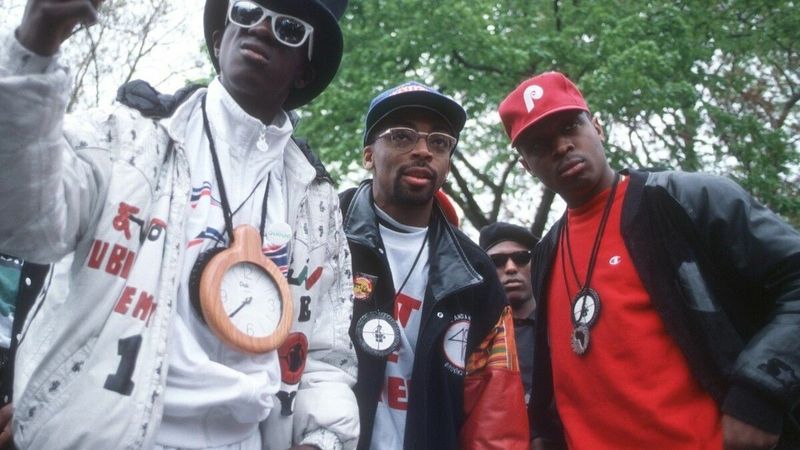
Flavor Flav, Spike Lee, and Chuck D — three of the most recognizable faces in 1989 hip hop.
That density became impossible to repeat after 1991. Once Grand Upright v. Warner Bros. made unlicensed sampling legally and financially dangerous, no producer could afford to stack 40 samples on a track again. It Takes a Nation of Millions and Fear of a Black Planet are therefore historical artifacts in the most literal sense — they’re albums that the legal system has since made impossible to remake.
Chuck D + Flavor Flav Was the Original Hero/Trickster Duo
Hip hop loves a contrast — straight man and clown, scholar and party animal, threat and comic relief. The template was set by Public Enemy. Chuck D rapped in a deep newscaster’s baritone about white supremacy, Black history, prison populations, and surveillance. Flavor Flav danced around him in oversized sunglasses with a clock the size of a hubcap around his neck, yelling yeah, boyee as a hype response.
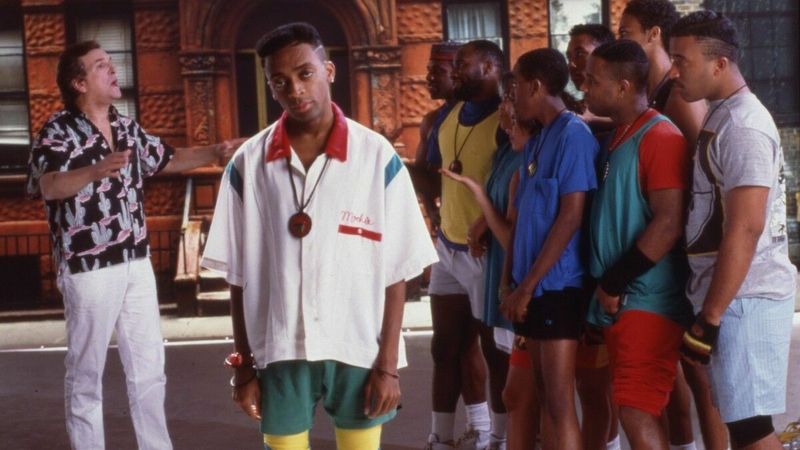
Spike Lee as Mookie in Do the Right Thing — the film built around Fight the Power.
The clock wasn’t a joke, or at least it wasn’t only a joke. Flav has said over the years that the clock was meant to remind people that time matters, that what time it is matters, that Black people in America are always running on borrowed time. Whether you take that seriously depends on the mood you’re in. What’s not debatable is that the Chuck/Flav dynamic was the blueprint everybody from Outkast to Run the Jewels has worked variations on since.
Bring the Noise with Anthrax Killed the Rap-Rock Border
In 1991, Anthrax guitarist Scott Ian asked Chuck D about doing a thrash-metal cover of Bring the Noise. Both groups were nervous — rap fans might call it a sellout, thrash fans might walk out. The compromise they landed on was a duet version with both groups performing it together. The collaboration shipped on Anthrax’s Attack of the Killer B’s later that year.
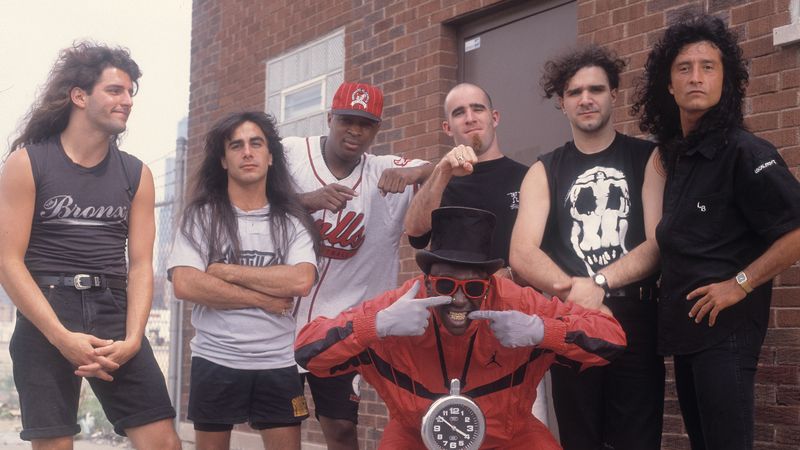
Anthrax and Public Enemy on the Bring the Noise photo shoot in 1991.
The video was filmed in Chicago in June 1991, and Anthrax + Public Enemy went on tour together with Primus and Young Black Teenagers in support — a lineup so weird on paper that it could only have happened in 1991. Without that tour, you don’t get Rage Against the Machine. You don’t get Limp Bizkit (sorry). You don’t get the entire late-90s nu-metal economy. Bring the Noise is one of the most consequential collaborations in popular music history, and almost nobody under 40 knows it happened.
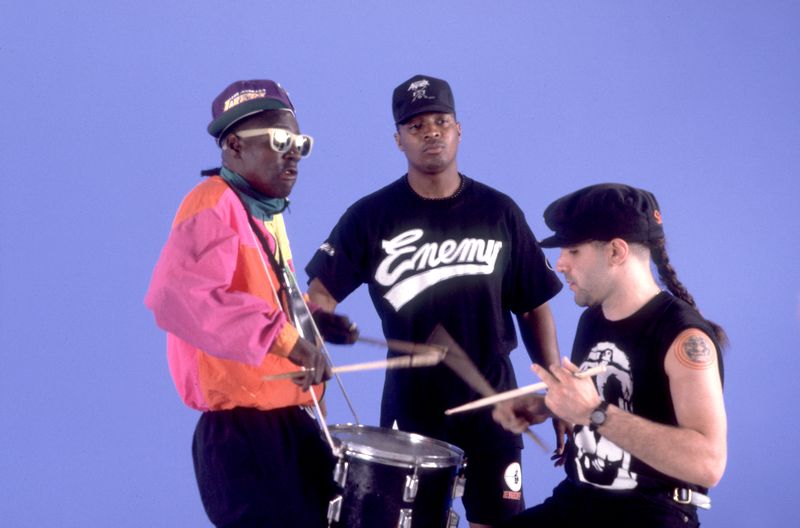
Flavor Flav, Chuck D, and Anthrax’s Scott Ian on the Bring the Noise sessions.
The Crosshairs Logo Said Everything in One Symbol
The Public Enemy logo — a B-boy silhouette in a Run-DMC-style hat, framed inside crosshairs — was designed by Chuck D himself with art director Eric “Vietnam” Sadler. Chuck has explained in multiple interviews that the silhouette is meant to represent the Black man in America standing inside a target. The hat is specifically a Run-DMC hat, not a state trooper hat, despite what a lot of people assumed at the time.
Chuck D inverted the meaning, too. The figure isn’t a victim cowering inside the scope. The figure is squared up, B-boy stance, looking back. That’s the entire group’s project in one image, which is part of why the logo is now in the National Museum of African American History and Culture’s permanent collection.
They Lapped the Field — and They’re Still Touring
Public Enemy was inducted into the Rock and Roll Hall of Fame on April 18, 2013, at the Nokia Theater in Los Angeles. They were the fourth rap act inducted, after Grandmaster Flash and the Furious Five, Run-DMC, and the Beastie Boys. Chuck D, Flavor Flav, Professor Griff, DJ Lord, and the S1W unit are all still doing dates as of 2026, more than 40 years after the group formed at Adelphi University.
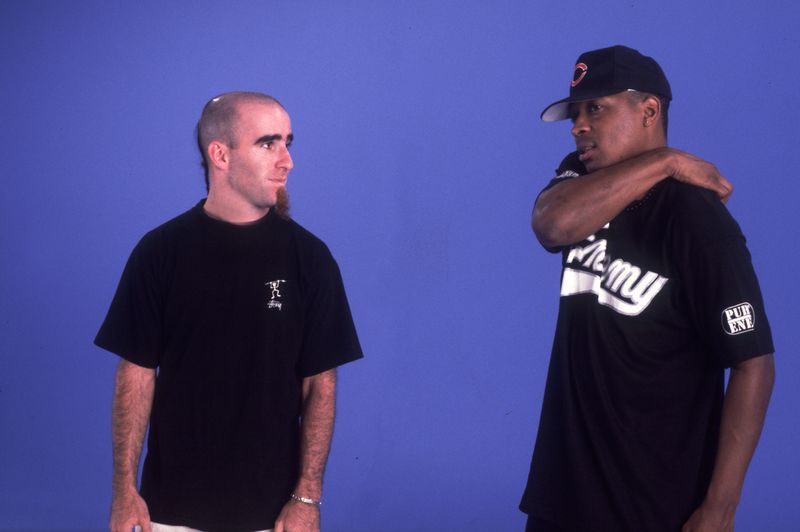
Chuck D and Anthrax’s Scott Ian — the duet that opened the door for everything that came after.
The bigger thing to watch is what happens after Chuck D stops touring. There’s no clean successor in current rap — no group has a Bomb Squad, no group has an S1W, no group has the willingness to make an album as confrontational as It Takes a Nation of Millions when the streaming algorithm rewards niceness instead. The most likely scenario is that the next generation rediscovers Public Enemy the same way every generation rediscovers Marvin Gaye’s What’s Going On — as a record that points to a road the industry decided not to take. Go listen to Black Steel in the Hour of Chaos with fresh ears and you’ll hear why that road still matters.
If this is where your hip hop history starts, dig further — the PMRC censorship war, the MC Hammer pop crossover, and Digital Underground’s Humpty Hump era all happened on the same timeline as Public Enemy’s peak, and they all rhyme with each other.
Sources
- Fight the Power (Public Enemy song) — Wikipedia — Song origin, Spike Lee commission, Pazz & Jop ranking.
- uDiscover Music — The Story Behind Public Enemy’s Fight the Power — Production notes and Motown release dispute.
- Okayplayer — How Fight the Power Saved Public Enemy and Almost Sank Do the Right Thing — Video shoot details and Bedford-Stuyvesant rally.
- It Takes a Nation of Millions to Hold Us Back — Wikipedia — Release date, Rick Rubin, single chart placements.
- Louder Sound — Anthrax and Public Enemy: the story of Bring the Noise — Collaboration genesis and 1991 tour history.
- Smithsonian NMAAHC — In the Crosshairs: Chuck D’s Logo for Public Enemy — Logo design history and museum acquisition.
- Rolling Stone — 2013 Rock and Roll Hall of Fame Inductees — Public Enemy’s 2013 induction details.
Browse retro and vintage-inspired apparel at the RetroRadical shop →
The Retro Almanac
A monthly roundup of "on this day" highlights from that month, decades back — plus first dibs on new retro merch drops. No spam, just the good stuff.