On This Day: September 12, 1992 — Mae Jemison Broke the Sky
The launch happened at 10:23 a.m. EDT from Launch Pad 39-B at Kennedy Space Center. Six other astronauts were on board. Endeavour was making NASA’s 50th shuttle flight. None of that, in the moment, mattered as much as the sight of Jemison’s name on the crew manifest — a physician, former Peace Corps doctor, chemical engineer, and lifelong Star Trek fan, about to do the thing she’d told people she would do since she was a child in Chicago’s South Side.
Mae Jemison Before the Shuttle
She was born in Decatur, Alabama in 1956 and raised in Chicago, where her family moved when she was three. The city suited her. By the time she was in elementary school she was reading every book the Chicago Public Library had on astronomy. Her teachers told her to set more realistic goals. She ignored them.
Stanford at 16, studying chemical engineering. Cornell Medical School. A residency. Then three years in West Africa — Sierra Leone and Liberia — as a Peace Corps physician, running health programs with limited supplies and no backup system to call. She came back to the United States in 1985, applied to NASA’s astronaut program, and got rejected. The program was shut down after the Challenger disaster. She applied again in 1987. This time, 2,000 people competed for 15 slots. Jemison got one.
The Retro Almanac
A monthly roundup of "on this day" highlights from that month, decades back — plus first dibs on new retro merch drops. No spam, just the good stuff.
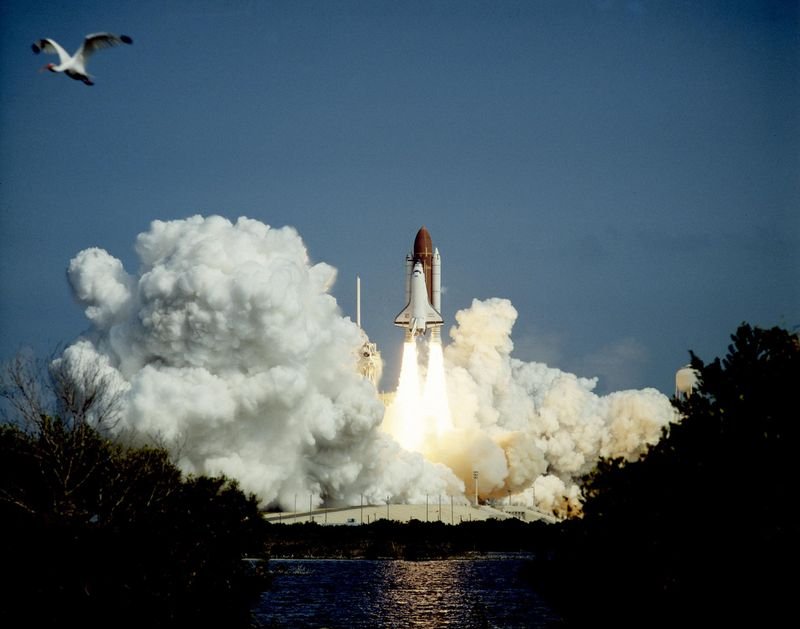
Endeavour leaves the pad at 10:23 AM EDT on September 12, 1992. NASA’s 50th shuttle mission.
NASA Wasn’t Looking for Her — She Made Them Look
Jemison’s selection in 1987 came as part of an astronaut class that was, by the standards of the time, unusually diverse. But diverse on paper and diverse in practice are different things. She trained for five years before getting a flight assignment. Five years is a long time to be an astronaut who hasn’t gone to space, maintaining focus while the roster above you rotates through missions and the program keeps suffering setbacks.
She didn’t wait around. Between training cycles, she taught environmental studies at Dartmouth. She kept practicing medicine. When STS-47 came together as a joint mission between NASA and the Japan Aerospace Exploration Agency — a Spacelab-J flight carrying 44 experiments across life sciences and materials processing — Jemison was assigned as science mission specialist. She was responsible for running the on-orbit experiments. The job fit her exactly.
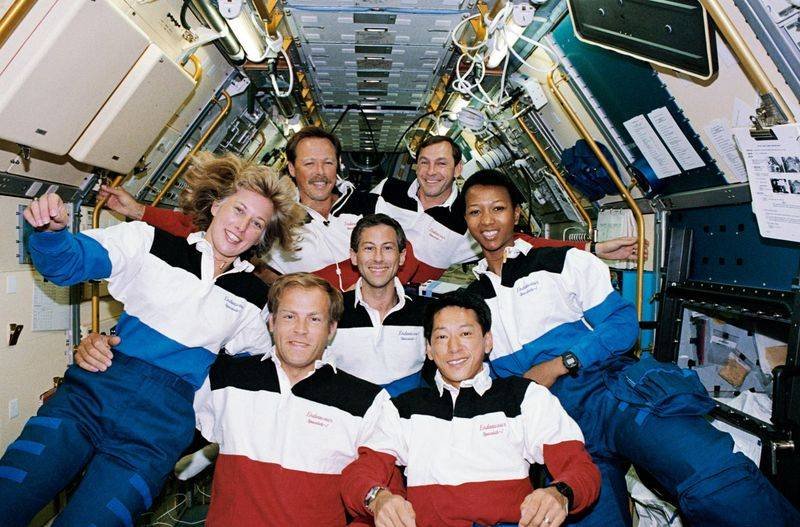
The STS-47 crew in the Spacelab-J science module. The mission was a joint NASA-JAXA flight, NASA’s 50th shuttle mission.
STS-47: One Mission, Three Historic Firsts
Jemison’s presence alone made STS-47 historic. But the mission stacked up records in ways the press coverage at the time couldn’t fully keep track of.
Mamoru Mohri, a Japanese payload specialist, became the first citizen of Japan to fly on an American spacecraft. Mark C. Lee and N. Jan Davis, both NASA mission specialists who had married between their assignment to the crew and the launch date, became the first married couple to fly together in space — a situation that created a genuine policy headache for NASA, which had never addressed the possibility. The agency decided to let it stand.
Three firsts on one eight-day mission. That kind of density doesn’t happen by accident; it reflects how long the program had been waiting for exactly these people to be ready.
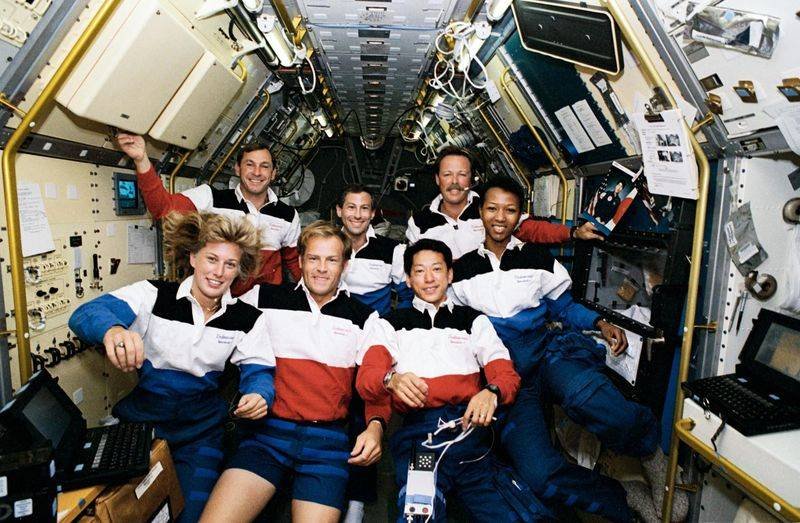
Official in-flight portrait: the seven-member STS-47 crew, photographed in the Spacelab-J module during the mission.
What She Actually Did Up There
Jemison ran experiments she had helped design. The Spacelab-J payload included 24 materials science experiments and 20 life sciences investigations — studies of bone loss, fluid movement in the body under zero gravity, motion sickness, and the behavior of cells without Earth’s constant pull. She was also, by necessity, a test subject. She took part in the motion sickness research herself, the same work she was running on her crewmates.
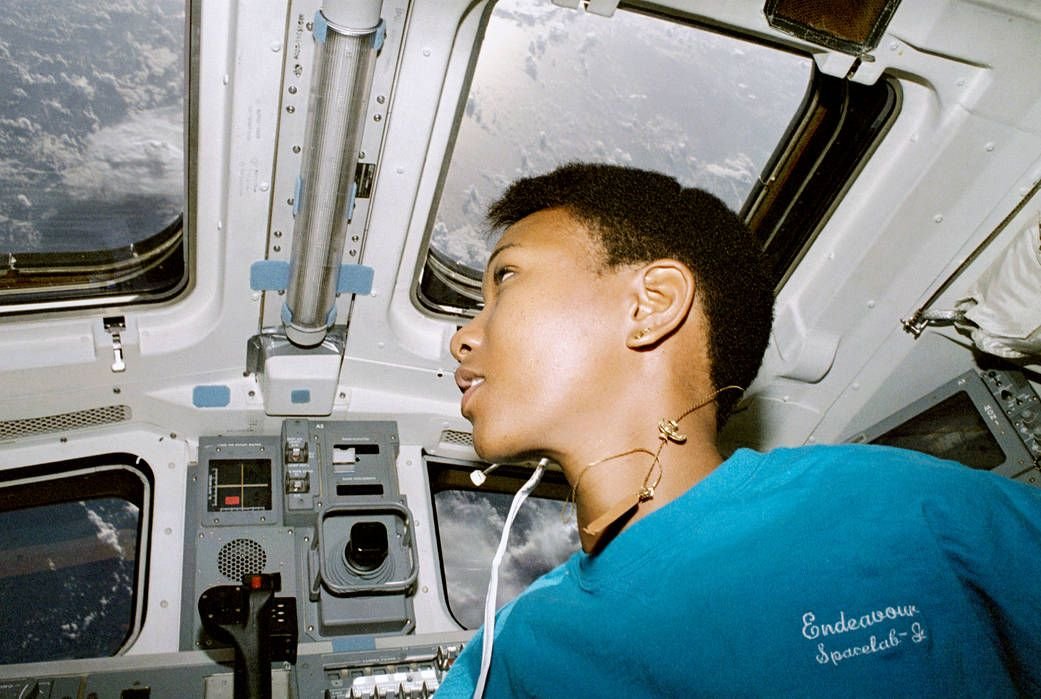
Endeavour circled Earth 127 times over eight days. The crew worked in rotating shifts to keep the experiments going continuously, logging data around the clock. When Jemison floated in the hatch and looked out the window over Africa, she later said it felt like coming home. She had spent three years working there. Seeing the continent from orbit — that particular view from that particular angle — wasn’t something she had planned for emotionally. It caught her off guard.
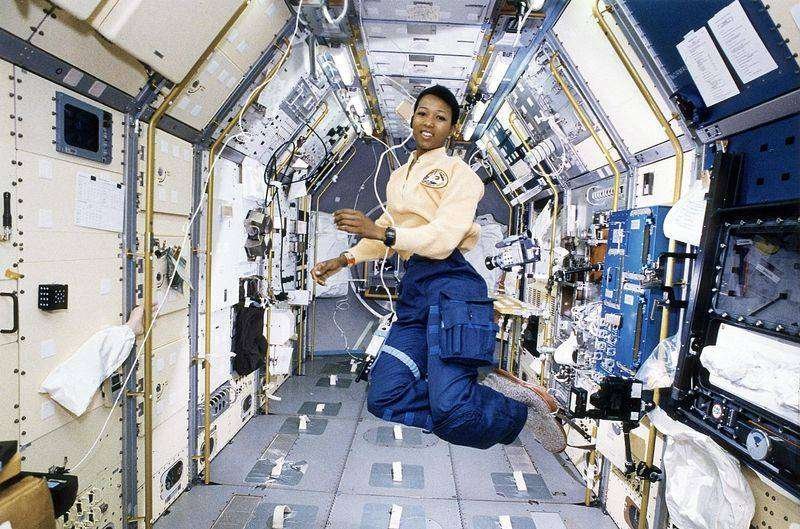
Jemison conducting experiment procedures in the Spacelab-J module. She was responsible for 44 on-orbit science investigations.
The Star Trek Connection
This is the part the internet always gets excited about, and it deserves the attention. Mae Jemison had been a Star Trek fan since childhood. Specifically, Nichelle Nichols — Lieutenant Uhura, the Black woman at the communications station on the bridge of the Enterprise — had made an impression on a kid growing up in 1960s Chicago who was told, regularly, that space wasn’t for people like her.
Uhura was there every week saying otherwise.
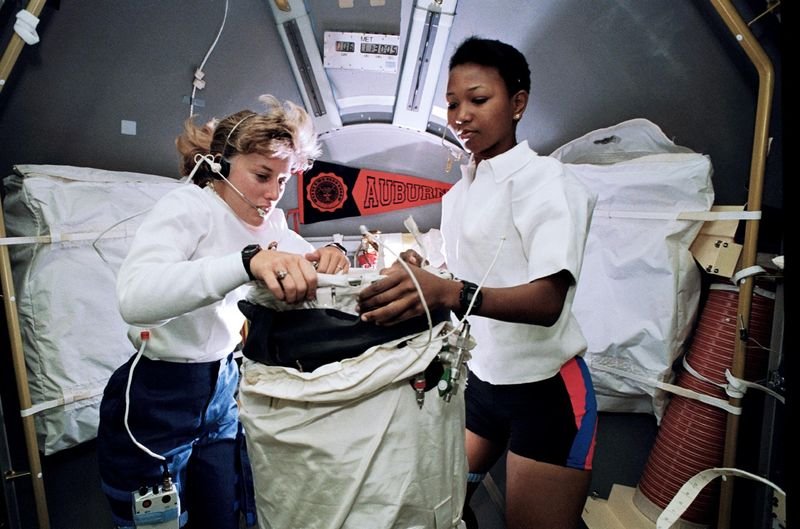
Mission specialists Jan Davis (left) and Mae Jemison aboard Endeavour. Davis and crewmate Mark Lee made history as the first married couple in space.
Jemison carried that with her into orbit. She made a point, on the mission, of beginning each shift with the words “Hailing frequencies open” — Uhura’s line from the original series. It was a private acknowledgment of where the inspiration had come from. The people who knew, knew.
A year later, Jemison appeared on Star Trek: The Next Generation as Ensign Palmer in the episode “Second Chances,” making her the first real astronaut to guest star in a Star Trek series. LeVar Burton — who played Geordi La Forge and directed the episode — had extended the invitation personally. Nichelle Nichols came to the set to visit during filming. The circle closed.
Love the retro era? Browse our shop for vintage finds, retro clothing, and 80s/90s nostalgia gear.
What September 12, 1992 Left Behind
The Endeavour landed on September 20 at Kennedy Space Center. Jemison had spent 190 hours, 30 minutes, and 23 seconds in space. She left NASA in March 1993 to start The Jemison Group, a technology company focused on bringing science and medicine to the developing world — the same work she’d done in West Africa, at a different scale.
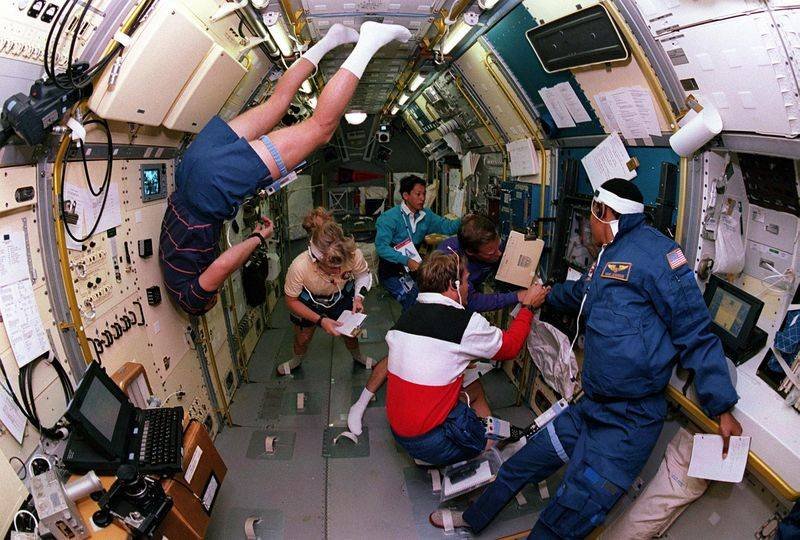
Crew members at work in the Spacelab-J module. The mission ran 44 science experiments across eight days in orbit.
1992 was a dense year for history. Hurricane Andrew had leveled South Florida just three weeks earlier. The political calendar was grinding toward a presidential election. But September 12 landed differently — it was the kind of news story that made people stop what they were doing and pay attention in a way that felt more personal than a hurricane track. It was a face they could put a name to, doing something that looked impossible, live on television.
For a generation raised on the Space Race mythology of the 1960s, the shuttle program had become ordinary. Launches happened; people tuned in, or they didn’t. STS-47 made people tune in. The morning of the launch, there were watch parties at schools across the country. Teachers wheeled television carts into classrooms. The footage of Jemison floating weightless in the Spacelab module, conducting experiments she’d helped design, was replayed on the evening news for days.
The trailblazers of that era rarely got the credit they deserved in the moment — the same way Oprah’s national debut in 1986 was treated as a curiosity before anyone understood what it meant. Mae Jemison didn’t wait for the industry to catch up. She made the call, logged the hours, ran the experiments, and came home. The record was set. History moved on. The record stayed.
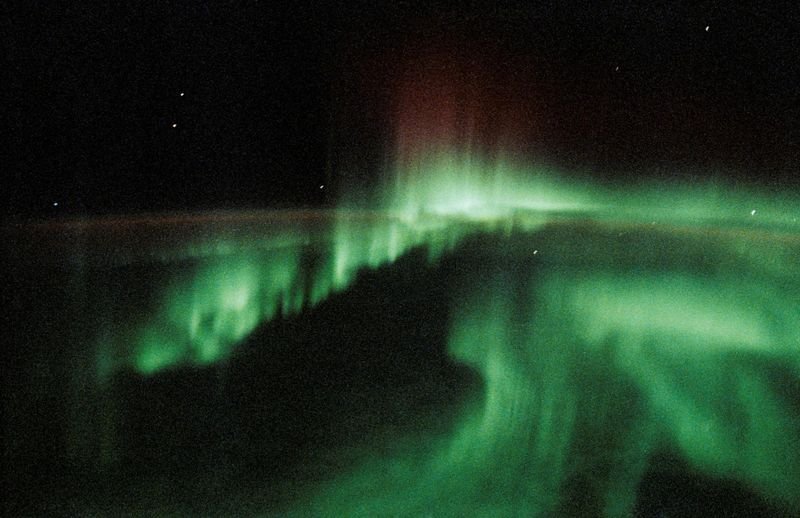
Aurora Australis photographed from Endeavour during STS-47. The shuttle orbited Earth 127 times over eight days.
She went on to launch the 100 Year Starship project — a DARPA-funded initiative to develop the technology needed for human interstellar travel within a century. She teaches. She lectures. She makes the same point she made when she was eight years old reading library books about astronomy: the universe is not a place that keeps people out based on who they are. The barriers are terrestrial. They come down one mission at a time.
September 12, 1992, was one of those times. It remains one of those times. The greatest achievements of the late ’80s and early ’90s have their own nostalgia — but what Mae Jemison did that morning at Cape Canaveral wasn’t athletics or entertainment. It was the kind of thing that rewrites what a kid thinks is possible.
Sources
- Mae Jemison becomes first Black woman in space | HISTORY — Summary of the September 12, 1992 STS-47 launch and mission details.
- She Had a Dream: Mae C. Jemison | Smithsonian National Air and Space Museum — In-depth profile of Jemison’s background and NASA career.
- Mae Jemison, First African American Woman in Space | NASA — Official NASA biography and mission photography archive.
- STS-47 Fact Sheet | Spaceline — Technical mission data including crew, duration, and experiment manifest.
- Catching Up With Dr. Mae Jemison | StarTrek.com — Jemison discusses the influence of Star Trek and her TNG guest appearance.
The Retro Almanac
A monthly roundup of "on this day" highlights from that month, decades back — plus first dibs on new retro merch drops. No spam, just the good stuff.