On This Day: September 17, 1988 — Seoul Opened the Olympics and Nothing Went According to Plan
Seventy thousand people packed Seoul Olympic Stadium that September afternoon. One of them was a 76-year-old named Sohn Kee-chung, who walked in carrying the Olympic torch and wept openly — and the crowd wept with him. He had earned this moment over 52 years, and so had the country watching him.
What followed over the next 16 days became the most dramatic, scandalous, and impossible-to-script Olympics of the 20th century.

The Retro Almanac
A monthly roundup of "on this day" highlights from that month, decades back — plus first dibs on new retro merch drops. No spam, just the good stuff.
The Nation That Built Itself to Be Here
In 1953, the Korean War ended and left South Korea as one of the poorest countries on earth — per capita income hovered around $100 USD. Thirty-five years later, the country’s GDP had grown to $340 billion, the result of industrialization so fast and so sustained that economists gave it a nickname: the “Miracle on the Han River.”
Seoul had won the right to host in 1981, beating heavily-favored Nagoya, Japan by a vote of 52 to 27. That win immediately created pressure on the military government — you cannot invite the entire world into your country while conducting visible crackdowns on your own citizens. Mass pro-democracy demonstrations in June 1987 forced reforms the government could no longer avoid. By December 1987, South Koreans had voted in their first free direct presidential election in decades. The man who declared the Games open in September 1988 — President Roh Tae-woo — had been elected by his own people just nine months earlier.
The Olympics did not just take place in South Korea. In ways still underappreciated, they helped create modern South Korea.
The Ceremony Sohn Kee-chung Deserved
The opening ceremony’s most unforgettable moment had nothing to do with fireworks or choreography. It came when Sohn Kee-chung entered the stadium with the torch.
In 1936, Sohn had won the Olympic marathon in Berlin. He ran it under the Japanese name “Kitei Son” — because Korea was under colonial rule, Koreans competed for Japan or not at all. When he stood on the victory podium, a Japanese flag was raised in his honor. A Korean newspaper that printed a photo of him with the flag digitally removed had its editors arrested and jailed. Sohn stood on that podium with his head bowed.
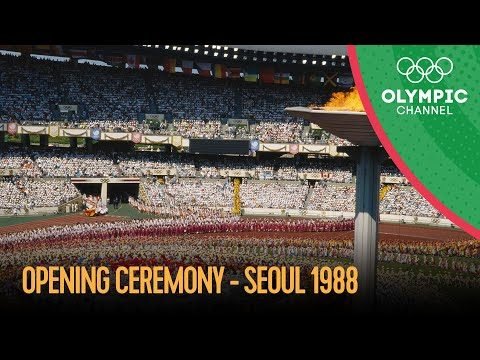
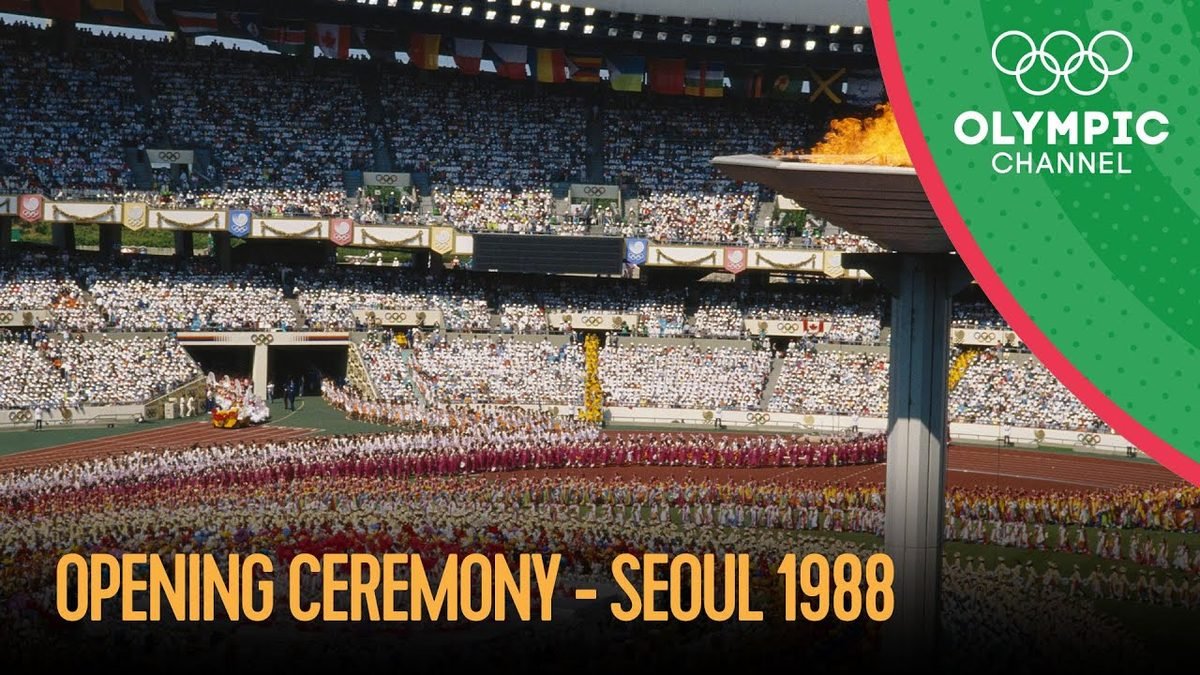
Fifty-two years later, he walked into a free Korea’s Olympic stadium. Seventy thousand people stood. He passed the flame to three final torchbearers who lit the cauldron together. Adults in the crowd were crying out loud.
Then, in what should have been a moment of pure joy, a tradition 68 years old ended in disaster. The ceremonial dove release — unbroken since the 1920 Antwerp Games — went wrong when the birds flew erratically into the stadium, refused to leave, and several landed directly on the rim of the cauldron just before the flame was lit. Camera operators reportedly panned away. The IOC quietly decided that no subsequent Summer Olympics would use live doves. They never have.
The Last Cold War Olympics
These were the first Summer Games since Munich 1972 where the United States, Soviet Union, East Germany, and West Germany all competed together. The 1980 Moscow Games had been boycotted by the US and approximately 65 allied nations over the Soviet invasion of Afghanistan. The 1984 Los Angeles Games saw a Soviet-led Eastern Bloc boycott in retaliation. For eight years, the world’s greatest athletes had been paying the price for decisions made in Moscow and Washington.
Seoul ended all of it. 160 national Olympic committees marched in the opening parade. 159 nations competed — the largest participation in Olympic history at the time. North Korea had pushed for years to co-host, demanding equal billing and half the events held in Pyongyang. The IOC offered what it could; North Korea rejected every compromise and announced its boycott in January 1988. North Korean agents had bombed Korean Air Flight 858 in November 1987, killing 104 people in a deliberate attempt to destabilize the Games. Only six other nations joined the boycott.
What no one watching the opening ceremony on September 17 could fully know: these were the last Summer Olympics of the Cold War. Four years later at Barcelona 1992, the Soviet Union and East Germany would no longer exist. Every athlete competing under those flags in Seoul was part of a final chapter — and nobody in the stadium knew they were watching it end.
Nine Seconds That Broke Everything
One week after the opening ceremony, Ben Johnson of Canada stepped to the line for the Olympic 100m final. He exploded off the blocks, crossed in 9.79 seconds — a world record — and pointed his finger skyward. Carl Lewis stood in lane six, second across the line at 9.92. It looked like the greatest sprint ever run.
Forty-one hours later, at 1:45 in the morning on September 26, IOC medical commission head Prince Alexandre de Merode sent a hand-delivered letter to the Canadian chef de mission: Johnson had tested positive for stanozolol, an anabolic steroid. He was summoned. His reported reaction: “There has to be some mistake.”
By September 27, the gold medal was gone. The world record was expunged. Johnson was expelled from the Games. At a full Canadian government inquiry — the Dubin Commission — he admitted under oath he had been using steroids since 1981. Six of the eight finalists in that race would eventually be linked to doping. The BBC documented it as “the dirtiest race in history.” The label has never been disputed.
Carl Lewis received the gold by elevation. He also won a second straight long jump gold and a silver in the 200m — the biggest medal haul of his career, and the most complicated, given his own positive test at the US Trials months earlier had been cleared on a disputed exemption.
The Records That Refused to Fall
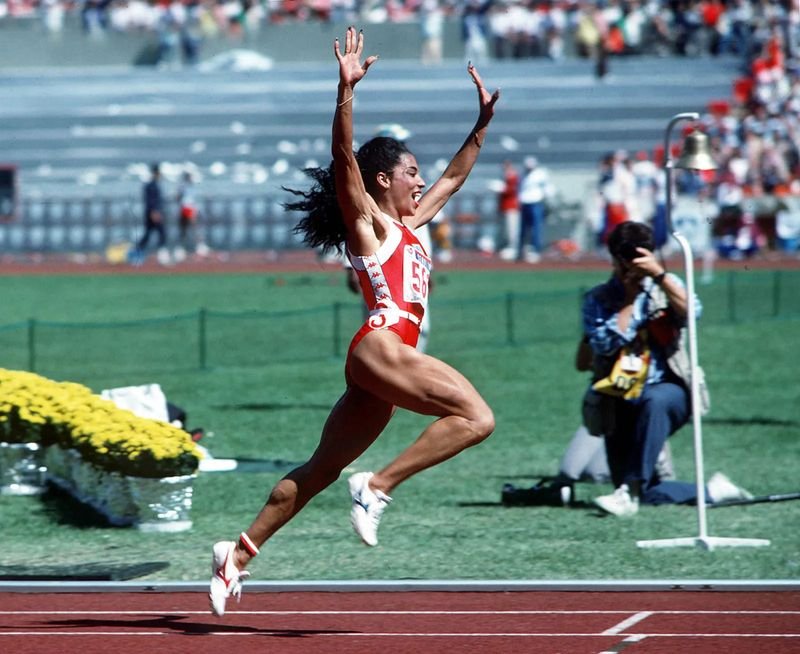
Florence Griffith Joyner ran 100 meters in 10.49 seconds at the US Olympic Trials on July 16, 1988. That record, as of 2026, still stands — the longest-lasting active track world record in existence. No woman has gone faster in the 38 years since.
She arrived in Seoul with one-legged running unitards and six-inch elaborately painted fingernails, looking as one writer put it, like she’d been told the Olympics were also a fashion show and decided to win that too. In the 100m final she won gold. In the 200m she ran 21.34 seconds — another world record that also still stands. She added a third gold in the 4x100m relay, a silver in the 4x400m relay, then retired almost immediately after Seoul.
The timing of that retirement is part of why those records have lasted so long. She was never tested at full speed in competition again. What she left on the track at the 1988 Seoul Olympics has never been touched.
Bleeding Into the Pool and Winning Anyway
Two days after the Games opened, Greg Louganis stood on the 3-meter springboard for a preliminary round. He went into a reverse 2.5 somersault pike — a dive requiring him to spin backward, toward the board. He came too close. The back of his head struck the springboard. The sound carried through the arena. He bled into the pool.
The team physician who stitched the wound worked without gloves. He had no idea Louganis had been diagnosed HIV-positive approximately six months earlier and was already taking AZT. No one on the team knew. Other divers subsequently entered the pool.
Louganis finished the preliminary round in third place. The next day, he returned and won gold on the 3m springboard — the first man to win back-to-back Olympic springboard golds. Then he won gold on the 10m platform. Two golds, one Games, after bleeding into the pool while carrying a secret that could have ended his career.
In his 1995 memoir Breaking the Surface, Louganis revealed his HIV status publicly for the first time and called Dr. Puffer personally to tell him. The doctor tested negative. CDC later confirmed the risk to other athletes had been negligible — blood is heavily diluted in pool water, and chlorine inactivates HIV. The courage required to come back and win twice with fresh stitches and a concussion: that part doesn’t change regardless of the science.
The Gold Medal That Was Handed Back
Roy Jones Jr. of the United States fought the light-middleweight boxing final and landed 86 punches. His South Korean opponent, Park Si-hun, landed 32. Three judges scored it for the South Korean, 3-2. All three were eventually suspended; two were banned from refereeing for life. The IOC’s response was to give Jones the Val Barker Trophy — awarded to the tournament’s best technical boxer — a wordless acknowledgment that something had gone badly wrong.
Decades later, Park Si-hun made the trip to Jones’s ranch in Pensacola, Florida. He gave him his gold medal in person. Roy Jones Jr. keeps it.
Also at those Games: Steffi Graf closed out the greatest single season in tennis history by winning Olympic gold on October 1 — the final piece of her Calendar Golden Slam, all four Grand Slams plus the Olympics in a single year. Tennis had only just returned to the Olympics in Seoul after a 64-year absence. No player has come close to matching it since. Her French Open final that year lasted 32 minutes and remains the shortest Grand Slam final ever played.
What the Flame Left Behind
The 1988 Seoul Olympics were supposed to be the Games where the world came back together after a decade of boycotts. They were that — 160 nations, two superpowers, the first full gathering since Munich. They also ended up as something stranger and more human than a diplomatic gesture.
Ben Johnson ran the fastest 100 meters ever recorded, then got caught. Flo-Jo ran times that 38 years of global competition have not touched. Greg Louganis won two golds after bleeding into the pool. Roy Jones Jr. lost a fight he dominated. Steffi Graf did something no one has replicated. And a 76-year-old man walked into a stadium carrying a torch under his own country’s flag for the first time in his life, in front of 70,000 people who knew exactly what it meant.
That was September 17, 1988. For the broader story of how the Soviet order that competed in Seoul collapsed just three years later, our piece on the 1991 Soviet coup attempt covers the moment it all fell apart.
Love the retro era? Browse our shop for vintage finds, retro clothing, and 80s/90s nostalgia gear.
Sources
- International Olympic Committee — Seoul 1988 Official Games Overview — Complete Games history including participant nations, opening ceremony, and results.
- BBC Sport — “The Dirtiest Race in History” — Ben Johnson, the 100m final, and the Dubin Commission findings.
- World Athletics — Women’s 100m World Record — Confirmation of Florence Griffith Joyner’s 10.49 record, set July 16, 1988.
- CNN Sport — Roy Jones Jr. and the Seoul Boxing Robbery — Account of the controversial light-middleweight final.
- Olympic.org — Florence Griffith Joyner Profile — Career statistics, Seoul medal haul, and world records.
- Sports Illustrated — 1988 Seoul Olympics Archive — Contemporary photography from the Games.
The Retro Almanac
A monthly roundup of "on this day" highlights from that month, decades back — plus first dibs on new retro merch drops. No spam, just the good stuff.