On This Day: October 14, 1987 — Baby Jessica Falls Into a Well
Jessica McClure had just turned eighteen months old when she climbed through a gap no wider than a dinner plate and dropped twenty-two feet into solid Texas rock. The well had been drilled for water, capped, and mostly forgotten — the kind of thing that sits in a backyard for years until it isn’t harmless anymore. Her mother ran a small home daycare out of the house. Jessica was playing with four other children when she vanished into the ground in the span of a few seconds.

A Backyard Well Nobody Thought Twice About
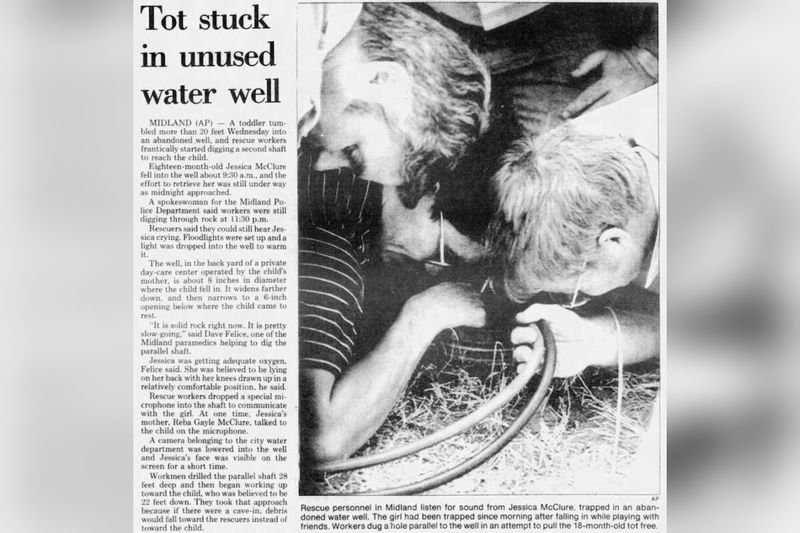
The well sat behind her aunt’s house, where Jessica’s mother, Reba Gayle McClure, ran a small home daycare. It was an abandoned water well, eight inches wide at the opening, that widened a few feet down and then narrowed again to six inches right where Jessica came to rest — just big enough to swallow a toddler, too narrow for an adult to follow in after her. She fell in around 9:30 that Wednesday morning while playing in the yard with the other children her mother was watching that day.
The Retro Almanac
A monthly roundup of "on this day" highlights from that month, decades back — plus first dibs on new retro merch drops. No spam, just the good stuff.
Within the hour, Midland police and fire crews were on scene with a microphone lowered into the shaft so they could track whether she was still conscious. She was. She cried, she sang fragments of “Winnie the Pooh,” and at one point rescuers lowered a camera that caught a few seconds of her face on a monitor above ground. That contact — hearing her voice, seeing her move — is what turned a plumbing emergency into a national vigil. Crews believed she was wedged on her back with her knees drawn up, roughly twenty-two feet down, in a pocket of the casing too narrow for an adult to reach.
58 Hours of Drilling Through Rock
The standard playbook for a well rescue — lower a harness, pull the child up — didn’t work here. The casing narrowed below where Jessica had come to rest, and nobody could get a rope past her shoulders. Midland’s fire department, city water department crews, and local oil drillers settled on a harder plan: sink a second shaft parallel to the well, then cut a horizontal tunnel sideways to reach her.
The ground fought them the entire way. Standard jackhammers are built to punch downward, not sideways, and the rock around the well casing turned out to be close to solid. “It is solid rock right now. It is pretty slow-going,” Midland paramedic Dave Felice told reporters as crews worked past midnight on the first night.1 A mining engineer was brought in to help direct the dig, and crews eventually switched to waterjet cutting equipment designed to slice through rock rather than hammer it. Forty-five hours in, they finally broke through the adjacent shaft and started the cross-tunnel toward Jessica.
The tunnel was too tight for most adults. Midland roofing contractor Ron Short, who was born without collarbones and could collapse his shoulders to a degree most people can’t, was on standby to go in if the professional rescuers couldn’t fit — he wasn’t ultimately needed, but his willingness says something about how small a town mobilizes when one of its kids is trapped. Paramedics Robert O’Donnell and Steve Forbes were the ones who finally reached her, coated her in petroleum jelly to slide her free of the narrow casing, and passed her hand to hand up the shaft. Around 8 p.m. on October 16, roughly 58 hours after she fell, Jessica McClure came out of the ground alive.
The Photograph That Won a Pulitzer
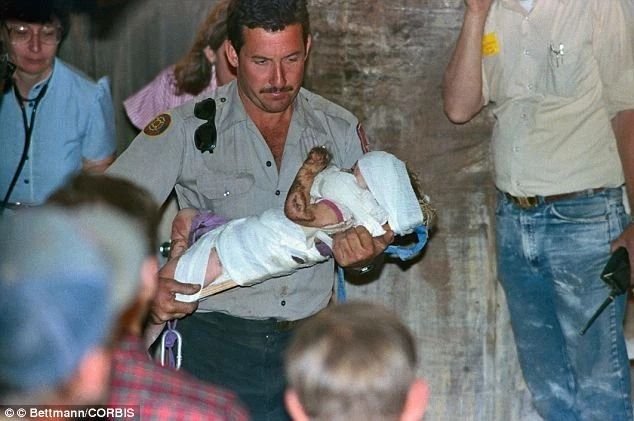
Scott Shaw was 24 years old, about a year and a half into his job at the Odessa American, when he shot the frame that the rest of the country would remember this story by: paramedic Steve Forbes carrying Jessica, her head wrapped in gauze, her small arm streaked with dirt and dried blood, through a crowd of exhausted rescue workers. Shaw won the 1988 Pulitzer Prize for Spot News Photography for it — the Pulitzer board’s citation simply credited him “for his photograph of the child Jessica McClure being rescued from the well into which she had fallen.”2 A small-town photographer on a routine assignment ended up with the defining image of a decade’s biggest live news story, which tells you something about how little newsrooms actually control these moments.

A Nation Stopped to Watch
By the second day, ABC, CBS, and NBC were all interrupting primetime programming for live updates from a backyard in West Texas. ABC cut into “I Married Dora” with Ted Koppel anchoring; CBS broke away from “Beauty and the Beast” with Dan Rather on air; NBC pulled out of “Rags to Riches” with Connie Chung reporting. CNN, still a niche cable upstart at the time, ran the rescue essentially wall to wall and came out of the weekend looking like a network that mattered. President Reagan later said that “everybody in America became godmothers and godfathers of Jessica while this was going on” — a line that undersells just how total the coverage was. At a University of Minnesota football game that Friday night, the stadium Jumbotron cut away from the game to announce Jessica was out, and the crowd cheered louder than it had for anything on the field.
Watch the footage now and it’s obvious this was a dry run for the kind of rolling, single-story news coverage that would define the next decade — the O.J. Simpson Bronco chase, the Chilean miners in 2010, every missing-child story that followed. Baby Jessica wasn’t the first live-TV crisis, but she’s the one that proved a local human-interest story could hold the entire country’s attention for two and a half straight days if the stakes were simple enough to understand: a baby, a hole in the ground, a clock running.
What the Well Cost Her
Jessica came out with a cut on her forehead, bruising, and circulation damage to her right foot after more than two days without being able to shift position. Doctors initially worried the foot would need to be amputated; hyperbaric oxygen treatment saved most of it, but gangrene had already set into one toe and it was removed. She carried a visible scar on her forehead into adulthood from where her head had rubbed against the well casing, and she underwent roughly fifteen additional surgeries over the following years to manage the scarring and reconstruct tissue. She has said in interviews that she has no first-hand memory of any of it — she was simply too young.


Donations poured in from strangers across the country almost immediately — spare change, savings bonds, handwritten letters — and were placed into a trust that Jessica couldn’t touch until she turned 25. The well itself was permanently sealed with a steel cap, hand-welded with a simple inscription: “FOR JESSICA 10-16-87 WITH LOVE FROM ALL OF US.”
The Rescuer Who Couldn’t Be Saved
Not everyone in this story got a happy ending. Robert O’Donnell, the paramedic who squeezed through the final stretch of tunnel and physically carried Jessica out, became a minor celebrity in Midland overnight — local parades, TV interviews, a standing invitation to speak about the rescue for years afterward. Friends and family later said he never adjusted to it. He struggled with depression and what would now likely be diagnosed as PTSD, lost his paramedic job, and became increasingly isolated as the fame faded and the attention moved on to the next story. On April 27, 1995, nearly eight years after the rescue, O’Donnell died by suicide on his parents’ ranch outside Stanton, Texas.3 It’s a hard detail to leave out of this story, because it says something true about what it costs to be handed instant, unasked-for fame for doing your job well on the worst day of someone else’s life.
Where Baby Jessica Is Now
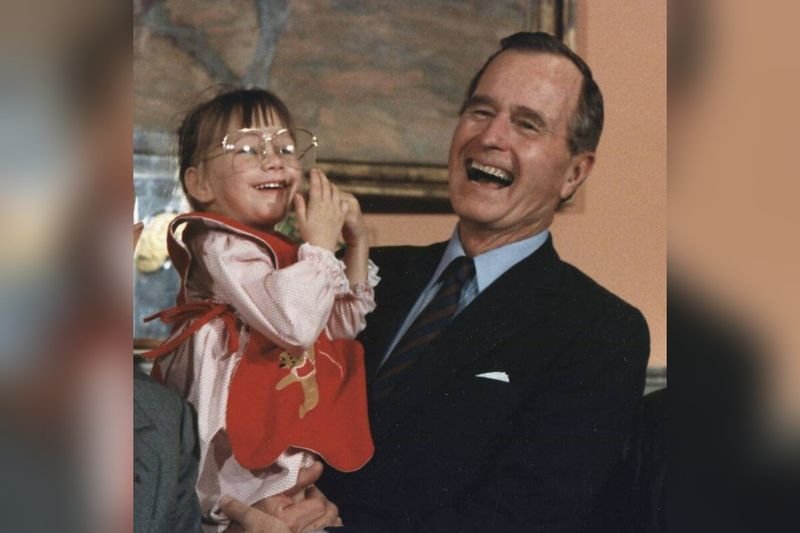
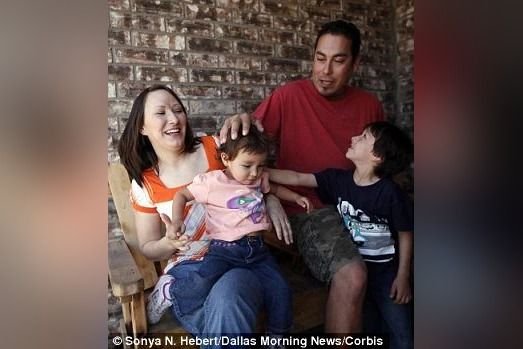
Jessica McClure Morales grew up mostly out of the spotlight in Midland, graduated from Greenwood High School in 2004, and met her husband Daniel Morales while working at a daycare center — the same kind of place her mother had once run out of their home. They married in 2006 and have two children. She gained access to her trust fund, worth roughly $1.2 million by then, on her 25th birthday in March 2011, though she’s said publicly that a chunk of it was lost to the 2008 financial crisis before she ever got to use it. In 1989, two years after the rescue, she met President George H.W. Bush at the White House, laughing and reaching for his face in a photo that’s almost the exact opposite mood of the one that made her famous.
ABC turned the story into a TV movie, “Everybody’s Baby: The Rescue of Jessica McClure,” in 1989, with Beau Bridges and Patty Duke. USA Today later ranked her among its “25 lives of indelible impact.” But the version of this story that sticks isn’t the trust fund or the TV movie — it’s 58 hours of strangers refusing to give up on a toddler they’d never met, broadcast into living rooms across a country that, for two and a half days in October 1987, couldn’t look away from one small Texas backyard.
Sources
- Rescue of Jessica McClure — Wikipedia — full incident timeline, rescue operation details, and aftermath.
- Baby Jessica Rescued From a Well as the World Watches — History.com — network television coverage details.
- UPI Archives, October 16, 1987 — contemporaneous wire reporting from the rescue itself.
- 1988 Pulitzer Prize winners — Wikipedia — Scott Shaw’s Spot News Photography award citation.
Love the retro era? Browse our shop for vintage finds, retro clothing, and 80s/90s nostalgia gear.
More from our On This Day series: Kathryn Sullivan becomes the first American woman to walk in space, Hollywood loses Orson Welles and Yul Brynner on the same day, and John Denver dies in a plane crash.
The Retro Almanac
A monthly roundup of "on this day" highlights from that month, decades back — plus first dibs on new retro merch drops. No spam, just the good stuff.