On This Day: October 11, 1984 — Kathryn Sullivan Becomes the First American Woman to Walk in Space
Six days into an eight-day flight, two astronauts in bulky white suits floated to the back of Challenger’s cargo bay with a job to do that had nothing to do with making history. Sullivan and Leestma were there to prove that a robot arm and two sets of human hands could refuel a satellite in orbit — a question NASA and the Department of Defense both wanted answered. The fact that Sullivan became the first American woman to do an EVA that day was, in a strange way, almost a footnote to the actual assignment.

A Crew That Was Already Rewriting the Record Book
Challenger left Kennedy Space Center on October 5, 1984, carrying seven astronauts — the largest crew NASA had ever flown. Sally Ride, who’d become the first American woman in space in June 1983, was back for her second flight. Sullivan was flying her first. Marc Garneau was aboard as the first Canadian ever to leave Earth, running a slate of Canadian-sponsored experiments under the name CANEX-1. Nobody on that crew needed a second “first” to make the mission notable, but six days later, Sullivan got one anyway.
The Retro Almanac
A monthly roundup of "on this day" highlights from that month, decades back — plus first dibs on new retro merch drops. No spam, just the good stuff.
The two women flying together was itself a milestone NASA had been circling for years. The Soviet Union had already beaten the U.S. to the punch on spacewalks specifically — cosmonaut Svetlana Savitskaya had done one in July 1984, three months before Sullivan’s. NASA knew it, and nobody on the STS-41-G crew pretended otherwise in press interviews afterward. Being second to a Cold War rival on a headline-grabbing first stung a little, and that’s a detail most retrospectives skip in favor of the triumphant version.
A Geologist, Not a Fighter Pilot
Sullivan didn’t come up through the test-pilot pipeline that produced most of NASA’s early astronaut corps. She held a PhD in geology from Dalhousie University in Nova Scotia, with a research focus on the structure of the ocean floor, and she’d spent time on oceanographic research vessels mapping seabeds before NASA selected her in 1978 — the first astronaut class to accept women at all. That background mattered more than it got credit for at the time. Space agencies in the 70s were still mostly recruiting military aviators, and Sullivan’s class represented a real shift toward scientists who happened to also qualify physically for spaceflight, rather than pilots who picked up science on the side.
It also explains a thread that runs through her entire career and gets its payoff decades later: an astronaut whose original expertise was the bottom of the ocean would eventually become the first woman to actually get there.
Getting Into the Suit Was Half the Mission
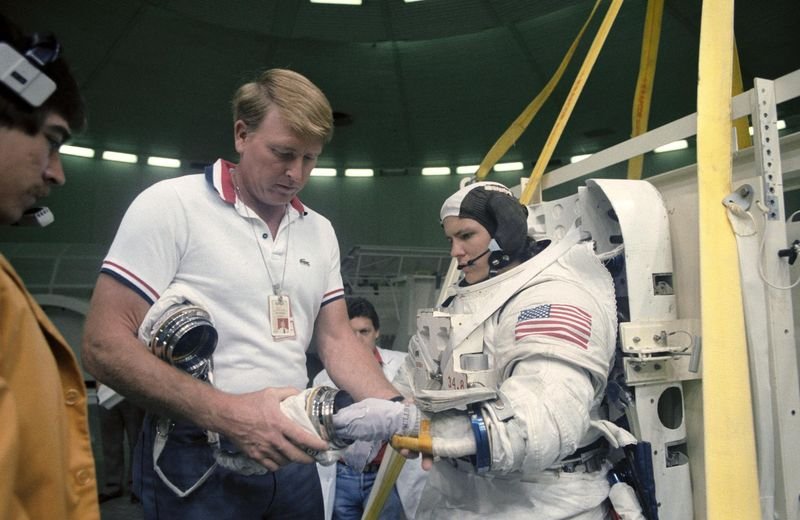
Before anyone opened a hatch, the crew spent flight day seven lowering Challenger’s cabin pressure from 14.7 psi down to 10.2 psi, a step that cut the risk of decompression sickness once Sullivan and Leestma switched to their suits’ pure-oxygen environment. Pilot Jon McBride helped both astronauts into their Extravehicular Mobility Units — the same style of hard-upper-torso suit NASA still uses variants of today — checking gloves, seals, and life-support packs by hand. Sullivan had already run this exact sequence dozens of times in the Johnson Space Center’s pool-sized Weightless Environment Training Facility, the closest approximation to zero-g NASA had on the ground.
Training for an EVA in 1984 meant hours underwater in a suit that weighed more than most of the astronauts themselves, rehearsing every handhold and tool exchange until it was muscle memory. That repetition is the unglamorous part of spaceflight nobody puts on a magazine cover, and it’s the reason the actual spacewalk ran as smoothly as it did.
Three Hours and Twenty-Nine Minutes Outside
Once the hatch opened, Sullivan and Leestma translated hand-over-hand along the payload bay rails to the aft section, where a mockup of a Landsat satellite’s propulsion system was mounted for the demonstration. Leestma did most of the hands-on valve work; Sullivan assisted, documented the procedure with photographs, and before heading back inside, secured the latch on the Shuttle Imaging Radar-B antenna — the task captured in the photo most people recognize from that day.
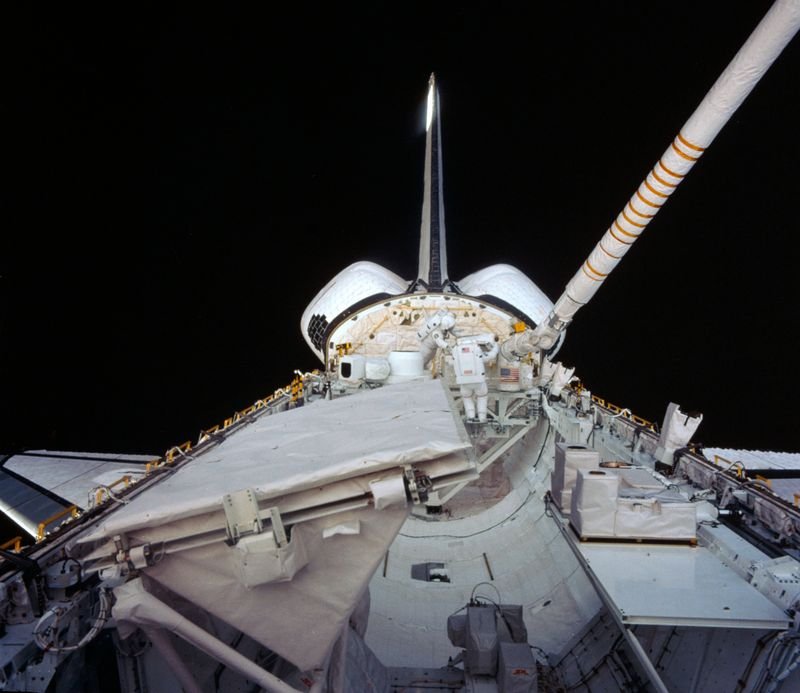
The spacewalk lasted 3 hours and 29 minutes, well within the margins NASA had planned for, and both astronauts reported no issues with the suits or the tools. For a procedure nobody on Earth had ever attempted outside a Soviet suit, that’s a quiet kind of success — nothing dramatic happened, which was exactly the point.
The Orbital Refueling System Mattered More Than the Headline
Here’s the part most coverage from 1984 buried: the actual engineering goal of the spacewalk was figuring out whether satellites could be serviced instead of abandoned once they ran out of fuel. Leestma installed a valve assembly into the simulated Landsat plumbing while Sullivan assisted, testing procedures that NASA and the Department of Defense both had a stake in — NASA for extending the life of remote-sensing satellites, the DoD for reconnaissance spacecraft it didn’t want to keep replacing.
That demonstration fed directly into the engineering confidence NASA needed a few years later when Discovery and other shuttles started doing real satellite repair and servicing missions, eventually including the Hubble Space Telescope repairs of the 1990s and 2000s. Sullivan’s spacewalk doesn’t get credited for that lineage nearly as often as it should. The “first woman” framing is the easy headline; the refueling test is the part that actually changed how NASA planned missions for the next two decades.
Before this demonstration, the standard assumption was that once a satellite ran out of maneuvering fuel, it was functionally dead — a multi-million-dollar piece of hardware left to drift until it reentered the atmosphere or drifted into a graveyard orbit. Proving that an astronaut in a pressurized suit could install a valve assembly with the same precision as a technician on the ground, using tools designed for bare hands, was the unglamorous proof-of-concept that made satellite servicing a real line item in NASA’s budget instead of a theoretical nice-to-have.

Back Inside, It Got a Little Weird
Spaceflight in 1984 still involved a lot of improvisation, and STS-41-G produced one of the better-documented examples of it. A few days into the flight, Ride and Sullivan rigged up a sleep restraint out of springs, clips, bungee cord, and Velcro, nicknaming the tangled contraption the “bag of worms.” It’s a small, human detail that doesn’t make it into most history-book summaries of the mission, but it’s exactly the kind of thing that happens when you put smart people in a confined space for eight days and tell them to solve their own comfort problems.

The mission carried an IMAX camera for what became the 1985 documentary “The Dream Is Alive,” and footage of Sullivan and Leestma’s spacewalk ended up on movie screens before most Americans had ever seen a shuttle EVA up close. For a lot of Gen X kids, that IMAX film — not the news broadcasts — was the first real look at what working outside a spacecraft actually looked like.

A Glove in a Display Case
One of Sullivan’s actual EVA gloves from the mission now sits in the Smithsonian’s National Air and Space Museum collection, alongside a pennant from the Society of Women Geographers she carried into orbit. It’s a strange object to look at up close — thick, yellowed at the palm, clearly built for function over comfort — and it’s a more honest artifact of what the job actually involved than any of the polished publicity photos from the same week.

From Low Earth Orbit to the Bottom of the Ocean
Sullivan left NASA in 1993 and went on to run the National Oceanic and Atmospheric Administration under the Obama administration, overseeing the agency responsible for weather forecasting and ocean research. Then, in June 2020, she climbed into a submersible called Limiting Factor and descended nearly seven miles to the bottom of the Challenger Deep in the Mariana Trench, becoming the first woman to reach the deepest known point in Earth’s oceans. That made her the only person alive who had both walked in space and touched the floor of the deepest ocean trench — a pairing of records nobody else can claim, before or since.
Sullivan wasn’t the only woman breaking barriers in orbit during that stretch of the 80s and 90s — eight years later, Mae Jemison became the first Black woman in space aboard Endeavour, part of the same slow, decade-by-decade expansion of who NASA sent up.
Love the retro era? Browse our shop for vintage finds, retro clothing, and 80s/90s nostalgia gear.
Watch the Full Story
What stands out looking back forty years later isn’t the “first” itself — it’s how little fanfare NASA gave the actual spacewalk at the time compared to how the story gets told now. In 1984, it was flight day seven of a packed eight-day mission, sandwiched between satellite experiments and a sleep-restraint built from spare bungee cord. The historic part only got the spotlight it deserved in hindsight.
Sources
- NASA — 40 Years Ago: STS-41G, A Flight of Many Firsts and Records — official mission timeline and EVA details
- NASA — Astronaut Kathryn Sullivan on Oct. 11, 1984 Spacewalk — official photo and caption
- Smithsonian National Air and Space Museum — America’s First Spacewalking Woman: Kathryn D. Sullivan — artifact collection and biography
The Retro Almanac
A monthly roundup of "on this day" highlights from that month, decades back — plus first dibs on new retro merch drops. No spam, just the good stuff.