Furby: The 1998 Toy That Got Banned by the NSA
Tiger Electronics priced the thing at $35 and still couldn’t make enough of them. By the time Hasbro’s accountants added up the three-year run, more than 40 million Furbies had shipped, and the toy had done something almost no other holiday fad manages: it scared a federal spy agency. Hasbro brought it back in 2026 with swappable personality glasses, which means a toy old enough to have a government paper trail is now also a toy aimed at kids who weren’t born when the original went quiet.
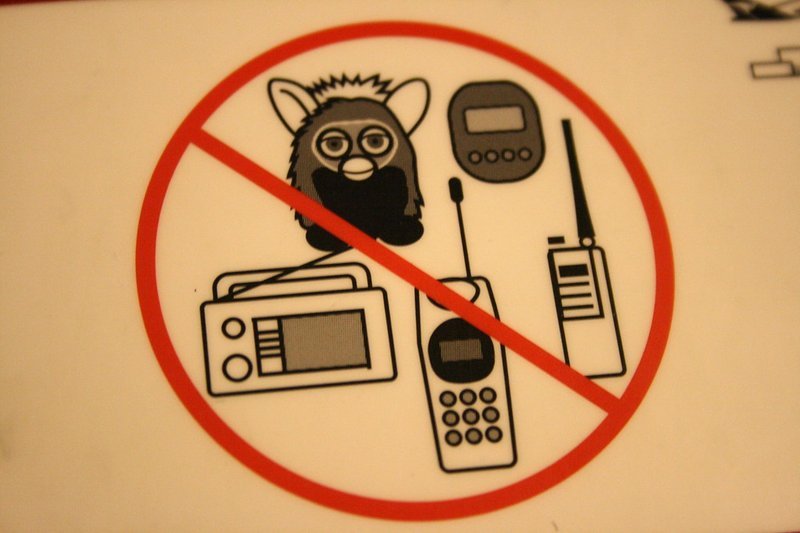
Furby got banned in more places than just toy stores — including, briefly, a U.S. spy agency.
The Retro Almanac
A monthly roundup of "on this day" highlights from that month, decades back — plus first dibs on new retro merch drops. No spam, just the good stuff.
What a 1998 Furby Could Actually Do
Strip away the fur and a Furby was a fairly basic machine: a light sensor in its eye, a touch sensor on its back, a sound-triggered microphone, and an infrared port that let two units near each other “talk.” None of that added up to recording equipment. The microphone could only register whether a sound crossed a volume threshold — loud or quiet, nothing more — which is why it reacted to claps and shouting but couldn’t play back a single word anyone said to it.
The learning gimmick was simpler than parents assumed, too. Furby shipped with a fixed vocabulary split across two tiers, mostly Furbish at first and gradually more English, and a random timer decided when new words unlocked rather than anything the toy actually heard you say. It also never slept. Pull the batteries and it shut up; leave them in and a Furby could start muttering to itself at 3 a.m. for no reason anyone ever figured out, which did as much for its reputation as the holiday shortage did.
Two Toy Guys and a Tamagotchi Problem
Dave Hampton and Caleb Chung built Furby after a trip to the 1997 Toy Fair, where they watched a demo of the Tamagotchi and landed on the one thing it was missing: you couldn’t touch it. Hampton figured a toy you could actually pet, one that reacted to being picked up and stroked instead of poked through a screen, would beat a virtual pet at its own game. He and Chung spent roughly nine months designing the concept and another nine building it before fellow toy inventor Richard Levy carried it to Tiger Electronics, where president Roger Shiffman bought the rights outright.
That bet paid off harder than anyone at Tiger projected. Internal forecasts reportedly assumed a modest seasonal hit along the lines of Tickle Me Elmo two years earlier. What they got was a product that outran its own factories before Thanksgiving.
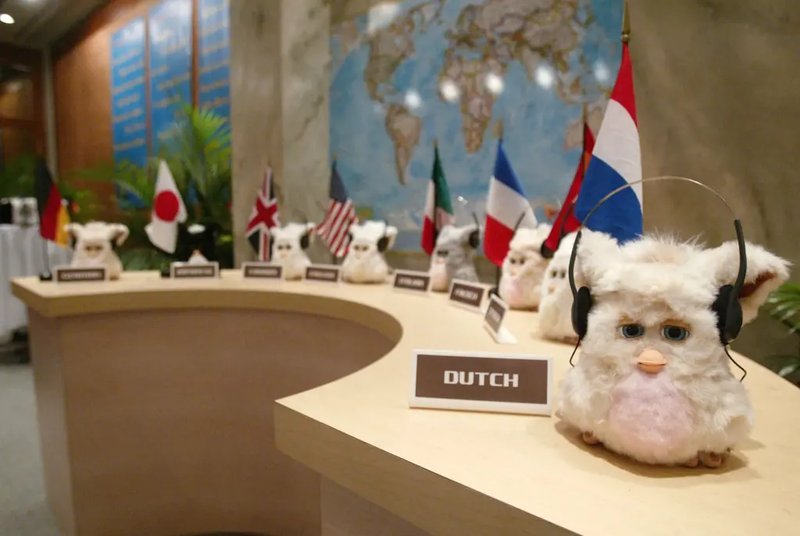
A later-generation Furby gets introduced to the public in New York, 2005 — the toy kept reinventing itself long after the original craze cooled.
The Christmas That Broke Toy Stores
By the time Furby hit shelves in October 1998, Tiger Electronics was already behind. The company sold 1.8 million units before the year ended, with most of that volume crammed into the six weeks before Christmas. Parents camped outside stores overnight, some locations ran lotteries just to manage the crowd, and one widely reported New Jersey bust turned up roughly 200 units stockpiled in a warehouse by resellers waiting to flip them. A $35 toy was changing hands for $300 or more once the shelves went empty, and FAO Schwarz in Manhattan became the epicenter of the whole thing — kids mobbing the counter the second a new shipment showed up, the same kind of scramble that greeted a Game Boy restock a decade earlier, just louder.
The math behind that frenzy is almost funnier than the frenzy itself. Tiger sold 1.8 million Furbies in 1998, then 14 million more in 1999 once supply caught up to demand — proof that the shortage wasn’t really about scarcity marketing. The factories genuinely couldn’t keep pace with a toy nobody at the company had modeled correctly.
The Ban That Wasn’t About Spying At All
On January 13, 1999, the NSA told employees to keep Furbies off the Fort Meade campus, and the U.S. Navy issued a similar notice at its Norfolk shipyard. The stated worry was that the toy’s “learning” marketing implied an internal recorder that might soak up classified chatter and parrot it back later. Tiger Electronics president Roger Shiffman answered with a statement that still reads as blunt three decades later: “Furby is not a spy.” Dave Hampton went further and demonstrated, on the record, that the microphone could only register a single flat beep from a loud noise — nothing close to a recording.
The ban stuck around for a while before quietly fading. What’s genuinely strange is how little that incident mattered to Furby’s sales — getting treated as a national security risk turned out to be free publicity, not a scandal, and the toy kept selling through 2000 regardless. Design notes from the era add a detail that gets left out of the spy story: Tiger reportedly gave Furby the ability to burp and pass gas specifically so boys, not just girls, would want one. A reprogramming challenge later offered $250 to anyone who could crack the epoxy-sealed shell and rewrite the thing, which tells you the company took the toy’s security more seriously than the NSA’s accusation ever warranted.

Furby Vibes, Hasbro’s 2026 line, swaps personalities with glasses instead of a software update.
A $100,000 Furby Actually Existed
Once the panic passed, the toy became a strange little canvas for excess. Jeweler Sidney Mobell built a bejeweled Furby in 1999 — 18-karat gold jewelry, 156 Swarovski crystals, 63 diamonds, plus rubies, sapphires, and emeralds — and FAO Schwarz sold it for $100,000. Only five were ever made. On the opposite end of the spectrum, a limited promotional run tied to Kid Cuisine frozen dinners and Publix supermarkets capped production at 500 units, which now makes it one of the rarer standard-run Furbies on the collector market.
Later generations tried to extend the brand well past its original gimmick. A 2005 Emoto-Tronic version added real voice recognition and got a public unveiling at the UN Plaza in New York. A 2012 refresh added a mobile app and LCD eyes, followed by Furby Boom in 2013 and Furby Connect in 2016 — the Connect version drew its own security scare, this time a legitimate one, when researchers flagged weak Bluetooth protections that could theoretically let a stranger take it over. Warner Bros. also sued Hasbro at one point, arguing the original design leaned too close to the Mogwai from Gremlins; the case ended in a settlement and a quiet redesign of the ears and face.

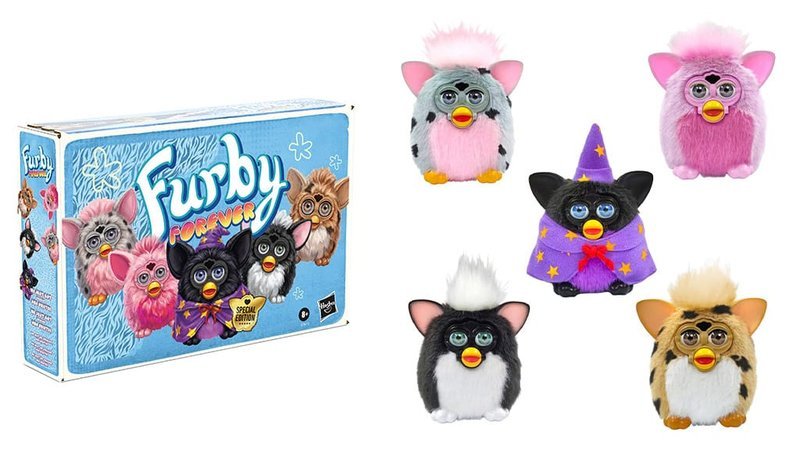
Furby Forever, Hasbro’s 2026 collector pack, brings back five original 90s designs in miniature.
Furby’s 2026 Comeback
Hasbro unveiled Furby Vibes at its February 2026 Toy Fair presentation, and the toy hits retailers on July 15 for $44.99. The gimmick this time is physical, not digital: three sets of swappable glasses — a star-shaped Star Diva pair, cucumber-slice Chill Spa glasses, and spiked Punk Rocker frames — each unlock a different set of songs, phrases, and games without any app or firmware update involved. Alongside it, Hasbro quietly released the Furby Forever Collector Pack, five miniature reissues of original 90s designs including the Cheetah, Leopard, Wizard, Skunk, and Flamingo patterns, aimed squarely at the adults who fought over the full-size version in 1998.
Furby also made the shortlist for the National Toy Hall of Fame’s 2025 class, losing out to other finalists but landing in the same conversation as Tickle Me Elmo, Connect Four, and Spirograph. That nomination is a decent proxy for where the toy actually sits now — not quite canonized, but no longer written off as a one-Christmas fluke either, in the same company as revival hits like the Pogo Ball that Hasbro also dusted off for a new generation.

Why the Original Still Outsells the Explanation
None of Furby’s later tech upgrades ever matched the cultural footprint of the dumb 1998 version with the threshold microphone and the fixed vocabulary list. That’s worth sitting with: the toy that caused a federal security scare wasn’t smart enough to justify it, and the panic happened anyway because the marketing was good enough to make “learning” sound like something more than a random word timer. Furby didn’t need real intelligence to feel alive to a seven-year-old in 1998, and judging by a $44.99 relaunch almost thirty years later, it still doesn’t.
FAQ
Did Furby really get banned by the NSA?
Yes. On January 13, 1999, the NSA told staff to keep Furbies off its Fort Meade, Maryland campus, fearing the toy could record and repeat classified conversations. The U.S. Navy issued a similar notice at its Norfolk shipyard. Both bans were based on a misunderstanding of how the toy’s microphone worked — it could detect volume, not record sound.
How many Furbies were sold in total?
Tiger Electronics sold 1.8 million in 1998, 14 million in 1999, and more than 40 million across the original three-year production run that ended around 2000.
Could the original Furby actually record conversations?
No. Its microphone could only detect whether a sound crossed a volume threshold. Co-inventor Dave Hampton demonstrated publicly that it could register a beep from a loud noise but had no capacity to store or play back audio.
Is Hasbro making new Furbies in 2026?
Yes. Furby Vibes launches July 15, 2026 for $44.99, with three swappable glasses unlocking different personality modes. Hasbro also released a Furby Forever Collector Pack with five miniature reissues of original 90s designs.
Sources
- Furby — Wikipedia — sales figures, generations timeline, and the Warner Bros. lawsuit
- How Old Is Your Furby? — Computer History Museum — invention story and the 1998/2005 photos used in this article
- The NSA Once Banned Furbies as a Threat to National Security — Gizmodo — details on the 1999 NSA and Navy bans
- Hasbro Brings Back Furby Fever with Nostalgic Collector Pack — The Pop Insider — 2026 Furby Forever Collector Pack details and press images
The Retro Almanac
A monthly roundup of "on this day" highlights from that month, decades back — plus first dibs on new retro merch drops. No spam, just the good stuff.