Candy Cigarettes — The Fake Smokes We All “Lit Up” in the 80s and 90s
Picture this: You’re ten years old, standing at the convenience store counter in 1987, fishing quarters from your pocket. “Can I get some candy cigarettes?” you ask, and for a brief moment, you feel like the coolest kid on the block. That little cardboard box with its pristine white sticks wasn’t just candy — it was your ticket to feeling grown-up, rebellious, and slightly dangerous, all while your biggest worry was whether you had enough change for a Slurpee.
Candy cigarettes were the ultimate paradox of childhood: forbidden fruit that wasn’t actually forbidden. We’d stand in groups on the playground, pretending to “light up” our chalky white sticks, exhaling imaginary smoke rings while feeling like we were getting away with something. Looking back, it’s wild to think that an entire generation of kids grew up role-playing with fake cigarettes, and our parents just… let us.
But here’s the thing about candy cigarettes — they weren’t just some random sweet treat. They were a cultural phenomenon that sparked controversy, launched health studies, and eventually forced an entire industry to rebrand. The story of candy cigarettes is really the story of how our attitudes toward childhood, marketing, and “harmless” fun completely shifted over a couple of decades.
What Were Candy Cigarettes?
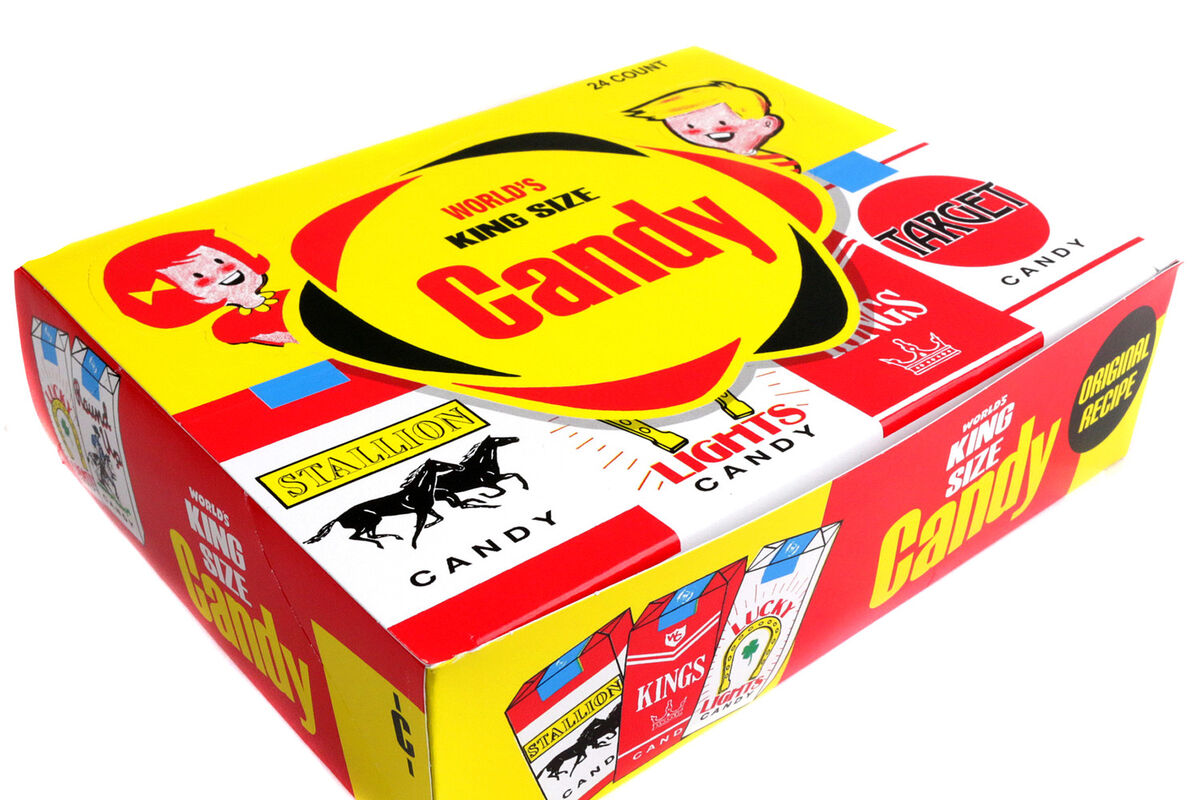
For those who somehow missed this rite of passage, candy cigarettes were exactly what they sounded like: candy designed to look, feel, and even “smoke” like real cigarettes. These weren’t subtle imitations — they were shameless replicas, complete with packaging that mimicked popular tobacco brands, right down to the fonts and color schemes.
The classic version was a stick of compressed dextrose (basically chalky sugar) that would snap with a satisfying crack when you bit into it. The taste was simple — pure, uncomplicated sweetness with a hint of vanilla. But the real appeal wasn’t the flavor; it was the performance. You could hold it between your fingers like a real cigarette, pretend to take a drag, and even blow out powdered sugar “smoke” if you got the bubble gum variety.
Candy cigarettes actually date back to the late 1800s, when candy makers first realized they could capitalize on adult behaviors to sell products to kids. But they reached peak popularity during our childhoods in the 80s and 90s, when they became a staple of corner stores, movie theaters, and school fundraiser catalogs.
There were three main types that ruled the playground, each with its own devoted following and unique appeal.
The Three Types That Ruled Our Childhood
The Original Chalky Sticks
These were the purists’ choice — white, cylindrical sticks made from pressed dextrose that delivered that signature chalky snap. World Confections was the king of this category, producing boxes that looked almost identical to real cigarette packs. The texture was everything: dry and powdery on the outside, but with enough structural integrity to not just crumble into dust when you bit down.
The flavor was deliberately mild — think pure sugar with a whisper of vanilla. Nothing flashy, nothing that would distract from the main event, which was the role-playing. You’d bite off the end with a satisfying crack, then hold the remaining stick like you were some kind of miniature Marlboro Man. The best part? That white powdery residue that would coat your lips, giving you the authentic “I’ve been smoking” look without any of the actual consequences.
Bubble Gum Cigarettes with the “Smoke”
Now these were the show-stoppers. Bubble gum cigarettes came wrapped in thin paper with a hidden pocket of powdered sugar between the wrapper and the gum. When you put the “cigarette” to your lips and blew gently through the paper tube, a small puff of white powder would escape, creating an incredibly realistic smoking effect.
The theatrical possibilities were endless. You could blow “smoke” rings, have “smoking” contests with your friends, or just enjoy the shocked looks from adults who did a double-take before realizing what they were seeing. Once you’d exhausted the smoke show, you’d peel back the paper to reveal a firm pink stick of tutti-frutti flavored gum.
The gum itself was nothing special — standard bubble gum that required serious jaw work to soften up and lost its flavor within ten minutes. But who cared? You weren’t buying it for long-lasting chew; you were buying it for the pure theater of it all.
Chocolate Cigarettes (European Style)
While American kids were crunching on chalky sugar sticks, European candy makers went the sophisticated route with actual chocolate cigarettes. Brands like Droste created thin milk chocolate sticks wrapped in elegant paper that looked like high-end tobacco products.
These were objectively the best-tasting of the bunch — rich, creamy chocolate that melted smoothly on your tongue. The thin profile meant they disappeared quickly, but the experience felt more luxurious than their American counterparts. The paper wrapper wasn’t just decorative; it served the practical purpose of keeping the chocolate from melting in your fingers.
Unfortunately for us, chocolate cigarettes never caught on big in the U.S., probably because they cost more and didn’t have that distinctive “snap” that made the chalky versions so satisfying.
Why We Were Obsessed with Candy Cigarettes in the 80s and 90s
Looking back, our obsession with candy cigarettes makes perfect sense within the context of 80s and 90s culture. This was the era of “Just Say No,” DARE programs, and constant messaging about the dangers of drugs and smoking. Yet somehow, candy cigarettes flew under the radar as harmless fun.
The appeal was obvious: they made us feel grown-up in a way that other candy simply couldn’t. Eating a Snickers bar was just eating candy, but “smoking” a candy cigarette was role-playing adulthood. We were mimicking behaviors we saw constantly in movies, TV shows, and real life. Remember, this was back when smoking was still allowed in restaurants, bars, and even airplanes. Adult behavior was all around us, and candy cigarettes gave us a way to participate.
There was also a delicious element of rebellion that felt completely safe. We knew we weren’t actually doing anything wrong, but we also knew that “smoking” looked cool and slightly dangerous. Standing around the playground with candy cigarettes made us feel like we belonged to some kind of exclusive club — too cool for regular kid stuff, but not quite ready for real trouble.
The peer pressure was real, too. If your friend group was into candy cigarettes, you pretty much had to get on board or risk being left out of the whole elaborate performance. We’d practice our “smoking” techniques, compare brands, and debate the merits of chalky vs. bubble gum varieties with the seriousness of actual tobacco connoisseurs.
The Controversy That Almost Killed Candy Cigarettes
But while we were innocently play-acting with our fake cigarettes, a storm was brewing in the world of public health and child psychology. By the late 90s and early 2000s, researchers were starting to ask uncomfortable questions about whether candy cigarettes might be influencing kids’ attitudes toward real smoking.
A landmark study from the University of Rochester Medical Center dropped a bombshell: they found that children who ate candy cigarettes were significantly more likely to become actual smokers as adults. The research suggested that the candy was essentially training wheels for tobacco use, normalizing the behavior and making the transition to real cigarettes feel more natural.
The American Academy of Pediatrics wasn’t having it either. They argued that candy cigarettes were a form of stealth marketing that desensitized children to tobacco use and made smoking seem fun and harmless. Medical professionals pointed out that at a time when they were desperately trying to reduce smoking rates, having kids practice the motions with candy seemed counterproductive at best and dangerous at worst.
The controversy reached fever pitch when health advocates began comparing candy cigarettes to other dangerous toys that had been banned for putting children at risk. The argument wasn’t that candy cigarettes were physically dangerous in the moment, but that they potentially created long-term behavioral risks that were just as serious.
Public pressure mounted throughout the early 2000s, with parent groups, health organizations, and politicians all calling for restrictions or outright bans. While the FDA never actually banned candy cigarettes (they only regulated real tobacco products), the writing was on the wall: the golden age of candy cigarettes was coming to an end.
Famous Brands and Where to Find Them Today
World Confections emerged as the last major producer of classic candy cigarettes, having survived the industry shakeout of the 2000s. Their boxes still featured the vintage-style packaging that made us feel so rebellious back in the day, though with some significant modifications to avoid controversy.
The Popeye brand was another survivor, cleverly rebranding their products as “Popeye Candy Sticks” to distance themselves from the cigarette association while keeping the same beloved recipe. Victory brand also hung on by shifting to more generic “candy stick” terminology.
Finding candy cigarettes today requires a bit more effort than it used to. They’ve largely disappeared from mainstream grocery store checkout aisles and most convenience stores. Your best bet is specialty retro candy shops, vintage-themed diners, or online retailers that cater to nostalgia buffs.
The irony is that while candy cigarettes became controversial for potentially encouraging smoking, they ended up sharing shelf space with cap guns and other toys that simulated adult behaviors that were equally questionable. The difference was timing — candy cigarettes faced scrutiny just as public attitudes toward smoking were shifting dramatically.
Amazon, specialty candy websites, and retro toy stores still carry them, though usually under the sanitized “candy sticks” name. The recipes haven’t changed much, so if you’re feeling nostalgic, you can still get that same chalky snap and powdery residue that defined your childhood contraband.
The Great Rebrand: From “Cigarettes” to “Candy Sticks”
Faced with mounting criticism and declining sales, the candy cigarette industry did what any smart business would do: they pivoted. Starting in the early 2000s, manufacturers began quietly dropping the word “cigarettes” from their packaging and marketing materials.
The most obvious change was removing the red-colored tips that had made candy cigarettes look even more realistic. Those little touches of red food coloring that simulated a lit cigarette? Gone. The packaging got more generic, with cartoon characters and bright colors replacing the sophisticated tobacco-inspired designs.
But here’s the genius part: they kept everything else exactly the same. Same recipe, same texture, same satisfying snap, same vanilla-tinged sweetness. They just called them “candy sticks” or “candy cylinders” and pretended the whole cigarette thing had never happened.
The strategy worked. By distancing themselves from tobacco imagery while preserving the core product experience, manufacturers managed to keep candy cigarettes alive through the moral panic. Kids could still get their chalky fix; they just had to ask for “candy sticks” instead of “candy cigarettes.”
Why Gen X Still Gets Nostalgic for Candy Cigarettes
There’s something uniquely powerful about the sensory memory of candy cigarettes. The sight of those little white sticks can instantly transport us back to corner store counters, playground hierarchies, and the simple pleasure of feeling slightly rebellious while doing something completely harmless.
For Generation X, candy cigarettes represent a very specific kind of childhood freedom that doesn’t really exist anymore. We could walk to the store by ourselves, buy candy that looked like tobacco products, and pretend to smoke without any adults freaking out about it. It was a different time, when toys could be a little dangerous and kids could engage in elaborate fantasy play without constant supervision.
The nostalgia runs deeper than just missing the candy itself. Candy cigarettes symbolize an era when childhood felt less managed, less anxious, and somehow more authentic. We weren’t performing our childhoods for social media or worrying about college applications in elementary school. We were just kids, playing elaborate games of make-believe with chalk and sugar.
That’s probably why candy cigarettes still show up at themed parties, retro candy buffets, and nostalgia events. They’re not just candy; they’re time machines that instantly transport us back to simpler days when the biggest controversy in our lives was whether the bubble gum or chalky variety was superior.
Even today, spotting a box of candy sticks (formerly cigarettes) in a store can trigger an almost Pavlovian response in anyone who grew up in the 80s or 90s. Suddenly we’re eight years old again, pooling our quarters and debating whether to go for the classic World Confections brand or try something new. It’s amazing how a stick of compressed sugar can hold so much cultural and emotional weight.
Sources
1. Klein, Jonathan D., et al. “Candy cigarettes: do they encourage children’s smoking?” BMJ, vol. 325, no. 7365, 2002, pp. 362-365.
2. University of Rochester Medical Center. “Study Links Candy Cigarettes to Real Smoking Behavior.” Medical Research Archive, 2007.
3. American Academy of Pediatrics. “Policy Statement on Candy That Resembles Cigarettes.” Pediatrics Journal, vol. 116, no. 4, 2005.
4. Food and Drug Administration. “Family Smoking Prevention and Tobacco Control Act Implementation.” Federal Register, 2009.
5. Smithsonian Institution. “Sweet Memories: The History of American Candy.” National Museum of American History, 2018.