
The Most Dangerous Toys Ever Made: Banned Playthings That Terrorized Childhoods
Six thousand seven hundred kids hit the emergency room for lawn dart injuries between 1978 and 1987, and one of them — seven-year-old Michelle Snow — never made it back home. The most dangerous toys ever made were not exotic foreign imports or back-alley knockoffs. They were the big-name plastic miracles you begged for at Christmas, sold by Mattel, Hasbro, and Galoob, ringing through the register at Toys “R” Us with a smile. Gen X grew up in the soft, padded gap between zero safety standards and the modern era of warning labels stacked six deep on every package, and a lot of us got the scars to prove it.
When Jarts Were Sticking Out of the Lawn Like Trophies
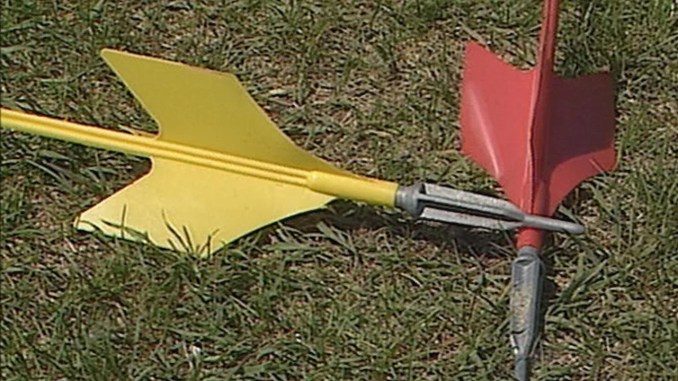
Lawn Darts — sold under the name Jarts — were three-pound projectiles with weighted metal tips, lobbed underhand toward a plastic ring on the grass while the rest of the family hung out on the patio. Franklin Sports, Regent, and a dozen other companies cranked them out from the early 1960s through the late 1980s, and for a generation of dads the post-cookout dart toss was a sacred summer ritual. The problem was geometry. A heavy metal spike falling out of a high arc onto a six-year-old’s skull does what gravity tells it to.
The Retro Almanac
A monthly roundup of "on this day" highlights from that month, decades back — plus first dibs on new retro merch drops. No spam, just the good stuff.
Roughly 6,700 Jarts-related ER visits between 1978 and 1987, according to Consumer Product Safety Commission records. Three children died. The death that finally broke the toy was Michelle Snow’s, struck in the head in 1987 by a neighbor’s stray dart. Her father David quit his job to lobby the CPSC, and on December 19, 1988 — the week before Christmas — Jarts were banned outright across the United States. For the longer story of the toy that set off the federal recall era, see our deeper dive into the deadliest backyard toy of the 80s.
Sky Dancers Spun Into Living Rooms Like Pink Ceiling Fans
Galoob launched Sky Dancers in 1994 as a kind of fairy yo-yo: you slotted a pony-tailed doll into a plastic launcher base, yanked a rip-cord, and watched her spin twenty feet into the air on stiff foam wings. The commercials sold magic — slow-motion glide, soft pastel light, sparkles. In real living rooms with real ceiling fans, the magic ended in stitches.
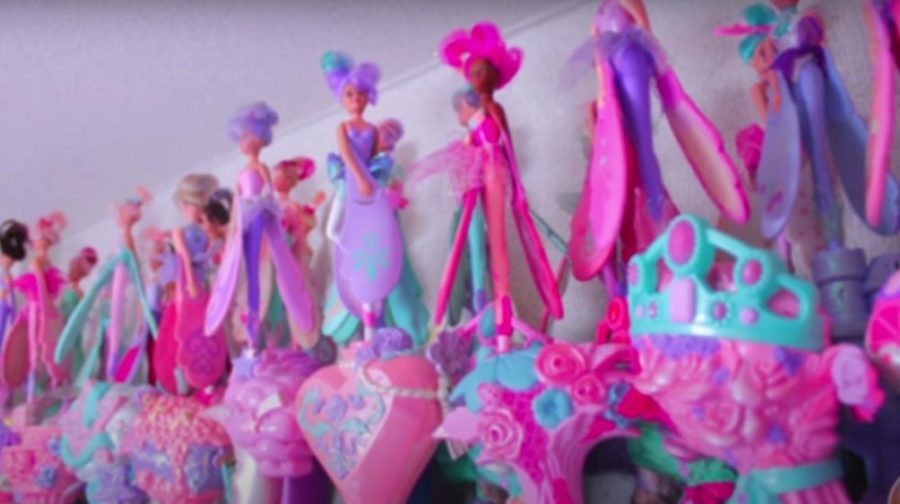
By the time Galoob and the CPSC pulled the trigger on a recall in June 2000, the company was sitting on 170 reports of injuries — scratched corneas, broken teeth, a mild concussion, a broken rib, and enough facial lacerations to make a plastic surgeon’s career. Nine million units came off shelves. The Sky Dancer wasn’t malicious. She was a small, hard, propeller-armed object launched at child-eye-level inside a living room. The physics never had a chance.
A Tiny Red Missile in a Larynx on Christmas Morning
On Christmas Day 1978, four-year-old Robert Jeffrey Warren of Atlanta was playing with his new Mattel Battlestar Galactica Cylon Raider. He pressed the trigger that fired the Raider’s spring-loaded missile, and the inch-and-a-quarter red plastic dart shot directly into his open mouth, lodged in his larynx, and asphyxiated him. He died on December 31. Mattel had already received three earlier reports that month of children inhaling the missiles.
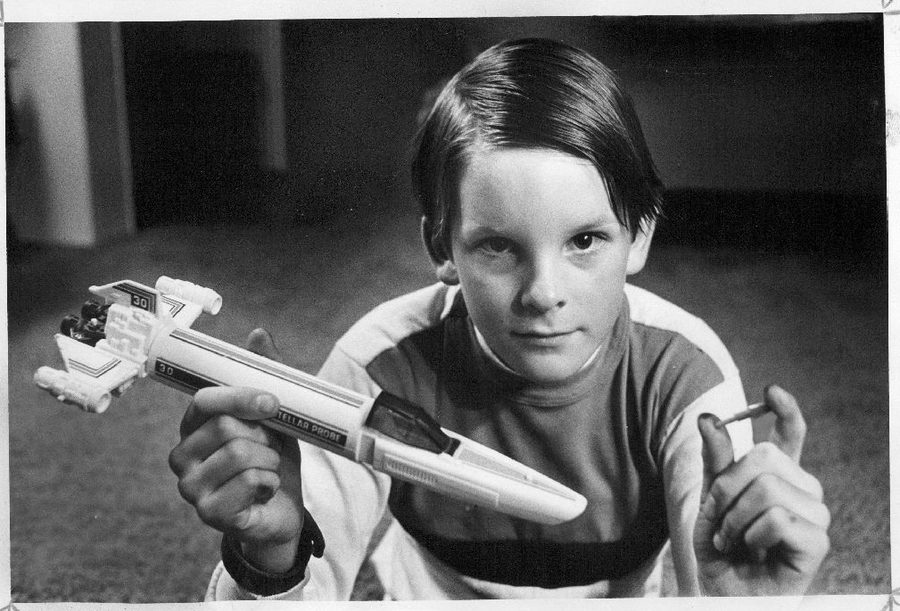
After Robert’s death, the company ran a national mail-in: send back the missiles, get a free Hot Wheels car. Every spring-launched toy in America was quietly redesigned over the next year so that projectiles could no longer leave the ship. If you ever wondered why your Boba Fett shipped with a fixed rocket pack instead of the firing missile Kenner originally planned, that is your answer — Robert Warren’s death scared every toy executive in the country into killing the firing-missile spec across the entire industry.

The Chemistry Set That Came With Real Uranium
A.C. Gilbert’s 1950 U-238 Atomic Energy Lab kit retailed for $49.50 and shipped with four jars of actual uranium-bearing ore — autunite, torbernite, uraninite, and carnotite — along with a working Geiger counter, an electroscope, a Wilson cloud chamber, and a manual that walked your kid through real nuclear experiments. The pitch was Cold War civic optimism: America needed the next generation of physicists, and Gilbert wanted them trained at the kitchen table.
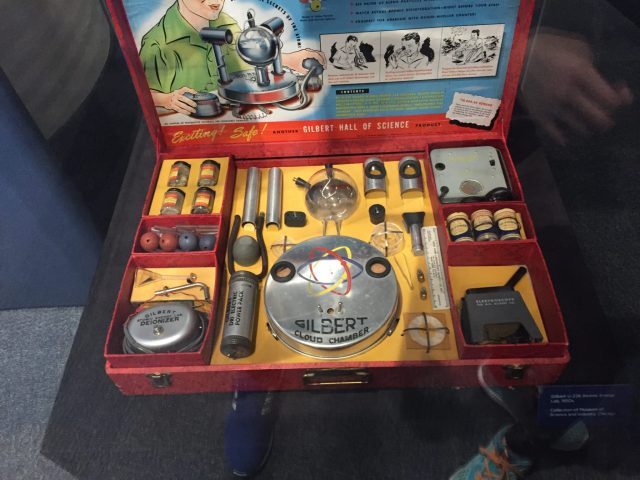
The Department of Energy later calculated the radiation exposure as roughly equivalent to a day in the sun, so the kit was less hazardous than its modern reputation suggests. What killed it was the price tag, not the radiation. Around 5,000 sets sold before Gilbert pulled the line in 1951. Surviving boxed sets routinely clear five figures at auction today. For more on the kits, dolls, and electronics that defined the toy aisle of that era, our roundup of 80s toys worth a fortune today covers what’s spiking on eBay right now.
The Pink Oven That Ate a Five-Year-Old’s Fingertip
Hasbro’s original 1963 Easy-Bake used a 100-watt lightbulb and a sliding metal pan to cook tiny brownies for tiny children. It worked, more or less safely, for forty years. The 2006 redesign moved to a front-loading sliding door at the bottom of the unit, and the door turned out to be a finger guillotine.
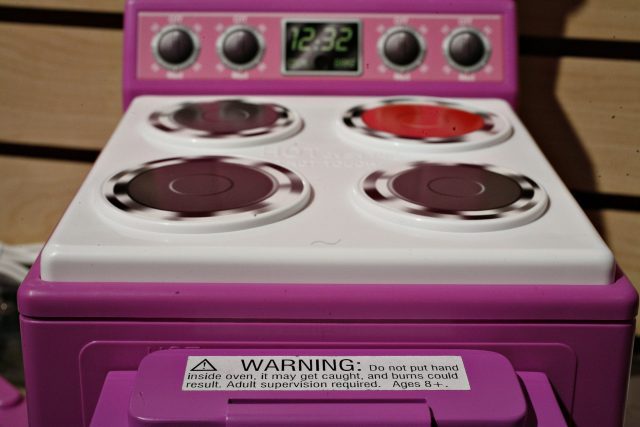
Small hands reached in to retrieve dropped batter, fingers wedged between the door and the heating element at 350 degrees, and the door wouldn’t open without a wrench. By July 2007 the CPSC had logged 249 reports of trapped fingers, 77 burns, 16 of those second- and third-degree, and the case that finally pushed Hasbro into a full second recall: a five-year-old girl whose fingertip had to be surgically amputated. Around one million ovens went back to the factory. For the wholesome side of the same brand, our piece on the lightbulb-powered Easy-Bake covers the original design that worked fine for four decades.
The Doll From Hell That Wouldn’t Let Go of Your Hair
Christmas 1996, Mattel rolled out the Cabbage Patch Snacktime Kid — a doll with battery-powered chompers that “ate” plastic carrots and french fries dropped into its mouth. There was no off switch. There was no jam protection. The motorized jaws kept grinding through whatever they latched onto, and by late December the news was full of kids whose ponytails had been swallowed up to the scalp by a Cabbage Patch doll that wouldn’t stop chewing.

One Bainbridge, New York paper ran the headline “The Dolls From Hell” over a story about seven-year-old Marjorie Cox, whose hair had to be cut out of her brand-new Snacktime Kid with kitchen scissors on Christmas morning. The CNN coverage from December 30, 1996 documented 35 confirmed hair-and-finger incidents. Mattel quietly pulled the doll off the market in January 1997 and offered a $40 refund per unit. About 500,000 had already shipped.
Two Plastic Balls on a String, One Trip to the ER
Clackers — also sold as Ker-Bangers, Klick-Klacks, or Klackers — were the simplest toy on this list: two solid acrylic balls suspended from a string, swung up and down until they smacked together with a sharp wooden-bat crack. Skilled kids could keep them clacking above and below the hand for minutes at a time. Unskilled kids — most of us — caught one on the wrist hard enough to bruise to the bone.
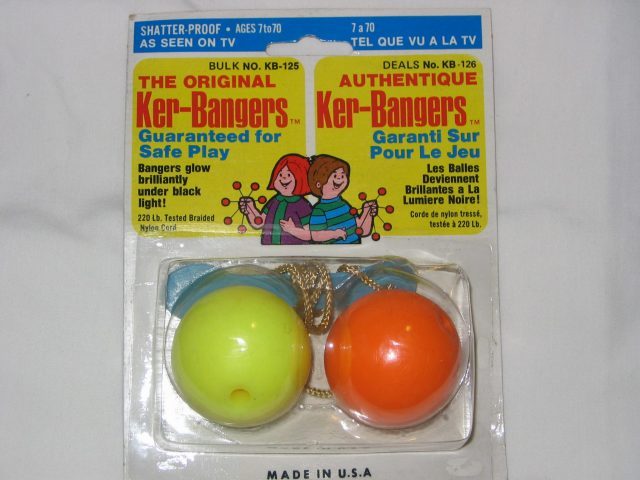
The bigger problem showed up later. The acrylic shells, fatigued by thousands of high-speed collisions, started to shatter into hundreds of razor-edged shards mid-clack. The FDA’s Bureau of Product Safety launched the first national investigation in 1971; reformulated polymer versions hung on into the late 1970s before injury lawsuits finished them off. A clean pair of original Ker-Bangers in unopened blister now sells for fifty to eighty dollars on eBay, mostly to nostalgic collectors who would never let their own kids touch them. The same era handed us cap guns in the backyard and candy cigarettes at the corner store — a portfolio of childhood that today’s product liability lawyers would lock in a vault.
What All These Recalls Actually Bought Us
The CPSC wasn’t created out of nowhere. It opened in 1973 with a small staff, modest enforcement power, and a stack of complaints that grew every year as the post-war toy boom kept inventing new ways to maim children. Every recall on this list shifted the law a little. Lawn Darts handed regulators the modern federal ban authority. Battlestar Galactica killed the firing-missile toy across the entire industry. Snacktime Kid wrote the off-switch requirement into design reviews at every major toy company. Sky Dancers tightened the projectile-toy testing protocol. The Easy-Bake redesign sent every front-loading appliance back to the drawing board.
The orange warning labels, the choke-hazard rings, the 12-page fine-print disclaimers on a $7 toy car — those exist because somewhere a kid bled first. The toys we remember as “fun” were also field tests, run on actual children, in actual living rooms, in real time. Most of us got out with bruises and good stories. Some kids paid the full bill. The most dangerous toys ever made aren’t dangerous anymore — but only because Michelle Snow, Robert Warren, and a hospital ward full of nameless others took the hits that made the rules.
Sources
- CPSC Votes Lawn Dart Ban to Protect Children — official 1988 commission ban release
- CPSC & Galoob Toys Announce Recall of Sky Dancers Flying Dolls — 2000 recall notice covering all 8.9 million units
- Mattel & CPSC Voluntary Refund Program for Cabbage Patch Snacktime Kids — official January 1997 refund announcement
- New Easy-Bake Oven Recall Following Partial Finger Amputation — July 2007 expanded CPSC recall
- CNN: Safety experts alarmed by chomping Cabbage Patch Kids — December 30, 1996 contemporary news report
- Smithsonian National Museum of American History — Lawn Dart Game artifact
- U.S. Department of Energy — Holiday Toy Shopping in the 1950s — Gilbert Atomic Energy Lab background
- Vintage Toy Emporium — The Tiny Red Missile That Shook Up the Toy Industry in 1979
Browse retro and vintage-inspired apparel at the RetroRadical shop →
The Retro Almanac
A monthly roundup of "on this day" highlights from that month, decades back — plus first dibs on new retro merch drops. No spam, just the good stuff.