Reagan Assassination Attempt: The Day America Held Its Breath — March 30, 1981
Forty-five years ago today, on March 30, 1981, the United States came terrifyingly close to losing its 40th president. At 2:27 p.m. on a gray Washington afternoon, six shots rang out on a sidewalk outside the Washington Hilton Hotel — and within seconds, the most powerful man on earth was bleeding in the back of a limousine, his lung filling with blood. John Hinckley Jr. had just pulled the trigger on one of the most shocking moments of the entire decade. For every American who was old enough to understand what was happening, March 30, 1981 is permanently burned into memory — the kind of day where you remember exactly where you were when you heard the news.
Sixty-Nine Days Into His Presidency
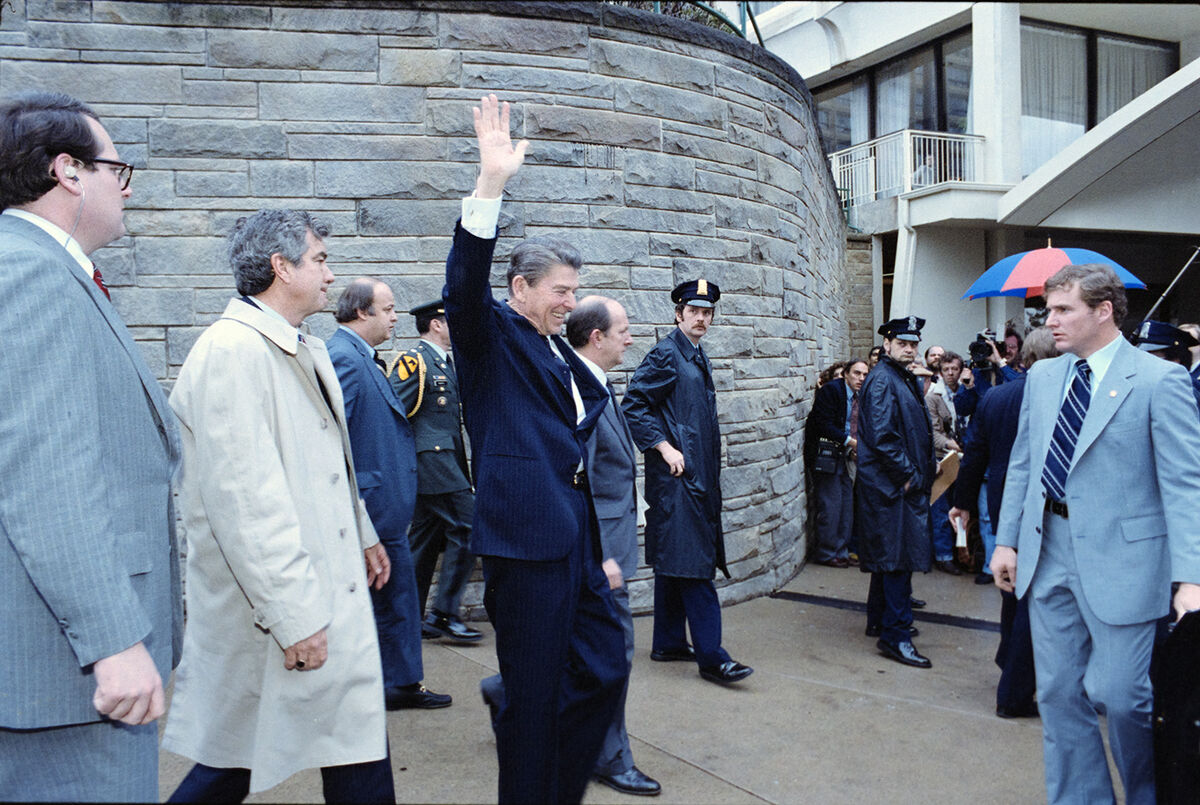
Ronald Reagan had been in office for just 69 days when it happened. He was riding a wave of optimism — “Morning in America” energy before that slogan even existed — and the country was still calibrating to the idea of a Hollywood actor running the free world. Reagan had just delivered a luncheon address to AFL-CIO representatives at the Washington Hilton, talking labor and economics to a crowd that wasn’t entirely in his corner. By all accounts, the speech went fine. What waited for him outside was something else entirely.
The Washington Hilton was considered one of the safest venues in the city for presidential visits. The Secret Service had inspected it more than 100 times since the early 1970s, and the hotel had a specially designed enclosed passageway — nicknamed “President’s Walk” — built specifically after the 1963 assassination of John F. Kennedy. Nobody was particularly worried. The public exposure between the hotel exit and Reagan’s waiting limousine was a mere 30 feet. Thirty feet.
It was enough.
The Six Shots in 1.7 Seconds
At precisely 2:27 p.m., Reagan exited through “President’s Walk” onto Florida Avenue and began moving toward the presidential limousine. A small group of reporters waited behind a rope barricade. Among the crowd — having slipped through not one but two security layers — stood a 25-year-old drifter from Colorado named John Warnock Hinckley Jr.
As an Associated Press reporter shouted “Mr. President—”, Hinckley dropped into a crouch and fired a Röhm RG-14 .22 caliber revolver six times in just 1.7 seconds. All six shots technically missed Reagan directly — but the chaos they caused was catastrophic.
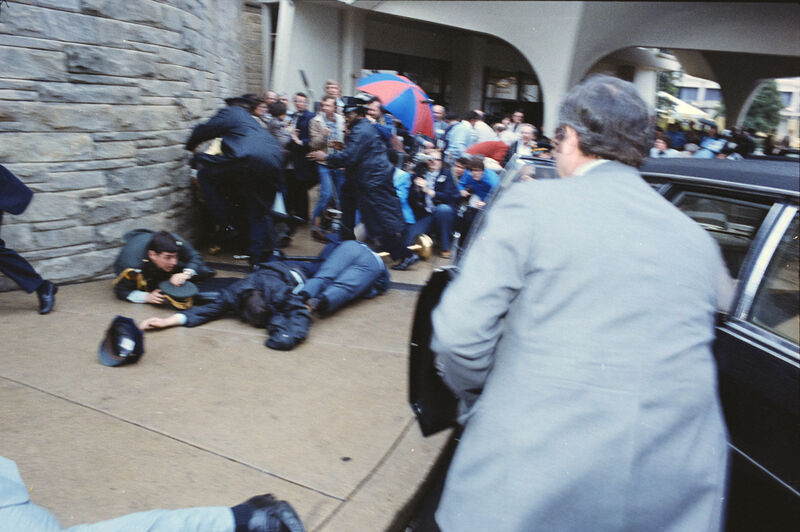
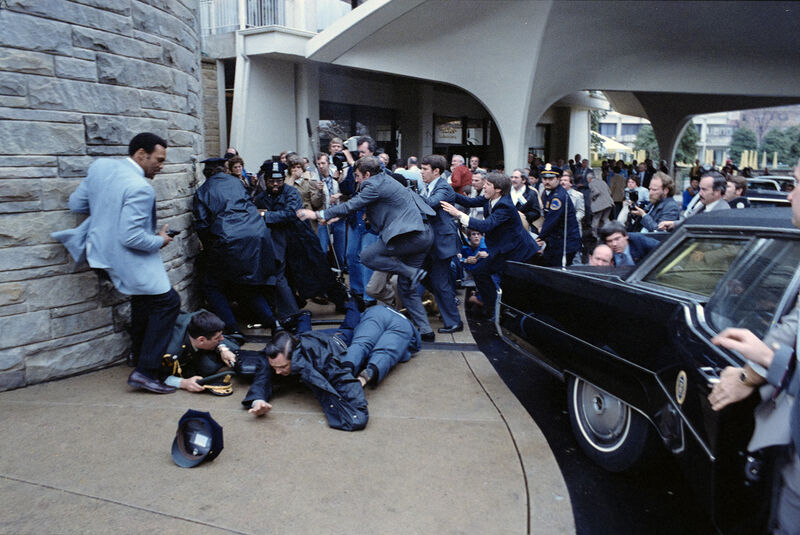
The first bullet hit White House press secretary James Brady in the head, above his left eye. The round passed through beneath his brain and detonated — Hinckley had loaded the gun with Devastator brand cartridges, designed to explode on impact. Brady collapsed immediately. The second shot struck D.C. police officer Thomas Delahanty in the back of the neck as he turned to identify the shooter. The third overshot entirely, striking a building across the street. The fourth hit Secret Service agent Tim McCarthy — who had deliberately spread his arms and legs wide to make himself a human shield between the gunman and the president — in the chest.
The fifth round hit the bullet-resistant glass of the open limousine door. The sixth and final bullet ricocheted off the armored side of the limousine, squeezed through the gap between the door frame and the car body, and punched into Reagan’s left underarm. It grazed a rib, punctured his lung, and came to rest less than an inch from his heart.
The Hero Nobody Talks About: Jerry Parr
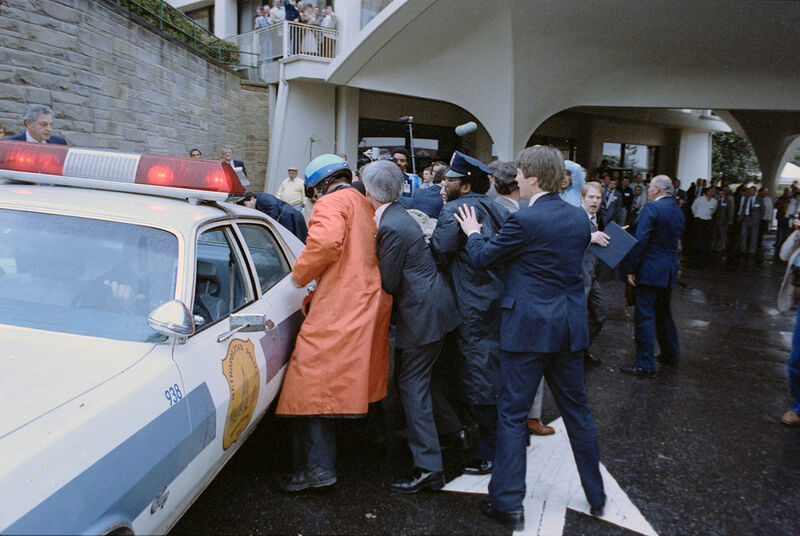
Special Agent Jerry Parr is one of the great unsung figures in American history. When the shots rang out, Parr almost instantaneously grabbed Reagan by the shoulders, dove with him toward the open rear door of the limousine, and essentially threw both of them into the car. His reflexes were so fast that his actions likely saved Reagan from taking a bullet to the head. That sixth ricocheting round only hit Reagan after Parr had pushed him most of the way into the vehicle.
Here’s what makes Parr’s story even more remarkable: as a child, he had seen the 1939 film Code of the Secret Service starring Ronald Reagan. That movie inspired him to join the Secret Service. Forty years later, he saved the man who had once inspired him. You genuinely cannot make this stuff up.
Initially, Parr didn’t even know Reagan had been hit. After checking the president’s body and finding no blood, Parr radioed that “Rawhide is OK” — Reagan’s Secret Service codename — and ordered the driver to head back to the White House rather than a hospital. It wasn’t until Reagan coughed up bright frothy blood that Parr changed the call and ordered an immediate diversion to George Washington University Hospital.
The Race to GW Hospital
Reagan arrived at George Washington University Hospital at 2:35 p.m. — just eight minutes after the shooting. He was in serious trouble, though almost nobody realized how serious yet. He walked into the hospital under his own power, then collapsed. His blood pressure had dropped dramatically, and he was losing blood fast from the punctured lung.
Reagan’s famous wit didn’t desert him even on the gurney. When doctors were preparing him for emergency surgery, he reportedly told the medical team: “Please tell me you’re all Republicans.” One of the surgeons, a Democrat, reportedly replied: “Today, Mr. President, we’re all Republicans.”
Later, when Nancy Reagan arrived at the hospital, Reagan greeted her with another line for the ages: “Honey, I forgot to duck.” He’d borrowed it from boxer Jack Dempsey, who said the same thing to his wife after losing the 1926 heavyweight championship to Gene Tunney. Whether Reagan had that reference in mind or it just fell out naturally, it perfectly encapsulated the man — keeping the mood light even while surgeons prepared to dig a bullet out of his chest cavity.
The surgery took two hours. The .22 caliber round had lodged less than an inch from his heart. Reagan, 70 years old at the time of the shooting, had lost more than half his blood supply. Dr. Benjamin Aaron, who led the surgical team, later said they were genuinely worried Reagan might not survive. He did — and was released from the hospital on April 11, just 12 days after being shot.
The Taxi Driver Obsession
The “why” behind Hinckley’s shooting spree is one of the strangest, most disturbing stories in American history. His motivation had essentially nothing to do with Reagan’s politics. It had everything to do with a movie and a young actress.
Hinckley had seen Martin Scorsese’s 1976 film Taxi Driver — in which Robert De Niro plays troubled loner Travis Bickle, who plots to assassinate a presidential candidate — at least 15 times. He became obsessed with Jodie Foster, who played a teenage prostitute in the film. When Foster enrolled at Yale University in 1980, Hinckley enrolled in a writing class there to be near her. He wrote her letters. He called her twice. She told him she wasn’t interested. He didn’t give up.
Hinckley decided that if he could pull off the same kind of dramatic act as Travis Bickle — if he could become a national figure by shooting a president — Foster would finally see him as her equal. About two hours before the shooting, he wrote her a letter explaining his plan. “I would abandon the idea of getting Reagan in a second,” he wrote, “if I could only win your heart and live out the rest of my life with you.”
He mailed nothing. He went to the Hilton instead.
The trial that followed riveted the nation. On June 21, 1982, a jury found Hinckley not guilty by reason of insanity on all 13 counts — a verdict that shocked the public and triggered a nationwide debate about the insanity defense in criminal law. He was committed to St. Elizabeths Hospital psychiatric facility. He wasn’t fully discharged from psychiatric supervision until 2022.
“I Am in Control Here” — The Alexander Haig Moment
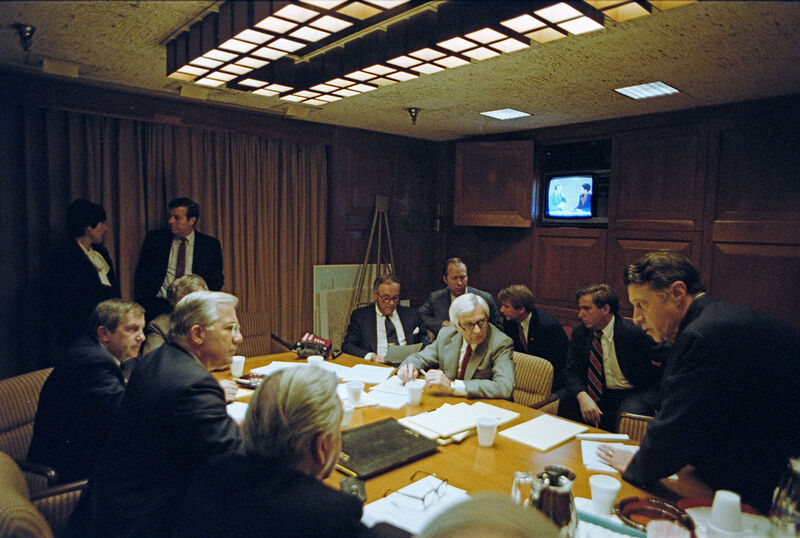
While Reagan was in surgery, the White House was in controlled chaos. Vice President George H.W. Bush was in the air, flying back to Washington from Fort Worth, Texas. Someone needed to project stability, and Secretary of State Alexander Haig stepped up — perhaps a bit too enthusiastically.
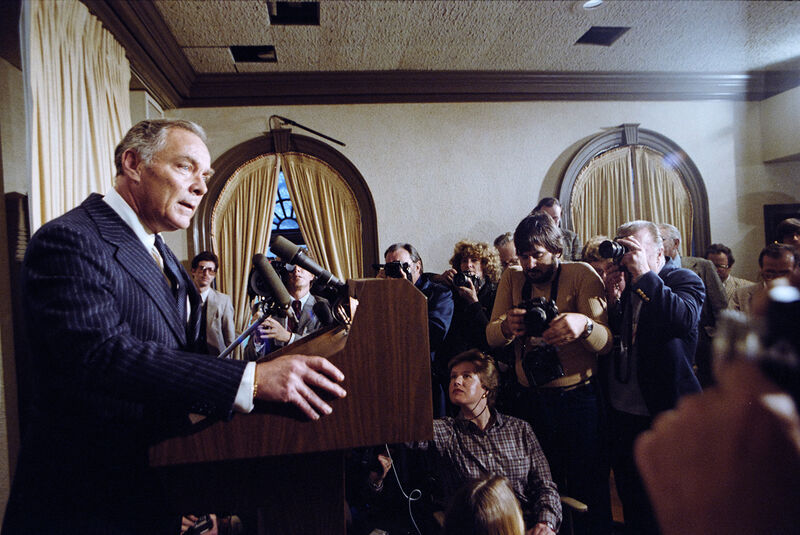
Haig strode to the White House press room and, visibly shaking on camera, announced: “As of now, I am in control here, in the White House, pending the return of the Vice President.” The statement was well-intentioned but constitutionally incorrect. Haig was actually fourth in the line of succession, behind Bush, Speaker of the House Tip O’Neill, and President pro tempore of the Senate Strom Thurmond. The clip became iconic — and for many Gen Xers who grew up watching news coverage of the 1980s, Haig’s sweating, trembling “I am in control here” is one of those indelible TV moments.
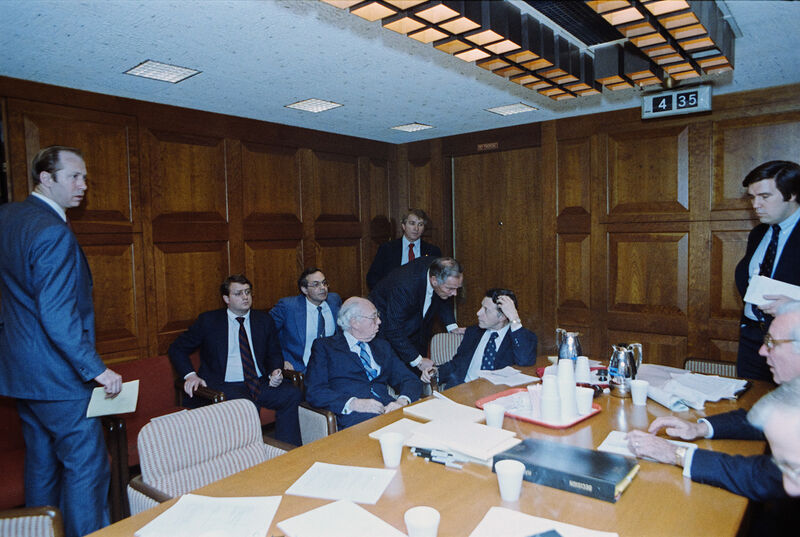
The actual situation room meeting was more composed. Defense Secretary Caspar Weinberger, CIA Director William Casey, and senior White House staff gathered to manage the crisis while the president was unconscious on an operating table. The Cold War tensions of the era made clear presidential succession not just a procedural question but a national security imperative — and the Soviet Union was absolutely watching.
The Ripple Effects
James Brady never fully recovered. The bullet to his head left him with permanent brain damage and paralysis, ending his role as press secretary. But Brady turned his injury into advocacy, becoming one of the most effective gun control campaigners in American history. In 1993, the Brady Handgun Violence Prevention Act — commonly known as the Brady Bill — was signed into law, requiring background checks for firearm purchases. Brady died in August 2014, and the medical examiner ruled his death a homicide, directly caused by the 1981 bullet wound — 33 years after the fact.
For Reagan himself, the shooting had a profound effect on his sense of purpose. In his diary, he wrote that he had decided his survival was an act of divine intervention, and that God must have spared him for a reason — specifically, to work toward ending the Cold War. Reagan’s famous “Star Wars” SDI speech of 1983 and his subsequent push for a nuclear-free world were, by his own account, partly rooted in the near-death experience of that March afternoon.
The attack also had political consequences. Reagan’s approval ratings surged in the aftermath — the public’s sympathy for a president who had survived an assassination attempt with his humor intact was enormous. His legislative agenda, including the massive 1981 tax cuts, sailed through Congress in the months following the shooting with significantly less opposition than it might otherwise have faced.
How It Felt in Real Time
For Gen X kids in 1981, this was the first major breaking news event many of them really understood. If you were eight or nine years old, you knew something enormous had happened. TV networks broke into regular programming — ABC News anchor Frank Reynolds famously got frustrated on-air with conflicting reports about James Brady’s condition. At one point, the networks erroneously reported that Brady had died. Reynolds, visibly distressed, corrected the report and reportedly slammed papers on the desk in frustration. It was raw, unrehearsed, imperfect television — nothing like the slick crisis coverage that would follow in later decades.
Walter Cronkite was there. Tom Brokaw was there. The big three networks competed for every update, and Americans sat glued to their TV sets in a way that looks almost quaint now but felt utterly terrifying then. The country held its breath for hours waiting to find out if its president would live.
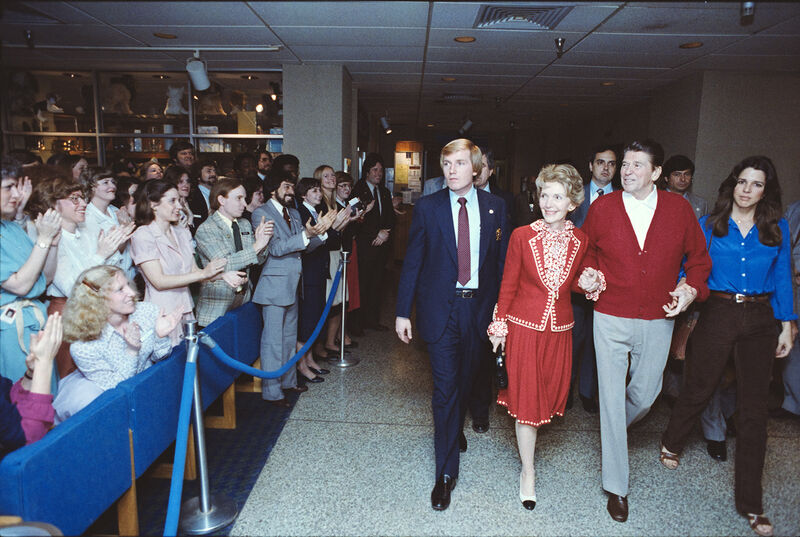
He did. And he walked out of George Washington University Hospital on April 11, waving to the crowd, visibly weakened but alive. Typically, he had insisted on walking out under his own power rather than being wheeled out in a chair. Reagan being Reagan, until the very end.
The Gun That Changed History
The Röhm RG-14 revolver Hinckley used was purchased at Rocky’s Pawn Shop in Dallas, Texas on October 13, 1980 — just days before Election Day. ATF agents traced it in just 16 minutes after the shooting. The gun cost $29. The Devastator explosive cartridges Hinckley loaded it with were designed to explode on impact; only the round that hit Brady actually detonated.
The ease with which Hinckley obtained the weapon — a convicted felon in a drug possession case wouldn’t have been able to buy it, but Hinckley’s prior weapons arrest in Nashville had never been flagged to the FBI — became central to the subsequent gun control debate. The Brady Act that followed over a decade later was, at its core, about closing exactly that kind of gap.
The gun itself is now on display at the U.S. Secret Service’s restricted-access museum, alongside the armored-glass limousine window that took Hinckley’s fifth shot — evidence of just how close things came to going much, much worse.
Forty-five years on, the footage from outside the Washington Hilton still hits hard. The rapid succession of gunshots. The scramble of bodies. The Secret Service agent spreading himself wide to take a bullet. The limousine peeling out. If you want to understand the 1980s — the paranoia, the Cold War anxiety, the strange mixture of optimism and dread that colored the decade — March 30, 1981 is as good a place to start as any. It was the day a Hollywood actor survived an assassination attempt through luck, a doctor’s skill, and one Secret Service agent’s supernatural reflexes. The decade that followed was shaped, in ways large and small, by all of it.
For more on the Reagan era and the political climate that defined the 1980s, check out our piece on Reagan’s Star Wars SDI Speech and the Cold War anxiety that permeated the decade, as well as our deep dive into The Day After, the 1983 TV movie that brought nuclear fears directly into America’s living rooms.
Watch It Happen
The CBS News footage from March 30, 1981, including live coverage of the shooting outside the Washington Hilton and the chaotic hours that followed, remains some of the most dramatic live television ever broadcast:
Sources
- Wikipedia: Attempted Assassination of Ronald Reagan — Comprehensive account of the events of March 30, 1981
- Ronald Reagan Presidential Library: Assassination Attempt Photo Gallery — Official White House photographs from March 30, 1981
- History.com: Reagan Assassination Attempt — Historical overview and timeline of events