The DeLorean: How a Failed Car Became a Pop Culture Icon
The DeLorean DMC-12 produced 9,000 cars in three years, bankrupted its creator, and got him arrested in an FBI cocaine sting. By every metric the auto industry uses, it was a disaster. Then a film school grad from Long Beach named Robert Zemeckis cast it as a time machine in a summer movie nobody expected to hit, and a $25,000 commercial flop turned into the most famous automobile in cinema history.
There is no other car that lost money this badly and won the culture this completely. The DMC-12 cratered at the dealership in 1982 and became immortal in July 1985, and that two-year gap between bankruptcy and resurrection is one of the wildest plot twists in American business. The car never got faster, never got cheaper, never sold better. It just got Marty McFly behind the wheel, and suddenly the stainless-steel sled with the gullwing doors meant something the engineers never engineered for it.
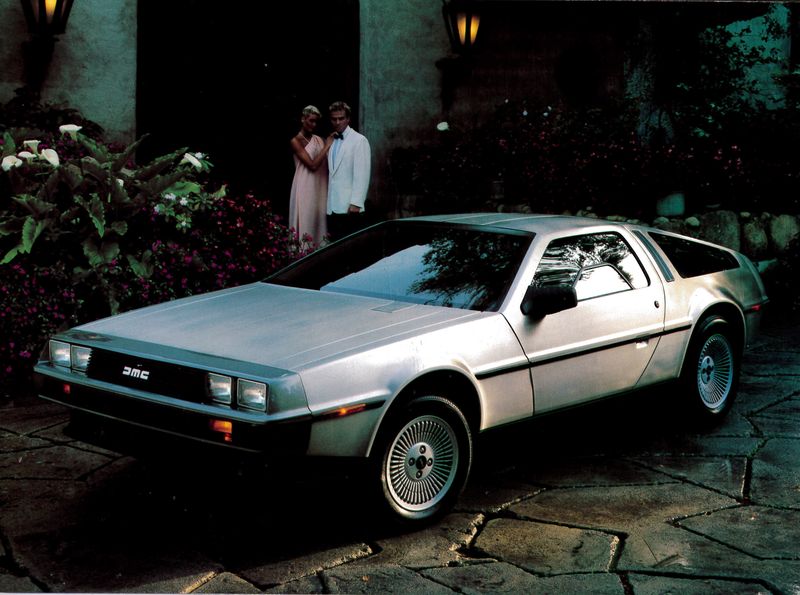
The 1981 DMC-12 in its original publicity push — pitched as the future of motoring.
The Retro Almanac
A monthly roundup of "on this day" highlights from that month, decades back — plus first dibs on new retro merch drops. No spam, just the good stuff.
John DeLorean Was Detroit’s Last Rock Star
Before the gullwing doors, before the cocaine trial, before Crispin Glover’s hairpiece, John Zachary DeLorean was the most charismatic man inside General Motors. He ran Pontiac by the age of 40 — the youngest division head in GM history — and the car that put him on the map was the 1964 Pontiac GTO. That GTO is generally credited as the first true muscle car, and DeLorean got nearly all the credit for shoving it through GM’s bureaucracy by stuffing a 389 V8 into a midsize Tempest body and calling it a trim option so head office wouldn’t notice.
He looked like a movie star. He dated models. He showed up to corporate meetings in open-collared shirts while everyone else was buttoned to the throat. In 1973 he walked away from a $650,000-a-year GM salary — well over $4 million in today’s money — to start his own car company. The reasoning he gave the press was Detroit had lost its nerve. The real story was DeLorean had spent two decades watching GM kill interesting cars because of accountants, and he was done.
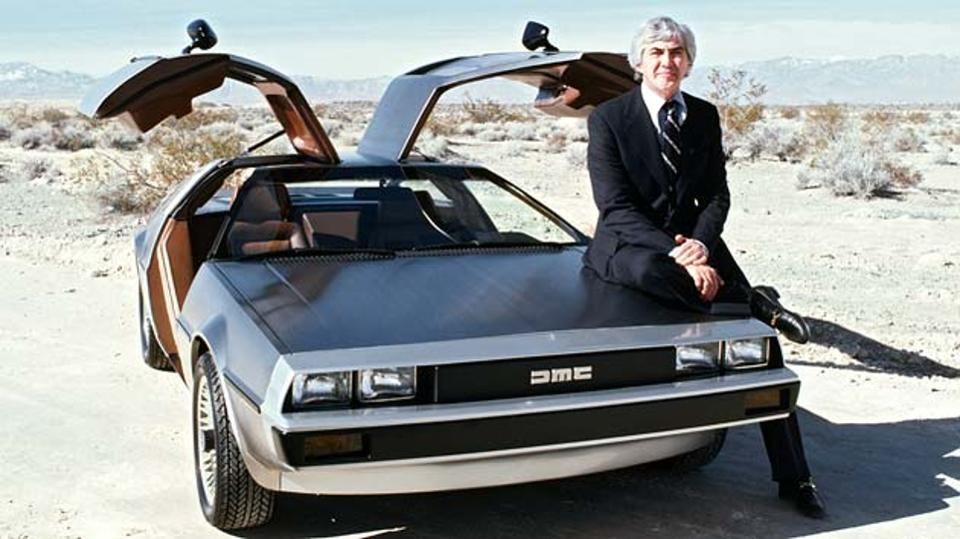
John DeLorean on the hood of his car in a desert publicity shoot — the only photo most people ever needed to see to remember who he was.
The DMC-12 Got Built in Belfast During The Troubles
The factory site was the strangest part of the whole DeLorean story. After being courted by Puerto Rico and Ireland, DeLorean took a deal from Margaret Thatcher’s government to build the DMC-12 in Dunmurry, just outside Belfast, in a region devastated by sectarian violence and chronic unemployment. The British government invested over £100 million. The 550,000 square foot facility went up in 16 months — a build pace that would be considered impossible today — and employed roughly 2,500 people at peak.
What is remarkable, and rarely mentioned, is that the workforce was deliberately balanced between Catholic and Protestant employees during the worst years of The Troubles. The Dunmurry plant was one of the few places in Belfast where the two communities worked side by side without incident. The cars themselves were complicated. The decision to use brushed stainless steel for the body panels meant every minor scratch showed and the panels could not be repaired conventionally, but the workforce hit production targets anyway and shipped 7,500 cars in their first year.
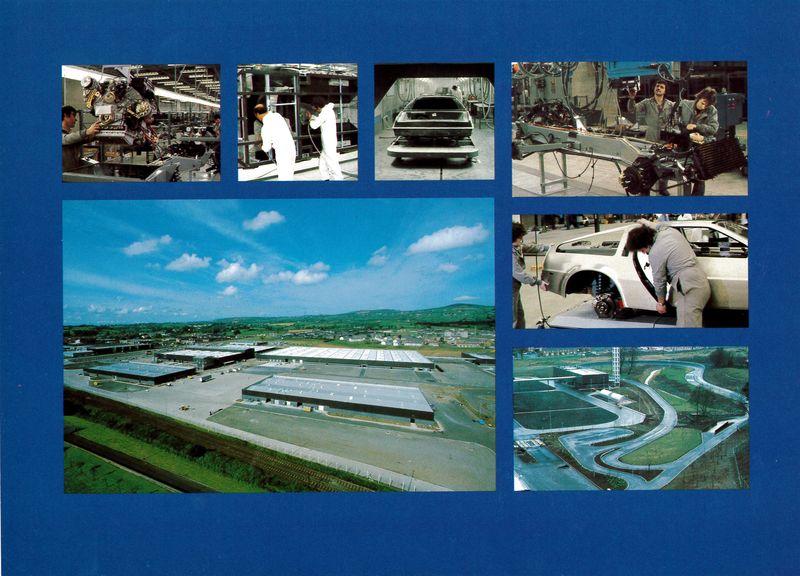
The Dunmurry factory in Northern Ireland — built in 16 months, killed in less than three years.
The Car Itself Was Slower Than Your Aunt’s Buick
Here is the punchline buried under three decades of nostalgia: the DMC-12 was not a very good sports car. The PRV V6 engine — co-developed by Peugeot, Renault, and Volvo — made 130 horsepower in the US-emissions version. Zero to sixty took roughly 9.5 seconds. Top speed was around 130 miles per hour and getting there took a while. For comparison, a 1981 Chevrolet Camaro Z28 cost less, hit sixty in 7.5 seconds, and didn’t require you to wax the body with a special cloth.
The original MSRP was $25,000, which in 1981 dollars meant the DMC-12 was priced against the Porsche 911 SC. That comparison was brutal. Buyers got a car with a slow engine, electrical gremlins, a fingerprint-prone body, gullwing doors that leaked in the rain, and zero brand prestige. Reviewers were polite about the looks and unsparing about everything else. Car and Driver basically said it was a Lotus chassis carrying a refrigerator.
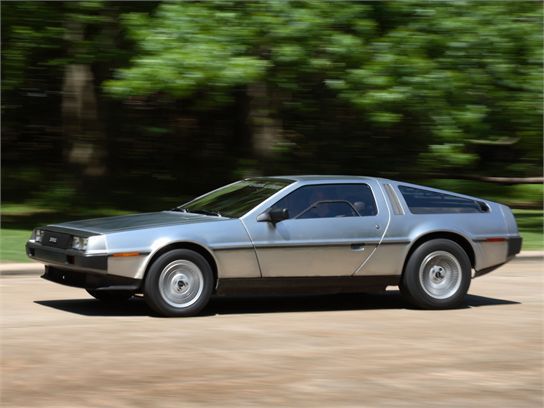
The car looked spectacular in motion. It was also, by 1981 sports car standards, slow.
October 1982 Was the Worst Month a Carmaker Ever Had
By early 1982 the DMC-12 was not selling. The recession of 1981–82 had killed luxury car demand, the strong dollar had made the British-built DeLorean more expensive in its primary US market, and the company was burning cash. In February, the DeLorean Motor Company entered receivership. The Dunmurry plant shut down. On October 19, 1982, John DeLorean was arrested at the Sheraton Plaza La Reina hotel in Los Angeles after being filmed by the FBI handling a suitcase containing 60 pounds of cocaine.
The sting was textbook entrapment, which is what DeLorean’s defense argued and what the jury ultimately agreed with — he was acquitted on all charges in August 1984. But by the time the verdict came down, the company was already gone. Seven days after the arrest, on October 26, 1982, DMC filed for bankruptcy. The leftover inventory of 9,000 cars — split between finished vehicles and partially assembled ones in the Dunmurry plant — got sold off piecemeal, and that ended the carmaking part of the story. What happened next was the part nobody planned for.
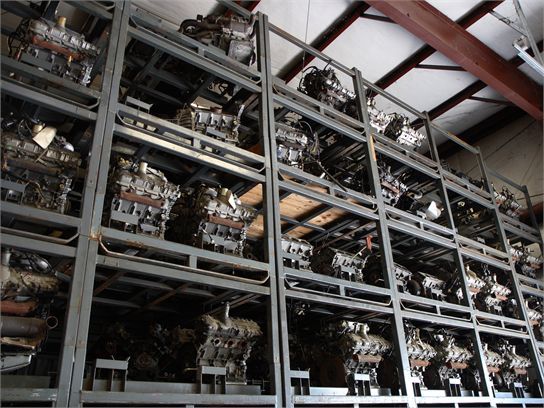
Surplus PRV V6 engines and parts — most of the original company’s leftover inventory ended up keeping the cars alive after DMC died.
How a Failed Car Became a Pop Culture Icon
The original script for Back to the Future used a refrigerator as the time machine. Robert Zemeckis and producer Bob Gale changed it because they were worried kids would climb into fridges trying to imitate the movie. What they needed was a vehicle that looked like the future. By 1984, when the production started building the props, the DMC-12 was already a punchline — a dead car you could buy used for less than a Toyota Celica. That obscurity was the point. Zemeckis later said the gullwing doors were what sold him. When they swung open at night, the car looked like a UFO landing.
Back to the Future released July 3, 1985 and grossed over $381 million worldwide on a $19 million budget. Universal built three main DMC-12 props for the film, designated Hero A, B, and C. The Hero A car was the close-up vehicle Michael J. Fox and Christopher Lloyd interacted with on camera. It survived all three sequels. After production wrapped, it sat outdoors at Universal Studios Hollywood for nearly two decades as a backlot tour attraction. By the early 2010s it was rusting apart.
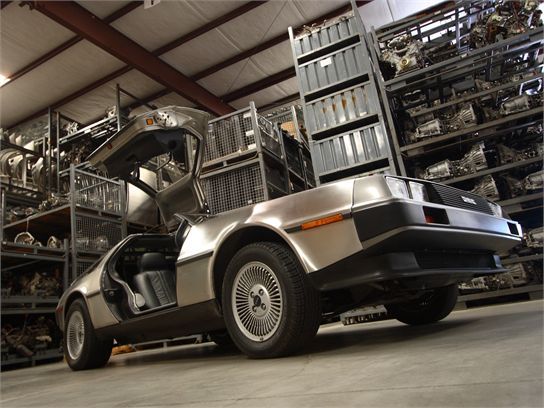
Those gullwing doors, more than any other detail, were what convinced Zemeckis the DMC-12 had to be the time machine.

The $500,000 Restoration That Saved Hero A
In 2012, a group of Back to the Future fans and DeLorean specialists petitioned Universal to authorize a full restoration of the Hero A car. The project was led by DeLorean expert Joe Walser and took roughly two years. Total cost ran between $500,000 and $700,000, depending on which estimate you trust, and the restoration was documented in the 2016 short film OUTATIME: Saving the DeLorean Time Machine. The restored Hero A went on permanent display at the Petersen Automotive Museum in Los Angeles on April 22, 2016, and it’s been the centerpiece of the museum’s Hollywood Dream Machines exhibit ever since.
The B car has been at Universal Studios Florida since the 1990s, where it sat outside for years before getting moved indoors. The C car was the stunt vehicle, and it was essentially destroyed by the end of filming on the third movie — partial remains exist, but it was never a candidate for restoration. There are also several replica DeLorean time machines that toured the convention circuit. Most fans who think they’ve seen the Hero A have actually seen a replica.
The DMC-12 Has Outlasted Almost Every Other 80s Sports Car
The Pontiac Fiero is forgotten. The Bricklin SV-1 is a trivia question. The Avanti II is in three museums and one guy’s barn. The DeLorean is everywhere. There’s an active DMC-12 community in 2026 with somewhere around 6,500 cars still on the road, an annual Eurofest gathering at the Dunmurry site, and a successor company — also called DeLorean Motor Company, based in Humble, Texas — that has been selling restored DMC-12s and manufacturer parts since 1995. They acquired most of the original NOS inventory after the Belfast factory shut down and have been keeping the car alive on a parts level for thirty years.
This is the part of the story that doesn’t get told often enough. The DeLorean DMC-12 outlived its creator, outlived its company, outlived its critics, and outlived most of its 1981 competition. It is, by some measures, the most owner-supported obsolete car in American history. The community that formed around the car was as much about the underdog story as the car itself. People bought a DeLorean in 1995 not because it was fast or luxurious but because it was a car that had survived being declared dead.
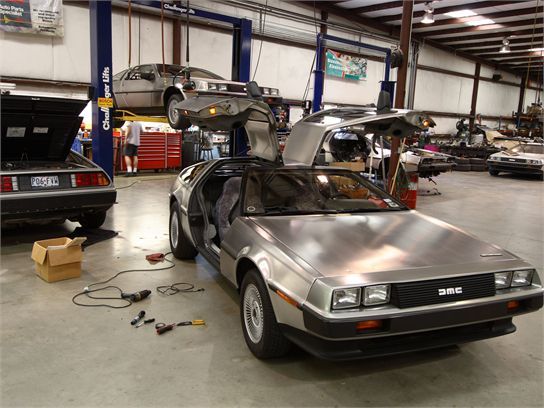
Two DMC-12s in a modern restoration shop — the cars outlived the company by four decades.

What the DeLorean Actually Means in 2026
Forty years after Back to the Future hit theaters, the DMC-12 has become shorthand for a specific kind of 1980s optimism. It was the car that believed in the future — in stainless steel, in gullwing doors, in the idea that a single charismatic guy could start a car company and beat Detroit at its own game. The car failed. The dream did not. Watching Marty McFly hit 88 miles per hour in 2026 still feels like watching the last moment American culture genuinely believed tomorrow would be cooler than today.
The car is also a Rorschach test. To car enthusiasts it’s an underbuilt Italian-designed European sports car with serious engineering compromises. To Back to the Future fans it’s a religious artifact. To 80s nostalgia merchants it’s a $40,000 used car that doubles as a marketing prop. All three are correct, and that contradiction — the gap between what the car was and what it became — is exactly the point. If you want to understand why 80s nostalgia still hits so hard for Gen X, look at the DeLorean. It is the entire decade compressed into 2,712 pounds of stainless steel.

Where to Actually See a Real DeLorean Today
The Hero A car is at the Petersen Automotive Museum in Los Angeles, on permanent loan from Universal Studios Hollywood. The Hero B car lives at Universal Studios Florida, which opened June 7, 1990 and added the DeLorean to its Back to the Future ride attraction in the same year. Eurofest, held every five years at the original Dunmurry factory site in Northern Ireland, draws hundreds of owners and their cars and remains the largest gathering of DMC-12s in Europe. If you want one of your own, the Texas-based DeLorean Motor Company will sell you a fully restored 1981–1983 DMC-12 starting around $55,000 — more than three times what one cost new — and demand continues to outstrip supply.
The car most people think killed John DeLorean’s career was actually the one that saved his legacy. He died in 2005 at age 80, and by every obituary written that week, he was remembered as the man who made the DeLorean. Not the man who made the Pontiac GTO, not the youngest division head in GM history, not the engineer who held 200 patents. The man who made the DeLorean. That outcome was statistically improbable in 1982 and felt impossible by 1984. A failed car became a pop culture icon because of one casting decision and a script change away from a refrigerator, and there is something deeply Gen X about loving a car for exactly that reason.
Sources
- John DeLorean Was a Larger Than Life Automotive Figure (MotorCities) — career history including the 1964 GTO and 1973 GM departure.
- Back to the Future DeLorean at Petersen Automotive Museum (Discover LA) — Hero A car restoration and 2016 unveiling.
- DeLorean DMC-12 Exclusive Photo Gallery (AutoWeb) — production specs and surviving parts inventory.
- The DeLorean Factory, Belfast: history, location, and key facts — Dunmurry plant construction and workforce details.
- 88MPH: The Story of the DeLorean Time Machine (Hagerty Drivers Foundation) — full documentary on the Hero A car.
Watch: The Full DeLorean Time Machine Documentary
Browse retro and vintage-inspired apparel at the RetroRadical shop →
The Retro Almanac
A monthly roundup of "on this day" highlights from that month, decades back — plus first dibs on new retro merch drops. No spam, just the good stuff.