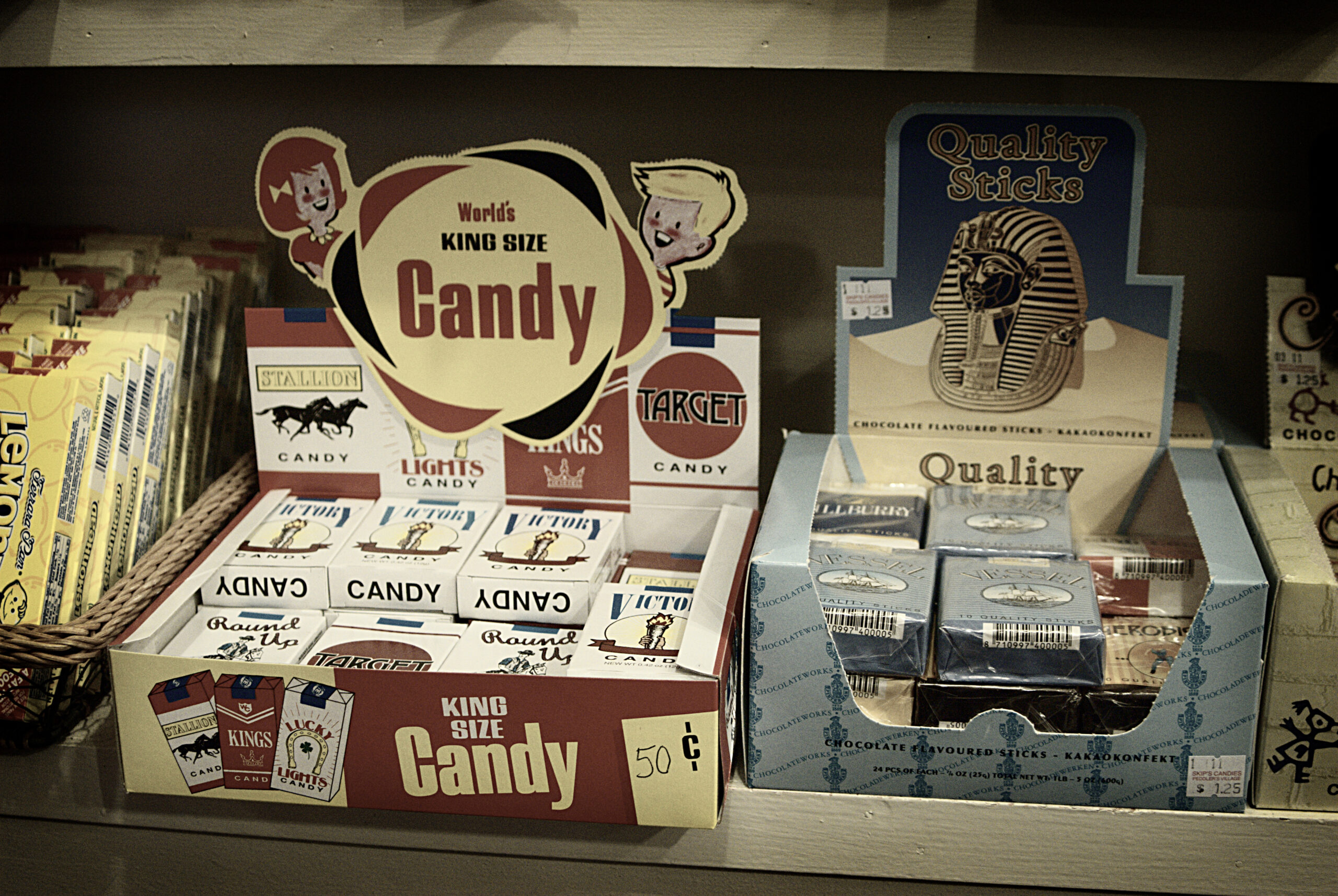
Candy cigarettes display in store 80s nostalgia
|

Smoking on Airplanes, Candy Cigarettes & Joe Camel: When Smoking Was Everywhere

A Haze That Hung Over Everything

If you grew up in the 1970s or 1980s, you grew up breathing secondhand smoke. Not occasionally. Not in certain places. Everywhere. The grocery store. The doctor’s waiting room. Your aunt’s kitchen. The back seat of your dad’s Buick with the windows rolled up in January. Smoking on airplanes at 35,000 feet while a flight attendant handed you a tiny bag of peanuts. It was all perfectly normal, and nobody batted an eye.

For Gen Xers, cigarette smoke wasn’t an occasional annoyance — it was the ambient atmosphere of our entire childhood. It’s hard to explain to younger generations just how pervasive smoking was. The world didn’t smell like laundry detergent and hand sanitizer. It smelled like Marlboro Reds and stale ashtrays. And somehow, we all just… lived with it.

Smoking on Airplanes Was Just Tuesday

This is the one that truly blows younger people’s minds. Yes, people smoked on airplanes. In a sealed metal tube hurtling through the sky at 500 miles per hour. With recirculated air. Sitting elbow-to-elbow with strangers, children, and pregnant women.

Airlines didn’t ban smoking overnight. It was a slow, painful process. The first smoking restrictions on flights started in 1988 when Congress banned smoking on domestic flights under two hours. Two years later, it extended to flights under six hours. It wasn’t until 2000 that federal law banned smoking on all flights to and from the United States. That means some of us were still breathing in cabin smoke well into the Clinton administration.

Vintage Camel cigarettes advertisement from the era when smoking was everywhere

Before the bans, airlines handled it the same brilliant way restaurants did — by creating a “smoking section.” On a plane. As if smoke respects invisible boundaries. Row 25 and back was smoking; Row 24 was non-smoking. The smoke apparently got the memo and stayed behind Row 24. Sure. Absolutely. That’s how air works.

The ashtrays are still there, by the way. Next time you’re in an airplane lavatory, look at the door. There’s a little metal ashtray built into it. Federal regulations actually require them to still be there, just in case someone ignores the law. It’s a tiny archaeological artifact of a time when the sky was full of smoke.

The Smoking Section: A Beautiful Lie

Restaurants had smoking sections too, and they were just as ridiculous as the ones on planes. You’d walk in, and the hostess would ask: “Smoking or non?” as if she were offering a choice between parallel dimensions rather than two sides of the same Denny’s.

Man smoking outside restaurant in New York City in the late 1980s

The “non-smoking section” was usually separated from the smoking section by… nothing. A half wall, maybe. A row of fake plants. Sometimes just a sign on a little stand. You could be sitting in “non-smoking” eating your Grand Slam breakfast while the guy at the next table — literally three feet away — was chain-smoking Camels and flicking ash into his coffee saucer.

Malls had ashtrays everywhere. Those big standing ones with sand in the top — every twenty feet in every corridor of every shopping mall in America. People smoked while they shopped. They smoked in the food court. They smoked walking past the Gap and B. Dalton and Spencer Gifts. The mall smelled like a combination of Cinnabon and Virginia Slims, and that was just the fragrance of American commerce.

The Teacher’s Lounge: Where the Smoke Was Thickest

Every school had a teacher’s lounge, and every teacher’s lounge was a smoke-filled cave of mystery. Students weren’t allowed in, which made it even more intriguing. You’d walk past the closed door and see wisps of smoke curling out from underneath. The muffled sound of adult laughter and the clink of coffee mugs. It was like a speakeasy, except the contraband was Kools and the password was a teaching certificate.

Teachers smoked. Openly. In the building where children spent eight hours a day. The gym teacher smoked. The science teacher smoked. The principal probably smoked. They’d emerge from the teacher’s lounge between periods smelling like they’d just survived a structure fire, smooth their hair, and go teach fractions like nothing happened.

Cigarette vending machine that was a common sight in the 80s

And it wasn’t just the teacher’s lounge. Coaches smoked on the sidelines during football games. Parents smoked in the bleachers at school plays. The PTA meeting was a blue haze of Parliament Lights and passive aggression. Smoking was woven into every single public space, and the idea that it might be harmful to children was treated like the opinion of cranks and health nuts.

Candy Cigarettes: Training Wheels for Addiction

If you want to understand how deeply normalized smoking was, consider that we gave children fake cigarettes as candy. Not ironically. Not as a commentary on consumer culture. As an actual product marketed to kids, sold at every gas station and grocery store checkout line in America.

Candy cigarettes display in store from the era of normalized smoking

Candy cigarettes came in two varieties. There were the chalky white sugar sticks that came in little boxes designed to look exactly like real cigarette packs — Marlboro, Lucky Strike, Camel — complete with fake brand names. You’d pull one out, pretend to puff on it, and the powdered sugar on the end would create a little puff of “smoke.” Then you’d eat it, and it tasted like sweetened chalk.

The other kind was bubble gum cigarettes, wrapped in paper with a thin layer of powdered sugar so that when you blew through them, actual white powder came out the end. Like smoke. These were marketed to children. In the open. On purpose. And nobody thought it was weird because smoking was so deeply embedded in the culture that mimicking it was considered cute.

Candy cigarettes are still technically legal in the United States, though they’ve been banned in several other countries. Most brands have quietly disappeared from mainstream stores, but you can still find them at nostalgic candy shops and online retailers. They’re a relic of a time when we casually trained children to imitate one of the most addictive and deadly habits on the planet, and then wondered why so many of them grew up to be smokers.

Joe Camel: The Cartoon That Sold Cancer

And then there was Joe Camel. If candy cigarettes were the appetizer, Joe Camel was the main course. R.J. Reynolds introduced this smooth, sunglasses-wearing cartoon camel in 1988, and within three years, Camel’s share of the under-18 cigarette market jumped from 0.5% to 32.8%. That’s not a typo. A cartoon camel moved the needle by 6,000 percent among children.

Joe Camel Zippo lighter merchandise from 1996 showing the power of tobacco marketing

Joe Camel was everywhere. Billboards. Magazine ads. T-shirts. Hats. Lighters. Pool table posters. He played saxophone. He rode motorcycles. He wore leather jackets and hung out with attractive cartoon women. He was basically a cartoon character designed by adults to sell cigarettes to children, and it worked spectacularly.

Studies found that six-year-olds could identify Joe Camel as easily as they could identify Mickey Mouse. Let that sink in. Six-year-olds. A study published in the Journal of the American Medical Association in 1991 found that Joe Camel was more recognizable to kids than Fred Flintstone. R.J. Reynolds was doing to children what Saturday morning cartoons had been doing — creating characters that kids loved — except the product was lung cancer.

The FTC finally went after R.J. Reynolds in 1997, and the Joe Camel campaign was killed as part of the massive Tobacco Master Settlement Agreement in 1998. But by then, the damage was done. An entire generation had grown up watching a cartoon camel sell them addiction, and many of them had taken him up on the offer.

The Marlboro Man and the Myth of Cool

Before Joe Camel, there was the Marlboro Man — the rugged cowboy who made smoking look like the most masculine thing a human being could do. From the 1950s through the 1990s, the Marlboro Man was one of the most recognizable advertising icons on the planet. He rode horses. He herded cattle. He stared into sunsets with a cigarette dangling from his lip. He was the American dream with a nicotine habit.

The Marlboro Man iconic cigarette advertising cowboy

The tragic irony? Multiple actors who played the Marlboro Man died of smoking-related illnesses. Wayne McLaren, David McLean, and Dick Hammer all died of lung cancer. McLaren became an anti-smoking activist before his death in 1992, testifying before Congress about the dangers of tobacco. He died at 51.

But in the 1980s, we didn’t know any of that yet — or more accurately, we chose not to think about it. The Marlboro Man was still riding across billboards on every highway in America, and smoking was still shorthand for toughness, independence, and cool. The Surgeon General’s warnings were printed on every pack, but they were about as effective as speed limit signs on the Autobahn.

The Slow Fade to Smoke-Free

The tide started turning in the late 1980s and accelerated through the 1990s. California banned smoking in workplaces in 1995 and in bars and restaurants in 1998 — a move that seemed absolutely radical at the time. New York City followed in 2003. State by state, city by city, smoking got pushed further and further to the margins.

Philip Morris Marlboro tobacco advertising billboard in the wild

Cigarette vending machines disappeared from restaurants and bowling alleys. Tobacco advertising was banned from television (that had actually happened in 1971, but billboards and magazine ads continued for decades). The smoking section became a historical curiosity. And eventually, smoking itself became something people did outside, huddled in designated areas, stamping out butts in receptacles that looked like they were designed by someone who actively hated smokers.

For those of us who grew up in the haze, the transformation has been genuinely surreal. Walking into a restaurant and not smelling smoke feels like visiting an alternate universe. Getting on a plane and breathing clean-ish recycled air feels like luxury. Seeing a Nickelodeon rerun from the 90s and noticing there are no ashtrays in any scene feels like watching footage from another civilization.

We lived through the last era of universal smoking, and we carry it in our lungs — literally and figuratively. The smoke has cleared, but the memories haven’t. And if you ever need proof of just how different the world was, just tell a Gen Zer that your third-grade teacher smoked in the classroom. Watch their face. It’s worth the story every single time.

https://www.youtube.com/watch?v=wGNvBv65ECY

Did your parents smoke in the car with the windows up? Tell us your most “you can’t make this up” smoking story from childhood.

Similar Posts