The Sega Master System: The Underdog Console That Fought Nintendo
If you grew up in the 1980s and your best friend had a Sega Master System instead of a Nintendo, you probably remember feeling like you were part of some kind of secret underground gaming club. While every other kid on the block was obsessed with Mario, you were rocking Alex Kidd, blasting through Fantasy Zone, and wondering why nobody else seemed to understand how awesome your console was.
The Sega Master System was the scrappy underdog of the 8-bit console wars — a machine that was technically superior to the NES in almost every measurable way, yet somehow got absolutely steamrolled in North America. But here’s the thing that makes this story so fascinating: while Nintendo was dominating the United States, the Master System was quietly conquering the rest of the world.
This is the story of the console that refused to die.
From the SG-1000 to the Mark III: Sega’s Rocky Start
Before the Master System existed, Sega was already in the console game — literally. In 1983, the same year the video game industry in North America was busy imploding like a dying star, Sega released the SG-1000 in Japan. And in one of the greatest pieces of terrible timing in gaming history, they launched it on the exact same day as Nintendo’s Famicom: July 15, 1983.


The SG-1000 was… fine. It wasn’t bad, but it wasn’t going to set the world on fire either. Sega knew they needed something better, so they itched and improved until 1985, when they released the Sega Mark III in Japan. This was the real deal — a genuinely powerful 8-bit machine with better graphics capabilities than the Famicom. The Mark III could push more colors on screen, handle smoother scrolling, and generally flex harder than Nintendo’s little gray box.
But Japan was already Nintendo’s territory. The Famicom had a death grip on the Japanese market, and no amount of technical superiority was going to pry those controllers out of kids’ hands. Sega needed a new battlefield.
The Sega Master System Hits America (And Gets Destroyed)
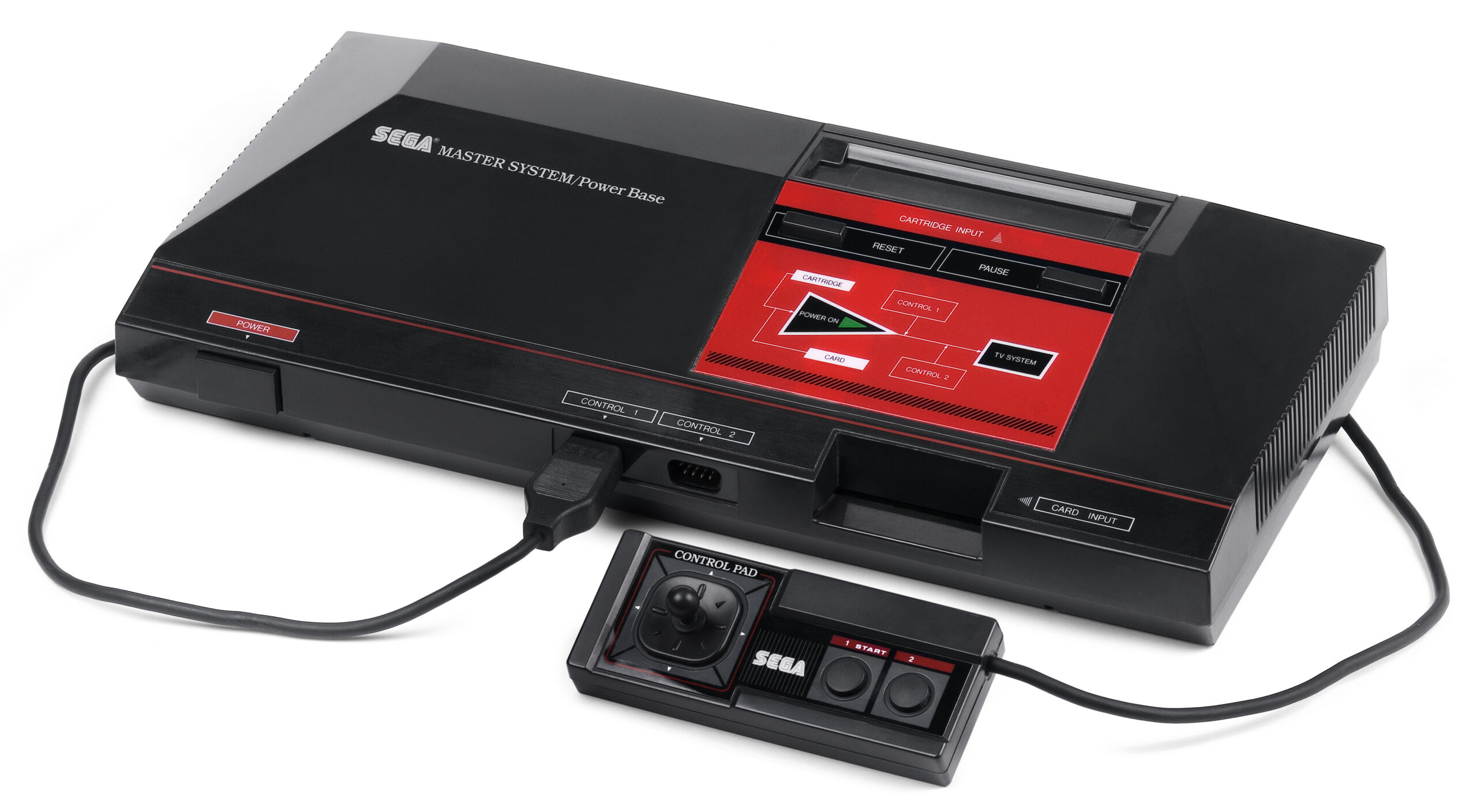
In 1986, Sega repackaged the Mark III for the Western world, gave it a slick new design, and christened it the Sega Master System. The American version was a good-looking piece of hardware — that black-and-red color scheme was legitimately cool, and the console itself looked more “futuristic” than the NES’s boxy VCR aesthetic.

There was just one massive problem: Nintendo had locked down North America tighter than Fort Knox. Thanks to their notorious licensing agreements, third-party developers who made games for the NES were forbidden from releasing those same titles on competing platforms. This meant Sega was fighting with one hand tied behind their back — they had the hardware, but Nintendo had the games. And in the console business, games are everything.
Sega tried. They really tried. They even handed North American distribution over to Tonka (yes, the toy truck company) in 1988, which went about as well as you’d expect. Imagine explaining your cutting-edge gaming console to a bunch of executives whose primary expertise was making yellow dump trucks for toddlers. The Master System ended up capturing roughly 10-15% of the North American market. Not exactly a victory lap.
The Games That Made the Master System Special
Despite the uphill battle, the Sega Master System had some genuinely fantastic games that deserve way more recognition than they get. If you only knew Nintendo’s library growing up, you missed out on some absolute gems.
Alex Kidd in Miracle World was the system’s flagship title, built right into later models of the console. This platformer had you playing as a kid with comically oversized fists, punching your way through colorful worlds and playing rock-paper-scissors boss battles. Yes, you read that right — you fought bosses by playing janken. It was weird, it was wonderful, and it was uniquely Sega.

Phantasy Star was arguably the crown jewel of the entire Master System library. Released in 1987, this RPG was lightyears ahead of anything else on 8-bit hardware. While Dragon Quest and Final Fantasy were doing their thing on the NES with top-down views and medieval settings, Phantasy Star delivered a sci-fi epic with first-person dungeon crawling, animated battle sequences, and a female protagonist named Alis who was saving the galaxy years before Samus took off her helmet. This game alone justified owning a Master System.
Then there was Wonder Boy III: The Dragon’s Trap, a Metroidvania-style adventure game that was so beloved it got a gorgeous HD remake in 2017. The original was a masterclass in game design — you transformed into different animal forms, each with unique abilities, exploring an interconnected world that kept revealing new secrets. It was the kind of game that made you forget you were playing on “the other console.”
And let’s not forget Sonic the Hedgehog on the Master System. While most people associate Sonic with the Genesis, the blue blur also had excellent 8-bit outings. The Master System version of Sonic was a completely different game from its 16-bit counterpart — shorter, tighter, and with some truly devious level design that would make you chuck your controller across the room.

Hardware That Was Ahead of Its Time
Here’s where the Master System really sticks it to the history books: on paper, it was the better machine. The SMS had a Zilog Z80 processor running at 3.58 MHz (same as the NES), but its graphics chip — the Texas Instruments TMS9918-derived VDP — could display 32 colors simultaneously from a palette of 64. The NES? It topped out at 25 colors from a palette of 54. The Master System could also handle larger sprites and smoother scrolling without the kind of flickering that plagued many NES games.
But Sega didn’t stop at basic specs. The Master System had some genuinely wild peripherals that showed the company was always thinking different. The Light Phaser was their answer to the NES Zapper, and it worked great with games like Safari Hunt and Rescue Mission. But the real party trick was the SegaScope 3-D Glasses — actual stereoscopic 3D gaming in 1987, decades before Nintendo’s 3DS or modern VR headsets. Games like Missile Defense 3-D and Space Harrier 3-D used active shutter technology to create genuine depth effects. Was it gimmicky? Absolutely. Was it also incredibly cool for 1987? You bet.

The console also accepted both cartridges and a smaller format called Sega Cards — credit card-sized game media that were cheaper to produce but held less data. It was an interesting idea that never really caught on, but it showed Sega was experimenting with different approaches to game distribution long before anyone else.
Where the Master System Actually Won: Europe, Brazil, and Beyond
Here’s the plot twist that most American gamers don’t know about: while the Sega Master System was getting crushed in the US and Japan, it was absolutely dominating in other parts of the world. And we’re not talking about modest success — we’re talking about complete, total, NES-destroying market domination.
In Brazil, the Master System wasn’t just popular — it was practically a cultural institution. Thanks to a partnership with local manufacturer Tectoy, the Master System became THE console in Brazil. And here’s the truly mind-blowing part: Tectoy continued manufacturing and selling new Master System consoles well into the 2000s, and there are versions that were still being produced into the 2020s. That’s not a typo. A console that launched in 1986 was still being sold brand new four decades later. Try wrapping your head around that one.

Tectoy didn’t just sell the standard Master System either. They created exclusive games, including Portuguese-language titles and even a version of Street Fighter II that was engineered to run on 8-bit hardware — something nobody thought was possible. They produced special editions, bundled games, and kept the platform alive through sheer force of Brazilian gaming passion.
In Europe, particularly the UK, the Master System held its own against the NES in ways that would have been unthinkable in America. European distribution was handled more competently (sorry, Tonka), and the console built a massive following. The same was true in Australia and New Zealand, where the Master System outsold the NES and became the default gaming platform for an entire generation of kids. If you mention the Master System to a Brazilian, British, or Australian gamer of a certain age, their eyes light up the same way American eyes light up when you mention the NES.
For more on 80s arcade culture and how gaming evolved during this era, the arcade scene was feeding directly into the console wars happening in living rooms.
The Console War Nobody Talks About
The narrative around the 8-bit console war has always been “Nintendo won, end of story.” And sure, globally, the NES sold about 62 million units compared to the Master System’s roughly 13 million. Those numbers look like a blowout. But they also tell a misleading story.
The Master System’s “failure” was almost entirely a North American and Japanese phenomenon. In the rest of the world — which, last time anyone checked, is actually most of the world — Sega competed fiercely and often won outright. The 8-bit era established Sega as a legitimate player in the console business, built brand loyalty that would pay enormous dividends when the Genesis launched, and proved that there was room for more than one company in the gaming space.
Without the Master System, there’s no Genesis. Without the Genesis, there’s no “Genesis does what Nintendon’t.” Without that rivalry, the entire trajectory of gaming changes. The console wars of the 16-bit era — the ones that actually became cultural events — were only possible because the Master System proved Sega could hang with the big boys.
The Master System Mark II: Streamlined and Still Fighting
In 1990, Sega released the Master System II, a redesigned, streamlined version of the console. It was smaller, cheaper, and came with Alex Kidd in Miracle World (and later Sonic the Hedgehog) built right in. The Mark II was stripped of some features — no card slot, no expansion port, and a simpler design overall — but it was positioned as a budget-friendly entry point to gaming.

This move was genius, especially in markets where the Master System was already strong. In Europe and Brazil, the Mark II kept the platform alive and thriving even as 16-bit consoles were stealing headlines. It was proof of something Sega understood instinctively: not every market moves at the same pace. While American and Japanese gamers were already eyeing the Super Nintendo and Genesis, millions of kids around the world were just discovering the joys of 8-bit gaming through the Master System II.
Sega even ensured backward compatibility with the Power Base Converter, an adapter that let you play Master System games on the Sega Genesis. It was a smart move that showed respect for the existing library and the fans who’d invested in it — something gaming companies could learn from today.
The retro gaming world was booming alongside these console developments, and 80s technology was changing everything about how we lived and played.
Legacy of the Underdog
The Sega Master System might never get the same nostalgic reverence as the NES in North America, and that’s a shame. It was a brilliant console with an incredible game library, innovative hardware features, and a global success story that defied the conventional wisdom about who “won” the 8-bit era.
In the retro gaming community, Master System collecting has exploded in recent years. Games like Phantasy Star, Wonder Boy III, and the various Sonic titles command serious prices on the collector’s market. The console itself has become a symbol of the road not taken — a reminder that gaming history isn’t as simple as “Nintendo good, everything else bad.”
For those of us who remember the rise and fall of the 80s arcade, the Master System represented something important: choice. It was the console for people who wanted to zig when everyone else zagged, who valued innovation over conformity, and who didn’t mind being the underdog. In a way, it was the most Sega thing Sega ever did — technically superior, frustratingly under-marketed, and beloved by everyone who actually gave it a chance.
If you’ve got an old Master System sitting in a closet somewhere, dust it off. Pop in Phantasy Star or Wonder Boy III. Remember what it felt like to be part of that secret club — the kids who knew that Sega’s little black box was something special, even when the rest of the world wasn’t paying attention.
Because the Sega Master System didn’t just fight Nintendo. In most of the world, it won.