1984 Olympics Boycott: 7 Cold War Shocks From May 8
The 1984 Olympics boycott began on May 8, 1984, when the Soviet Union announced it would skip the Los Angeles Summer Games — a Cold War retaliation that pulled fifteen Eastern Bloc nations and four allies out of competition just eleven weeks before the opening ceremony. The walkout was the largest Olympic boycott since 1980, when the United States led 65 nations away from Moscow over the Soviet invasion of Afghanistan. Four years later, Moscow returned the favor, and the Coliseum in Los Angeles became a Cold War stage with no Soviets on it.
For Gen X, this was the summer the Soviets stayed home, McDonald’s gave away free food every time an American won gold, and Mary Lou Retton became the most famous gymnast in the country. But the absence of the USSR cast a long shadow. Here is the full story of the boycott, the politics behind it, and the games that went on without the world’s reigning sports superpower.
Why the Soviet Union Walked Away From the 1984 Olympics
The Soviet Union boycotted the 1984 Olympics for one reason it stated and one reason everyone knew. The official explanation, delivered by the Soviet National Olympic Committee on May 8, came wrapped in language about athlete safety, “anti-Soviet hysteria,” and “chauvinistic sentiments” inside the United States. The committee claimed Soviet athletes would face protests and possible physical attacks if they competed in Los Angeles. The real reason was retaliation.
In January 1980, President Jimmy Carter announced that the United States would boycott the Moscow Summer Games unless Soviet troops left Afghanistan. They did not, and on March 21, 1980, Carter formalized the boycott. Sixty-five nations followed Washington’s lead. More than 460 American athletes lost their shot at Moscow, and the games went on with the lowest participation since 1956. The Politburo never forgot.
By the spring of 1984, Konstantin Chernenko sat at the head of a Soviet leadership convinced that Los Angeles posed an unacceptable diplomatic risk. The 1983 downing of Korean Air Lines Flight 007 had hardened anti-Soviet sentiment in the United States, and a California group called the Ban the Soviets Coalition was openly trying to spook Moscow into staying away. It worked. The KGB filed report after report warning that defections, demonstrations, and security failures were inevitable.

What Happened on May 8, 1984
The Soviet announcement landed like a thunderclap in Lausanne and Los Angeles. The Soviet National Olympic Committee released a statement declaring that “the participation of the Soviet athletes in the 23rd Olympic Games in the city of Los Angeles is impossible.” The committee added that competing “would be tantamount to approving the anti-Olympic actions of the American authorities and the Games’ organizers.” The wording was bureaucratic. The blow was strategic.
International Olympic Committee president Juan Antonio Samaranch flew to Moscow within days to plead with Soviet officials to reverse course. He returned empty-handed. Within a week of the Soviet announcement, Bulgaria, East Germany, and Vietnam released near-identical statements. By the end of May, Czechoslovakia, Hungary, Poland, Cuba, and Mongolia had joined them. The dominoes kept falling through June.
The Reagan administration called the move “a blatant political decision for which there was no real justification.” Secretary of State George Shultz told reporters, “We have bent over backwards to meet all Soviet concerns, and have met them.” Privately, the White House was relieved the announcement came in May rather than July, giving the Los Angeles Olympic Organizing Committee ten weeks to recalibrate.
Which Countries Joined the Soviet Boycott
Nineteen nations ultimately stayed away from Los Angeles. The Eastern Bloc contingent included the Soviet Union, Bulgaria, East Germany, Mongolia, Vietnam, Laos, Czechoslovakia, Afghanistan, Hungary, Poland, Cuba, South Yemen, Ethiopia, North Korea, and Angola. Four non-aligned countries — Albania, Iran, Upper Volta, and Libya — pulled out for their own reasons, ranging from ideology to logistics.
Two notable defectors stayed in. Romania, under Nicolae Ceaușescu, broke with Moscow and sent a full delegation. The Romanians were rewarded with 53 medals, including 20 golds, and a hero’s welcome from Reagan in the Coliseum’s presidential box. Yugoslavia, never a Warsaw Pact member, also competed. The People’s Republic of China made its first Summer Olympics appearance since 1952, a Cold War story of its own.

Romania’s defiance was the largest visible crack in the Soviet bloc since the Prague Spring. It cost Bucharest the Friendship Games but earned Ceaușescu a state visit invitation and a brief thaw with the Reagan administration. The thaw did not last, and the Romanian dictator’s regime collapsed five years later.
How Los Angeles Pulled Off the Games Anyway
The 1984 Olympics were already an experiment before the boycott. Los Angeles was the only city that bid for the Summer Games, and the LAOOC, under chairman Peter Ueberroth, ran the entire operation as a private, for-profit venture without public funding. That approach turned out to be a financial blueprint and a Cold War lifeline.
When the Soviets pulled out, Ueberroth’s team scrambled to backfill the broadcast and sponsorship promises that hinged on USSR participation. ABC paid $225 million for U.S. television rights and needed star power. McDonald’s launched its now-legendary “When the U.S. Wins, You Win” promotion, giving away Big Macs, fries, and Cokes whenever an American medaled. The boycott meant Americans medaled often. The franchise lost millions on free food.

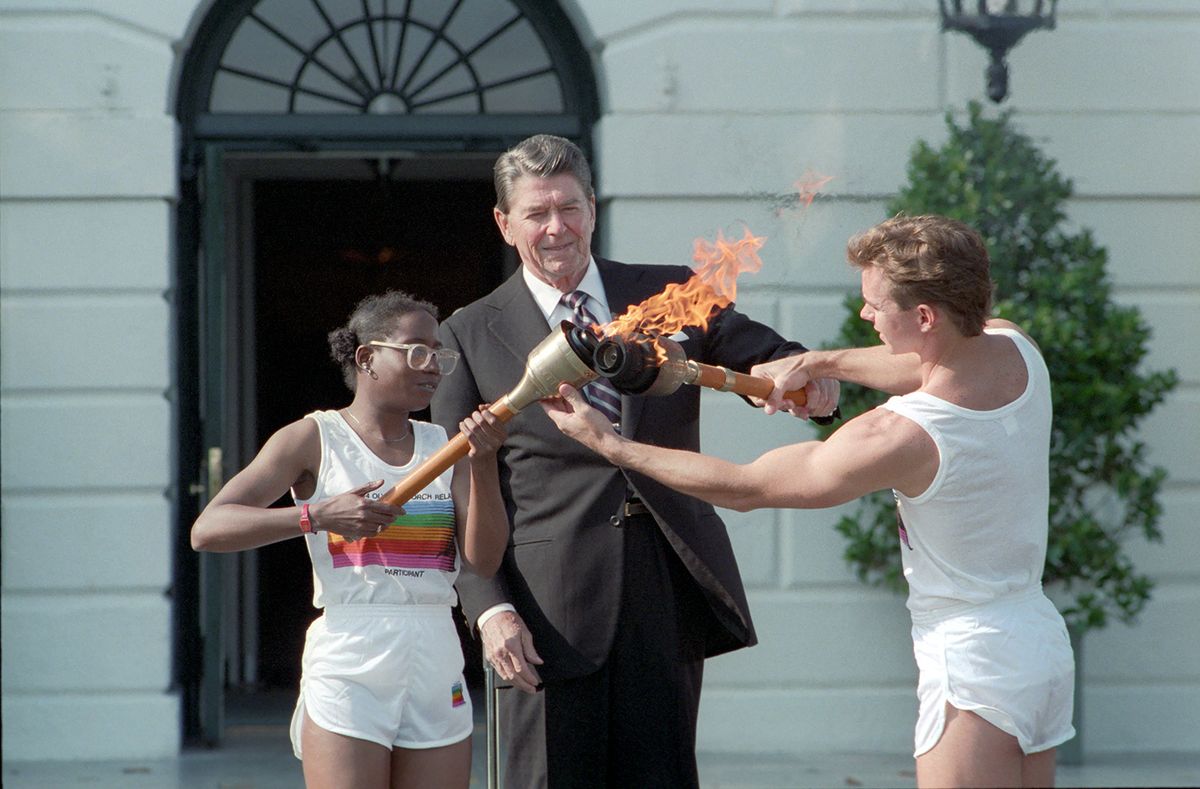
The opening ceremony on July 28 became one of the most-watched television events of the decade. A jet-pack pilot named Bill Suitor flew over the Memorial Coliseum. Eighty-four grand pianos performed Gershwin’s “Rhapsody in Blue.” Gina Hemphill, granddaughter of Jesse Owens, carried the torch into the stadium and handed it to Rafer Johnson, the 1960 decathlon champion, who climbed 99 steps to ignite the cauldron — the first African-American to do so in Olympic history.
The Friendship Games — The Soviet Alternative
The Soviets did not simply sit out the summer. From July through September 1984, the boycotting nations staged the Friendship Games, an alternative competition spread across nine Eastern Bloc countries. Moscow, East Berlin, Prague, Havana, and Sofia all hosted events. The Friendship Games drew more than 2,300 athletes from 50 countries and produced dozens of marks that, on paper, beat Olympic results in Los Angeles.
The Soviets argued that the Friendship Games proved their athletes did not need the Olympics. Western journalists pointed out that the events were not run under the same anti-doping protocols, were spread across friendly countries with hometown crowds, and were boycotted by every Olympic-medal nation that had shown up in California. The IOC refused to recognize Friendship Games results as Olympic equivalents. Soviet sport historians still cite them as the “real” 1984 championships.

Behind the scenes, the games revealed how isolated the Eastern Bloc had become. East Germany, the Soviet Union’s most successful Olympic ally, had reportedly lobbied internally to compete in Los Angeles. Erich Honecker’s government overruled its own sport ministers. The Friendship Games were a face-saving exercise. The Olympic gold medals were in Los Angeles.
The American Medal Haul Without the Soviets
The United States won 174 medals at Los Angeles, including 83 golds — an Olympic record at the time. The boycott inflated the number, but several performances would have stood up against any field. Carl Lewis won four gold medals in track and field, equaling Jesse Owens’ 1936 haul. Mary Lou Retton scored back-to-back perfect tens to become the first American woman to win the all-around gymnastics title, edging Romanian Ecaterina Szabo by 0.05 points. Edwin Moses won the 400-meter hurdles. Greg Louganis swept the diving events.

The asterisk hangs over the totals. Soviet wrestlers, weightlifters, gymnasts, and rowers had dominated the 1980 Moscow Games and the world championships in between. East German swimmers were untouchable. The 1984 medal table reflected American excellence and Eastern absence in roughly equal measure. As one Soviet sports official put it that summer, “We are not boycotting the Olympics. We are boycotting Los Angeles.” The line played differently in Russian than in English.
The Cold War Legacy of the 1984 Olympics Boycott
The 1984 Olympics boycott was the last full-scale Cold War boycott of an Olympic Games. Four years later, in Seoul, the Soviet Union and East Germany returned to competition, and only North Korea, Cuba, and Ethiopia stayed out. The thaw that followed Mikhail Gorbachev’s 1985 rise to power made tit-for-tat boycotts politically unsustainable. By 1992 in Barcelona, the Soviet Union no longer existed, and a “Unified Team” of former Soviet republics competed under the Olympic flag.
The boycott also reshaped the Olympic movement. Ueberroth’s commercial model, born of necessity in 1984, became the playbook every host city has followed since. Television rights, sponsorship tiers, and licensed merchandise turned a money-losing global ritual into one of sport’s most lucrative properties. The mascot, Sam the Eagle, was designed by a Disney veteran and licensed to 43 companies. The torch relay was sponsored by AT&T. None of that would have been possible without the financial pressure the boycott created.

For a generation of American athletes, the boycott era closed a window. Track stars like Mary Decker had been training their whole careers for a Soviet-Cuban-East German field that never showed up. For their Soviet counterparts — sprinter Sergey Bubka, gymnast Dmitri Bilozerchev, weightlifter Yuri Vardanyan — the missing 1984 medals were career-defining wounds that a different geopolitics might have healed.
What the 1984 Olympics Boycott Reveals About the Decade
Looking back, the boycott fits the pattern of a decade that ran on superpower theater. The same year, the Soviets walked out of arms control talks in Geneva. Reagan’s Strategic Defense Initiative was reshaping the missile balance. The made-for-television film The Day After had aired in November 1983 and put nuclear annihilation on the family television. The Soviet command-and-control infrastructure that powered the Dead Hand system was being upgraded. Five years later, the Berlin Wall fell. Six years after that, the country that boycotted the 1984 Olympics no longer existed, and breakaway republics like Lithuania were declaring independence.

For viewers who lived through the summer of 1984, the boycott is now a cultural memory: the McDonald’s giveaways, the perfect-ten landings, Bruce Jenner in a media booth, Bill Suitor in a jet pack, and the strange feeling that the United States had won the Olympics by walkover. For everyone else, it stands as a reminder that the Cold War never stayed inside the Kremlin or the Pentagon. It went to the Olympics, and on May 8, 1984, the Olympics felt the cold.
Sources
- History.com — Soviets announce boycott of 1984 Olympics, May 8, 1984 — primary timeline of the announcement.
- Wikipedia — 1984 Summer Olympics boycott — list of boycotting countries and Friendship Games details.
- U.S. Department of State, Office of the Historian — FRUS 1981–1988 Vol IV, Document 217 — declassified diplomatic record of the boycott response.
- National Archives — Cold War Diplomatic Games: The 1984 Los Angeles Summer Olympics — White House and State Department documents on the games.
- Olympics.com — Los Angeles 1984 Summer Olympics — official IOC results and athlete records.
- History.com — The California activists who scared the Soviets away from the 1984 Olympics — Ban the Soviets Coalition background.