Baltimore Colts History: The Midnight Move That Broke a City
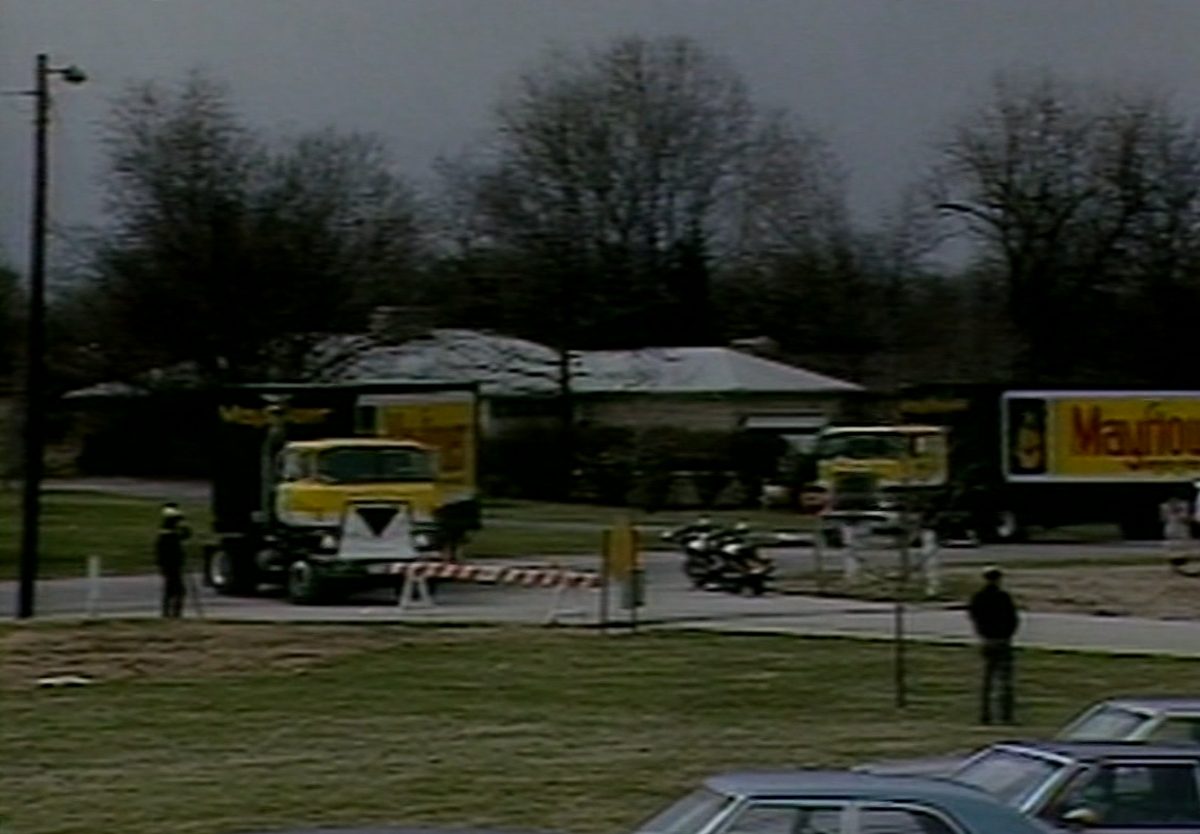
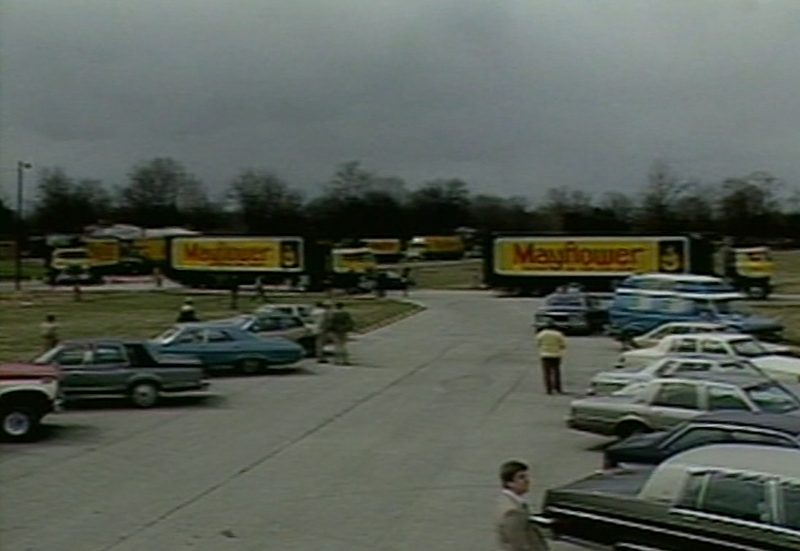
On the night of March 28, 1984, a fleet of fifteen Mayflower moving trucks rolled into a snow-dusted office park in Owings Mills, Maryland, and quietly stole an NFL franchise. The Baltimore Colts move to Indianapolis wasn’t announced. It wasn’t voted on. It happened under cover of darkness while the city slept, and by the time the morning paper hit doorsteps the trucks were already crossing into Pennsylvania, hauling thirty-one years of football history toward a town that had never wanted anything more.
Forty years later, ask anyone over fifty in Baltimore about that night and watch their jaw set. The wound doesn’t really heal. It just gets quieter.
The Retro Almanac
A monthly roundup of "on this day" highlights from that month, decades back — plus first dibs on new retro merch drops. No spam, just the good stuff.
The House That Johnny Unitas Built
You can’t understand why losing the Colts mattered without understanding what the Colts were to Baltimore. This wasn’t a city renting a team. This was a town whose civic identity was stitched into a horseshoe helmet. The 1958 NFL Championship Game — the one Johnny Unitas won in sudden death against the Giants — is the reason pro football became the dominant American sport. Without that game, no Super Bowl culture. Without Baltimore, no Johnny U.
Memorial Stadium on 33rd Street was the building where it all happened. Fans nicknamed it “The World’s Largest Outdoor Insane Asylum,” and they meant it as a love letter. Forty-six-thousand-something blue-collar people screaming themselves hoarse on Sundays in a stadium that vibrated. The Colts marching band played at every home game from 1947 onward — the only NFL marching band in the league. Tailgating wasn’t a marketing concept. It was a religious practice.
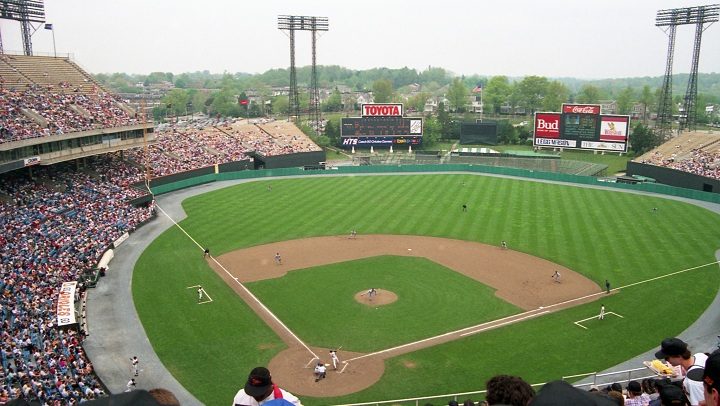
The Colts won three NFL Championships and Super Bowl V. They produced Hall of Famers in bunches — Unitas, Raymond Berry, Lenny Moore, John Mackey, Art Donovan, Gino Marchetti. The team felt like family because, for thirty-one years, it was. Baltimore is one of those cities where 80s nostalgia hits different, partly because so much of what defined the city in that era got ripped out of it by force.
The Owner Baltimore Couldn’t Forgive
Robert Irsay bought the Colts in a 1972 franchise swap with Carroll Rosenbloom that involved trading entire NFL teams like collectible cards. Irsay got Baltimore. Rosenbloom got the Los Angeles Rams. The fans got a heating and air-conditioning magnate from Chicago who had no feel for the city he’d just inherited.
The relationship soured fast. Irsay feuded with players, drank publicly, fired front-office staff in fits, and treated Memorial Stadium like a building he wanted to leave. He spent the late 1970s and early 1980s shopping the team around — Phoenix, Memphis, Jacksonville, Indianapolis — playing each city against the next. Baltimore wanted a new stadium. Irsay wanted somebody else to build him one for free.
On January 20, 1984, Irsay held a press conference at BWI Airport and looked the city in the eye. “I haven’t any intention of moving the team,” he told reporters, with Mayor William Donald Schaefer standing right next to him. Two months and eight days later, he was gone. The press conference is still on YouTube. It plays like a hostage video in reverse — the hostage was the entire city.
Around the same window, real estate hustlers and TV stars were buying up American football teams like Monopoly properties — Donald Trump was busy steering the USFL into a wall by purchasing the New Jersey Generals. NFL ownership in the early 80s was full of bored rich men who treated franchises like trophies. Irsay was just the one who took it furthest.
The Eminent Domain Bill That Lit the Fuse
Baltimore was not naive. By early 1984 the city smelled what was coming. Maryland’s legislature drafted a bill giving Baltimore the power to seize the franchise by eminent domain — the same legal tool a city uses to condemn a house for a highway, only pointed at a football team.
On March 27, 1984, the Maryland Senate passed the eminent domain bill 38–4. The House had already passed its version. By morning, Governor Harry Hughes would sign it. Irsay had a window of maybe twelve hours before Baltimore could legally take the Colts away from him.
He did not need twelve. He needed one phone call.
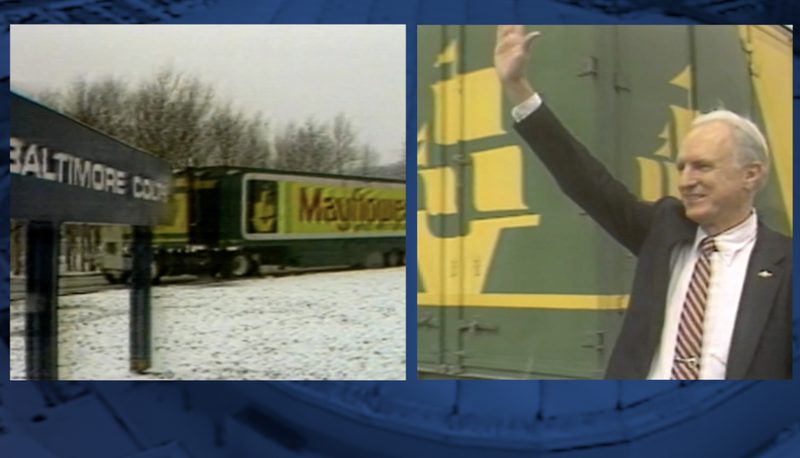
According to the Indianapolis Star’s reporting, Indianapolis Mayor William Hudnut had been quietly courting Irsay for years. The Hoosier Dome — built in 1982 on speculation, without an NFL tenant — was sitting empty, waiting for somebody to fill it. Hudnut picked up the phone, called his neighbor John B. Smith, who happened to be the CEO of Mayflower Transit, and asked if Mayflower could send a fleet of trucks to Owings Mills, Maryland, that night. Smith said yes and refused to charge a dollar.
A Snowstorm, a Phone Call, and a Fleet of Strangers
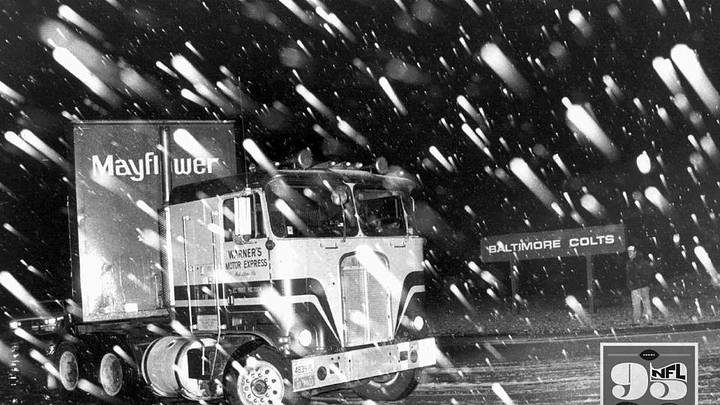
Fifteen Mayflower trucks were dispatched from yards scattered across the eastern seaboard. None of the drivers were told the destination. They received an address — 7001 Winterset Way, Owings Mills — and instructions to show up after dark. A late-winter snowstorm was rolling in, which is part of why the photographs from that night look so cinematic. Snowflakes catching in the truck headlights. Footprints filling in fast.
The Colts staff had been told earlier that day to start packing. Equipment, jerseys, helmets, trophies, the team chiropractor’s table, the head coach’s filing cabinets — everything went into boxes. By midnight, the trucks were lined up. By 2 a.m., the first ones were rolling.
The drivers were given different routes on purpose so no single highway patrol officer would see fifteen Mayflowers in a row and start asking questions. Some headed west on I-70. Some looped north through Pennsylvania. If Maryland state troopers tried to stop a truck before the state line, the driver was to keep moving and call dispatch. The eminent domain law would not take effect until the governor signed it, but nobody wanted to test the timing.
One Baltimore Sun photographer, Lloyd Pearson, got tipped off and made it to Owings Mills in time. He took the only photograph of the trucks in motion that survived the night, snow falling through his lens, a Mayflower logo glowing under a security light. That single image became the iconic visual of the move. The Colts organization itself later used it in their official documentary series.
The Morning Baltimore Woke Up Empty
Dawn broke over Owings Mills on March 29 to an empty parking lot and a ransacked office complex. The Baltimore Sun ran the news on the front page. Radio stations played funeral dirges. Mayor Schaefer, the same one who had stood beside Irsay two months earlier, called it the worst day of his political life. History.com’s account captures the surreal civic shock of that morning — a sports town suddenly with no team to talk about at the diner.
The marching band found out the way everyone else did: from the radio. They kept the uniforms. They kept the instruments. For thirteen years, the Baltimore Colts Marching Band continued to perform at parades and football games for other people’s teams, refusing to disband, refusing to give up the name. It might be the most stubborn act of civic devotion in American sports history.
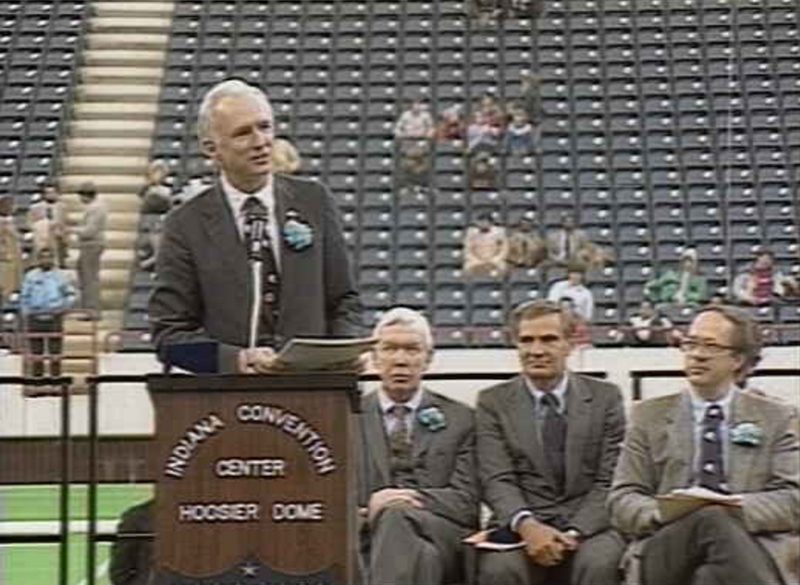
Out in Indiana that same morning, Mayor Hudnut held a press conference and announced the Indianapolis Colts to a city that had not gone to bed knowing it had an NFL team. A crowd of more than twenty thousand showed up at the Hoosier Dome that week for a welcome rally. Indianapolis had no idea who Bert Jones was. They were just grateful. Baltimore was furious. Indianapolis was ecstatic. Both reactions were correct, depending on where you were standing.
The Hoosier Dome Inherits a Ghost
The new Indianapolis Colts were not very good. They went 4–12 in their first season. Bert Jones, the franchise quarterback Baltimore had drafted, was already injured and traded before the move even completed. Coach Frank Kush ran a brutal training camp in Anderson, Indiana, and the roster was a patchwork of holdovers and rejects. Eric Dickerson would not arrive until 1987.
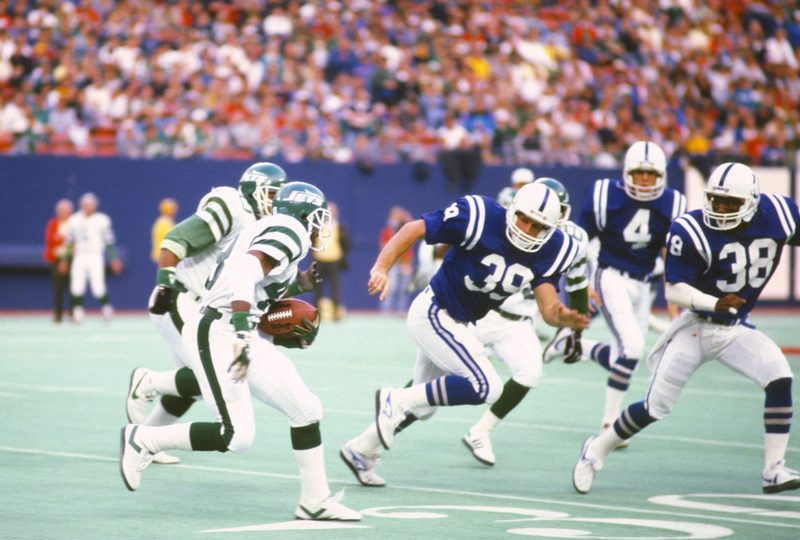
Indianapolis didn’t care the team was bad. The Hoosier Dome sold out anyway. For a Midwestern city losing steel jobs, the Colts were proof the place still counted on a national map. Indianapolis had finally landed something it had been chasing for a generation. The losing record was beside the point.
This is the part of the story that gets glossed over in Baltimore. The Colts didn’t move to a city that already had everything. They moved to a city being told, loudly, that it didn’t matter. The NFL franchise changed that overnight. Indianapolis would not have hosted a Super Bowl, would not have built Lucas Oil Stadium, would not have become a real sports town without that night in March 1984. The wound in Baltimore made another city possible.
What Baltimore Did Next
Baltimore filed an antitrust suit against the NFL. It lost. The city sued under the eminent domain bill. It lost. Bob Irsay testified that he had every right to move his team and that Baltimore had failed to deliver a stadium. The courts agreed. By 1985 the legal options were exhausted and the only thing left was to wait for the league to award another franchise. That wait lasted twelve years.
The CFL Stallions came in 1994 and won a Grey Cup. They were not the Colts. The Ravens arrived in 1996 when Art Modell yanked the Browns out of Cleveland in his own version of the midnight move — only without the literal trucks, and with a four-year planning runway. Baltimore got its NFL team back. Cleveland did the same thing to itself, and a little bit of the city’s soul went with the franchise.
The Ravens won the Super Bowl in 2000 with Ray Lewis and a defense that played like it had something to prove. They won again in 2012 with Joe Flacco. Baltimore loves the Ravens. But ask any season-ticket holder over fifty whether the Ravens replaced the Colts, and the answer is always the same: no team replaces what was stolen.
The Wound That Never Quite Healed
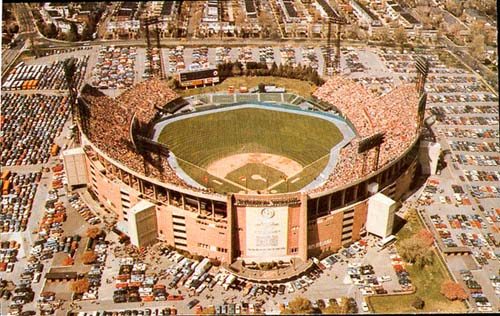
Memorial Stadium was demolished between 2001 and 2002. The Orioles had already moved to Camden Yards in 1992. The site retains a plaque. That’s about it.
Bob Irsay died in 1997 without ever publicly apologizing to Baltimore. His son Jim Irsay inherited the franchise and acknowledged in interviews that the way the move happened was wrong — though always with the careful language of someone who knows the franchise valuation triples every time a Baltimore fan visits the gravesite. Jim Irsay himself died in 2025. The Colts remain in Indianapolis.
The story still hits because of what it represents. The 1980s were the decade when American sports franchises stopped being civic institutions and started being inventory. The Colts move was the first one done in literal darkness, on literal moving trucks, before a literal eminent-domain deadline. Cleveland, Houston, St. Louis, Oakland — every NFL relocation since 1984 carries some of that same DNA. The same era that produced football’s biggest crossover stars produced its biggest civic betrayals.
If you grew up rooting for a Colts team in the 1970s and lost it on a March night in 1984, no Super Bowl banner in Indianapolis fixes that. The trucks rolled. The snow covered the tracks. The city woke up alone. That is the Baltimore Colts story, and the reason a forty-year-old wound still bleeds whenever somebody asks about Bob Irsay.
Sources
- Sports Illustrated — NFL History in 95 Objects: The Colts’ Mayflower Trucks
- Colts.com — The Move Ep. 3: Mayflower
- History.com — Baltimore Colts Move to Indianapolis, March 28, 1984
- WISH-TV — March 28, 1984: When the Colts Ditched Baltimore
- CBS Baltimore — Football Was Ripped Away From Baltimore
- Wikipedia — Baltimore Colts Relocation to Indianapolis
Browse retro and vintage-inspired apparel at the RetroRadical shop →
The Retro Almanac
A monthly roundup of "on this day" highlights from that month, decades back — plus first dibs on new retro merch drops. No spam, just the good stuff.