On This Day: May 28, 1987 — Mathias Rust Lands in Red Square
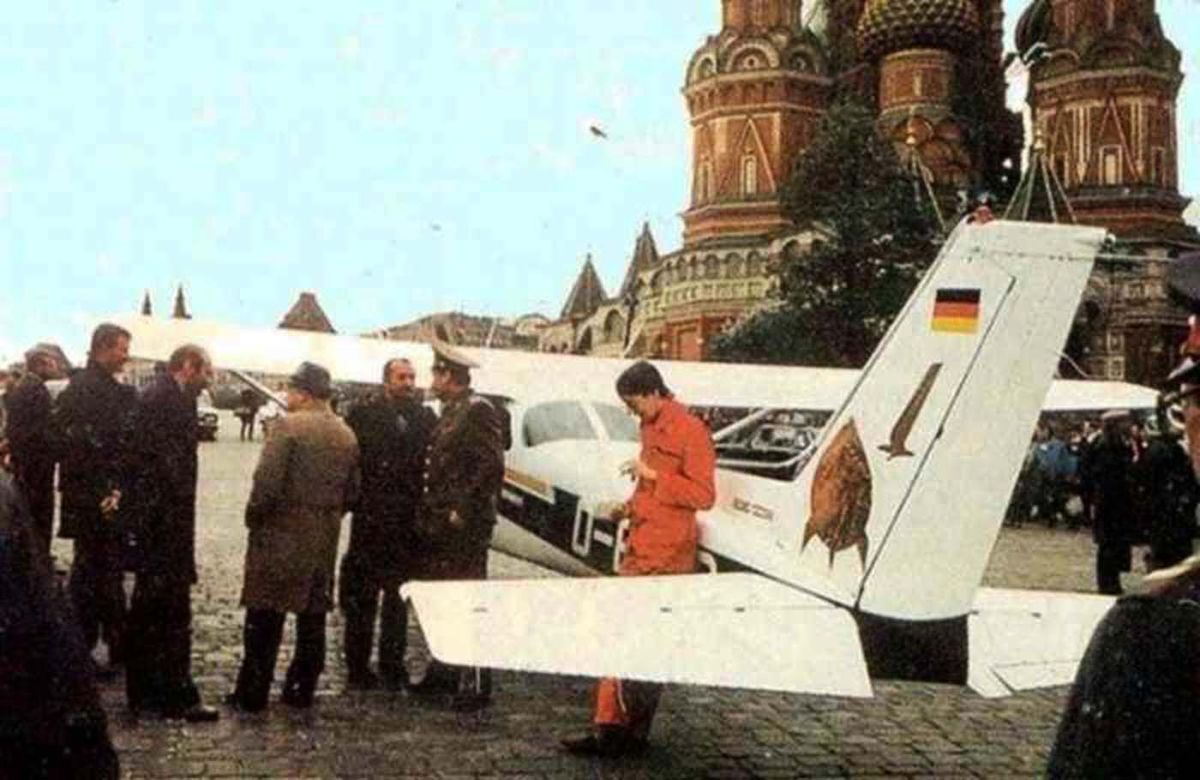
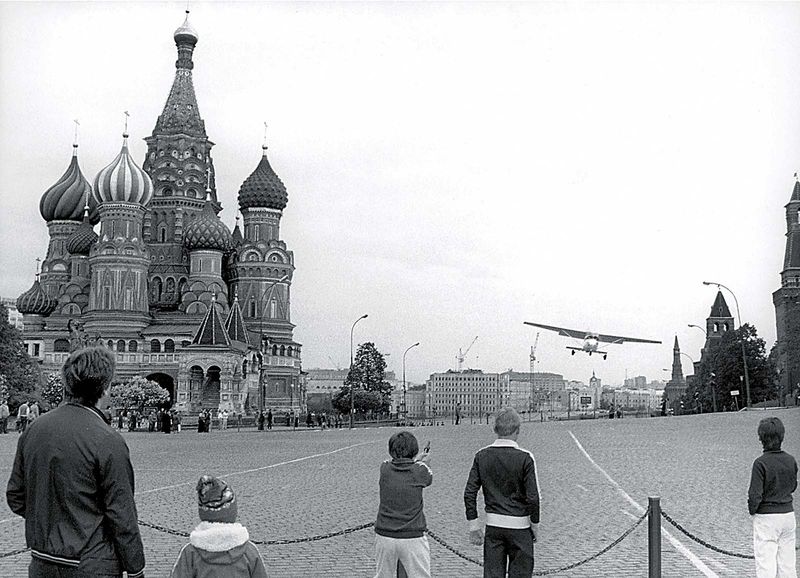
At 6:43 p.m. on May 28, 1987, an 18-year-old West German kid named Mathias Rust set the wheels of a rented Cessna 172 down on a bridge fifty feet from St. Basil’s Cathedral. He had just flown 750 miles through the most heavily defended airspace on the planet. Soviet radar had tracked him. A MiG-23 pilot had asked permission to shoot him down and been denied. And now he was taxiing past the Kremlin walls while Russian tourists wandered up to ask the strange foreigner in red coveralls for autographs. The Mathias Rust Red Square landing did more than embarrass the Soviet military — it gave Mikhail Gorbachev the political cover to gut a faction that had been blocking his reforms for years.
Who Was the Kid in the Cessna?
Mathias Rust was born June 1, 1968, in Wedel, a town tucked next to Hamburg. By May 1987 he had been flying for two years and had clocked about 50 hours behind the yoke of a single-engine plane — the rough equivalent of a brand-new private pilot still working out crosswind landings. He was not an instrument-rated aviator. He was not a stunt pilot. He was a quiet, slightly awkward teenager who, by his own account, had grown obsessed with the idea that he could personally puncture the Cold War.
The plan was not impulsive. Rust rented a Reims-built Cessna F172P, registration D-ECJB, from his local flying club in Hamburg. He pulled the rear seats out and installed auxiliary fuel tanks in the cabin to triple the aircraft’s range. Then he took the long way around: from Uetersen to the Faroe Islands, on to Keflavík in Iceland, back through Bergen, and finally into Helsinki. That entire warm-up loop was preparation — a way to log distance flying and get comfortable navigating over open water before he pointed the nose at Moscow.


The Lie He Told Helsinki Tower
On the morning of May 28, Rust topped off the Cessna’s tanks at Helsinki-Malmi Airport and filed a flight plan to Stockholm. At 12:21 p.m. he lifted off, climbed out west — and then, near the town of Nummela, banked hard to the east. He shut down the transponder and stopped talking on the radio. Finnish controllers watched the blip vanish, assumed a crash, and scrambled a search-and-rescue operation. A patch of oil on the surface of the Gulf of Finland convinced them they were looking for a wreck.
Rust meanwhile was already over Soviet territory. At 2:29 p.m. his Cessna lit up the radar screens of Soviet Air Defence Forces and got the combat tracking number 8255. He was painted as an unknown target, low and slow, on a direct line for Moscow.
How a Cessna Beat the Soviet Air Defense Forces
This is the part most aviation history sites still gloss over. Soviet air defense in 1987 was the most expensive, most layered, most paranoid air defense system humans had ever built. Surface-to-air missile batteries spotted Rust within minutes. A MiG-23MLD from the Tapa air base, piloted by Senior Lieutenant A. Puchnin, was vectored to intercept at 2:48 p.m. near Gdov. Puchnin saw the Cessna, identified it as a small piston single resembling a Yak-12, and radioed in for permission to engage.
Permission denied.

The truth is, the Soviets had spent the previous four years trying to live down the shootdown of Korean Air Lines Flight 007. Killing civilians by mistake was no longer a free action politically. So the rules of engagement had been tightened, the decision pushed up the chain, and that hesitation cascaded. The Pskov-area air regiment was running maneuvers that afternoon, and inexperienced pilots had been bungling their IFF transponder codes — so controllers had simply marked everything in the area as friendly. Rust got tagged friendly. Twice.
Add one more piece. May 28 was Border Guards Day in the Soviet Union, a holiday that traditionally meant a lot of vodka and a thinned-out duty roster. By the time Rust crossed into the Moscow military district, near Torzhok, the air around him had filled up with rescue helicopters looking for an unrelated crash. A slow propeller plane at 600 meters looked like one of those choppers. Nobody intervened.

The Landing on Bolshoy Moskvoretsky Bridge
Rust crossed Moscow at rooftop height just before 7 p.m. His original plan had been to land inside the Kremlin walls. Smarter heads talked him out of it in mid-air — once he saw the cobblestone courtyard, he realized the KGB could quietly arrest him and pretend the flight never happened. Red Square was a better target. Open. Public. Loaded with foreign tourists.
He circled twice. Red Square itself was packed with people, so the cobblestones were not an option. He banked toward the Bolshoy Moskvoretsky Bridge, the concrete arch span that runs east of the Kremlin walls past St. Basil’s Cathedral. The bridge normally carried trolleybus power lines strung above the lanes — wires that would have shredded his propeller. Pure dumb luck: the lines had been taken down that very morning for routine maintenance. They were put back up the next day.
He touched down, rolled along the deck, taxied past the cathedral, and stopped roughly 100 meters short of Red Square proper. Then he climbed out, in those bright red and white coveralls, and signed autographs for the crowd that gathered. Soviet citizens assumed he was part of an air show. It took two hours for the KGB to figure out what had actually happened and arrest him.

The Trial, Lefortovo, and the Goodwill Release
Rust’s trial opened on September 2, 1987, in a Moscow courtroom. The charges were hooliganism, violations of aviation law, and unlawful border crossing. He pleaded that the flight had been a peace mission — an “imaginary bridge” between East and West. The court sentenced him to four years in a general-regime labor camp, but he never saw a camp. He served his time in Lefortovo, the high-security pre-trial detention facility used by the KGB, in a single cell, mostly alone.

He served 14 months. In August 1988, against the backdrop of the Reagan-Gorbachev summit thaw, the Supreme Soviet quietly released him as a “goodwill gesture to the West.” He flew home to West Germany a folk hero — for about six hours, until the German press began reminding everyone that he had also embarrassed his own government, broken aviation law, and now refused to apologize for any of it.
The Purge That Gave Gorbachev His Opening
This is where the story stops being a stunt and starts being history. Within 24 hours of the landing, Mikhail Gorbachev was on the phone with the Politburo demanding heads. Defense Minister Sergei Sokolov — a 76-year-old Marshal of the Soviet Union — was sacked. The Commander-in-Chief of Soviet Air Defence Forces, Chief Marshal Alexander Koldunov, was sacked. Within weeks, hundreds of officers up and down the chain were forced into retirement or reassigned.
William E. Odom, the former director of the U.S. National Security Agency, later wrote that “Rust’s flight irreparably damaged the reputation of the Soviet military” and triggered the largest single shake-up of Soviet armed forces since Stalin’s pre-war purges. Gorbachev replaced Sokolov with Army General Dmitri Yazov, a younger officer thought to be more sympathetic to perestroika. Suddenly the military hardliners who had been slow-walking arms reduction talks lost their loudest voices. The INF Treaty was signed five months later, in December 1987.
That is not a coincidence. The Rust flight was the unforced error the Soviet military hawks could not survive, and Gorbachev moved fast enough to make sure they didn’t. Anyone who lived through the late 80s knows the West read it the same way at the time — the joke going around Moscow that May was that Red Square should be renamed Sheremetyevo-3, after the city’s third airport. The Soviets had been a punchline, and a teenager from Hamburg had written the joke.
For more on the geopolitics colliding in 1987–88, see our coverage of the Soviet withdrawal from Afghanistan and the 1984 Olympics boycott, both flashpoints in the same Cold War arc.
What Watching the Landing Actually Looked Like
A British physician named Günter Schlich happened to be on Red Square that evening with a Super-8 camera. The footage he shot — shaky, narrow, but absolutely authentic — is the reason we have a moving image record of the landing at all. The Soviet press tried to suppress it; the footage made the rounds in the West within 72 hours. The clip below from DW News reconstructs the timeline, including the Schlich footage and the official Soviet response.
The Rest of Mathias Rust’s Strange Life
The version of Rust that flew to Moscow was 18, intense, and convinced he was performing a moral act. The version that emerged from Lefortovo was harder to read, and his post-prison life never settled. In November 1989, while doing community service at a hospital in West Germany, Rust stabbed a female co-worker with a knife after she refused his advances. He was sentenced to two and a half years and released after 15 months.

In 1996 he converted to Hinduism to marry the daughter of an Indian tea merchant. The marriage didn’t last. In 2001 he was convicted of stealing a cashmere sweater; in 2005 of fraud. By 2009 he was describing himself as a professional poker player. In 2012 a Swiss interview placed him in Zürich, working as an analyst at an investment bank and training to be a yoga instructor on the side.
None of that walks back what happened on May 28, 1987. It just turns the central character into a more complicated human than either the Soviet propagandists or the Western press wanted him to be.
The Cessna That Outlived the Cold War
D-ECJB, the actual aircraft, had a quieter retirement than its pilot. Soviet authorities returned the plane to its Hamburg flying club. A French entrepreneur named Jean-Loup Sulitzer bought it and ran it around Europe as a touring attraction. It was later sold to a Japanese collector and put on display in Tokyo, then in Niigata, for about a decade. In 2008 it came home to Germany permanently, and you can see it today hanging from the rafters of the German Museum of Technology in Berlin — original red, white, and blue paint, German flag on the tail, the dolphin emblem on the rudder still intact.

The crazy part is that nothing about the plane itself was special. A 1980 Reims-built Cessna 172 with auxiliary tanks was the most generic flying machine in Western Europe. The pilot wasn’t special either. That, more than anything, is the lesson the Soviet military took home that summer: a system that costs billions and tracks every airliner over the Arctic can still be punctured by one ordinary kid making slightly above-average decisions.
Forty years on, the Mathias Rust Red Square landing remains the cleanest single example of how the late Cold War actually ended — not with a missile or a treaty, but with a Cessna, a holiday weekend, and a Marshal of the Soviet Union losing his job before the maintenance crew put the trolleybus wires back up. If you want the broader arc — the same year that produced Reykjavík and the INF Treaty — read on through our On This Day Cold War timeline.
Love the retro era? Browse our shop for vintage finds, retro clothing, and 80s/90s nostalgia gear.
Sources
- Mathias Rust — Wikipedia — Full biography, flight timeline, Soviet response, and aftermath
- The Notorious Flight of Mathias Rust — Smithsonian Air & Space — Detailed reconstruction of the flight and museum display history
- 28 May 1987 — This Day in Aviation — Aircraft specifications, registration, and aviation context
- Former Defense Minister Sokolov Dies at 102 — The Moscow Times — On Sokolov’s dismissal and the post-Rust military shake-up
- Bolshoy Moskvoretsky Bridge — Wikipedia — On the bridge where Rust actually touched down