Tipper Gore and Susan Baker testifying at the PMRC Senate hearing on the parental advisory sticker
| |

Parental Advisory Sticker: 9 Wild Truths from the PMRC War

The parental advisory sticker exists because an 11-year-old girl in 1984 hit play on Prince’s “Darling Nikki” and her mom — wife of a future Vice President — heard the line about Nikki in a hotel lobby with a magazine. That mom was Tipper Gore. Within months, she had assembled four senators’ wives, a Washington PR machine, and a 15-song hit list called the Filthy Fifteen. By September 19, 1985, the United States Senate was holding hearings on rock lyrics, and Frank Zappa, Dee Snider of Twisted Sister, and John Denver were sitting at the witness table.

That sticker on every explicit record, cassette, and CD for the next forty years? It came from a six-hour committee meeting most kids never heard of and most parents never read about. Here are nine truths about the PMRC war that the Filthy Fifteen mythology mostly forgets.
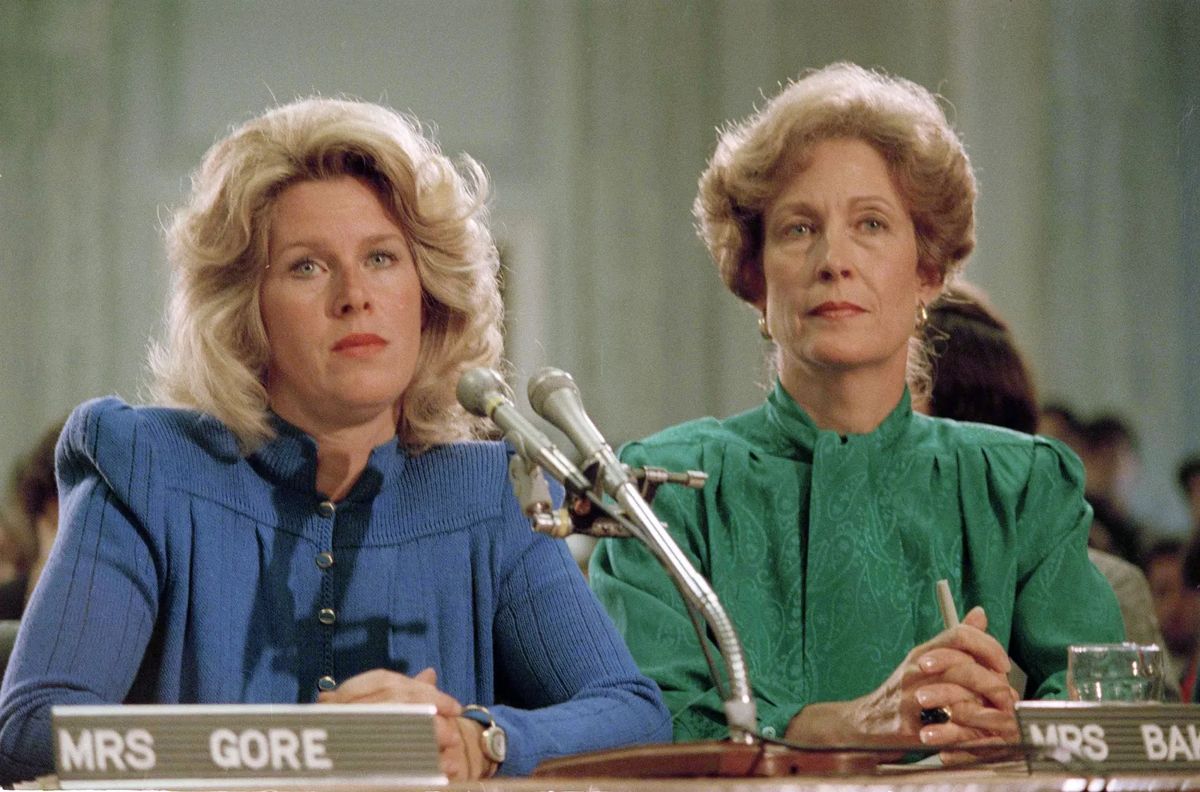
Tipper Gore and Susan Baker testifying about the parental advisory sticker at the 1985 PMRC Senate hearing

1. The Parental Advisory Sticker Started With a Prince Song in 1984

Tipper Gore bought Purple Rain for her 11-year-old daughter Karenna in late 1984. Track five is “Darling Nikki,” which opens with Nikki masturbating in a hotel lobby with a magazine. Tipper said later she was stunned — not because she didn’t think Prince could be sexual, but because nothing on the album cover or sleeve warned her. That single moment of parental whiplash is what every history of the parental advisory sticker traces back to.

Was Karenna actually traumatized? Probably not — she was eleven and the language is more weird than graphic. But Tipper Gore did the thing that mothers in Washington can do that mothers in Topeka can’t: she called Susan Baker, wife of then-Treasury Secretary James Baker, and the two of them decided to do something about it. By April 1985 they had four founding members, a name (Parents Music Resource Center), and a list.

2. The “Washington Wives” Were Politically Connected By Design

The PMRC’s four founders were Tipper Gore, Susan Baker, Pam Howar, and Sally Nevius. Howar’s husband Raymond was a prominent DC realtor. Nevius’s husband John was former chairman of the DC city council. Baker’s husband ran the Treasury under Reagan. Gore’s husband Al was a sitting US senator. The press nicknamed them the “Washington Wives,” and the nickname stuck because it was accurate.

Critics at the time — Frank Zappa loudest among them — pointed out that ordinary parents complaining about Prince don’t get a Senate Commerce Committee hearing scheduled in five months flat. The PMRC’s access wasn’t a side issue. It was the only thing that turned a parents’ pressure group into a federal proceeding.

Frank Zappa and Dee Snider holding US Senate transcripts at the 1985 PMRC parental advisory sticker hearings

3. The Filthy Fifteen Was an Odd, Petty List

In May 1985, the PMRC published a list of fifteen songs they wanted parents to know about. The categories were sex (S), violence (V), drugs and alcohol (D/A), and occult (O). The actual lineup was stranger than memory suggests:

  • Prince — “Darling Nikki” (S)
  • Sheena Easton — “Sugar Walls” (S)
  • Judas Priest — “Eat Me Alive” (S)
  • Vanity — “Strap On Robbie Baby” (S)
  • Mötley Crüe — “Bastard” (V/L)
  • AC/DC — “Let Me Put My Love Into You” (S)
  • Twisted Sister — “We’re Not Gonna Take It” (V)
  • Madonna — “Dress You Up” (S)
  • W.A.S.P. — “Animal (F**k Like a Beast)” (S/L)
  • Def Leppard — “High ‘n’ Dry (Saturday Night)” (D/A)
  • Mercyful Fate — “Into the Coven” (O)
  • Black Sabbath — “Trashed” (D/A)
  • Mary Jane Girls — “In My House” (S)
  • Venom — “Possessed” (O)
  • Cyndi Lauper — “She Bop” (S)

The list mixed glam metal, satanic theater, R&B, pop, and Cyndi Lauper. Putting “Dress You Up” — a song about flirting — next to Venom’s “Possessed” is the kind of move that made Zappa’s case for him. Rolling Stone later argued the list reads like someone wrote down whatever was on MTV that week and then added Mercyful Fate to look serious.

The PMRC Filthy Fifteen album covers that prompted the parental advisory sticker in 1985

4. September 19, 1985 — The Hearing Most People Picture Wrong

The Senate Committee on Commerce, Science, and Transportation convened at 9:30 AM on September 19, 1985. The official subject: “the content of certain sound recordings and suggestions that recording packages be labeled to provide a warning.” Senator John Danforth chaired. Al Gore sat on the panel — yes, the same Al Gore whose wife had organized the entire thing. That conflict of interest got almost no airtime in 1985.

The hearing was technically not about banning anything. It was about a rating system. The PMRC’s specific 1985 proposal was a letter code on every album: X for sex, V for violence, O for occult, D/A for drugs and alcohol, plus a generic warning for everything that didn’t fit. Lyrics on the back of every sleeve. Adult sections in record stores. None of it was law — it was a “voluntary” system the RIAA could agree to under congressional pressure.

Six and a half hours. Three musicians. One sticker that eventually emerged from the whole thing.

5. Dee Snider Walked In and Demolished the Caricature

Dee Snider of Twisted Sister arrived with a denim vest, no sleeves, a wall of permed blonde hair, sunglasses, and a sober mind. The senators had clearly prepared for a meathead. They got something else entirely: a faithful Christian who did not drink, did not use drugs, and could explain his lyrics line by line.

Tipper Gore’s written testimony had claimed Twisted Sister’s song “Under the Blade” was about sadomasochism, bondage, and rape. Snider used his opening minute to correct the record on national TV. The song, he explained, was written about a band member’s throat surgery and the fear of going under the knife. “The only sadomasochism, bondage, and rape in this song,” he told the panel, “is in the mind of Ms. Gore.” The hearing room reacted, and Snider went on for another twenty minutes without losing his composure once.

Dee Snider testifying against the parental advisory sticker at the 1985 PMRC Senate hearing

That moment is why heavy metal won the day in public opinion even though it lost the policy fight. Snider still talks about the hearing as the single most consequential afternoon of his career.

6. Frank Zappa Called the Proposal “Ill-Conceived Nonsense”

Zappa showed up in a suit, with a folder of prepared remarks, and proceeded to dismantle the PMRC line by line. His opening statement is the part everyone remembers: “The PMRC proposal is an ill-conceived piece of nonsense which fails to deliver any real benefits to children, infringes the civil liberties of people who are not children, and promises to keep the courts busy for years dealing with the interpretational and enforcemental problems inherent in the proposal’s design.”

What got less attention was the practical case Zappa made. Who decides what counts as occult content? Who decides what counts as drug content? Does Bob Dylan’s “Rainy Day Women #12 & 35” — with its “everybody must get stoned” chorus — get a sticker, or is that protected because it’s poetry? Zappa argued the system was unworkable in principle and would be censorship in practice. The senators sparred with him for two hours. He didn’t budge.

Frank Zappa testifying against the parental advisory sticker at the 1985 PMRC Senate hearing

The Senate hearing transcript ran 117 pages. The C-SPAN archive of the live broadcast has been online for years and is still the best primary source on what actually happened in that room.

7. John Denver Was the Plot Twist Nobody Saw Coming

The third witness was supposed to be the safe one. The PMRC arguably invited John Denver — clean-cut, “Rocky Mountain High,” all-American folk — because they thought he’d reinforce their case. Instead, Denver took the microphone and explained that “Rocky Mountain High” had already been pulled from radio playlists in some markets because programmers heard “high” and assumed drugs.

The song, Denver clarified, is about being moved by the natural beauty of Colorado. It was banned anyway, by people doing exactly what the PMRC was now proposing — making subjective calls about lyrics based on surface readings. Denver’s testimony was quiet, polite, and devastating. The committee had counted on him and miscounted. He told them flatly that he opposed any form of censorship in music and that the labeling system would harm artists they hadn’t even considered.

John Denver who testified against the parental advisory sticker proposal at the 1985 PMRC hearings

Three witnesses, three demolitions, and the PMRC still won. That’s the part that’s hard to swallow even forty years later.

8. The Sticker Hit Hip Hop the Hardest

The RIAA cut a deal in November 1985 — two months after the hearings — to put a generic “Parental Advisory: Explicit Lyrics” notice on records the industry deemed warranted it. The familiar black-and-white sticker we all picture didn’t actually debut until July 24, 1990, on 2 Live Crew’s Banned in the U.S.A. The hearings produced a deal; the deal produced a slow rollout; the rollout caught fire when it intersected with rap.

This is the part of the story that gets buried under the metal narrative. The PMRC’s hearings were ostensibly about Prince, Mötley Crüe, and Twisted Sister. The actual long-term casualty list was hip hop. 2 Live Crew’s As Nasty As They Wanna Be was declared legally obscene in a Florida federal court in 1990 — the first album in US history given that ruling. The 1988 film Colors, which leaned heavily on Ice-T’s gang-life soundtrack, ran into the same blowback. NWA’s Straight Outta Compton in 1988 became the test case for whether the FBI would write letters to record labels. (They did.)

By 1995, almost every major label had given retailers explicit/clean versions of every rap release the PMRC sticker covered. Wal-Mart wouldn’t stock anything with the label, which meant artists like MC Hammer who scrubbed their content for the mainstream kept their distribution, while artists who refused — Ice-T, NWA, the Geto Boys — got shoved out of the biggest single retail channel in America. The metal acts the hearings were nominally about, by contrast, kept selling through specialty and mall record stores.

Madonna performing during the parental advisory sticker era of music censorship

9. The Parental Advisory Sticker Made Records Sell Better

Here’s the unkind truth about forty years of parental warning labels: they worked as marketing. Kids in 1991 sorted bins at the record store by which albums had the sticker. The black-and-white square became a signal of authenticity, edge, and unsupervised cool — the exact opposite of what the PMRC wanted.

Snoop Dogg’s Doggystyle sold 800,000 copies in its first week in 1993, sticker included. Dr. Dre’s The Chronic sold three million. The Marshall Mathers LP by Eminem moved 1.76 million units in its opening week in 2000, and the parental advisory sticker was so central to the album’s brand that the cover treats it as part of the design. The sticker didn’t keep kids from buying albums. It told kids which albums to buy.

Tipper Gore with Al Gore during the parental advisory sticker era

Tipper Gore told Rolling Stone in 2015 that she still believed the labels did some good — that they gave parents information they didn’t have before. Maybe. Most music writers count the PMRC as the moment American adults publicly lost a culture war they thought they could win on a Senate floor. Streaming killed the physical sticker. The hearings stayed.

The PMRC Lost the Argument and Won the Sticker

The hearings should have been a vindication for free expression. Three musicians showed up, dismantled the case for federal labeling on live television, and the RIAA agreed to label albums anyway because the political cost of saying no was higher than the business cost of saying yes. The label outlasted vinyl, cassette, and CD. It’s still on Spotify in pixel form. That’s the part of the parental advisory sticker story that the Filthy Fifteen mythology mostly avoids: the people who showed up to defend the music were better prepared, more articulate, and more honest than the people who showed up to censor it — and the censors got their sticker anyway.

If you want the unfiltered version, the full hearing is on YouTube. Watch Zappa’s opening, watch Snider correct Tipper Gore on her own testimony, and decide for yourself who won the argument in that room versus who won the policy outside of it.

If the PMRC hearings shaped your record collection in the 90s — directly, because of what you bought to spite a sticker, or indirectly, because of what your local Wal-Mart wouldn’t stock — you’re part of the legacy. Browse our Music & Movies archive for more of the era, or read our Grunge vs Punk breakdown for the post-PMRC chapter that quietly changed everything again.

Sources

  1. Parents Music Resource Center — Wikipedia — Founding, members, hearing timeline, RIAA settlement.
  2. Rolling Stone — PMRC’s “Filthy 15”: Where Are They Now? — Song-by-song breakdown of the Filthy Fifteen list.
  3. C-SPAN — PMRC Hearing Dee Snider Testimony — Primary source video footage from September 19, 1985.
  4. NPR — Tipper Gore, Twisted Sister and the Fight to Put Warning Labels on Music — 40th anniversary retrospective.
  5. Dee Snider — 1985 PMRC Senate Hearings: Then and Now — Snider’s own account, including pre-hearing context.
  6. uDiscover Music — The Filthy Fifteen: Censorship, Gore, and the Parental Advisory Sticker — Industry-side history of the sticker.
  7. Rolling Stone — Tipper Gore Reflects on PMRC 30 Years Later — Gore’s 2015 retrospective interview.
  8. Stereogum — The Parental Advisory Sticker Debuted 30 Years Ago Today — 2 Live Crew, July 1990 rollout.

Similar Posts

Leave a Reply

Your email address will not be published. Required fields are marked *