On This Day: June 2, 1989 — Dead Poets Society Premieres
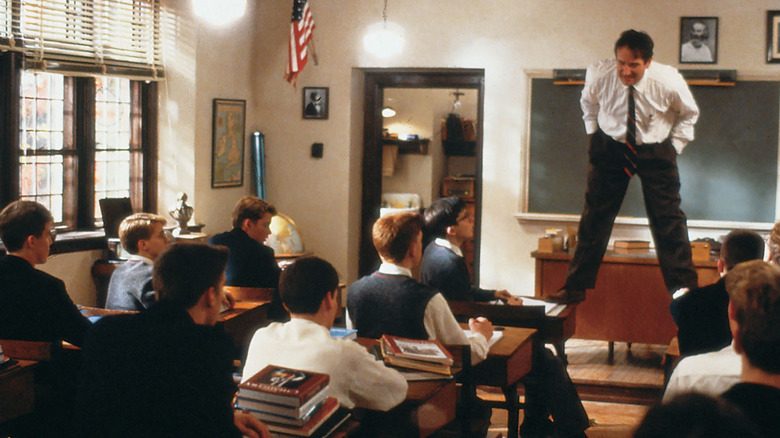
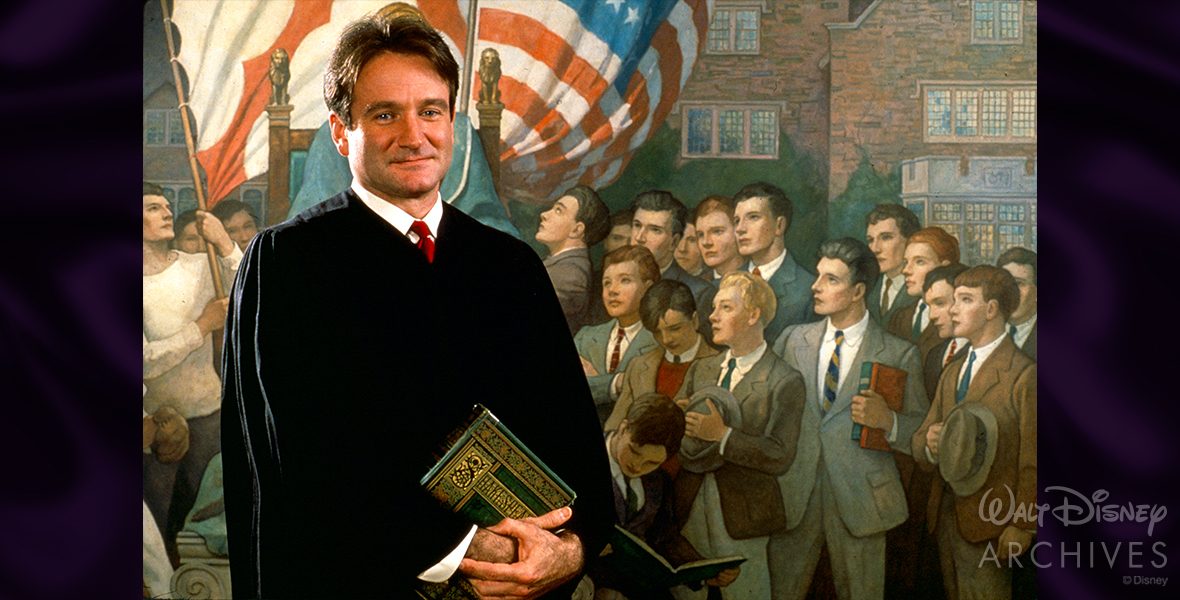
On June 2, 1989, Dead Poets Society opened in just eight U.S. theaters and took in $340,456 — a per-screen average that signaled Touchstone Pictures had something special on its hands. By the end of its run, Peter Weir’s quiet boarding-school drama had grossed $235.9 million worldwide on a $16.4 million budget, becoming the fifth-highest-grossing film of 1989 and the highest-grossing drama of the year. Robin Williams played John Keating, an English teacher who jumps on his desk and tells fifteen-year-old boys to suck the marrow out of life. Nobody expected a movie about poetry to do this.
Thirty-seven years later, “O Captain! My Captain!” is shorthand for everything a teacher should be, two words from Walt Whitman that a 16-year-old Ethan Hawke turned into the most-quoted ending in 80s cinema.
The Day Carpe Diem Went Wide
The limited June 2 release was a hedge. Disney’s Touchstone label didn’t believe a literary period piece about prep school boys could compete with the summer of 1989, a season that included Tim Burton’s Batman, Indiana Jones and the Last Crusade, Lethal Weapon 2, and Ghostbusters II. The studio booked the film into eight art houses, watched it sell out, and quickly expanded it to a wide release later that month. Word of mouth did the rest. Audiences walked out the doors quoting Whitman and trying to remember the last time a movie made them feel that fired up.

The setup is simple. Welton Academy, “the best prep school in America,” class of 1959. Seven boys, one outsider English teacher, and a copy of Five Centuries of Verse they’re told to rip the introduction out of on day one. By the end of the semester, two of them are sneaking out to a cave at night to read poems by candlelight and one of them is dead. Tom Schulman’s screenplay, which won the 1990 Academy Award for Best Original Screenplay, never gives Mr. Keating an arc. He arrives fully formed, gives his students a vocabulary for who they already are, and gets blamed when the world they’re trapped in punishes them for it.
Robin Williams Hid Half a Day of Comedy From Disney
Williams was the gamble. By 1989 he was a stand-up legend and an Oscar nominee for Good Morning, Vietnam, but his manic style had a way of swallowing whatever movie surrounded him. Peter Weir’s pitch to him was the opposite of every script Williams had been handed: be quiet. Be still. Let the boys be the story.
Weir and Williams agreed early on to tone the comedy down — but Williams was Williams, and improvisation was the engine of his entire career. So Weir cut a deal with his star. He let Williams improvise freely for one half-day of shooting, then hid that footage from Disney executives, who had been nervously asking when their movie star was going to start being funny. The slate read “John Keating Reads His Students Poetry.” What Williams actually did was a riff-fest that included impressions of John Wayne reading Shakespeare and Marlon Brando doing Hamlet. Only a few seconds of that day made the final cut — including the John Wayne bit — but Weir credited the freedom of that afternoon with helping Williams find his restraint for the rest of the shoot.

The Cast of Boys Who Became a Generation of Actors
Casting director Howard Feuer auditioned more than 500 young actors to fill seven roles. He landed a murderer’s row of future leading men. Ethan Hawke, then 17, was Todd Anderson. Robert Sean Leonard played Neil Perry, the tragic center of the film. Josh Charles was the lovesick Knox Overstreet. Gale Hansen got Charlie “Nuwanda” Dalton, the boy whose rebellion outruns his judgement. Dylan Kussman, James Waterston, and Allelon Ruggiero rounded out the seven.
Hawke and Charles became lifelong friends on set — a friendship that resurfaced 35 years later when both showed up in Taylor Swift’s “Fortnight” music video in 2024, recreating the rhythms of their teenage chemistry. Robert Sean Leonard went on to play Dr. Wilson opposite Hugh Laurie for eight seasons of House. Hawke became Hawke — three Oscar nominations, two for writing the Before trilogy with Richard Linklater. None of them were stars when they showed up at St. Andrew’s School in November 1988. All of them left changed.

The most-told story from the shoot is Hawke’s. He thought Robin Williams hated him. Williams, in character as Keating, kept icing Hawke out between takes — a deliberate choice meant to mirror how Todd Anderson felt around his new teacher. Hawke spent most of the production convinced he had been miscast. Then on the final day, Williams pulled him aside, told him he was going to have a real career, and quietly slipped him a piece of advice about how to survive Hollywood. Hawke has retold the story in interviews for three decades.
Welton Was Actually a Boarding School in Delaware
The Welton Academy of the film is fictional. Schulman based it loosely on his own high school, Montgomery Bell Academy in Nashville, and named John Keating after his real-life English teacher Samuel Pickering, who later wrote about the experience of having a Hollywood version of himself wandering around theaters worldwide.
The campus on screen, though — the stone halls, the chapel spire, the wide green quad where boys kick a soccer ball in slow motion to Maurice Jarre’s score — is real. After scouting more than 70 prep schools and small colleges, Weir’s production designer Wendy Stites picked St. Andrew’s School in Middletown, Delaware. Founded in 1929 by A. Felix du Pont, St. Andrew’s sits on a 2,200-acre estate of Collegiate Gothic Revival stone buildings and one of the largest secondary-school campuses in the country. Stites called it “a set dresser’s dream.” Weir shot there over Thanksgiving and Christmas 1988 to avoid disrupting actual classes.

The pond where the boys row at sunrise is on the campus. The crew teams still use it. The famous opening procession down the chapel aisle was filmed in Founders Hall, the central 1929 building. Dead Poets Society was the first feature film ever shot entirely in Delaware, a fact the state still trades on.
What Peter Weir Did That Most Directors Wouldn’t
Weir, an Australian best known then for Witness and The Year of Living Dangerously, ran the production like a boarding school. He told the young cast not to use modern slang on or off camera. He had them read Whitman, Thoreau, and Frost between takes, then quizzed them on it. He filmed the movie in chronological order — a luxury most productions can’t afford — so the boys would actually feel the autumn turn to winter, feel Keating’s lessons accumulate, feel the dread tighten around Neil Perry.

That last decision is part of why the climax lands. By the time Neil’s father (Kurtwood Smith, two years before Robocop) pulls him out of the school play and ends his future, the boys have lived inside the world long enough that the loss feels personal. Williams’s reaction in the school gym the next morning — Keating folding into himself as the news breaks — wasn’t blocked or rehearsed. Weir gave him the news right before the take.
The Cave, the Candles, and the Real Dead Poets Society
The boys’ secret society meets in a cave in the woods, where they read poetry by candlelight while half-quoting it from memory. The cave was constructed on a soundstage, lit by hundreds of actual candles, and shot with a wide-angle lens that made the space feel deeper than it was. The “Dead Poets Society” name and the ritual of opening each meeting with Thoreau’s “I went to the woods because I wished to live deliberately” — that was Schulman’s invention.

The “barbaric yawp” scene where Keating drags a terrified Todd Anderson around the classroom forcing him to invent a poem on the spot was the moment Hawke decided to rewrite his own dialogue. He thought the scripted version made Todd sound too articulate, too cleaned up. He pitched Weir on a stuttering, half-finished version where Todd visibly cannot find the words until he finally does. Weir let him try it. That version is what made the cut.
“O Captain! My Captain!” and Why It Still Lands
The final scene is the reason any of this is still remembered. Keating has been blamed for Neil’s suicide and fired. He comes back to the classroom to collect his things. The boys are silent under their new teacher’s watch. Then Todd Anderson — the stuttering kid who couldn’t get a poem out three months earlier — stands on his desk and says “O Captain! My Captain!”
One by one, the others follow. Williams’s reaction — the slow turn, the choked “thank you, boys” — was a single take. Weir cut a wider version that included a sweeping crane shot. He threw it out and kept the close-up. The wider shot, he said, would have asked the audience to admire the moment. The close-up makes you sit in it.

After Robin Williams died on August 11, 2014, fans around the world recreated that scene as a tribute — climbing on desks at schools, offices, funerals. The Whitman poem was actually written about the death of Abraham Lincoln. The students don’t know that in the film. The boys reciting it for Keating are, in 1989 movie logic, simply giving him the gift of being seen one last time before he leaves. It’s the kind of grace note that doesn’t survive a modern script-doctor’s pass.
Watch the Original Trailer
The 1989 trailer is a piece of marketing history in its own right — Touchstone wasn’t sure how to sell a poetry movie, so the trailer pitches it like a coming-of-age thriller. The score swells, the boys whisper Latin, Keating thunders. None of it prepares you for how quiet the movie actually is.
Awards, Box Office, and the Argument the Film Started
The Academy gave the film four nominations: Best Picture, Best Director, Best Actor for Williams, and Best Original Screenplay. Schulman won. Driving Miss Daisy took Best Picture. Oliver Stone won Director for Born on the Fourth of July. Daniel Day-Lewis beat Williams for My Left Foot. The film also won the BAFTA for Best Film and the César in France for Best Foreign Film, where it became a phenomenon — the title Le Cercle des poètes disparus is still shorthand in French schools for an inspiring teacher.
The argument the film started in 1989 has never quite gone away. Critics like Roger Ebert gave it two stars, calling Keating’s methods reckless and the whole thing emotionally manipulative. The novelist David Foster Wallace called it the most influential movie of his college years. Both reads can be true. Keating tells boys to seize the day without quite teaching them how to survive what happens after. The film’s defenders argue that’s the point — Mr. Keating is not a self-help book. He’s a teacher who shows up, lights a fire, and then is gone.

Why June 2, 1989 Still Matters
The summer of 1989 belonged to Tim Burton’s bat-signal and Indiana Jones’s whip. The film that endures from that summer — the one schoolteachers still play on the last day of senior English, the one Robin Williams was eulogized with — opened in eight theaters with no marketing muscle behind it. Dead Poets Society proved that a quiet movie about poetry could outearn most of what Hollywood was building blockbusters around. It made Robin Williams a dramatic actor, made Ethan Hawke a leading man, and made Walt Whitman trend for the first time since high school. Not bad for a Friday opening.
For more 1980s movie premieres that shaped the decade, check out our pieces on The Shining’s May 23, 1980 premiere and Return of the Jedi opening on May 25, 1983. And for a darker look at Robin Williams’s contemporaries, our Christopher Reeve piece covers another beloved actor whose life shifted on a single day.
Love the retro era? Browse our shop for vintage finds, retro clothing, and 80s/90s nostalgia gear.
Sources
- Dead Poets Society — Wikipedia — production, cast, awards, and reception
- The Making of a Classic: The Story Behind Dead Poets Society — D23 — Disney’s official production history
- Dead Poets Society released in selected theaters — HISTORY — June 2, 1989 release record
- Robin Williams Had To Hide One Of Dead Poets Society’s Best Scenes From Disney — SlashFilm — the hidden improvisation day
- Dead Poets Society — AFI Catalog — production credits and filming locations