On This Day: June 6, 1984 — Tetris Is Born in Moscow
On June 6, 1984, a 28-year-old Soviet computer engineer named Alexey Pajitnov finished a small puzzle program on a machine that could not draw pictures. He called it Tetris. The original ran on an Elektronika 60 at the Dorodnitsyn Computing Centre in Moscow, with seven falling shapes assembled from square brackets because the hardware had no graphics card. Forty-two years later, Tetris has sold an estimated 520 million paid units and lives on every phone, console, and browser tab on Earth. This is the story of how a productivity-killing bug test became the most-played game in history — and why June 6, 1984 is the date the entire industry quietly orbits.
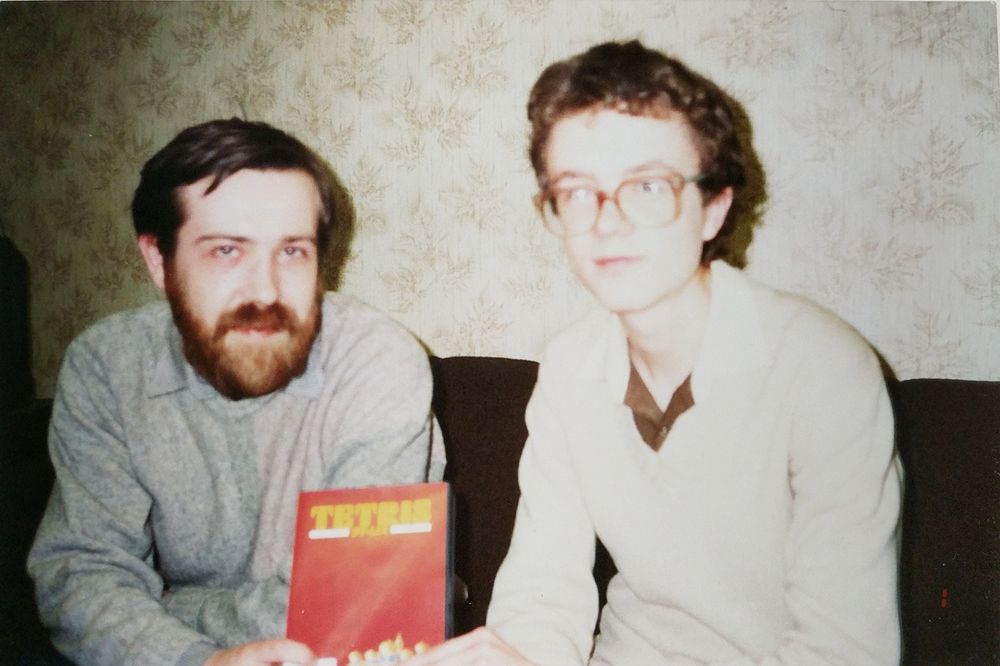
Alexey Pajitnov (left) and Vadim Gerasimov, the teenage student who ported Tetris to the IBM PC. Photo via Vadim Gerasimov’s personal archive.
The Retro Almanac
A monthly roundup of "on this day" highlights from that month, decades back — plus first dibs on new retro merch drops. No spam, just the good stuff.
The Day Tetris 1984 Was Born
Tetris 1984 was not a planned product. Pajitnov was an artificial intelligence researcher tasked with stress-testing the Elektronika 60, a clunky Soviet clone of the DEC PDP-11. He needed a small program that would exercise the machine’s logic without crashing it, and he had a stack of pentomino puzzles on his desk at home. Pentominoes — twelve shapes made of five squares — were too complicated for the screen budget he had, so he sliced one square off each piece. Seven shapes. Four squares each. He typed the Greek word for four, “tetra,” into the name and stuck the suffix from his favorite sport, tennis, on the end. Tetris.
The first build was finished in two weeks of evening sessions. By June 6, 1984, it was playable. Pajitnov demoed it to a colleague who lost his entire afternoon to it. Within a week, the program was spreading on floppy disks across every research institute on the Moscow Ring Road, and Pajitnov’s bosses were quietly telling people to stop installing it because nothing was getting done. That was the first sign that this was not a normal piece of software.
The Soviet Computer That Couldn’t Draw a Single Pixel
You cannot tell the Tetris origin story without sitting with the Elektronika 60 for a minute. The machine had no raster graphics, no sound card, and no color. Output was a green text terminal that could render letters and a handful of punctuation marks, and that was it. Pajitnov programmed the game in Pascal under the RT-11 operating system, and to draw a tetromino he used a pair of square brackets — [ ] — for each block. A line clear was a row of brackets disappearing. The whole game was ASCII, rendered live, with the play field running about ten characters wide.
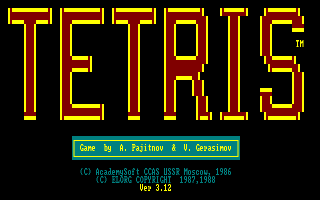
The original Tetris title screen from version 3.12, crediting Pajitnov, Gerasimov, AcademSoft, and ELORG.
The constraints turned out to matter. Because the Elektronika 60 could not animate smoothly, Pajitnov had to make each piece’s fall feel deliberate — a tick-tick-tick rhythm that the brain could lock onto. When the game was later ported to color screens with smooth animation, the designers kept that tick. It is one of the few cases in gaming where a hardware limitation became a permanent feature of the genre.
Why Pajitnov Picked Four Squares Instead of Five
Mathematicians had been chewing on pentominoes since the 1950s. Pajitnov loved them but spotted a practical problem the second he started laying them out on a screen: twelve shapes was too much information for a player to track in real time, especially under falling-block pressure. He dropped a square. Seven shapes — line, square, T, L, J, S, Z — felt right. They tile a rectangle, they rotate cleanly, and they form a closed system small enough to memorize on first contact.
The choice looks obvious in hindsight, but it was the single most important design call in the game. Tetris is playable because seven is a number a human can hold in working memory while making a thousand sub-decisions a minute. Six would have been too easy. Eight would have collapsed the readability. The math was already done for him; he just had the taste to stop at four squares.
The IBM PC Port That Broke Out of the Soviet Union
Pajitnov’s original Elektronika version would have died on a shelf in Moscow if not for a 16-year-old named Vadim Gerasimov, who hung around the Computing Centre and pestered the older engineers for project time. Gerasimov rewrote Tetris in Turbo Pascal for the IBM PC, added color blocks using DOS character codes, and posted version 3.12 to the friend-of-a-friend bulletin board network that connected Soviet labs in 1986. Within months, the game had crossed the Iron Curtain — first to Budapest, then to a Hungarian software company called Novotrade, which showed it to Robert Stein of Andromeda Software in London. Stein flew to Moscow to license it. The rights were a mess from the day he landed.
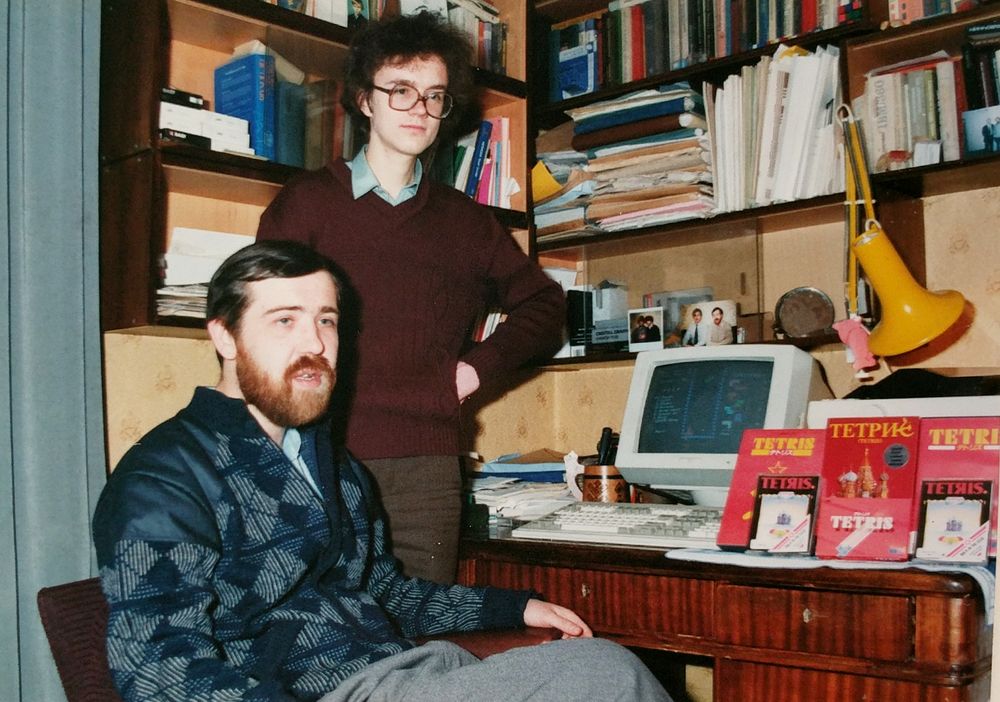
Pajitnov and Gerasimov in Moscow with retail Tetris boxes — the export versions licensed through ELORG.
Here is the part the Apple TV movie skims over: under Soviet law, Pajitnov did not own his own game. Anything created on state computers belonged to the state. The licensing authority was Elektronorgtechnica — ELORG — and ELORG had no idea what Tetris was worth. Stein walked out with what he believed were worldwide rights for a few thousand dollars. He was wrong about which rights, and that single misunderstanding fueled five years of lawsuits.
The Cold War Licensing Knife Fight
By 1988, three different companies thought they owned Tetris. Mirrorsoft had it for European computers via Andromeda. Spectrum HoloByte had North America. Atari Games — operating under the Tengen brand on consoles — believed it had the rights for arcades and home systems. Sega was selling a wildly popular arcade version in Japan, licensed through Atari. Nintendo, watching from Kyoto, was about to launch the Game Boy and needed a killer pack-in title.
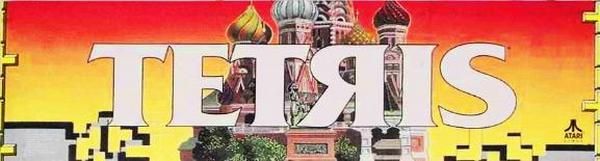
The Atari Tetris arcade marquee from 1988 — Saint Basil’s Cathedral became the unofficial Tetris logo for a decade.
Enter Henk Rogers, a Dutch-American game designer running a small Tokyo studio called Bullet-Proof Software. Rogers played Tetris four times in a row at the 1988 Consumer Electronics Show, decided the entire planet would do the same, and flew to Moscow uninvited to find out who actually owned the rights. He had two million dollars of Game Boy cartridges sitting in a Nintendo warehouse waiting on his answer, and his in-laws’ house was the collateral. He got into the ELORG office by walking through the front door without an appointment, which Soviet officials told him was technically a crime.
Inside, he met Pajitnov for the first time. The two of them hit it off immediately — both designers, both obsessive about systems — and Pajitnov quietly steered the ELORG negotiators toward Nintendo. By the time Rogers flew out of Sheremetyevo, he had handheld and console rights nailed down, the Game Boy bundle was safe, and Atari was about to discover that their entire NES print run was unlicensed. The truth is, the Tetris licensing war was won in a Moscow hotel bar over Pepsi and Pajitnov’s hand-drawn diagrams.
The Game Boy Bundle That Sold 35 Million Copies
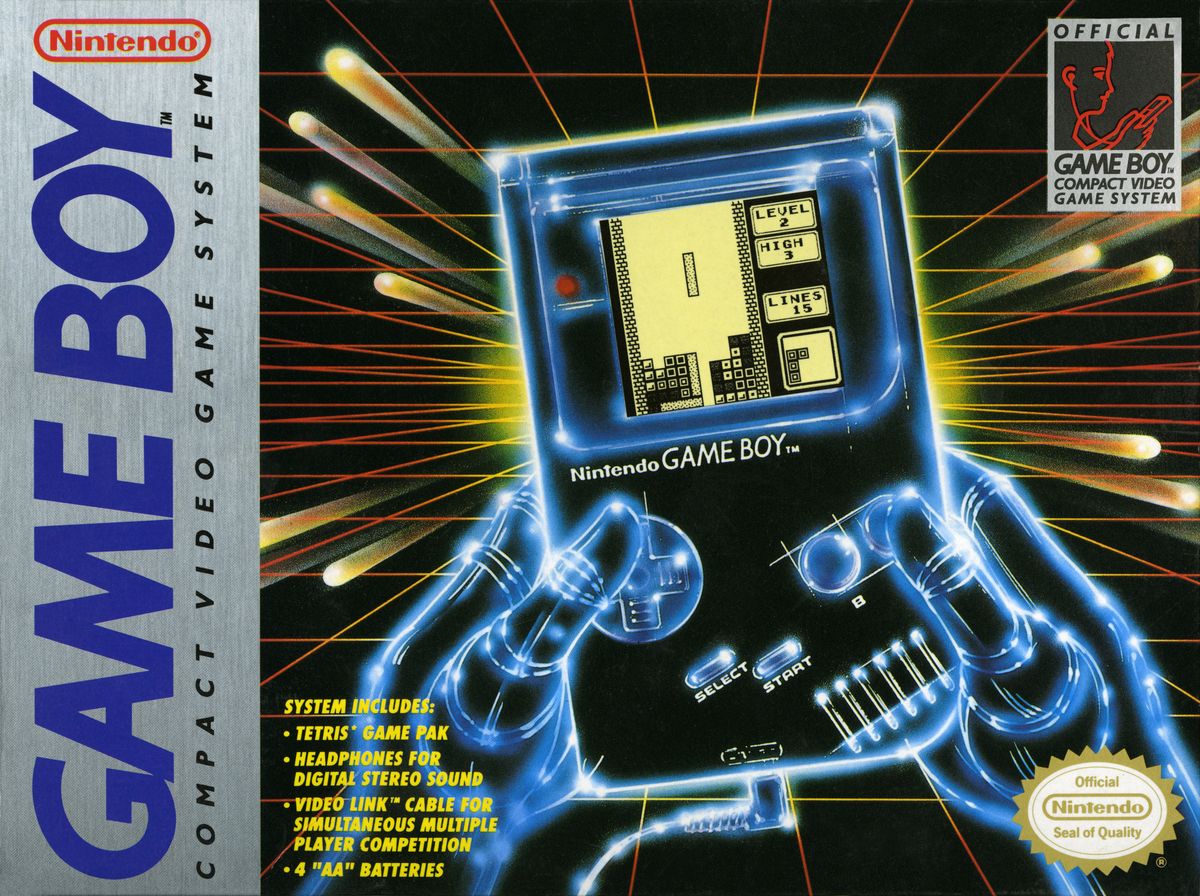
Nintendo launched the Game Boy in Japan on April 21, 1989, and in North America that July. In every market outside Japan, every box shipped with Tetris in the cartridge slot. That single decision — pairing a battery-friendly puzzle with a portable screen — sold the Game Boy to an audience Nintendo had never reached before: adults, women, commuters, and bored teachers who would have laughed at Super Mario. By 1990, six months after launch, the NES version alone had moved 1.5 million units worth $52 million. The Game Boy version eventually sold over 35 million copies, making it one of the top ten best-selling video games of all time.
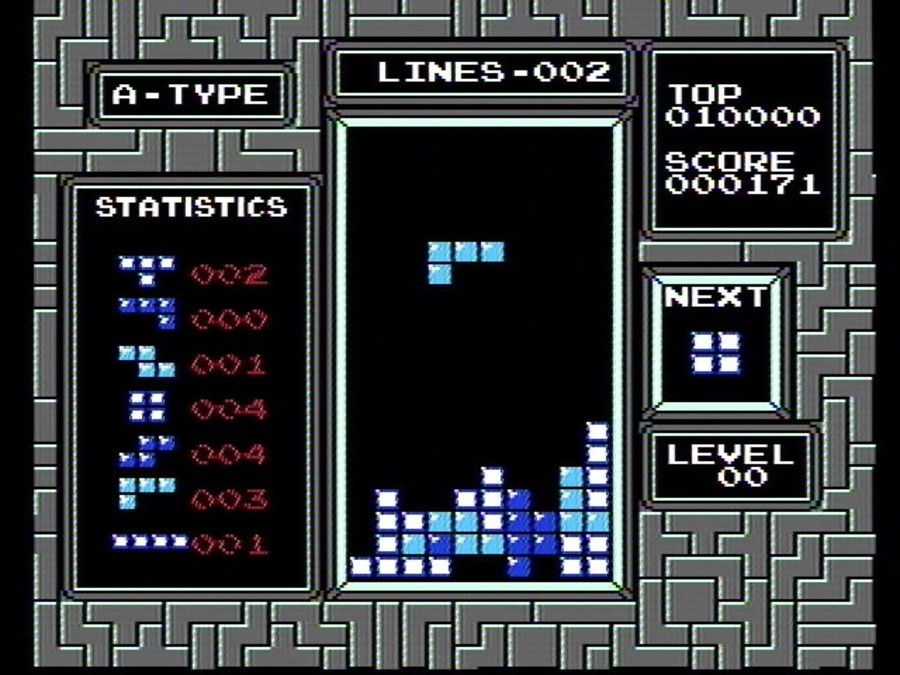
Nintendo’s official NES Tetris from 1989 — the A-Type endurance mode that defined the genre for a decade.
The numbers tell only half the story. The Game Boy’s killer feature was the Game Link cable, which let two players battle in real time. That detail came directly out of Rogers’s pitch to Nintendo of America’s Minoru Arakawa: “If you want kids to buy two Game Boys, you have to give them something to do with the second one.” Versus Tetris was the answer. Multiplayer puzzle games existed before, but Tetris on Game Boy is the one that made every middle-school cafeteria sound like a battle station for the next four years.
The Tengen Black Cartridge Mess
Atari, through its Tengen subsidiary, refused to accept that it had lost the NES rights. In May 1989, Tengen shipped its own NES Tetris in a black plastic cartridge — the company’s signature middle finger to Nintendo’s licensing program. Many fans still argue Tengen’s version is the best home Tetris ever made: smoother animation, simultaneous two-player on one screen, and an opening cinematic of a Russian dancer. It sold 100,000 copies in a month.

The Tengen Tetris box, June 1989 — recalled and destroyed weeks after release by court order.
Then a federal judge in San Francisco issued an injunction. By August, 268,000 Tengen Tetris cartridges had been ordered destroyed. Most were crushed. A few thousand survived in the hands of retailers who hid them in back rooms, and those copies trade on eBay today for two to four hundred dollars apiece. If you owned a Tengen black cart in 1990, you owned a piece of contraband that the U.S. legal system had personally tried to delete.
Why Tetris Outlived Every Other 1980s Game
Most 80s blockbusters faded with the hardware that birthed them. Pac-Man belongs to the arcade. Super Mario Bros. belongs to the NES. The Game Boy itself is a museum piece. Tetris is on your phone right now, and probably on your smartwatch. That portability is not an accident — it is baked into the design. The game has no story, no characters, no language, no required cultural context. A six-year-old in Lagos, a retiree in Osaka, and a developer in Berlin all play it the same way. That makes it the closest thing video games have to a universal grammar.

Pajitnov and Rogers cementing their handprints at Lucca Comics & Games 2024 for Tetris’s 40th anniversary.
Pajitnov earned almost nothing from Tetris for the first decade — Soviet copyright law saw to that. He finally moved to Seattle in 1991, joined Microsoft, and in 1996 he and Rogers founded The Tetris Company, which now controls the brand. He has called June 6, 1984 “the most important Tuesday of my life.” That part checks out: June 6, 1984 was indeed a Tuesday. For a generation of 80s and 90s gamers, it was the day the most addictive software ever written quietly leaked out of a Soviet research lab and started its march across the planet.
The Gaming Historian Documentary
For the full visual telling of the Tetris saga — the licensing fights, the Moscow trips, and the Game Boy bundle deal — Gaming Historian’s hour-long documentary is the definitive treatment. It includes archival footage of the original Elektronika 60 and interviews with Pajitnov and Rogers.
What Tetris 1984 Means in 2026
The game is now older than most of the people playing it. June 6, 1984 sits in the small club of dates that genuinely changed entertainment — alongside the launch of Super Mario Bros., the premiere of MTV, and the release of the first Walkman. Pajitnov’s brackets started something the industry has tried and failed to copy for forty-two years. Pick up your phone, open the App Store, and search “Tetris.” You will get hundreds of clones, official ports, and tributes. None of them quite work the way the original does, because none of them were debugging an Elektronika 60 on a Tuesday afternoon in Moscow.
Sources
- Vadim Gerasimov: The Original Tetris, Story and Download — Co-creator’s personal archive with version 3.12 download and first-person history.
- Tetris — Wikipedia — Full timeline of the game’s design, ports, and licensing history.
- Tetris at 30: Interview with Alexey Pajitnov — TIME — Pajitnov’s own account of the June 1984 prototype.
- Tetris 40th Anniversary at Lucca — Variety (2024) — Coverage of Pajitnov and Rogers’s Walk of Fame induction.
- From Russia with Fun: How Nintendo Got the Tetris Rights — Vice — The Henk Rogers Moscow trip, told in detail.
- Alexey Pajitnov — Wikipedia — Career biography and post-1991 Microsoft and Tetris Company work.
The Retro Almanac
A monthly roundup of "on this day" highlights from that month, decades back — plus first dibs on new retro merch drops. No spam, just the good stuff.