Tamagotchi 90s: 9 Wild Facts About the Virtual Pet Craze
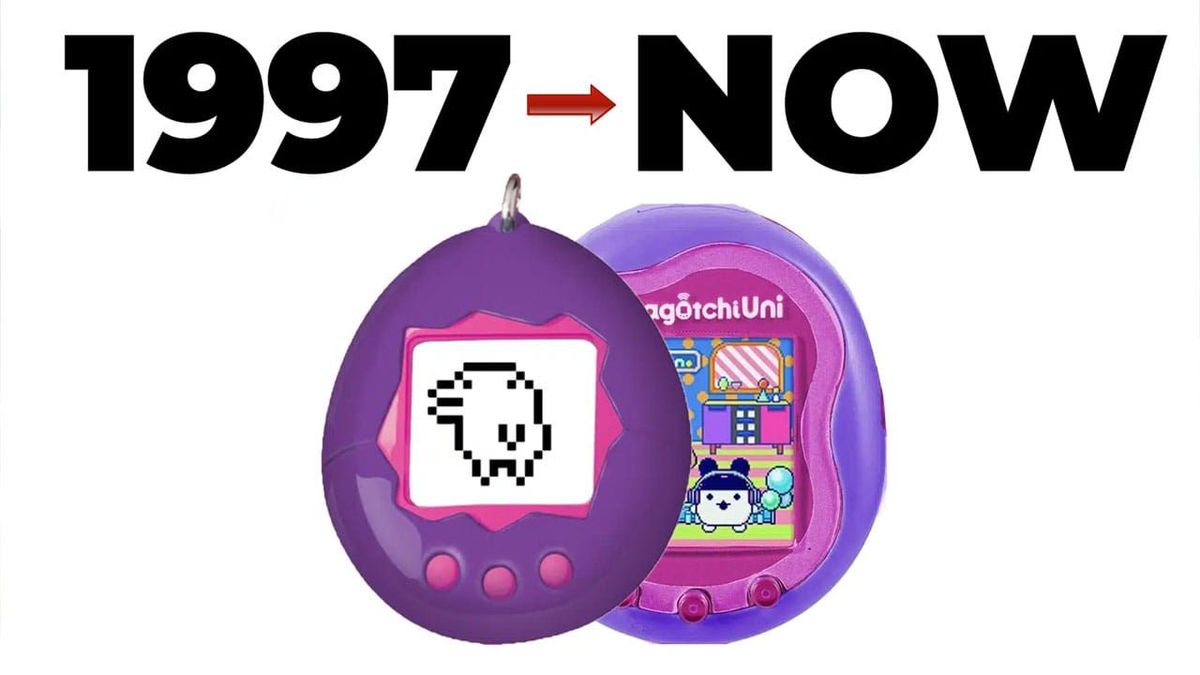
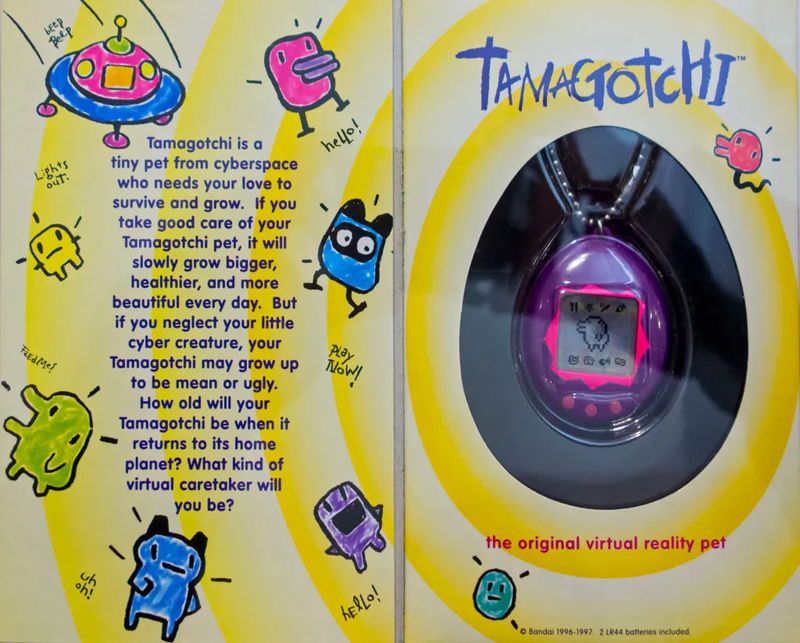
The Tamagotchi 90s craze peaked when an egg-shaped piece of plastic the size of a quarter convinced 82 million people that pixel poop required immediate attention. Bandai’s virtual pet launched in Japan on November 23, 1996, hit the US on May 1, 1997, and triggered a moral panic that got the device banned from classrooms across three continents. The original retailed for ¥1,980 (about $18 then, $35 today) and sold out so fast Bandai’s factories couldn’t keep up — kids waited in lines that snaked around toy stores while parents lost their minds.
This is the deep history: why the original Tamagotchi 90s phenomenon worked, what those pixel characters actually meant, which schools went to war over it, and how a toy everyone wrote off as a fad is still selling new units in 2025. If you owned one, this will explain why you cried when it died.
1. The original Tamagotchi was invented by a Bandai office worker who hated her commute
Aki Maita, a 30-year-old employee in Bandai’s planning division, kept watching kids in Tokyo hauling plastic pet carriers onto trains. She wondered what a portable pet would look like if you stripped away the carrier, the food bowl, the smell, and the lawsuit risk. The answer was a key-chain LCD that beeped when it was hungry. Maita pitched it internally in 1995, partnered with Akihiro Yokoi at toy developer WiZ, and named the device by combining tamago (Japanese for egg) with uotchi (a phonetic riff on “watch”).
The Retro Almanac
A monthly roundup of "on this day" highlights from that month, decades back — plus first dibs on new retro merch drops. No spam, just the good stuff.
The first units shipped November 23, 1996, in white shells with grey LCDs. The launch sold out in weeks. Bandai had projected 300,000 units for the first year and blew past that number before Christmas. By the time the Tamagotchi reached the US in May 1997, the company was already on its third production ramp-up — and still couldn’t make enough.
2. Tamagotchi 90s sales hit 82 million units worldwide
The numbers are absurd even now. Bandai officially reports that the original Tamagotchi line has moved more than 82 million units across all variants since 1996. The first 18 months alone accounted for roughly 40 million. Compare that to the Game Boy’s lifetime number (~118 million across a 14-year run) and the toy was hanging with one of the most successful consoles in history despite being plastic, monochrome, and the size of a poker chip.
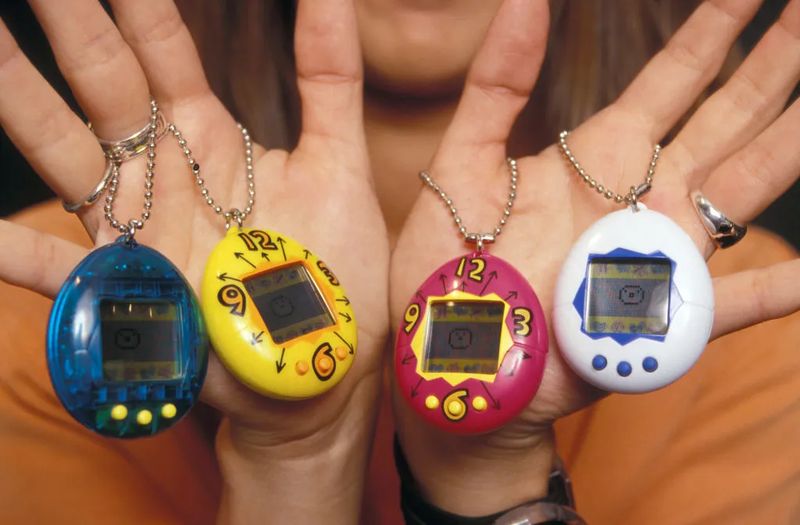
Resale prices got weird almost immediately. Original Tamagotchi units that retailed for $18 were trading hands on school playgrounds for $50, then $100, then more. By the end of 1997, U.S. parents were paying scalpers north of $150 for the white-and-grey originals. Bandai’s response was to flood the market with color variants — the move that birthed the rainbow of teal, pink, yellow, and purple shells most Gen Xers actually remember.
3. Schools banned Tamagotchi 90s devices by the thousands
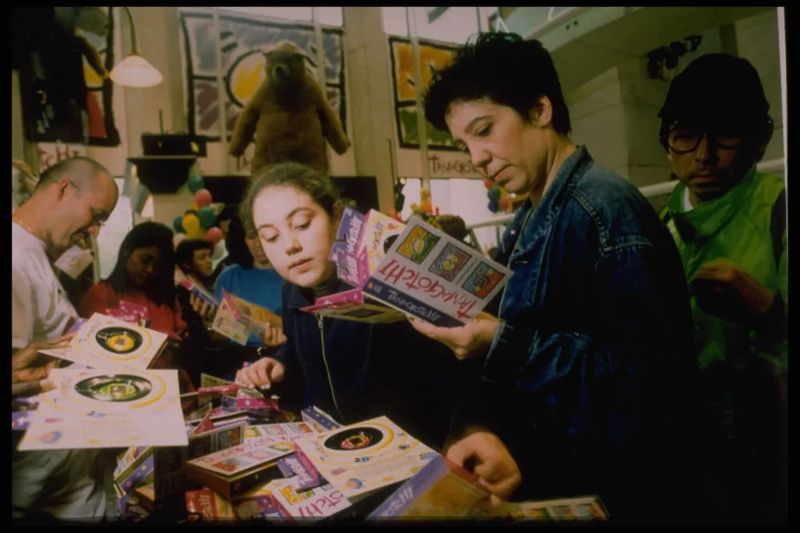
The bans started in spring 1997. Schools in Florida, Massachusetts, California, the UK, Australia, and Japan all moved to ban Tamagotchi from classrooms because the beep — every time the pet needed food, attention, or a fresh round of digital poop scooping — was destroying lesson plans. Some districts cited “playground theft incidents” after kids started fighting over the rare colored shells. A 1997 St. Petersburg Times piece quoted a middle-school principal complaining that “the funeral wails” of kids whose pets had died mid-math-class were causing more disruption than the beeping itself.
The Hong Kong Education Department went full nuclear and circulated a formal advisory urging all primary schools to confiscate any Tamagotchi found in class. In Japan, multiple high schools added Tamagotchi explicitly to their lists of prohibited items — alongside cigarettes and pagers. Yes, the same era this site covers with the 07734 Pager Tote Bag celebrating that same chunky tech moment.

4. The Tamagotchi 90s virtual pet actually died — permanently
This is the part that genuinely shocked kids in 1997, and it’s why so many adults still talk about Tamagotchi with weird residual grief. If you neglected the device — left it in a drawer, missed too many feeding alerts, ignored the discipline meter — the pet would die. Not pause. Not reset to a baby. Die. The screen displayed a small angel or a gravestone (the original Japanese ROM showed a ghost; the Western version got the more religiously universal angel), and the only way back was a full reset that wiped the unit’s memory.
For a generation of kids who had never owned a real pet, this was the first death they personally caused. Pediatric counselors in 1997 fielded enough Tamagotchi-grief calls that the New York Times ran a piece on it. Bandai eventually softened the death mechanic in later generations — by Tamagotchi Connection (2004) you could revive your pet — but the original V1 stayed brutal. That’s part of why originals sell on eBay today for $200 to $600 in working condition.
5. There were 12 evolution stages — and rare paths most kids never saw
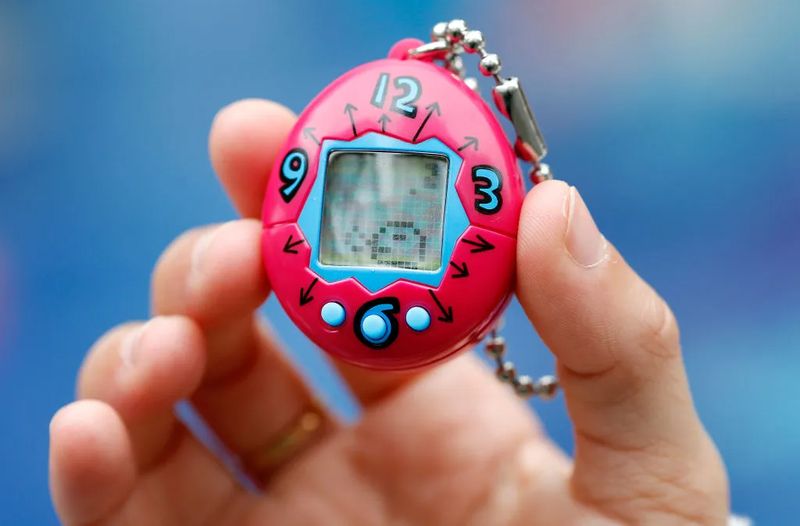
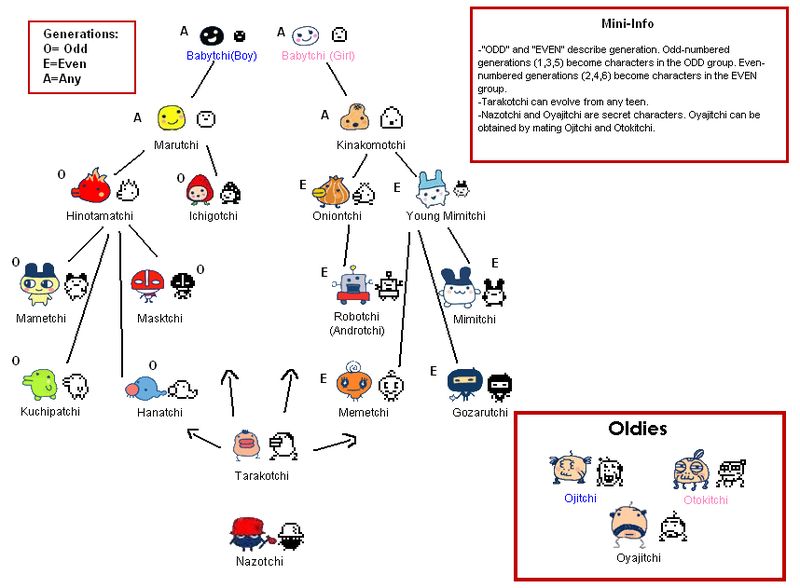
The original Gen 1 Tamagotchi had a hidden depth that most people never explored. Your pet hatched from the egg as a Babytchi, evolved into a Marutchi (the round one everyone remembers), then branched into one of seven possible adult forms based on how you raised it. Mametchi was the “good ending” — the smart, round-eared adult you got from near-perfect care. Kuchipatchi was the laid-back version. Tarakotchi was what you got if you slacked off. Nyorotchi was the worst-case outcome — basically a snake — and meant you were a bad parent.
There was also a secret character called Oyajitchi — an old salaryman-looking dude with a sash — that only appeared if your pet hit a specific age and discipline combo. Most kids never saw him. The Gen 1 evolution tree was reverse-engineered by fans over years and now lives in dozens of online guides; if you played one in 1997, you almost certainly missed half the characters available to you.
6. Bandai turned down Pokémon for Tamagotchi — and it nearly killed them
Here’s a buried Tamagotchi 90s fact: Bandai had a chance to license Pokémon for a Western toy push in 1996 and passed on it because Tamagotchi was eating the company’s entire production capacity. Nintendo went elsewhere, Pokémon detonated, and Bandai spent the next two years watching a fad they could have owned go to a competitor. The internal post-mortem at Bandai is now cited in Japanese business case studies as a classic example of the fad-vs-franchise trap.
When the Tamagotchi craze cooled in late 1998, Bandai was left with warehouses full of unsold units and a $90 million write-down. The company stock dropped 30% in three months. Bandai survived but became famously cautious about chasing the next fad — a stance that arguably saved them during the Furby and Beanie Baby collapses, but also meant they spent the early 2000s playing catch-up in handheld toys.
7. What is a Tamagotchi actually doing inside?
If you’ve ever wondered what is a Tamagotchi from a hardware perspective: a Seiko Epson 4-bit microcontroller, 32 bytes of RAM, a custom LCD with 32×16 pixels, a piezo buzzer, and three buttons. That’s it. The whole pet — its mood, hunger, age, character path, evolution stage, discipline level, all of it — runs on less computing power than a 1980s digital watch. The reason it could go three to five days on a single CR2032 watch battery is that the LCD was so primitive it consumed almost nothing when idle.
Compare this to its 1989 handheld cousin: the original Game Boy launched in Japan on April 21, 1989 with a 4.19 MHz CPU and 8KB of RAM — orders of magnitude more powerful, yet the Tamagotchi punched harder culturally because the constraint was the point. The whole appeal was that this tiny thing demanded your attention like a real living creature. Add more processing power and you’d just have a worse version of a Game Boy.
8. The Tamagotchi 90s craze inspired knockoffs that outsold the original in some markets
Bandai’s success spawned an arms race of fakes. Giga Pets (Tiger Electronics, 1997) was the dominant US knockoff and at one point outsold actual Tamagotchi units at Target and Walmart — partly because Tamagotchi was perpetually sold out. Nano Babies, Nano Kitty, Dinkie Dino, Yasashii Pet, Compu Kitty — there were dozens. China produced a flood of unbranded “virtual pet” eggs that sold for $2 each at gas stations and convenience stores.
The knockoff economy was so large that by 1998, “Tamagotchi” had effectively become a generic term for any LCD virtual pet. Bandai sued aggressively over trademark dilution but couldn’t move fast enough to keep up with the Chinese factory output. This is why the modern brand reset around the Tamagotchi Connection in 2004 — Bandai needed to reclaim the name with a clearly differentiated product.
9. Tamagotchi 90s never actually died — it just got Wi-Fi
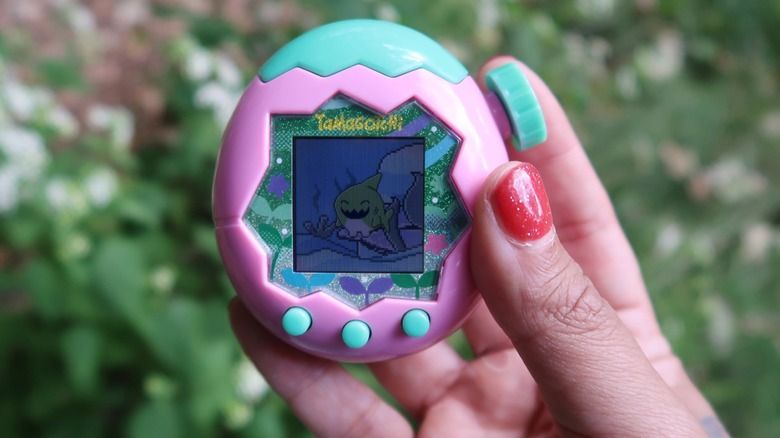
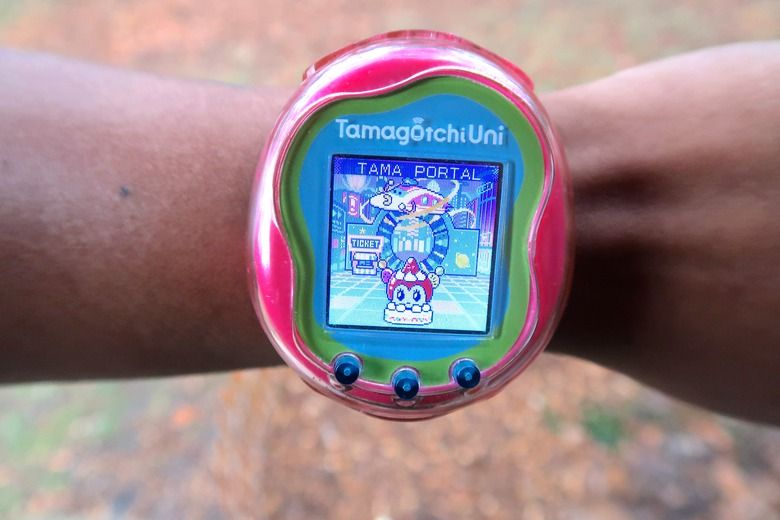
The brand has never been off-shelves for long. Bandai re-released the original Gen 1 design in 2017 for the 20th anniversary, then again in 2021. The Tamagotchi On (2019) added connectivity and color. The Tamagotchi Pix (2021) added a camera. The Tamagotchi Smart (2021) was the first wearable. The Tamagotchi Uni (2023) shipped with Wi-Fi, an app ecosystem, and a five-year content roadmap. The Tamagotchi Paradise (2025) brought touch controls and a new “biome” mechanic.
Bandai now reports that the franchise has crossed 91 million lifetime units sold across all generations. The 2023 fiscal year alone added more than 2 million sales — meaning Tamagotchi today sells better than most modern toy launches and is still a top-5 product line for Bandai’s Toy & Hobby division. The 90s kids who buried their first Tamagotchi at age 9 are now buying them for their own kids at age 35. That’s the rare fad arc that actually compounds instead of fading.
What the Tamagotchi 90s craze actually tells us
Look at what’s selling in 2025: AI companion apps, Replika, NPC streams, virtual girlfriends, “talk to your dead relative” chatbots. Then look at a $18 plastic egg from 1996 that did the same emotional job with a 4-bit microcontroller. The Tamagotchi nailed a behavioral loop — neglect punishes you, attention rewards you, the pet remembers — that the entire AI industry is now trying to recreate with neural networks. Bandai got there first with three buttons and a beep.
The real lesson from the Tamagotchi 90s era isn’t nostalgia. It’s that the technology you need to make someone genuinely care about a digital entity is almost trivial. The hard part is the design — knowing exactly when to demand attention, exactly how much grief to deliver, exactly which sounds will lodge in someone’s brain three decades later. That part still hasn’t been improved on. Hand a modern kid a working 1997 Tamagotchi and they’ll get attached inside an hour. The original cracked the code on the first try.
If you fell down this rabbit hole, the Ultimate 90s Nostalgia Guide covers the rest of the era’s pocket-sized obsessions, and the Sony Walkman retrospective walks through the other small plastic rectangle that changed how 90s kids lived.
Sources
- Keeping Tamagotchi Alive — Smithsonian Magazine — Long-form history of the device, the inventor, and the 1997 launch chaos.
- The History of Tamagotchi — Retro Dodo — Generation-by-generation rundown of every Tamagotchi model from 1996 to present.
- Tamagotchi Paradise Review — Engadget — Coverage of the 2025 model and the franchise’s modern direction.
- Tamagotchi Uni Update Review — Engadget — Deep dive into the Wi-Fi wearable revival.
- Bandai Namco Annual Reports — Source for cumulative sales figures and franchise performance data.
Browse retro and vintage-inspired apparel at the RetroRadical shop →
The Retro Almanac
A monthly roundup of "on this day" highlights from that month, decades back — plus first dibs on new retro merch drops. No spam, just the good stuff.