On This Day: July 19, 1996 — Muhammad Ali Lights the Atlanta Flame
Billy Payne spent nine years and roughly $1.7 billion building the 1996 Summer Olympics, and the whole thing came down to eleven seconds of a man who could barely hold a torch. When the flame finally caught and the crowd realized who was standing on that platform, grown adults in the stands started to cry. That is the kind of night July 19, 1996 turned out to be.
The Secret Nobody Cracked
The identity of the final torchbearer is usually the worst-kept secret at any Games. Reporters dig, officials leak, bookmakers take bets. Not this time. Evander Holyfield, the Atlanta-based heavyweight champ, was the presumed choice and even lit a leg of the relay. Longtime NBC Sports boss Dick Ebersol quietly argued for someone bigger, and the organizing committee flew Ali into Atlanta the day of the ceremony and hid him in a downtown hotel room.
The Retro Almanac
A monthly roundup of "on this day" highlights from that month, decades back — plus first dibs on new retro merch drops. No spam, just the good stuff.
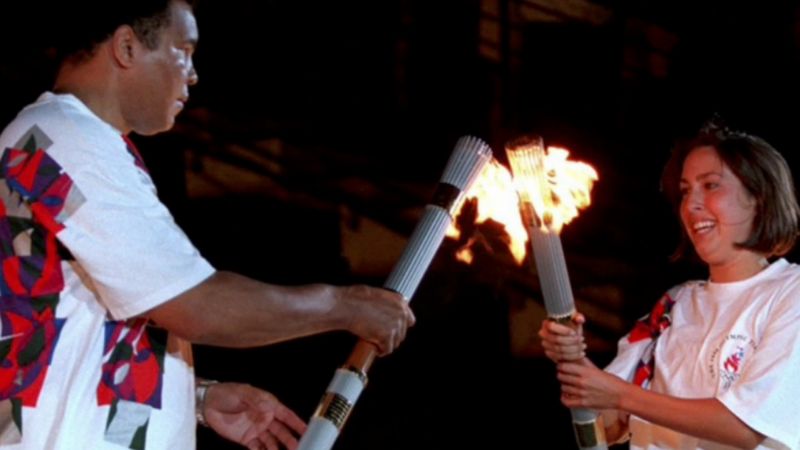
Athletes on the field didn’t know. Broadcasters guessing on air didn’t know. Even swimmer Janet Evans, the four-time gold medalist assigned to hand off the flame, only learned who she was passing it to shortly before showtime. “I never cried after any of my Olympic medals,” Evans said later, “but I wanted to cry” when she reached the top of the ramp and saw him waiting.
Out of the Dark
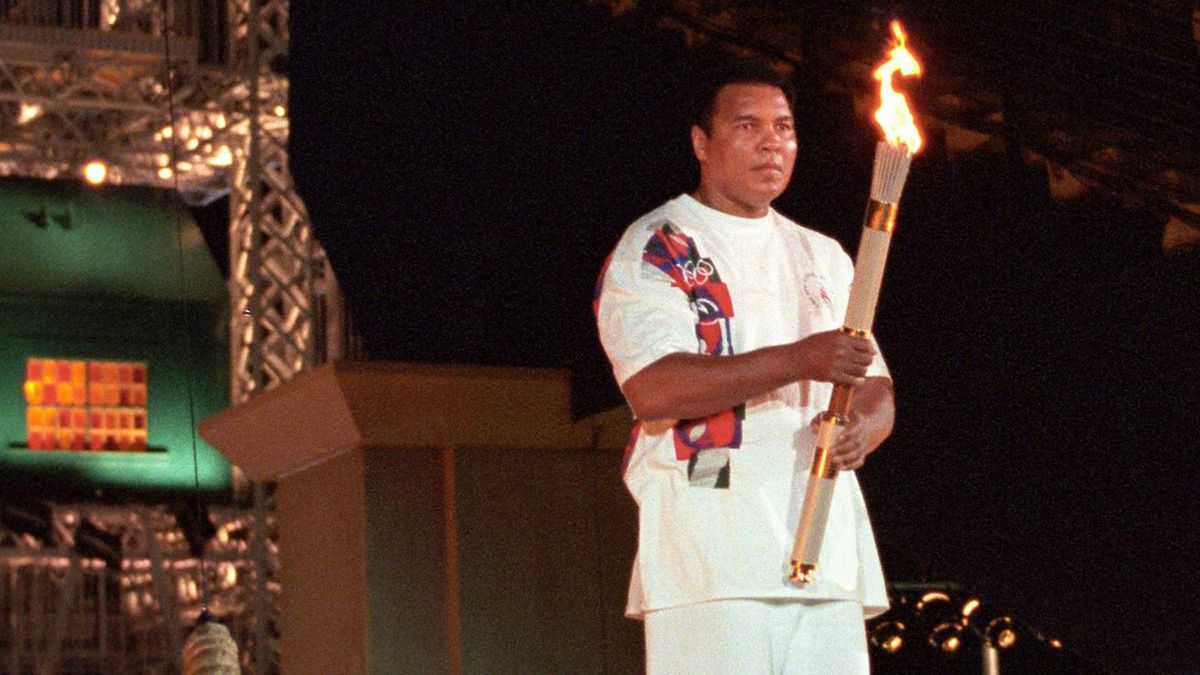
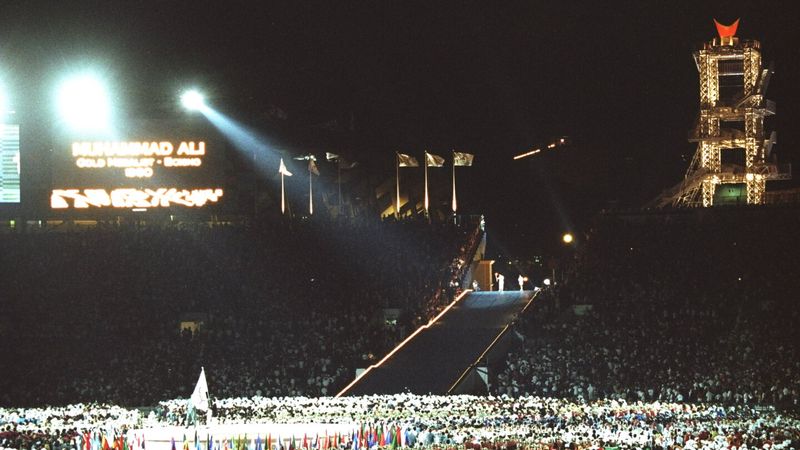
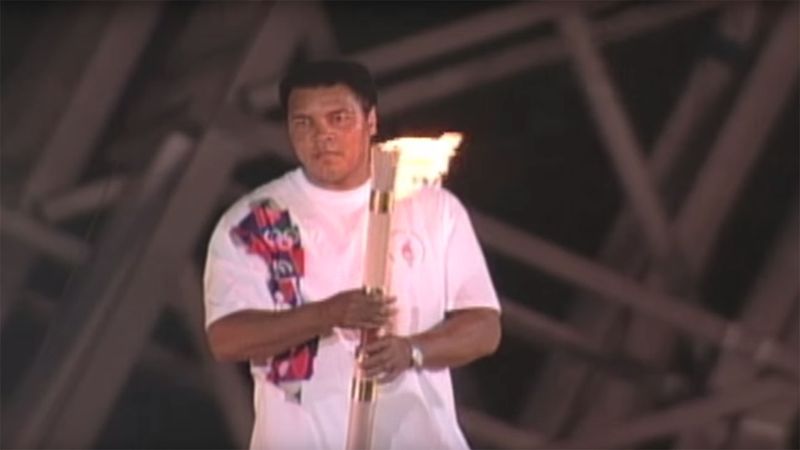
Evans carried the flame up a long ramp at the north end of Centennial Olympic Stadium. Then a spotlight snapped on, and there he was: Muhammad Ali, dressed in white, the most recognizable face on the planet, holding the torch in his right hand. The gasp was audible on the broadcast. The scoreboard flashed his name and his old credential — gold medalist, boxing, 1960 — and 85,000 people lost it.
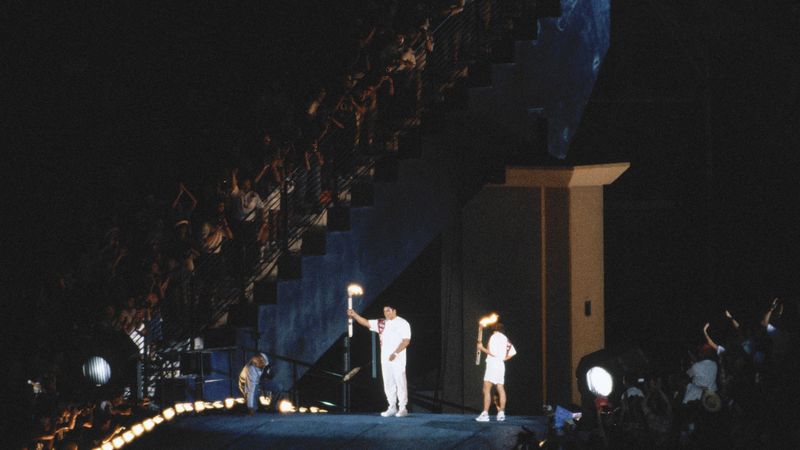
This was the man who had thrown his Rome gold medal off a bridge (or lost it, depending on which version he told that decade), who refused induction into the Army in 1967 and lost his prime years to the ban, who beat Sonny Liston, Joe Frazier, and George Foreman. By 1996 Parkinson’s had stolen his speech and stilled the fast hands. But it could not touch what he meant.
Eleven Seconds That Felt Like Ten Minutes
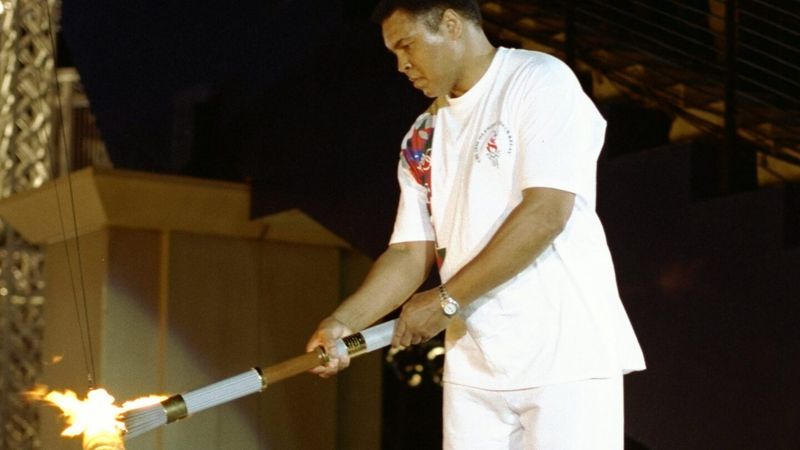
Here is the part people forget: it did not go smoothly, and that is exactly why it landed. Ali’s left arm shook badly. He had to hold the torch steady with one hand while lowering it to a mechanism that would send the flame rocketing up a wire to the cauldron high above the stadium. For a few agonizing seconds it looked like the flame near his sleeve might catch him. He didn’t flinch.
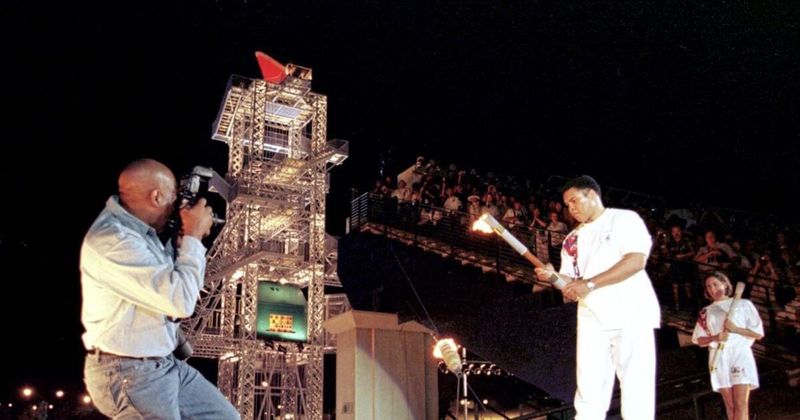
The fuse caught. A ball of fire climbed the wire, and the giant cauldron at the top of a 116-foot tower roared to life. Parts of the crowd broke into the old ring chant — “Ali! Ali! Ali!” — the same three syllables that had chased him around the world for thirty years. He never said a word. He didn’t need to.
Why It Still Hits Different
Great opening-ceremony torch-lightings usually trade on spectacle — an archer firing a flaming arrow in Barcelona four years earlier, a giant mechanical cauldron rising in London later. Atlanta went the other way. It bet everything on one vulnerable human being standing very still, and it worked because vulnerability reads truer than fireworks. You were not watching a stunt. You were watching a champion refuse to let a disease have the last word on live television.
There was a second act, too. Ali had thrown away or lost his 1960 Olympic gold medal years earlier. During the Atlanta Games, the International Olympic Committee quietly presented him with a replacement at a basketball game, and the crowd there gave him another standing ovation. The 1996 Olympics gave Ali his medal back and gave the rest of us the picture we still think of first.
The Centennial Games were not a smooth seventeen days. A pipe bomb in Centennial Olympic Park nine days later killed two people and injured more than a hundred, a scar Atlanta still carries. Transportation and logistics drew constant complaints. But ask anyone who watched July 19 what they remember, and they don’t say the buses. They say the shaking hand and the flame.
The Tower Still Stands
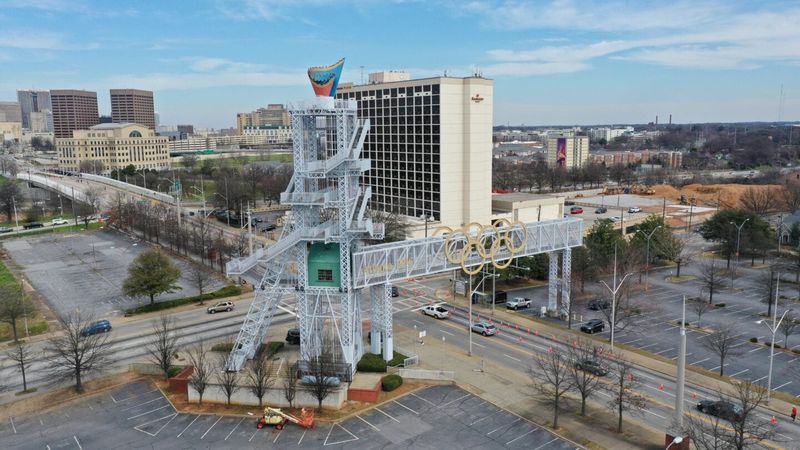
The cauldron Ali lit was too big and too far from the field for comfort, and its clunky design got mocked at the time. It has aged into a landmark. For years it sat near the old Olympic stadium site by what became Turner Field, and Atlanta has worked to preserve and relocate it so the moment has a permanent home. The flame is long out, but the structure is a pilgrimage stop for anyone chasing 1996.
The Atlanta Games were stuffed with moments that defined the back half of the ’90s — Kerri Strug’s one-footed vault, Michael Johnson’s gold shoes, Donovan Bailey’s 100-meter world record. If you love this era of sports drama, our look back at the 1994 World Cup final and the 1999 Women’s World Cup final live in the same emotional neighborhood. And for a night when a stadium full of strangers became one crowd, nothing beats Live Aid in 1985.
Love the retro era? Browse our shop for vintage finds, retro clothing, and 80s/90s nostalgia gear.
Ali lived another twenty years, appearing less and less as the disease advanced, and died in June 2016. When the tributes poured in, the clip everyone shared was not a knockout or a Howard Cosell interview. It was a man in white on a summer night in Atlanta, hand shaking, refusing to drop the torch. That is the whole story of Muhammad Ali in about eleven seconds — and it happened on this day in 1996.
Sources
- Olympics.com — “Shining star Ali lights up the world” — Official account of the Atlanta 1996 cauldron lighting.
- Sports Illustrated — Dick Ebersol on how Ali was chosen — Behind-the-scenes on keeping the secret.
- NBC Sports — Janet Evans relives the torch handoff — First-person recollection of the moment.
- Atlanta History Center — Atlanta’s Olympic Cauldron — History and preservation of the cauldron tower.
The Retro Almanac
A monthly roundup of "on this day" highlights from that month, decades back — plus first dibs on new retro merch drops. No spam, just the good stuff.