On This Day: June 13, 1983 — Pioneer 10 Leaves the Solar System
At 2:00 AM Pacific time on June 13, 1983, an 11-year-old NASA probe weighing less than a small car crossed an invisible line in space and made history. Pioneer 10 became the first human-made object to leave the solar system, slipping past the orbit of Neptune at a distance of 2.8 billion miles from Earth. The little spacecraft that no one was sure would even survive Jupiter had just opened the door to interstellar space.
The Day Pioneer 10 Left the Solar System
In mission control at NASA Ames Research Center in Mountain View, California, the moment was less Hollywood and more office party. Engineers gathered around tracking consoles as the probe’s calculated position finally ticked past the orbit of Neptune. Pioneer 10 wasn’t doing anything new that day. It had been quietly cruising outward for over a decade. But the trajectory chart said what the trajectory chart said: the probe had crossed the last planetary orbit.
One technical curiosity made the milestone slightly weird. Pluto, riding its strange tilted orbit, was actually closer to the sun than Neptune for the entire stretch between January 1979 and February 1999. That made Neptune the outermost planet on June 13, 1983 — and made Pioneer 10’s crossing the official “we left” moment. By 2026 standards, Pluto isn’t even a planet anymore, but the 1983 line still stands. The probe had cleared every world the solar system had to offer.
The Retro Almanac
A monthly roundup of "on this day" highlights from that month, decades back — plus first dibs on new retro merch drops. No spam, just the good stuff.
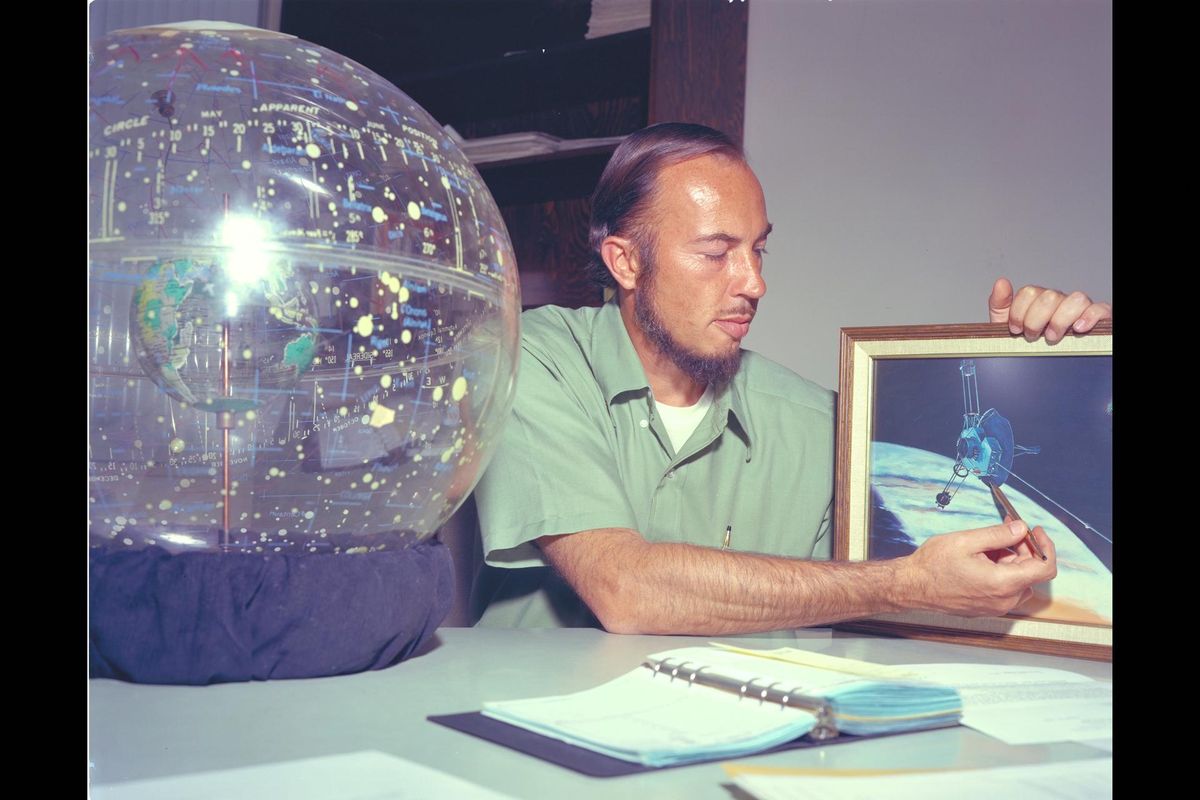
NASA Administrator James M. Beggs called it “a milestone in deep space exploration.” Carl Sagan, who had helped design Pioneer 10’s famous plaque, told reporters humanity had just sent its first envelope to the stars. Project manager Charlie Hall, who’d shepherded the mission since 1969, gave reporters a peace sign at the Ames press conference the next day — the picture ran in newspapers from Tokyo to Toronto.
A Probe Built in 1972 to Survive Forever
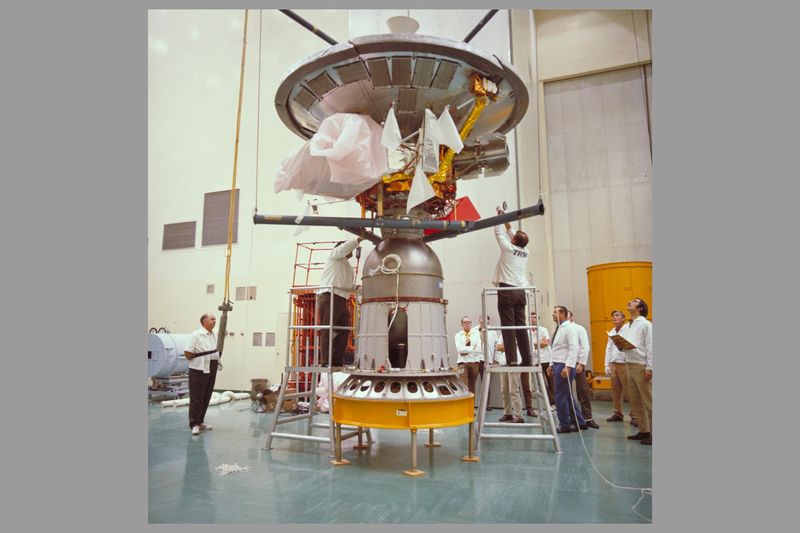
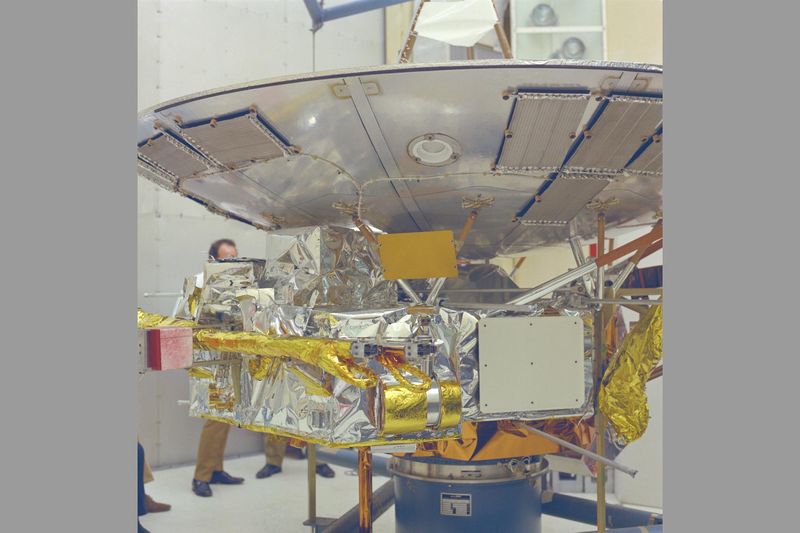
Pioneer 10 launched on March 2, 1972, atop an Atlas-Centaur rocket from Cape Canaveral. The mission goal back then was modest by today’s standards: get to Jupiter, send back pictures, and don’t get fried by the radiation belts. The probe weighed 570 pounds. It carried 11 scientific instruments. Its main computer had less processing power than a 1980s pocket calculator. NASA Ames and TRW built it in roughly two years on a budget of about $350 million in today’s money.
What made Pioneer 10 special was that the engineers built it to last way longer than the brochure said. The radioisotope thermoelectric generators on board — small plutonium-238 power sources — were designed to keep the radio transmitter alive for a decade after the Jupiter flyby was finished. Mission planners hoped that meant a few extra years of data. They got 30.
The probe also had to survive the asteroid belt — something no spacecraft had ever crossed. Astronomers in the late 1960s genuinely worried that the belt was so packed with rocks that any probe trying to fly through would be shredded. Pioneer 10’s safe crossing in 1972–73 quietly rewrote textbooks. The belt, it turned out, was mostly empty.
Jupiter Was the Slingshot
Pioneer 10 reached Jupiter on December 3, 1973. It came within 81,000 miles of the cloud tops — closer than any craft would manage again until Galileo in 1995. The probe sent back the first up-close photos of the gas giant, captured Jupiter’s radiation belts at point-blank range, and confirmed that the planet’s massive magnetic field could fry electronics if you got too close. Pioneer 10’s instruments took the hit; some sensors degraded permanently. But it survived.
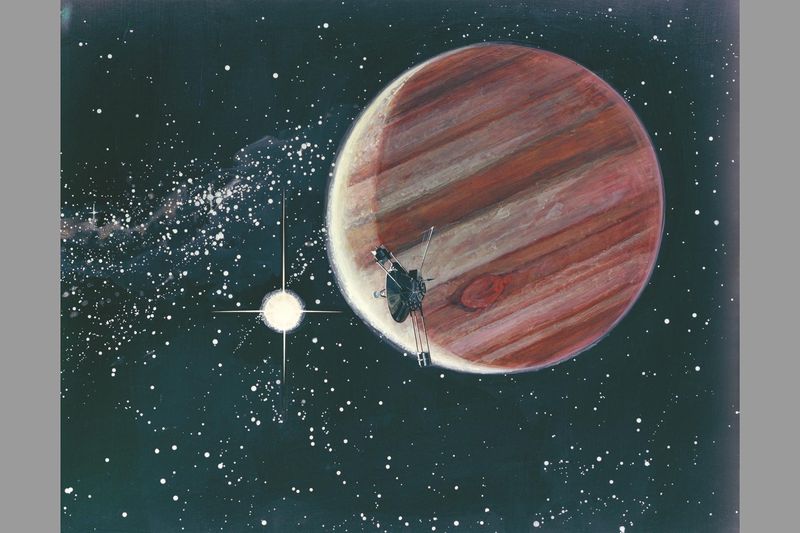
The real magic of the Jupiter encounter wasn’t the photos. It was gravity. Jupiter’s mass yanked Pioneer 10 onto a hyperbolic trajectory and accelerated it from 30,000 mph to roughly 82,000 mph relative to the sun — fast enough to escape the solar system entirely. That gravity assist is the only reason Pioneer 10 ever made it past Neptune. Without Jupiter’s slingshot, the probe would have looped back inward and orbited the sun forever.
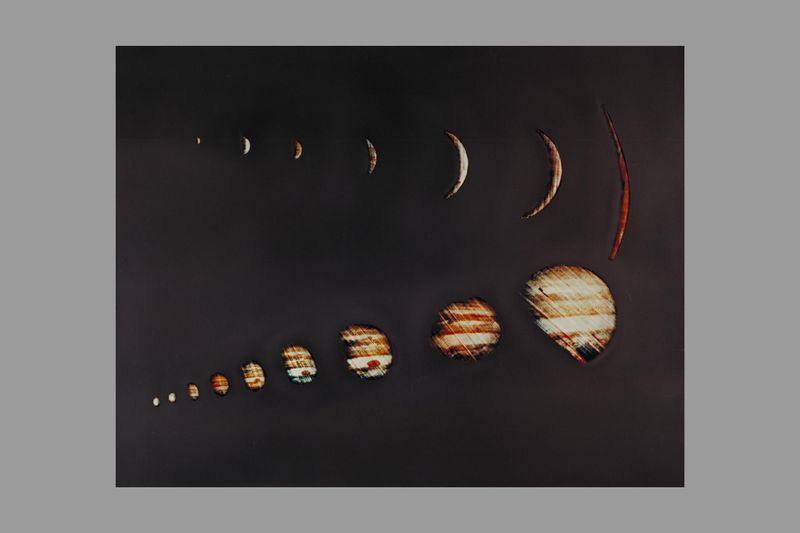
The Jupiter flyby also taught NASA something about deep-space communications. Even from 500 million miles out, Pioneer 10’s tiny 8-watt transmitter still managed to send images back to Earth’s deep-space dishes. Eight watts is less than a kitchen nightlight. The lesson — that you can hear a whisper from across the solar system if you build a big enough antenna — shaped every probe NASA launched afterward, from the Voyagers in 1977 to the Galileo and Cassini missions of the 90s.
The Plaque That Made Pioneer 10 Immortal
Bolted to the antenna support struts of Pioneer 10 is a 6-by-9-inch gold-anodized aluminum plate that turned the probe into a cultural artifact. Carl Sagan and Frank Drake designed it in three weeks after Sagan realized the spacecraft would eventually leave the solar system and drift, possibly forever, through interstellar space. Sagan’s wife at the time, Linda Salzman Sagan, drew the figures. The whole thing got engraved and bolted on with about a month to spare before launch.
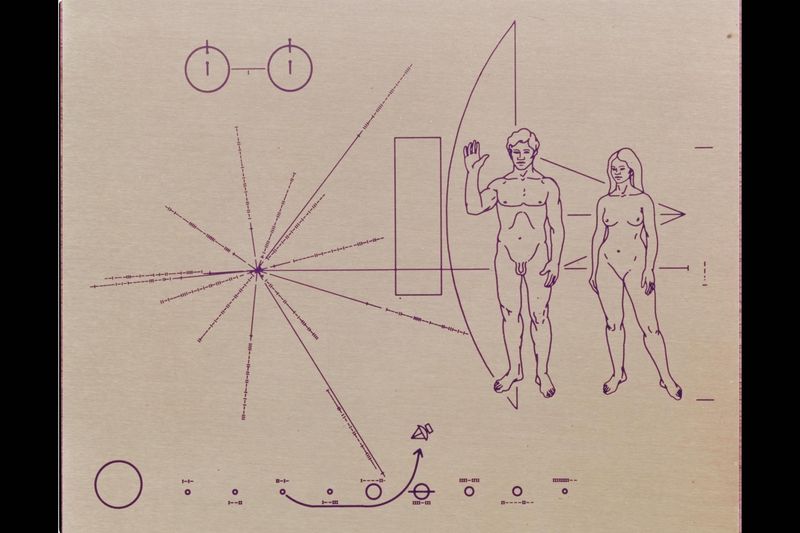
The plaque shows a naked man and woman, the man waving in greeting. To the left, a starburst diagram pinpoints Earth’s location relative to 14 known pulsars — a kind of cosmic GPS readable by any civilization capable of detecting pulsar rotation rates. A diagram along the bottom marks Earth’s place among the planets. The hyperfine transition of hydrogen, the most common element in the universe, gives the whole plaque a measuring unit anyone with basic physics could decode.
The public reaction in 1972 was wilder than NASA expected. Newspapers ran editorials objecting to the nudity. Sagan got fan mail from people who thought the plaque was either humanity’s noblest gesture or its weirdest. The plaque went on Pioneer 11 too, when it launched the following year. The truth is, the odds of anyone ever finding either probe are vanishingly small — but the gesture itself is what made Pioneer 10 the spacecraft that captured the public imagination.
For more on how 1980s space milestones reshaped public perception of NASA, see our earlier piece on how NASA saved Solar Max in 1984 — another decade-defining win after a string of post-Apollo doubts.
Why Neptune Was the Finish Line in 1983
The 1983 milestone hung on a quirk of Pluto’s orbit that today feels almost like a trivia question. Pluto’s orbit is eccentric — it sweeps in toward the sun and then back out again over a 248-year cycle. Between January 23, 1979 and February 11, 1999, Pluto was closer to the sun than Neptune. That meant for 20 specific years, Neptune was the outermost planet, and Pioneer 10 crossing Neptune’s orbit really did mean crossing the last planetary boundary.
If Pioneer 10 had reached Neptune’s orbit a year earlier — say June 1978 — it wouldn’t have counted. Pluto was still further out. The window NASA used for the official “Pioneer 10 leaves the solar system” announcement was the exact 20-year sweet spot when Neptune held the title. The mission planners knew it. Charlie Hall actually joked about it at the press conference: “We wanted to be sure we beat Pluto on a technicality.”
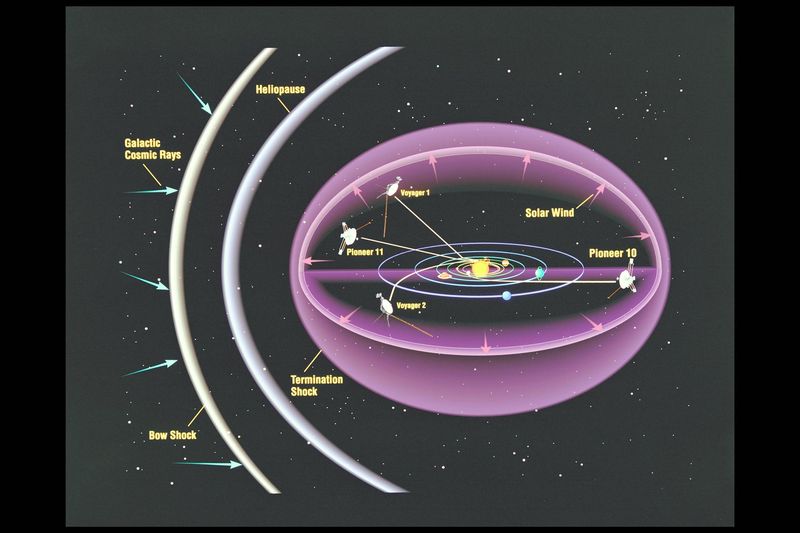
The framing also fed into a bigger debate scientists were starting to have about where the solar system actually ends. Is it at Neptune’s orbit? The Kuiper Belt? The heliopause, where the solar wind dies out? The Oort Cloud, a light-year from the sun? By the 1990s, NASA had quietly shifted to calling the heliopause crossing the “real” exit — and Voyager 1 finally got there in 2012. But in 1983, Neptune’s orbit was the line, and Pioneer 10 was the first to cross it.
NASA Listened to Pioneer 10 for 20 More Years
The signal kept coming. Pioneer 10 transmitted usable science data until March 31, 1997, when NASA officially ended routine mission tracking after 25 years. Even then, the engineers couldn’t quite let go. The Deep Space Network kept listening on and off, picking up Pioneer 10’s faint carrier signal as a kind of engineering exercise. The last contact came on January 23, 2003, from 7.6 billion miles away — a signal so weak it took 22 watts on Earth’s side to detect 1.5 nanowatts on Pioneer 10’s side. That’s like trying to hear a single cricket from the other side of the Pacific Ocean.
Along the way, Pioneer 10 also helped solve a small physics mystery. Its trajectory was slowing down ever so slightly more than gravity alone would predict — a few hundred-thousandths of a centimeter per second per second. Physicists called it the “Pioneer Anomaly” and spent two decades arguing about whether it pointed to new physics or just an instrument error. The eventual answer, settled in 2012 by JPL researcher Slava Turyshev, was almost boringly mundane: thermal radiation from the spacecraft itself was pushing it backward. Pioneer 10 helped close out a real scientific puzzle long after its useful life was supposed to be over.
Where Pioneer 10 Is Right Now
As of June 2026, Pioneer 10 is roughly 13.4 billion miles from Earth — about 144 AU — drifting silently toward the red giant star Aldebaran in the constellation Taurus. At its current speed of about 27,000 mph, it’ll reach the general neighborhood of Aldebaran in approximately two million years. No one will be tracking it. The plutonium pellets that powered it ran out of usable juice years ago. The plaque, though, will still be readable. Gold-anodized aluminum doesn’t weather in interstellar space.
The probe also passed Voyager 1 in heliocentric distance for a while — Voyager 1, launched five years later, eventually overtook Pioneer 10 in 1998 because of a more aggressive Saturn slingshot. But by then, Pioneer 10 had already done the historic first. Every interstellar mission since — Voyager 1 and 2, New Horizons, the proposed Interstellar Probe — owes its trajectory math and its public legitimacy to the little probe that left the solar system on June 13, 1983.
Pioneer 10 in 80s and 90s Pop Culture
Pioneer 10 had its pop culture moment too. Star Trek V: The Final Frontier (1989) opened with a Klingon captain destroying a probe — explicitly identified in the script as Pioneer 10 — for sport. NASA reportedly objected. The probe also showed up in Larry Niven’s late-80s short fiction, in episodes of Carl Sagan’s Cosmos (which had already aired in 1980 but kept finding new audiences on PBS), and in countless classroom posters of “where humanity has been in space.” Generation X kids who watched the moon landings on grainy reruns grew up with Pioneer 10 as the next chapter — the small, plucky probe that proved we could send something past the planets and keep talking to it.
For more retro space history from the Pioneer 10 era, our deep dives into the Mir Space Station’s first crew launch in 1986 and Reagan’s Star Wars speech of March 1983 cover the wider 1980s space race context that made Pioneer 10’s exit feel even more like a victory lap.
The clearest legacy is the one we’re still living. Every NASA probe sent past the planets — Voyager, New Horizons, the proposed missions launching in the 2030s — runs on the operational playbook Pioneer 10 wrote in pencil. Long-life plutonium power sources. Gravity assists from Jupiter. Quiet, decades-long tracking. The next time someone asks you when humanity first reached beyond the solar system, the answer is a Monday morning in California, June 13, 1983. The probe is still out there.
Sources
- NASA — Pioneer 10 mission page — official mission archive and timeline.
- NASA History — Pioneer 10 Launches — primary source for launch and Jupiter encounter details.
- The Planetary Society — Pioneer 10 — independent breakdown of trajectory and Pioneer Anomaly.
- NASA Solar System Exploration — Pioneer 10 In Depth — instrument list and post-Jupiter operations.
- Pioneer Plaque background — design history of the Sagan/Drake plaque.
The Retro Almanac
A monthly roundup of "on this day" highlights from that month, decades back — plus first dibs on new retro merch drops. No spam, just the good stuff.