
On This Day: July 26, 1990 — The ADA Changed America Forever
Three thousand people gathered on the South Lawn of the White House on a hot July morning in 1990 — many in wheelchairs, some on crutches, others who had spent years organizing and lobbying and getting arrested for a moment exactly like this one. When President George H.W. Bush looked up from the table and said “Let the shameful wall of exclusion finally come tumbling down,” the crowd broke into tears. The pen had hit paper. The Americans with Disabilities Act was the law of the land.

Before the ADA, America Was a Different Place
It is easy to forget, from the vantage point of a world with curb ramps and wheelchair lifts and captioned videos, just how exclusionary the built environment once was. Before July 26, 1990, a private employer could legally refuse to hire someone because they had epilepsy. A restaurant owner could turn away a customer in a wheelchair with zero legal consequence. A person who was Deaf had no right to a telephone relay service. A child with a physical disability could be barred from a public school and sent to a segregated facility instead.
The Retro Almanac
A monthly roundup of "on this day" highlights from that month, decades back — plus first dibs on new retro merch drops. No spam, just the good stuff.
Roughly 43 million Americans lived under these conditions — about one in six people. Many were veterans, injured on the job, or living with conditions like multiple sclerosis, cerebral palsy, or Parkinson’s. The Civil Rights Act of 1964 had protected Americans from discrimination based on race, sex, religion, and national origin. Disability had been left out entirely.
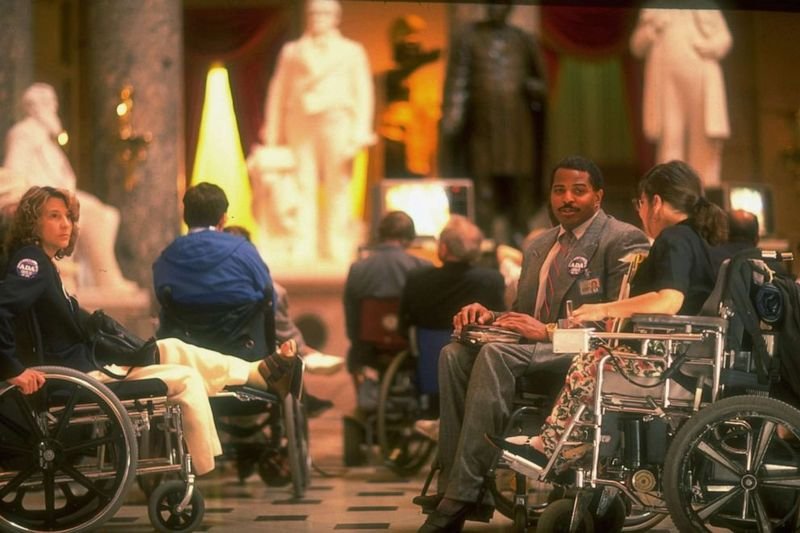
The push to change that had been building for two decades. Section 504 of the Rehabilitation Act (1973) had protected people with disabilities in federally funded programs, but enforcement was weak and coverage was narrow. By the mid-1980s, a national disability rights movement had formed — a coalition unlike anything that had come before, uniting people with wildly different conditions behind a single demand: equal treatment under the law.
The Capitol Crawl That Moved the Nation
The ADA had been introduced in Congress in 1988 and passed the Senate in 1989. By early 1990, it was stalling in the House. On March 12, 1990, disability rights activists decided to make the obstacle visible in the most literal way they could think of.
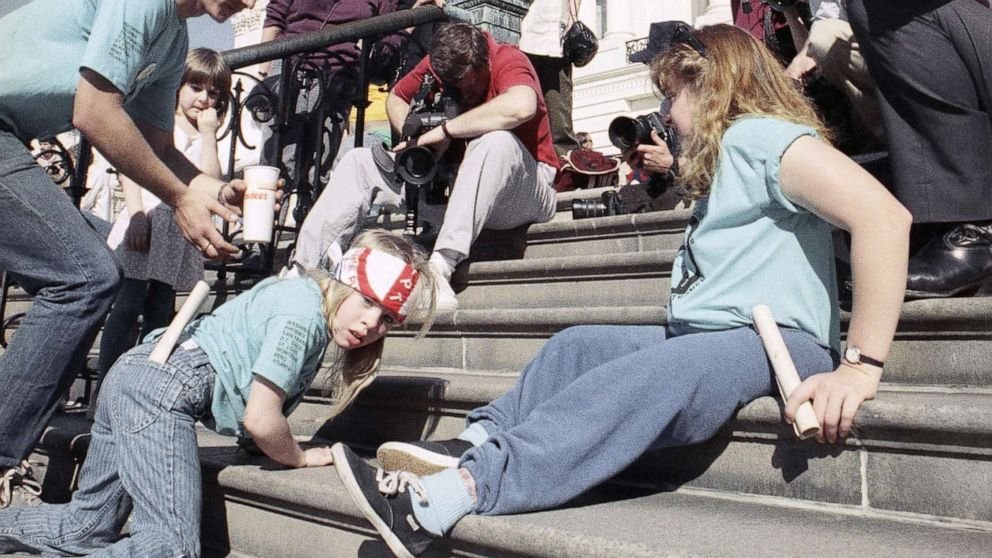
They gathered at the base of the U.S. Capitol’s 83 marble front steps. Then they left their wheelchairs behind and began to crawl up.
Jennifer Keelan was eight years old and had cerebral palsy. She got out of her chair, dug her hands into the stone, and started pulling herself up the steps one at a time. A photographer caught her in mid-climb — small girl, determined face, the Capitol dome rising above her. “I’ll take all night if I have to,” she said. The photograph ran on the AP wire worldwide. Within weeks, the House passed the ADA.
The event became known as the Capitol Crawl, and it stands as one of the most visceral protest images of the 1990s — a kid demonstrating the everyday reality of inaccessible architecture more effectively than any speech could. Congress had stairs. Jennifer Keelan had her hands and her will. The rest of the country understood the point.
The Signing Ceremony: July 26, 1990
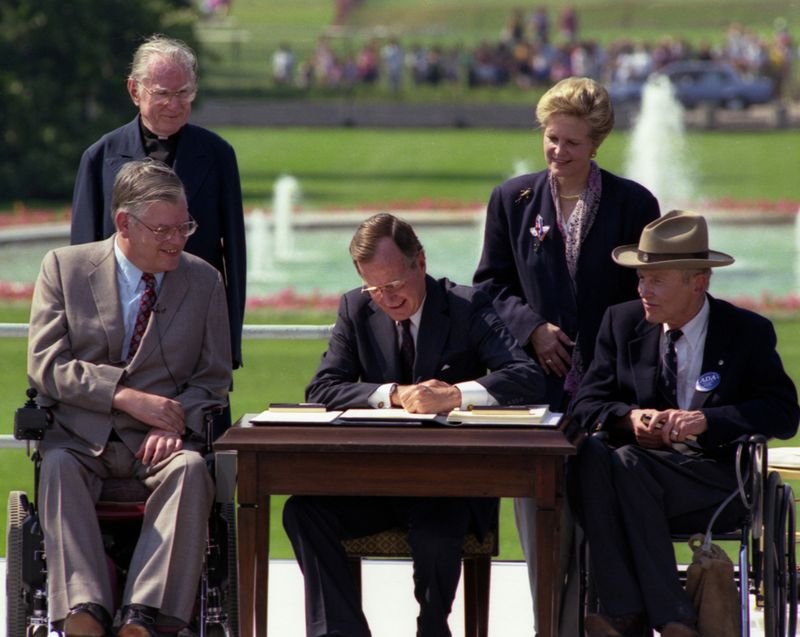
The ceremony on the South Lawn was unlike any other bill signing in recent memory. Presidents typically gather a small group of legislators and stakeholders around a table. This was closer to a rally. Three thousand people had come from every state, representing an enormous breadth of disability communities — wheelchair users, people who were blind or Deaf, veterans with traumatic injuries, parents of children with Down syndrome, advocates who had spent their careers working toward this day.
Bush signed surrounded by Justin Dart Jr. and Evan Kemp, both of whom had helped shape the bill. Reverend Harold Wilke, who had been born without arms, used his mouth to hold a pen and sign as a witness. It was a carefully staged tableau that communicated something real: the people most affected by this law had been in the room where it was made.
Love the retro era? Browse our shop for vintage finds, retro clothing, and 80s/90s nostalgia gear.
“With today’s signing of the landmark Americans for Disabilities Act, every man, woman, and child with a disability can now pass through once-closed doors into a bright new era of equality, independence, and freedom,” Bush said. The crowd that had waited so long for those words did not stop cheering for a long time.
The People Who Made It Happen

Justin Dart Jr. is widely called the father of the ADA, though he would have rejected the title as incomplete. The son of a wealthy businessman, Dart contracted polio at 18 and spent his adult life as a disability rights organizer. Through the late 1980s, he traveled to all 50 states holding town-hall sessions with people with disabilities — gathering firsthand testimony about what discrimination actually looked like on the ground. He wore a cowboy hat, a leather jacket, and a button that read “ADA Now.” He lobbied everyone.
Evan Kemp, who served as chairman of the Equal Employment Opportunity Commission under Bush, was a wheelchair user who had written a 1981 essay in the New York Times arguing that the “supercrip” narrative in telethons — the emphasis on pity and charity — did more harm than good. He believed disability rights were civil rights, not charity. Sitting beside Bush at the signing table, he had both the policy expertise and the personal standing to make that argument land.
Judy Heumann, who had survived polio as a child and was denied a teaching license in New York City because of her disability (she sued and won), spent decades building the infrastructure of the movement before the ADA made it into law. She would later serve in the Clinton and Obama administrations — and became, for many people with disabilities, the most visible face of what the law was actually supposed to mean.
What the ADA Actually Changed — and When You First Noticed

The changes came in waves through the early and mid-90s. If you were paying attention, you started to notice: the new curb cuts at corners that had never had them before, the ramps appearing at building entrances that had only had steps, the wheelchair lifts appearing on city buses. Closed captioning, which had been a niche feature, became required on televisions 13 inches or larger starting in 1993 under rules triggered by the ADA.
For anyone who grew up in the 1980s, the change in public spaces was stark. A 1986 survey by Louis Harris found that two-thirds of Americans with disabilities were not attending movies, concerts, or sports events — not because they didn’t want to, but because the venues weren’t accessible. The ADA gave those people an enforceable right to show up.
In employment, the change was slower and harder to measure. Employers had to provide “reasonable accommodations” for qualified employees with disabilities — a standard that produced years of litigation to define. But the baseline changed: it was no longer legal to reject a candidate simply because they had a condition that affected their body or their senses, as long as they could perform the essential functions of the job.

The “curb cut effect” became a term for something researchers had noticed: the accessibility features built for people with disabilities turned out to benefit everyone. Curb ramps were used by people pushing strollers, by delivery workers with dollies, by anyone on a bicycle. Captioning made it easier to watch TV in a noisy bar. Automatic doors helped shoppers with their hands full. When you design for the margins, you often end up improving the center.
A Law That Came with a Soundtrack
Here is the actual signing ceremony from July 26, 1990 — 22 minutes of history, preserved by the George Bush Presidential Library. If you’ve never watched Bush’s speech in full, it’s worth your time.
35 Years Later
The ADA has been amended once (in 2008, to expand the definition of disability after a series of Supreme Court rulings narrowed it), and its provisions have been tested in thousands of court cases. It remains imperfect — enforcement is complaint-driven, meaning people with disabilities often have to sue to vindicate their rights, and digital accessibility (websites, apps) was not part of the 1990 framework and has been a source of ongoing legal uncertainty.
But the physical world was transformed. The United States has a more accessible built environment than virtually any other country — a direct result of a law that started with activists crawling up Capitol steps and a president who, unlike many, decided the politics of inclusion were worth the lobbying resistance from the business community. Six years after Muhammad Ali — who was living with Parkinson’s disease by 1996 — lit the Atlanta Olympic flame with visibly trembling hands, the world saw a man whose disability did not diminish his moment. The ADA was part of why that image was possible at all.
Jennifer Keelan, the eight-year-old who crawled up the Capitol steps, later became Jennifer Keelan-Chaffins. She grew up. She still talks about that March morning in 1990 — the cold stone under her hands, the distance still to go, the decision to keep moving anyway.
Sources
- Americans with Disabilities Act signed into law — HISTORY.com — July 26, 1990 event coverage and historical context
- Bush Signs Act — National Archives Pieces of History — Signing ceremony details and photograph
- How the Americans with Disabilities Act transformed a country — National Geographic — Scope and legacy of the ADA
- When the Capitol Crawl Dramatized the Need for the ADA — HISTORY.com — Jennifer Keelan and the March 12, 1990 protest
- Remarks on Signing the Americans with Disabilities Act, July 26, 1990 — Miller Center — Full text of Bush’s speech
- 30th Anniversary of the Capitol Crawl — ABC News — Anniversary coverage and activist testimony
The Retro Almanac
A monthly roundup of "on this day" highlights from that month, decades back — plus first dibs on new retro merch drops. No spam, just the good stuff.