On This Day: July 28, 1984 — Los Angeles Threw the Greatest Party in Sports History
The Soviet threat was real enough in 1984 that a government had told its athletes to stay home. Nineteen countries — the USSR, East Germany, Cuba, and 16 others — refused to compete in Los Angeles, the most significant Olympic boycott since the US had pulled out of Moscow four years earlier. You might expect that to dim the excitement. It didn’t.
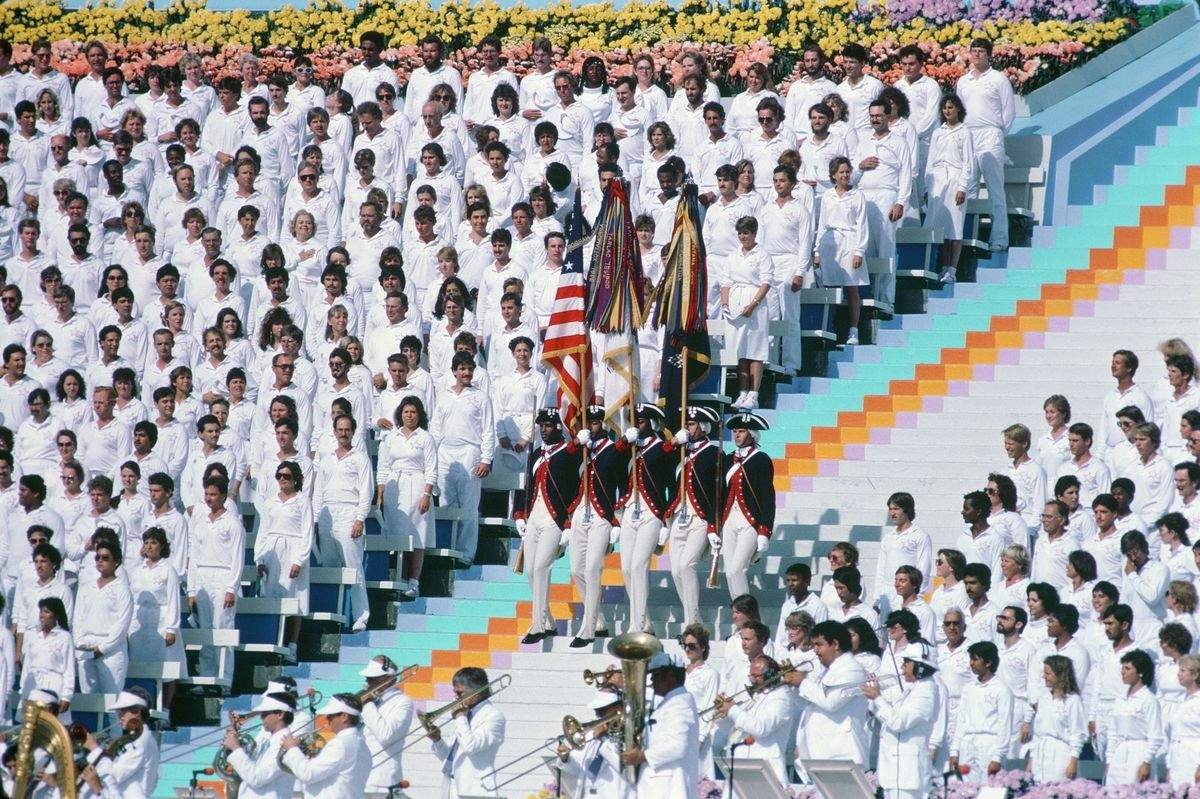
On the afternoon of Saturday, July 28, 1984, the Los Angeles Memorial Coliseum was packed beyond capacity with 92,516 people. What unfolded over the next three hours won an Emmy Award, permanently changed how the Olympics are organized, and printed itself onto the brain of anyone who watched it live — or caught the tape the next morning.
A Cold War Shadow Over the Coliseum
The 1984 boycott was pure tit-for-tat. In 1980, the US led a boycott of the Moscow Olympics to protest the Soviet invasion of Afghanistan. Four years later, the Soviets returned the favor, citing “security concerns and anti-Soviet hysteria in the United States” — though most observers called it what it was: retaliation.
The Retro Almanac
A monthly roundup of "on this day" highlights from that month, decades back — plus first dibs on new retro merch drops. No spam, just the good stuff.
The Soviet announcement came on May 8, 1984, barely 80 days before the opening, and 18 more countries followed: East Germany, Bulgaria, Cuba, North Korea, Hungary, Czechoslovakia, and others. It was the largest politically coordinated boycott in Olympic history.
What the boycott did, unintentionally, was hand the United States a nearly competition-free run at the medal table. East Germany had been winning 40+ golds per Games for a decade. With them absent, American athletes swept event after event. The US finished with 83 gold medals — a number that still stands as the single-country, single-Games record.
Romania defied Soviet pressure and sent its athletes. The American crowd gave the Romanian delegation one of the loudest ovations during the parade of nations — a spontaneous, televised moment of appreciation that landed differently in Bucharest than the Soviet propaganda machine had intended. Romania finished with 53 medals and 20 golds. Their presence made the Games more legitimate; their crowd reception made a point.
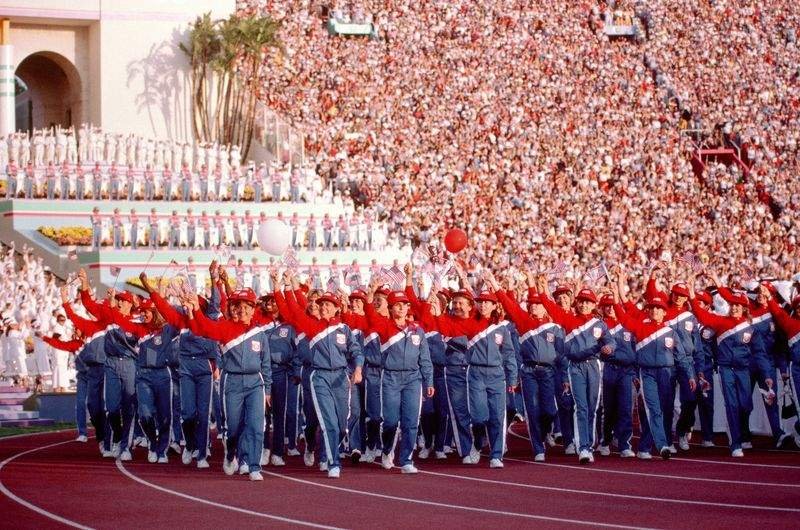
The US Olympic Team marches into the Coliseum. With the Soviet bloc absent, the Americans would dominate the medal table like never before.
Three Hours of Pure 1984
The ceremony began at 4:30 PM Pacific, and it was immediately clear this was not going to be a routine flags-and-speeches affair. The organizing committee, led by businessman Peter Ueberroth, had hired director David Wolper and given him a $5 million budget. Wolper spent every cent.
John Williams composed a new piece for the occasion — “Olympic Fanfare and Theme” — performed live by 150 trumpets, 20 timpani, and church bells ringing across Los Angeles simultaneously. The fanfare went on to win a Grammy and became the default sonic signature of Olympic broadcasts for the next decade. You’ve heard it in every Olympics broadcast since; it was born in this stadium.
The “Music of America” segment marshaled over 12,000 performers, including a 736-piece marching band drawn from all 50 states. Then came the moment nobody saw coming.
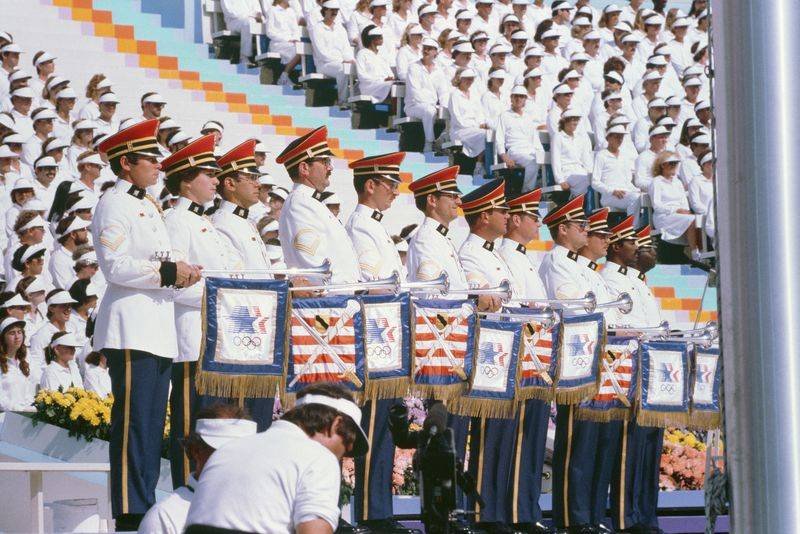
The US Army Band was one of 12,000+ performers who participated in the $5 million opening ceremony production.
An announcer cut through the crowd noise: “Ladies and gentlemen, our salute to a generation of stargazers and dreamers: the Rocketman.”
Test pilot Bill Suitor, strapped into a Bell Aerosystems hydrogen-peroxide “rocket belt,” lifted off from the Coliseum floor and flew the length of the track — no wires, no CGI, no safety net below him. Ninety-two thousand people went completely silent for two seconds, then erupted all at once. It remains one of the most genuinely shocking moments in the history of live television.
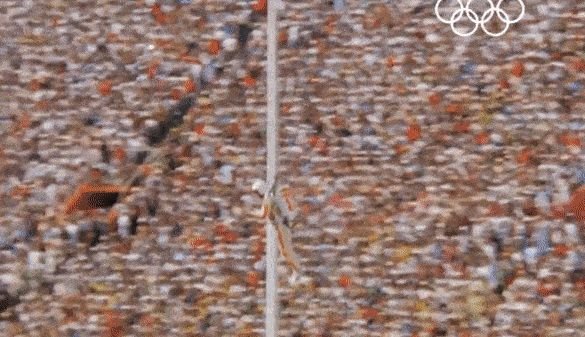
Bill Suitor’s rocket belt flight was spontaneous enough that thousands in the crowd initially thought it wasn’t real. It was entirely real. Credit: Michael Montfort/Michael Ochs Archives/Getty Images
The ceremony’s centerpiece came next: 84 grand pianos rolled out from the Coliseum’s peristyles, each played by a tuxedoed pianist performing Gershwin’s “Rhapsody in Blue” with full orchestra accompaniment, 200 dancers in blue silk weaving between them. A 300-member gospel choir followed with “When the Saints Go Marching In,” then a ’80s pop medley that included Irene Cara’s “Fame” and Michael Jackson’s “Beat It.”
The ceremony would win an Emmy Award for Outstanding Live Sports Special. It was the first Olympic opening ceremony to place the artistic program before the formal protocol — a structural decision that every subsequent Games has copied.
The Torch, the Man, the Weight of It
When the moment came to light the Olympic cauldron, the choice of torchbearer was deliberate. Rafer Johnson — the 1960 decathlon gold medalist, California-raised — climbed 99 mechanical steps while the flame traveled through channels shaped like the five Olympic rings, finally lighting the cauldron above the stadium.
Johnson became the first Black athlete in Olympic history to light the Olympic cauldron. In a city still carrying the weight of the Watts riots and decade after decade of racial inequality, the image of Johnson with the flame above that stadium said something that no speech could.
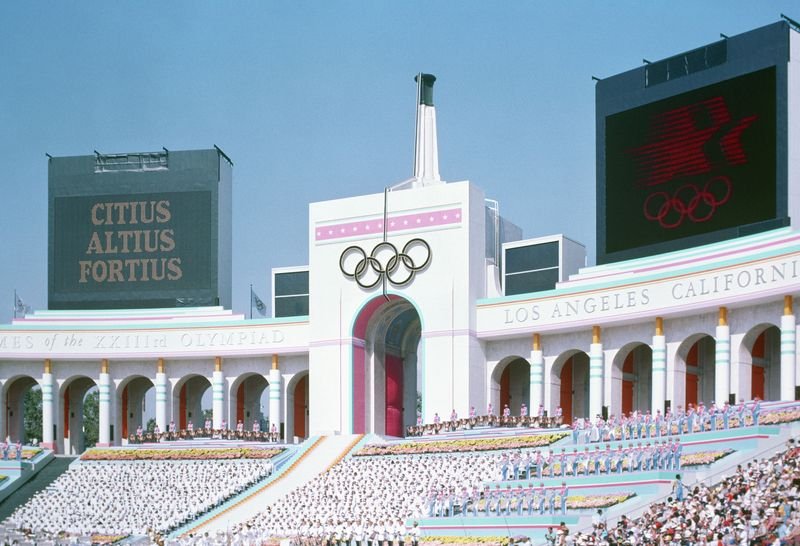
The Olympic flame burned above the Coliseum for the duration of the Games — and the torch tower became one of the defining images of the 1984 Olympics.
Ronald Reagan, seated in the crowd alongside First Lady Nancy Reagan, formally declared the Games of the XXIII Olympiad open. For a president who had spent his first term reframing American identity as something to be proud of again, the spectacle unfolding around him was perfectly on message.
The Athletes Who Gave Those Three Hours Their Meaning
The opening ceremony was extraordinary. The athletes who followed were historic.
Carl Lewis entered these Games having made promises he wasn’t supposed to make — he’d publicly declared he would win four gold medals, matching Jesse Owens’ 1936 Berlin performance. He did it. The 100m, 200m, long jump, and 4×100m relay. He was 23. The comparisons to Owens were immediate and, depending on who you asked, deserved.
Edwin Moses had not lost a 400m hurdles race since August 26, 1977. He added a gold medal in Los Angeles as part of what would become a nine-year, nine-month, nine-day unbeaten streak. Athletes at these Games essentially competed for silver in Moses’ event — everyone knew it, and he knew they knew it.
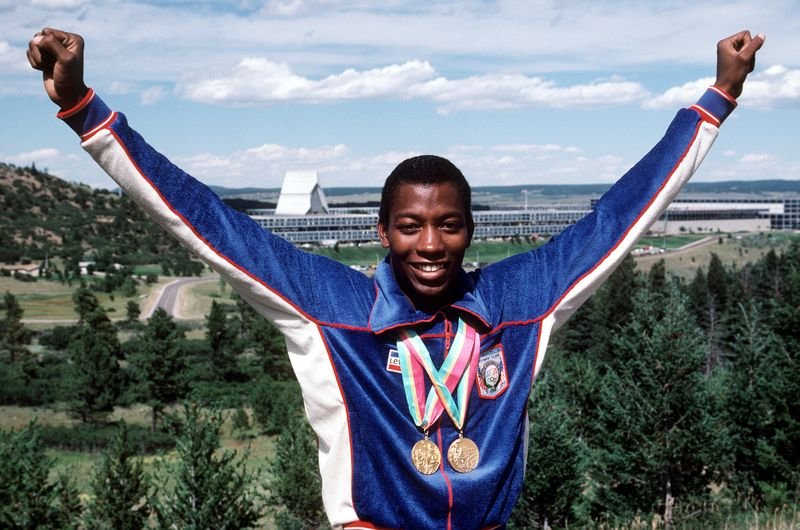
US Air Force second lieutenant Alonzo Babers won gold in the 400m and anchored the gold-medal 4×400m relay team — two of America’s 83 gold medals at the 1984 Games.
Alonzo Babers, a US Air Force officer, won the 400m in 44.27 seconds and came back to run the final leg of the winning 4×400m relay. Mary Lou Retton — whose defining perfect-10 vault came six days later on August 3 — was already the face of these Games before she set foot on the mat.
For the women’s 400m hurdles, Morocco’s Nawal El Moutawakel won gold, becoming the first woman from an African country, an Arab country, and a Muslim-majority country to win an Olympic gold medal. King Hassan II of Morocco declared a national holiday.
The Legacy: A $232 Million Profit and a New Olympic Blueprint
The 1984 Los Angeles Olympics were the first Summer Games to operate entirely without government funding. Peter Ueberroth ran them as a private enterprise: corporate sponsorship from United Airlines, Coca-Cola, ARCO, and McDonald’s; existing venues instead of expensive new construction; tight budget control and an eye on the bottom line.
The final result: a $232.5 million profit. In 1984. At the Olympics.
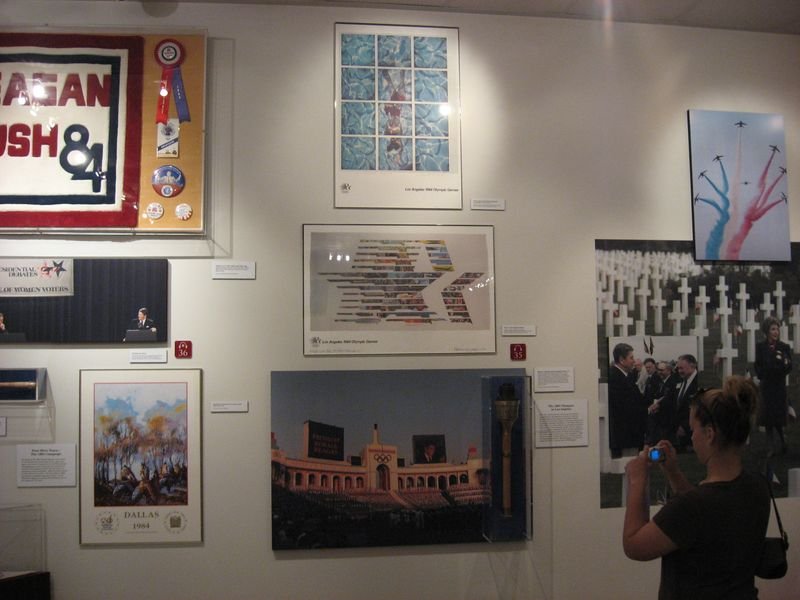
The legacy of the 1984 Olympics — including the financial model Ueberroth created — is preserved at the Reagan Presidential Museum in Simi Valley, California.
Every Olympic Games since 1984 has used some version of what Ueberroth built. The idea that the Olympics could turn a profit — rather than bankrupting a host city — was genuinely revolutionary. Montreal had still been paying off its 1976 Games debt in 1984. Los Angeles changed the calculus permanently.
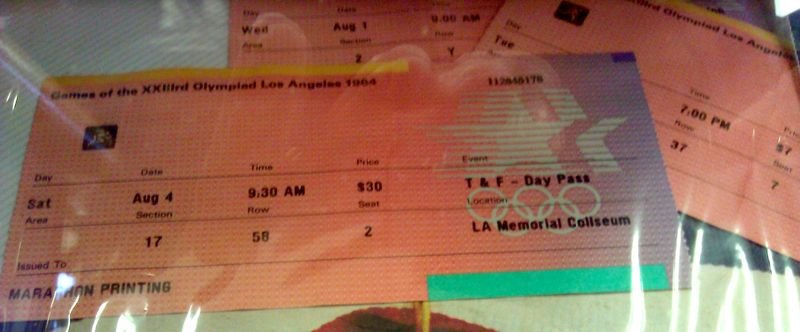
Original 1984 Olympic track and field tickets — these pieces of cardboard got fans into some of the most dominant athletic performances in American history.
Los Angeles is set to host again in 2028 — the third time for a city that clearly knows how to throw a party. The Coliseum will be ready. Forty-four years later, the jet pack might even be back. In 1984, anything felt possible. That’s what those three hours at the Coliseum on July 28 were actually about.
For more Olympic moments from this era, read about the Magnificent Seven’s gymnastics gold at Atlanta 1996 and the unforgettable night Muhammad Ali lit the flame in Atlanta. And if you want to know how close those 1996 Games came to catastrophe, read about the bombing at Centennial Olympic Park.
Love the retro era? Browse our shop for vintage finds, retro clothing, and 80s/90s nostalgia gear.
The official Olympic Games opening ceremony highlights from July 28, 1984.
Sources
- UPI — On This Day: 1984 Summer Olympics open in Los Angeles — Confirmed date and opening ceremony details.
- Wikipedia — 1984 Summer Olympics opening ceremony — Full ceremony timeline, performers, and Emmy Award detail.
- California Sun — Jetman’s 1984 Olympic Flight — Bill Suitor’s rocket belt flight details and aftermath.
- Britannica — Los Angeles 1984 Olympic Games — Medal table, athlete results, and legacy summary.
- Classic FM — When Gershwin’s Rhapsody in Blue reverberated on 84 pianos — The musical centerpiece of the ceremony.
The Retro Almanac
A monthly roundup of "on this day" highlights from that month, decades back — plus first dibs on new retro merch drops. No spam, just the good stuff.