Pogs 90s: 9 Wild Facts About the Schoolyard Craze
By spring 1995, the Pogs 90s craze was pulling in $175 million a year for a single Hawaiian-juice-turned-toy company — and a kid trading paper milk caps at recess could lose a month of allowance in twenty minutes. The whole thing burned through American schoolyards in roughly three years, then collapsed almost overnight when teachers, parents, and bored consumers all turned on it at once. It is the textbook case of a fad: dirt-cheap inputs, a built-in gambling mechanic, holographic upgrades, McDonald’s tie-ins, and a global ban list that stretched from Sweden to Australia.
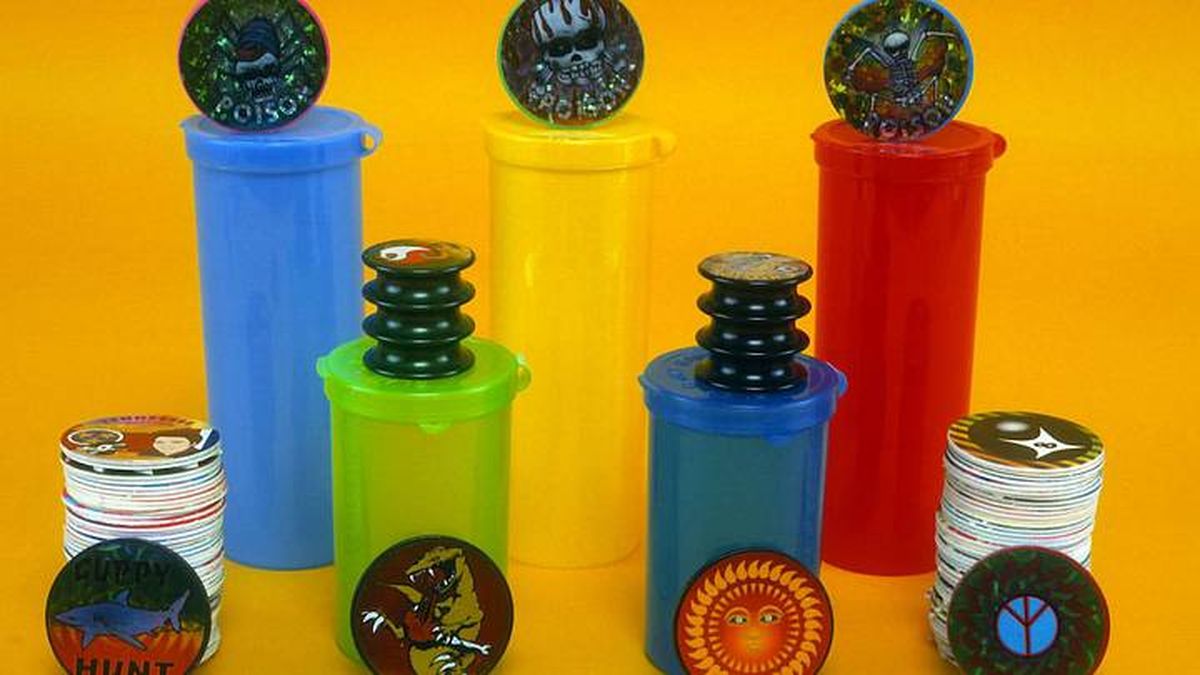
If you were between eight and fourteen in 1994, you owned a black plastic tube full of cardboard discs and a metal slammer heavy enough to dent a desk. This is the story of how a non-violent Hawaiian classroom exercise became the fastest-rising, fastest-falling kid empire of the decade.
The Retro Almanac
A monthly roundup of "on this day" highlights from that month, decades back — plus first dibs on new retro merch drops. No spam, just the good stuff.
The Pogs 90s Story Started With a Glass of Hawaiian Juice
The name is short for Passion Orange Guava — a tropical juice blend bottled by Haleakala Dairy on the island of Maui starting in 1971. The dairy printed its branding on the cardboard caps that sealed the glass bottles, and for years those caps were nothing more than throwaway packaging. Kids saved them anyway, because nine-year-olds save everything.
The deeper roots go further back. Japanese immigrants who arrived in Hawaii in the 1920s and 30s brought a centuries-old paper-slapping game called menko, where players flip each other’s cards by throwing their own down hard. As local kids ran out of menko cards, they swapped in milk bottle caps from Honolulu Dairymen’s Association — same physics, free inventory. By the time POG juice hit the market, the game had a forty-year head start in Hawaiian schoolyards.
A Schoolteacher Named Blossom Galbiso Lit the Fuse
In early 1991, a kindergarten teacher named Blossom Galbiso at Waialua Elementary School on Oahu pulled the old milk-cap game back out of retirement. She wanted a non-violent alternative to dodgeball that also forced kids to practice math — counting flipped caps, tracking who owned what, doing trades. She used the easiest caps she could find: empty POG juice caps from the Haleakala Dairy.
That was the spark. Within a year, schools across the Hawaiian islands were doing the same thing. By 1992 the local press was running stories. By early 1993 an LA-based businessman named Alan Rypinski had bought the POG trademark from Haleakala Dairy, registered the World POG Federation, and started shipping branded sets to the mainland. The mainland did not know what hit it.
How to Play Pogs (and Why the Slammer Mattered)
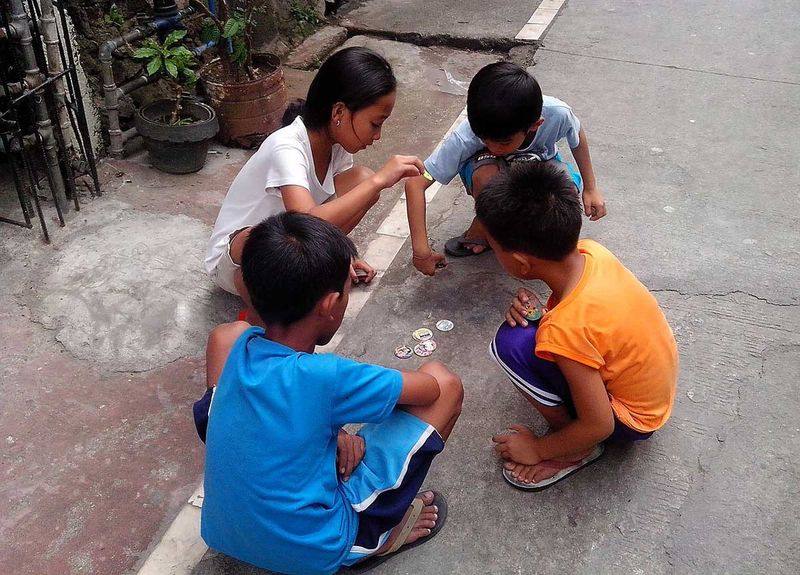
The rules took about ninety seconds to learn. Each player put an equal stack of caps face-down on a flat surface — a desk, a sidewalk square, the lid of a Trapper Keeper. One player then dropped a slammer, a heavier disc made of plastic, rubber, or metal, onto the top of the stack. Any caps that flipped face-up went to that player. The remaining stack got restacked and the next player took a shot. When the stack was empty, the player with the most flipped caps won.
The slammer was the whole game. A regulation Pog cap was 38 millimeters across and roughly the weight of two pennies. A good slammer weighed five times that. Kids quickly figured out that a heavier slammer flipped more caps, which is why metal slammers — brass, steel, sometimes lead — became the schoolyard arms race. Teachers hated them because metal slammers dented school furniture. That fact alone got the game banned in dozens of districts before the actual gambling complaints started.
The rule that turned the game from a hobby into a problem was for keeps. You played for keeps, you kept what you flipped. A kid who walked onto the blacktop with eight caps could walk off with eighty. Or zero.
The World POG Federation Turned a Fad Into $175 Million
Rypinski was not a toy guy. He had previously run Armor All, the car-detailing brand, and he understood licensing better than anyone in the toy aisle. The World POG Federation did not invent the game; it just stuck a trademark on it, signed deals with Disney, Nintendo, Marvel, the NHL, and McDonald’s, and put Pogman — a cartoon mascot in a backwards baseball cap — on packaging in fifteen countries.

By the WPF’s second full year, sales topped $175 million. The numbers got crazy: McDonald’s tossed exclusive caps into Happy Meals. Hardee’s printed Apollo 13 promotional sets. Universal Studios issued movie tie-ins. Major League Baseball, the NBA, and the NHL all licensed their logos onto cardboard. Knock-off brands flooded the lower end — Slammer Whammers, Tazos in Australia and Mexico, Caps in the UK — and the WPF didn’t care, because the knock-offs only made the game bigger. They cared about the licensed sets, where the margins lived.
This is the part the Pogs 90s nostalgia tour usually skips. Pogs were never really a children’s toy economy. They were a marketing channel. Every cartoon studio, every cereal brand, every fast-food chain wanted their mascot on a cap, because a cap cost almost nothing to print and traveled home in a kid’s pocket like a billboard.
Why Schools Banned Pogs Across Four Continents
The for-keeps rule is what killed it in classrooms. By 1994, parents were calling the principal’s office complaining that their kid had lost a $40 holographic Power Rangers set during morning recess. The principals, after a few months of this, called it gambling. School districts in the United States, Canada, Sweden, Iceland, Germany, the United Kingdom, and Australia issued formal bans, sometimes with confiscation policies and disciplinary write-ups.
Some teachers split the difference: you could bring Pogs to school, but only to play “for fun” with caps going back to their original owners at the bell. Kids hated this version. It was like dodgeball where you couldn’t actually hit anyone. The for-keeps thrill was the entire product.
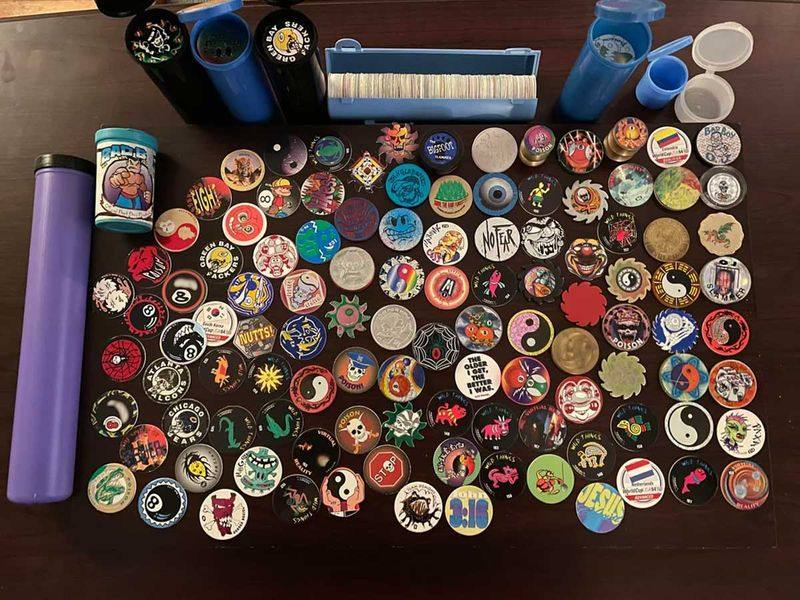
The metal slammer ban arrived next. Beat-up linoleum and gouged wooden desks gave janitors and PTAs an easier complaint than gambling — you didn’t have to explain it to a school board. By late 1995, most U.S. districts had banned slammers heavier than a quarter, or banned all slammers, or just banned the whole game outright. The ripple effect was instant: the second the playground closed, the resale market started shrinking.
The Pog Designs That Defined the Decade
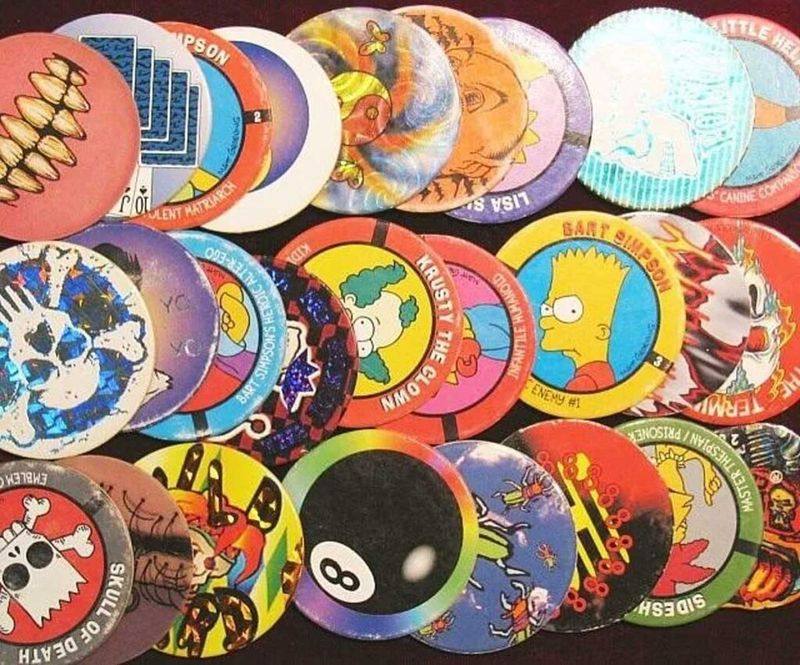
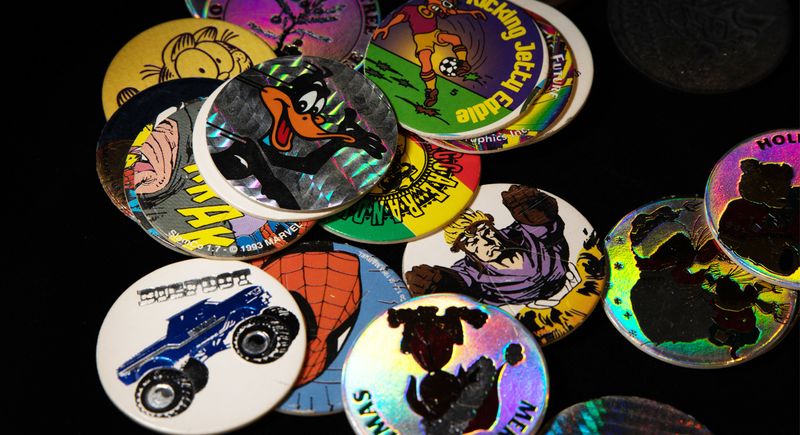
The reason a Pog collection felt like an empire was the art. Pogs were tiny, cheap, and easy to print, which meant every brand, band, and B-movie wanted in. The Simpsons sets came in 1994 — Bart, Krusty, Maggie, Lisa, and a Skull of Death that, no kidding, was a real Pog you could buy at a grocery store endcap. Skybox printed DC SkyCaps with Superman, Batman, and the Flash. Marvel licensed Spider-Man, the X-Men, and the entire Daredevil run.
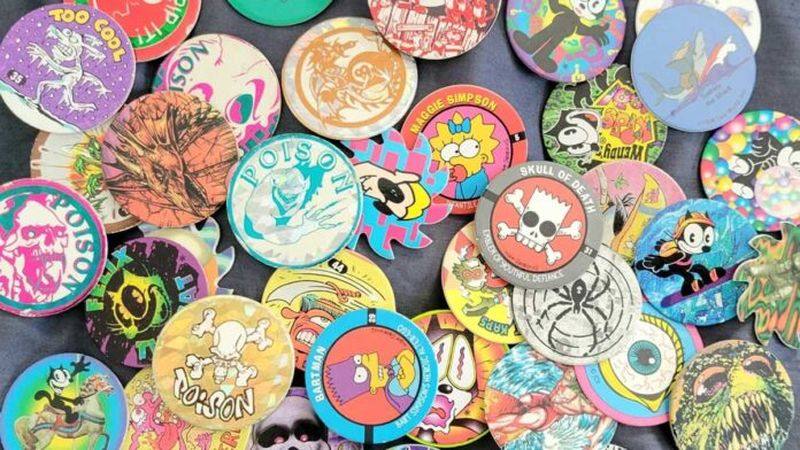
The grossout aisle exploded next. Skulls, biohazard symbols, the word POISON in dripping fonts, eyeballs, alien faces, and any other thing your mom would have refused to put on the fridge — it all sold. The Pogs 90s aesthetic was the visual cousin of Garbage Pail Kids cards: bright, weird, gross, slightly threatening, and aimed straight at the parent-irritation reflex.
Promotional tie-ins ran in parallel. McDonald’s exclusive caps shipped with Happy Meals in 1995. Hardee’s had the Apollo 13 set. Coca-Cola, Pepsi, Pizza Hut, and Burger King all ran short-run promotional sets. If a brand had a marketing budget, it had a Pog set, because the game itself did the distribution for free.
Holographic Slammers Were the Schoolyard Currency
Once licensed sets saturated the market, the WPF needed an upgrade path. They invented one: holographic Pogs. Foil-stamped, prism-finish, mirror-edge, color-shifting — any disc that caught the light became worth two or three matte ones in the trade economy. Holographic slammers ranked even higher. A holographic metal Yankees slammer was the kind of thing a sixth grader would carry inside a sock.
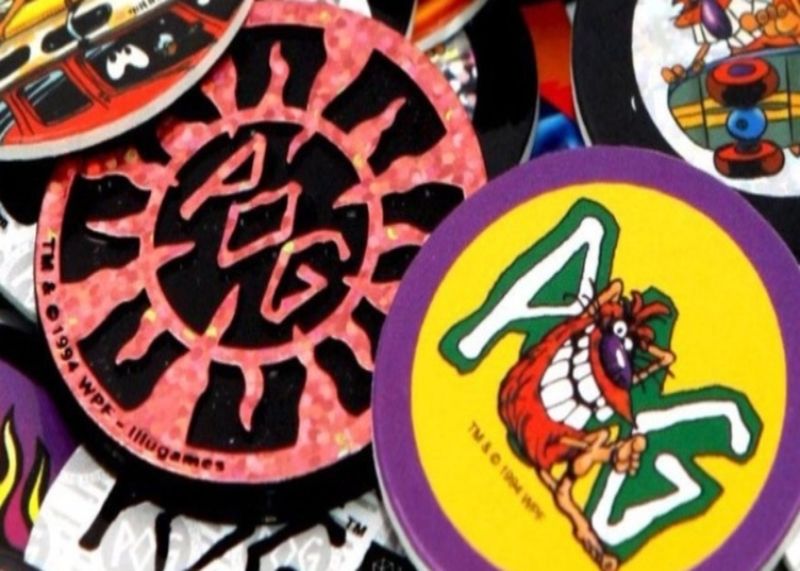
Schoolyard valuation got specific fast. A common Bart Simpson Pog was worth one trade unit. A holographic Bart was worth four. A holographic Skull of Death slammer, in mint condition, in a kid’s hand, could pull eight commons out of the next kid’s tube. The currency was unstable — a new design could collapse old values in a week — but every recess from October 1993 to about February 1996, kids were running their own commodities exchange on the blacktop.
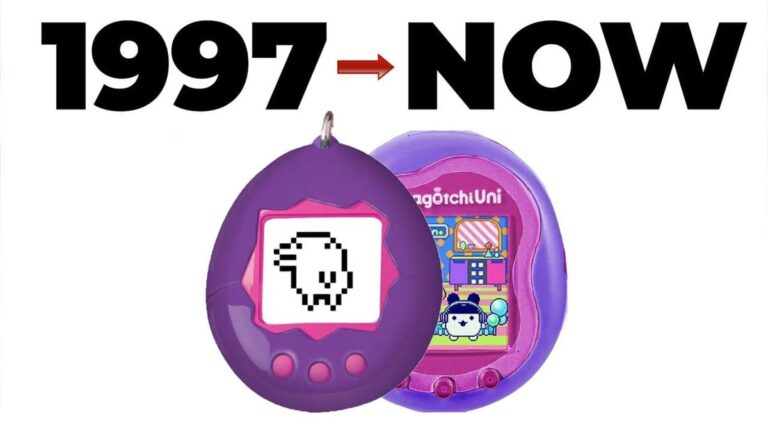
This is the part that made the school bans feel less hysterical in hindsight. The kids weren’t just playing. They were running little markets, with winners and losers and tears at dismissal. The same instinct that powered Pog trading is the one that, ten years later, powered fantasy football and twenty years later powered virtual pet collectibles like Tamagotchi.
The 1995 Tournament Boom Was the High-Water Mark
In February 1993, the WPF threw the first U.S. National POG Tournament in Los Angeles. By 1995, there were regional tournaments in Phoenix, Houston, Chicago, and Boston. Kids brought their best collections in carrying cases. Mall locations of Toys “R” Us and KB Toys hosted Saturday afternoon tournaments where the prize was — yes — more Pogs.
The shopping mall was the headquarters. A Pog kiosk was usually a six-foot circular tower in the middle of a busy concourse, manned by a tired part-time clerk and stacked with rotating licensed sets. Mall culture in the 80s and 90s had a way of converting passing kids into devoted hobbyists in under ten minutes, and Pog kiosks did it on schedule.
Embed Break: When POG Was King
RetroDaze put together a tight history of the 90s Pog mania that hits everything from Blossom Galbiso to the WPF collapse. Worth nine minutes if you want the full arc with vintage footage.
How the Pogs 90s Empire Collapsed by 1997
The crash had three causes, and they all hit in the same eighteen-month window. The school bans cut off the daily play environment, so the kids who got their fix at recess simply stopped buying. The licensed-set glut meant any cartoon could end up on a cap by 1995, and the perceived rarity that drove trades vanished — when every shelf has a Power Rangers Pog, no Power Rangers Pog is worth anything. And the WPF made the same mistake every fad merchant makes: they expanded too fast, signed too many licenses, and stocked too much inventory.
By 1996, Pog kiosks in the malls were being replaced by cell phone booths and massage chairs. Rypinski sold control of the WPF to Pacific Capital Group, who renamed and downsized the operation. Neither move saved it. By 1998 the game was effectively dead at retail. Kids had moved on to Tamagotchi, Beanie Babies, and the first wave of Pokémon trading cards — which is to say, three more for-keeps collectible economies, each more sophisticated than the last.
What Vintage Pogs Are Worth Today
The honest answer: most Pogs are worth almost nothing. A tube of 100 commons sells on eBay for $10 to $25, and the seller usually has to pay shipping. The bulk of the 90s Pog supply is paper, printed in volumes that would embarrass a baseball card factory.
The exceptions are real, though, and they are getting more real every year. A complete unopened 1994 McDonald’s Pog set in original packaging has sold for $300 to $500. Specific holographic 1993 Jurassic Park Pogs from the original promotional run trade in the $100 range. The 1994 Beatles set, which Apple Corps shut down after one production run, regularly clears $400 to $600 when complete. The rarest single Pog — an original Haleakala Dairy Passion Orange Guava cap from the early 1970s, before anyone thought of them as collectibles — has a market value somewhere north of $1,000 in mint condition, because almost nobody saved them.
The real collector market is for rare slammers. Brass and steel pre-WPF slammers from Hawaii sell to private buyers in tight communities, often without ever appearing on a public listing. If you have a black Tupperware tube under your bed with a metal slammer your dad confiscated in fifth grade, dig it out and look at it under good light. Some of those are worth more than the rest of the tube combined.
Why the Pogs 90s Era Still Matters
The truth is, Pogs were the first time most Gen X and elder Millennial kids ran a real economy. Every recess was a small commodities market with currency, speculation, scarcity, theft, and ruin. The lesson stuck. The kids who lost their entire tube in week one of fifth grade grew up to recognize the same pattern in stock options, in NFT drops, in retro sneaker resale. The kids who ran the table grew up to start brands.
If you still have a stack of milk caps in a shoebox somewhere, don’t sell them. Bring them to your kid, set them on the kitchen table, and teach them how the slammer works. The game is still good. It was always good. The fad died because the licensing died, not because the rules ever stopped being fun.
Sources
- Mental Floss — The Weird History of Pogs — Origin story, Blossom Galbiso, WPF business arc
- HowStuffWorks — You’re Definitely a Kid of the ’90s if You Played POGs — Game rules, slammer types, school ban list
- Kalamazoo Valley Museum — The History of POGs — Menko origins and Hawaiian milk cap history
- Kandor Archives — The History of Milk Caps, Menko, and POGs — Haleakala Dairy and Steve Allen patent records
- The Retro Network — POGs: The Fad That Slammed the ’90s — Tournament era and collapse timeline
Browse retro and vintage-inspired apparel at the RetroRadical shop →
The Retro Almanac
A monthly roundup of "on this day" highlights from that month, decades back — plus first dibs on new retro merch drops. No spam, just the good stuff.