Trapper Keeper Mead: 7 Reasons This 80s Binder Ruled
The Trapper Keeper Mead sold more than 75 million units between 1978 and the end of the 1990s, and for most of Gen X, the cover you picked at the start of the school year said more about you than the clothes you wore that day. The neon water droplets, the rainbow unicorns, the F-14 Tomcat dive-bombing across the front of a three-ring binder — those weren’t accessories. They were the first piece of branding most kids ever owned, and the brand they were broadcasting was themselves.
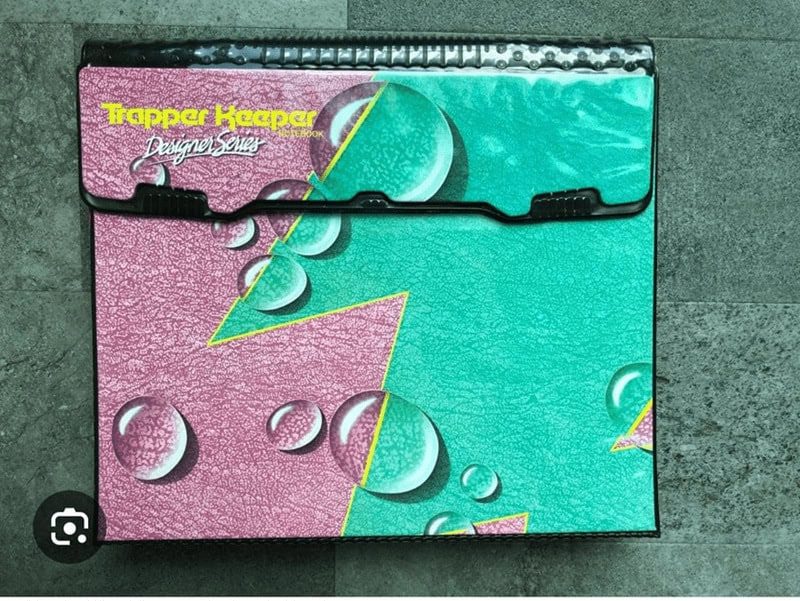
The Trapper Keeper Mead Designer Series in its purest form — pink leather texture, teal geometric, water droplets. This is the cover you fought your sister for in 1987.
The Retro Almanac
A monthly roundup of "on this day" highlights from that month, decades back — plus first dibs on new retro merch drops. No spam, just the good stuff.
What Made the Trapper Keeper Mead Different From Every Other Binder
The story starts with a Mead executive named E. Bryant Crutchfield, who in 1978 noticed that the school binders kids were using had one annoying flaw — paper kept falling out. Every kid in America was carrying around a wad of loose-leaf that exploded the second the binder tipped sideways in a locker. Crutchfield’s fix was deceptively simple: take a regular three-ring binder, add a folded-over front flap that fastened with a metal stud or, later, a strip of velcro, and call it the “Trapper” because it trapped your papers from sliding out.
The first version was just called Trapper Notebook. The “Keeper” part came a year later when Mead bundled the Trapper with a set of color-coded pocket folders — the actual “Trappers” — that slid onto the rings inside. Those folders had angled pockets so paper couldn’t escape sideways, and they were the part that made the whole system work. The Keeper held the Trappers. The Trappers held the homework. By 1981, Mead was selling them by the freight container, and a generation of kids had something to argue about at the lunch table other than what was on TV the night before.
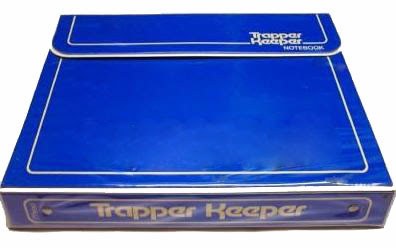
The original 1978 Trapper Keeper Mead — solid royal blue, no art, just the logo. Within five years it would look nothing like this.
The 1980s Designer Series That Turned a Binder Into Identity
By 1984, Mead realized the binder itself was secondary — what kids actually wanted was the cover. The Designer Series launched with airbrushed art straight out of the era’s visual playbook: sports cars on Miami beaches, hot air balloons over canyons, unicorns silhouetted against double rainbows, F-14 Tomcats screaming over aircraft carriers. The covers were sealed under glossy laminate, and they survived years of being thrown into lockers, sat on, and used as makeshift sleds during recess.
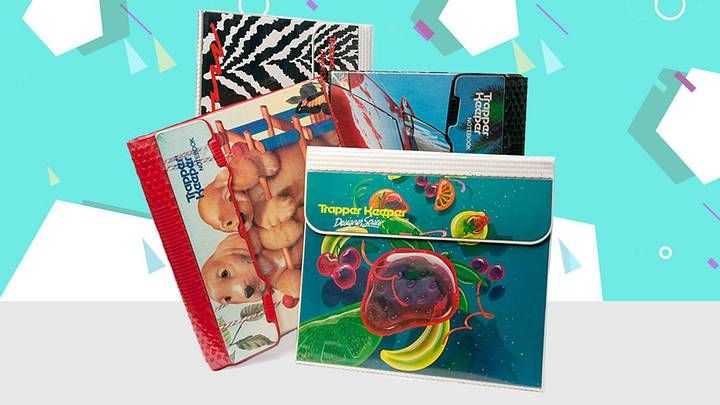
The Designer Series catalog reads like a focus group’s fever dream: puppies, the Golden Gate Bridge, zebra-stripe strawberries. There was a cover for every kid.
What’s wild is how rigidly the social hierarchy mapped onto the cover designs. The kids with the F-14 Tomcat were the ones who wanted to be Maverick from Top Gun. The kids with the puppies were quiet readers. The kids with the geometric neon abstracts were the ones whose parents bought whatever was on sale at K-Mart. Pick the wrong cover and you’d hear about it. Pick the right one and you got two semesters of compliments before someone showed up with the next year’s design.
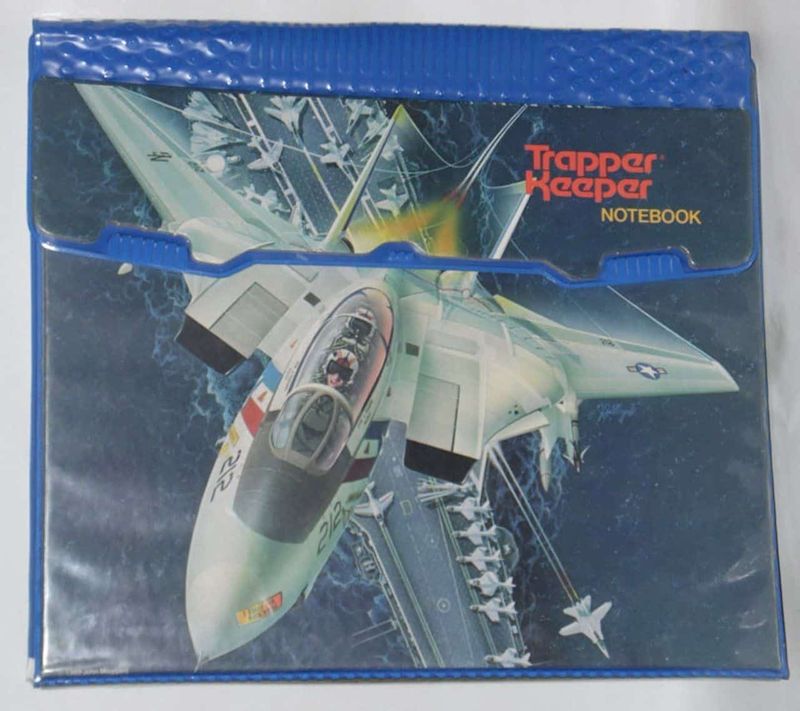
The F-14 Tomcat Trapper Keeper. Every fifth-grade boy in 1986 wanted to be in this binder.
How Lisa Frank Took Over the Trapper Keeper
If the Designer Series owned the early ’80s, the late ’80s and early ’90s belonged to Lisa Frank. The Tucson-based artist had been licensing her hyper-saturated rainbow animals to stickers and folders since 1979, but the Lisa Frank Trapper Keeper deal — leopard-spotted seals, hummingbirds with peacock feathers, dolphins jumping through tropical sunsets — turned every elementary school hallway into a neon hallucination starting around 1991. The covers used metallic foil printing and glittered laminate that caught the fluorescent lights of school hallways and threw them back as small, distracting rainbows.
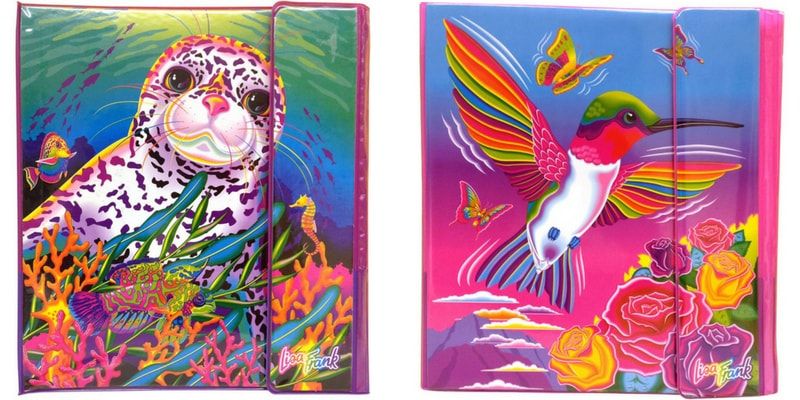
The Lisa Frank Trapper Keeper line — the binder that taught a generation of girls that nothing in nature was actually saturated enough.
Lisa Frank’s deal with Mead was reportedly worth millions, and for a while it kept her studio funded entirely on Trapper Keeper royalties. The covers became so synonymous with the brand that most people under 40 today picture a Lisa Frank dolphin when they hear “Trapper Keeper” — even though, by total units sold, the Designer Series animals and abstracts probably moved more inventory across the binder’s whole run.
Inside the Trapper Folders That Held It All Together
The genius of the Trapper Keeper Mead was never the cover — it was the folders. Each binder came with three or four Trappers, color-coded pocket folders that slid onto the three rings and held loose paper in angled pockets. The angle was the thing: a regular folder lets paper slip out sideways when you tilt it, but the Trapper folders had inverted-V pocket seams that caught the paper at exactly the angle a falling sheet would try to escape. Combined with the velcro front flap, the system was nearly leak-proof.
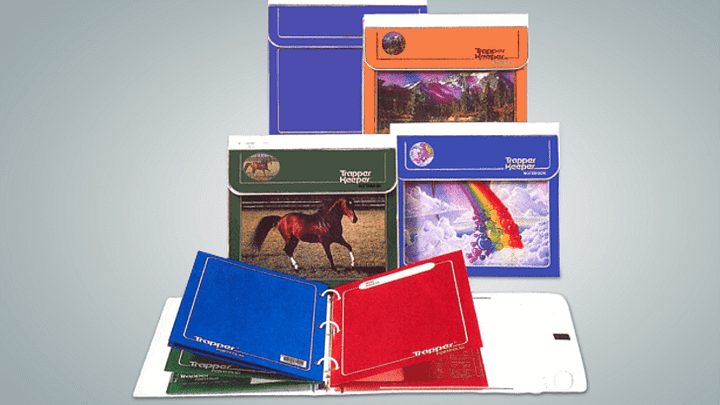
The interior. The Trappers held the homework. The Keeper held the Trappers. The velcro held everything.
The failure modes were specific. The rings would warp if you sat on the binder wrong, and once they were misaligned, the whole thing became a paper grenade. The velcro lost its grip after about two semesters of aggressive use, which is why most well-loved Trapper Keepers from the era have visible elastic-band patches where someone’s mom stitched the flap back into service. The cover laminate would peel at the corners if the binder spent too much time in a hot trunk. None of this stopped anyone from buying another one the next year.
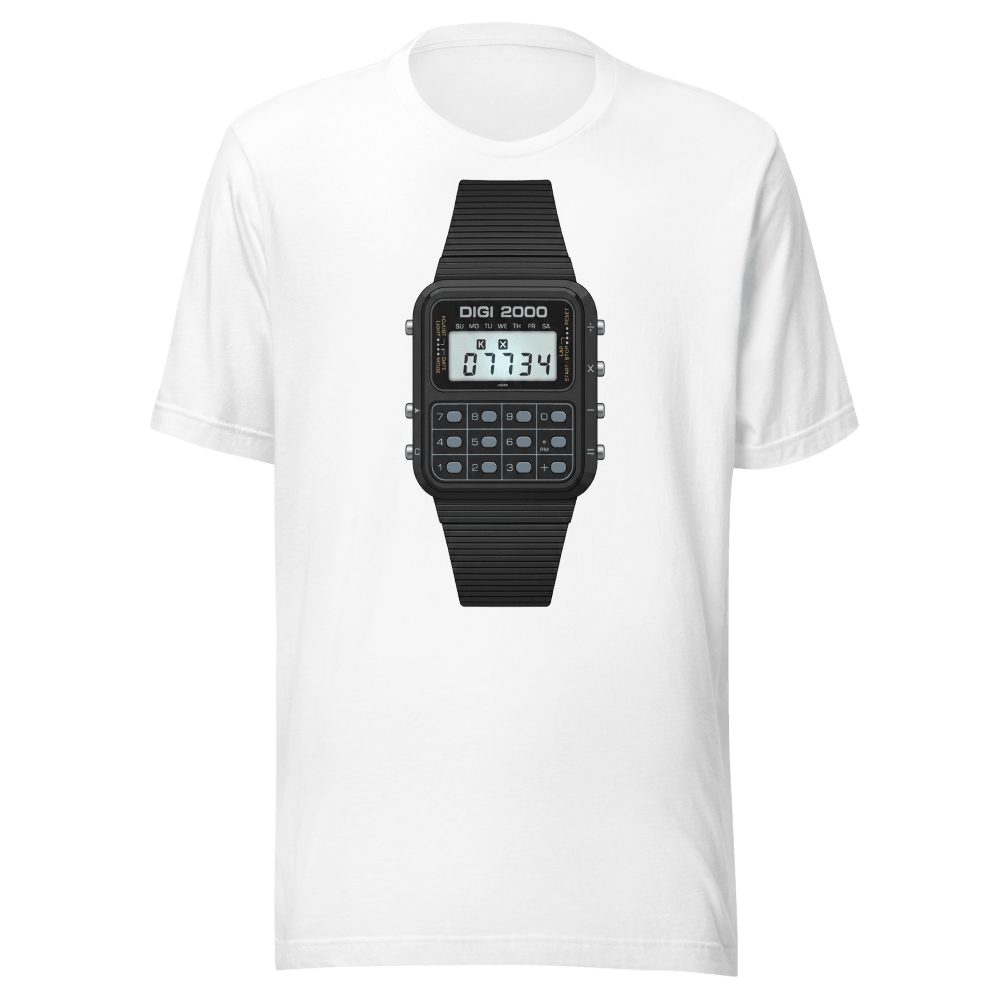
Why Schools Started Banning Trapper Keepers in the 90s
By 1992 a quiet wave of Trapper Keeper bans had spread through American school districts. The official complaints were practical — the binders didn’t fit in the smaller lockers the new middle schools were installing, and the velcro flaps made a tearing sound when opened that teachers said disrupted class. The real reason was probably economic. The Designer Series had crossed over into status-symbol territory, and administrators worried about the kids who showed up with regular three-ring binders feeling left out.
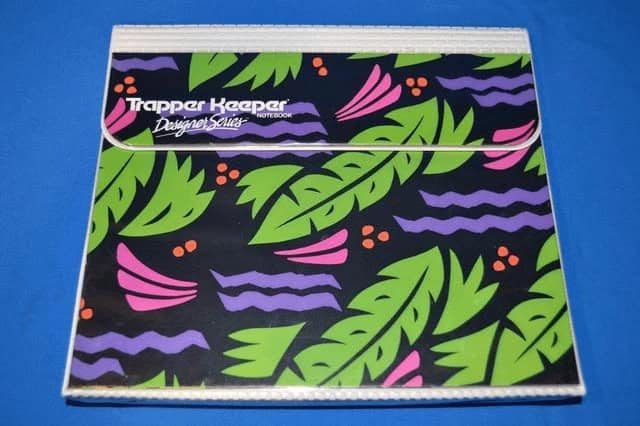
The neon tropical leaves design — peak 1989, peak Designer Series. This cover went on to inspire half of Saved by the Bell’s set design.
The bans backfired the way most school bans do. Kids who had been happy with the standard Designer Series suddenly wanted the rarest Lisa Frank cover precisely because they couldn’t bring it. Mead’s response was to release a smaller “Trapper Keeper Junior” line designed to fit the new locker sizes, but the brand had already started losing ground to ring-bound trapper imitators and to the rise of other schoolyard fads that pulled the cultural attention elsewhere.
The 1987 Trapper Keeper Commercial That Defined the Era
If you want to understand exactly what Mead was selling — and it wasn’t really a binder — watch the 1987 commercial. The ad opens with a kid’s textbook exploding in slow motion, paper flying everywhere, the whole disaster set to dramatic synth music. Then the Trapper Keeper Mead appears in a beam of light, the kid clicks the velcro flap shut, and the world is whole again. It’s selling salvation, not stationery.
The commercial ran heavily on Saturday morning cartoons in 1987 and 1988, which is why it lives in Gen X memory next to the He-Man, GI Joe, and Pop-Tarts ads that aired in the same time slot. Mead’s advertising spend during that window was enormous — by some estimates the brand was the second-biggest ad buyer in the back-to-school category, behind only Crayola.
The South Park Episode That Made It a Meme Again
By the year 2000 the Trapper Keeper had been mostly forgotten by the culture, replaced by Mead’s blander Five Star line and a generation of kids who lugged JanSport backpacks instead. Then in November of that year, South Park aired a Season 4 episode titled simply “Trapper Keeper” in which Cartman acquires a sentient, Terminator-style Trapper Keeper that tries to assimilate everything around it. The episode parodied The Terminator, 2001: A Space Odyssey, and the entire post-apocalyptic AI genre at once, and it had the side effect of dragging the brand back into the cultural conversation for a generation of younger viewers who had never owned one.
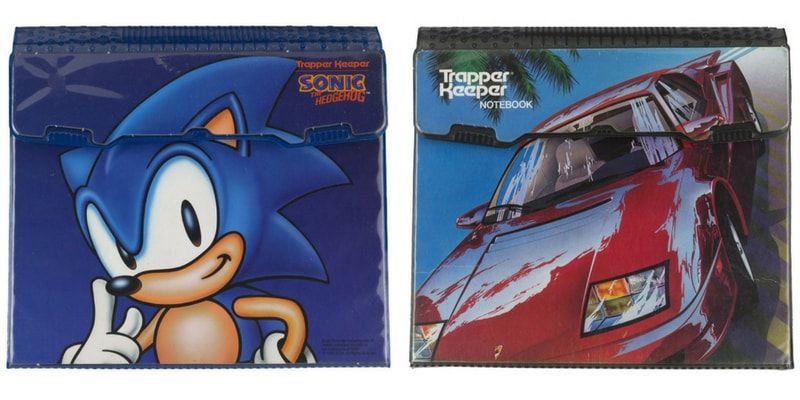
The 90s licensing era. Once Sonic showed up on a Trapper Keeper cover, the brand had pivoted from “school supply” to “tie-in toy.”
Mead never officially commented on the episode, but anecdotal sales data from that period shows a small spike in collector demand for vintage Designer Series binders starting in 2001. It was the first sign that the brand had moved from active product to nostalgia object — the same arc that Garbage Pail Kids and a hundred other 80s schoolyard items would later follow.
What a Vintage Trapper Keeper Sells For in 2026
The vintage Trapper Keeper market has gotten serious. Sealed Designer Series binders from the 1984–1989 run regularly sell on eBay for $80 to $200 depending on the cover design, and a sealed Lisa Frank Trapper Keeper from 1992 can clear $300 if the laminate is intact and the original Trappers are still inside. The F-14 Tomcat design and the unicorn-on-clouds Lisa Frank are the two most-searched designs by collectors, with the puppy and kitten covers a close third.
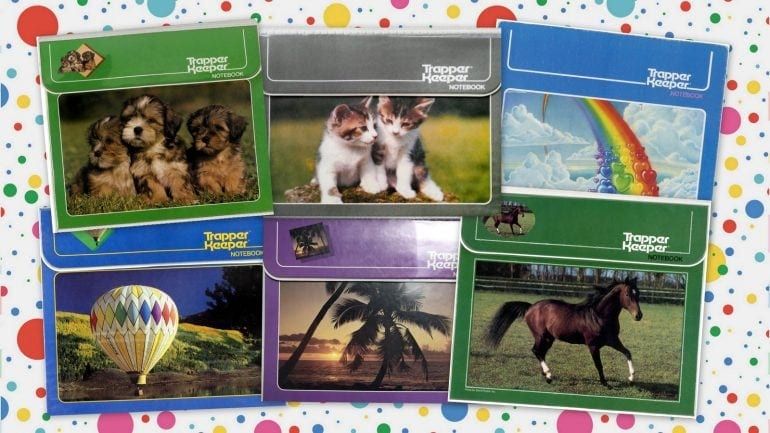
A small sample of the Designer Series catalog. Each one of these binders is now worth more than the kid who carried it earned that whole school year.
The collector value tracks with a broader pattern in 80s memorabilia, where items that were mass-produced enough to be unremarkable at the time become scarce once a couple of decades of school lockers, trunk space, and divorces have done their work. A binder that cost $4.99 at K-Mart in 1986 is now a small investment, which is exactly the kind of inversion that makes 80s nostalgia hit harder than any other decade’s on the secondary market.
The 2021 Mead Trapper Keeper Reissue
In August 2021, Mead quietly relaunched the Trapper Keeper in three new designs — a vaporwave purple sunset, a geometric black-neon throwback to the 80s Designer Series, and a pastel cloud pattern — sold exclusively through Walmart. The relaunch was timed to the brand’s 43rd anniversary and was clearly aimed at millennial parents shopping for their own kids. The covers were thinner, the velcro was replaced with magnetic snaps, and the interior Trapper folders were reduced from four to two, but the core form factor was unchanged.
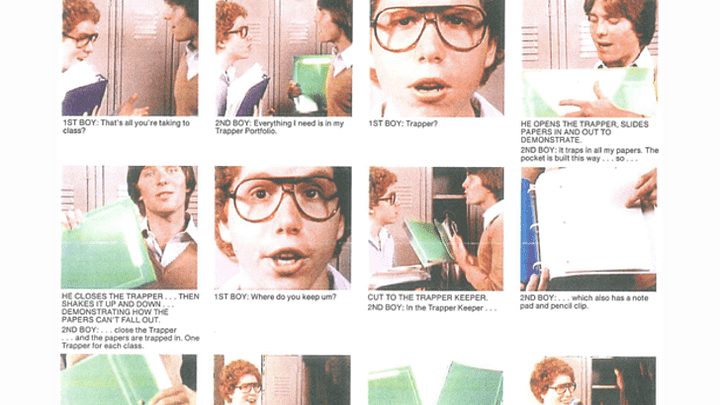
Storyboard from the original 1978 Mead Trapper Keeper TV commercial — the ad that started the whole thing.
E. Bryant Crutchfield, the inventor, died in February 2022 at the age of 85. He had retired from Mead in the late 1990s and spent his last two decades on the lecture circuit talking about consumer product design. In interviews he would point out that the Trapper Keeper Mead made him exactly zero dollars in personal royalties — his name was on the patent, but the patent belonged to Mead. He never seemed bitter about it. He said the thing that mattered to him was that he had invented something every kid in America had touched.
The Trapper Keeper Was the First Brand You Ever Picked
For most Gen X kids, the Trapper Keeper Mead was the first consumer product they ever chose themselves — not for utility, but for identity. You weren’t buying a binder. You were buying a small public statement about who you wanted to be at school that year. That’s a lesson a generation of marketers absorbed and then spent the next four decades replicating with sneakers, phone cases, and laptop stickers. Crutchfield’s velcro flap turned out to be the prototype for the entire personal-branding economy. Not bad for a guy who just wanted his daughter’s homework to stop falling out of her binder.
Sources
- Mental Floss — A Brief History of the Trapper Keeper — Mead archive interviews and Crutchfield-era studio photos
- Click Americana — 10 Vintage Trapper Keeper Designs From the 80s — original Designer Series catalog imagery
- Wikipedia — Trapper Keeper — patent dates, sales figures, and South Park episode reference
- Fox 2 Detroit — Trapper Keeper Inventor E. Bryant Crutchfield Dies at 85 — obituary and 2021 reissue coverage
- Relic Record — Trapper Keeper Nostalgia and Profit — Lisa Frank licensing era and secondary market analysis
Browse retro and vintage-inspired apparel at the RetroRadical shop →
Shop on Amazon
80s Collectibles on Amazon →
As an Amazon Associate we earn from qualifying purchases.
Shop on eBay
80s Collectibles on eBay →
We may earn a commission when you shop through our eBay links.
The Retro Almanac
A monthly roundup of "on this day" highlights from that month, decades back — plus first dibs on new retro merch drops. No spam, just the good stuff.