Mr T A-Team icon BA Baracus gold chains mohawk 1980s
| |

Mr T A-Team: 7 Reasons BA Baracus Owned the 1980s

By 1984, four men appeared on roughly half the lunchboxes in America: He-Man, Han Solo, Hulk Hogan, and a former Chicago bouncer with a mohawk and twelve pounds of gold around his neck. The bouncer made $80,000 a week, refused to drink, refused to fly, and told kids on Saturday mornings to drink their milk. Mr. T and the A-Team weren’t just a hit — they were a cultural takeover. Two years earlier, Laurence Tureaud was working nightclub doors on Rush Street. Two years later, Nancy Reagan was sitting on his lap in the East Room.

This is how a kid from a 12-person Chicago apartment ended up as the most quoted, most cosplayed, most parodied tough guy of the decade — and why he still gets recognized at gas stations 40 years later.

Mr T and the A-Team: From Chicago Doorman to Prime Time
Mr T A-Team icon BA Baracus gold chains mohawk 1980s

Laurence Tureaud was born May 21, 1952, on Chicago’s South Side — one of twelve children in a three-room apartment after his father left when he was five. He wrestled and played football at Dunbar Vocational High School, won a football scholarship to Prairie View A&M, washed out after a year, served in the Army’s Military Police Corps starting in 1975, and tried out for the Green Bay Packers before a knee injury closed that door. By the late ’70s he was working the door at Dingbats, a Rush Street discotheque, hauling drunks into the alley.


He legally changed his name to “T” at age 18. The reason was specific and unglamorous: he wanted every person who addressed him to start with the word “Mister.” He had watched his father and uncles get called “boy” their entire adult lives, and he wasn’t going to inherit that. The persona he built — the chains, the haircut, the booming voice — was a piece of armor with a thesis behind it.

Rocky III and “I Pity the Fool” (1982)

The audition that broke Mr. T’s career was a televised “America’s Toughest Bouncer” competition. Sylvester Stallone saw him on Games People Play and remembered him when casting the next Rocky. Real boxers — Joe Frazier, Earnie Shavers, Ken Norton, Jim Brown, Fred Williamson — were considered for Clubber Lang. Mr. T beat out roughly 1,200 contenders by memorizing seven pages of script and improvising the rest in his screen test.

Mr T Clubber Lang face-off with Sylvester Stallone Rocky III 1982

Rocky III opened on May 28, 1982, and grossed roughly $270 million worldwide — the fourth-highest-grossing film domestically that year. Clubber Lang was an avenging force: an orphan from Chicago’s South Side who learned to fight in detention and treated trash talk as a separate sport. When a reporter asked Clubber if he hated Rocky, he gave the answer that would follow Mr. T for the rest of his life: “No, I don’t hate Balboa. But I pity the fool.”

The line wasn’t even the centerpiece of the film. Survivor’s “Eye of the Tiger” (written after Queen denied Stallone permission to use “Another One Bites the Dust”) spent six weeks at #1 and became the second-best-selling single of 1982. But “I pity the fool” became the catchphrase Mr. T essentially built his second career on — every Saturday morning intro, every wrestling promo, every cereal commercial.

BA Baracus and the NBC Phenomenon

NBC entertainment president Brandon Tartikoff handed Stephen J. Cannell and Frank Lupo a one-line pitch — “The Wild Bunch meets The Dirty Dozen meets Mission: Impossible with a bit of Magnificent Seven thrown in” — and what came back was The A-Team. It premiered January 23, 1983, after Super Bowl XVII. The pilot drew 26 million viewers.

Mr. T played Sergeant First Class Bosco Albert “B.A.” Baracus — the “B.A.” officially stood for “Bad Attitude.” A mechanical savant, ex-Special Forces commando, milk-drinking teetotaler, terrified of flying. The character had a clarity Hollywood almost never gives a Black action lead in 1983: he was the heart of the show, not the comic relief or the muscle prop.

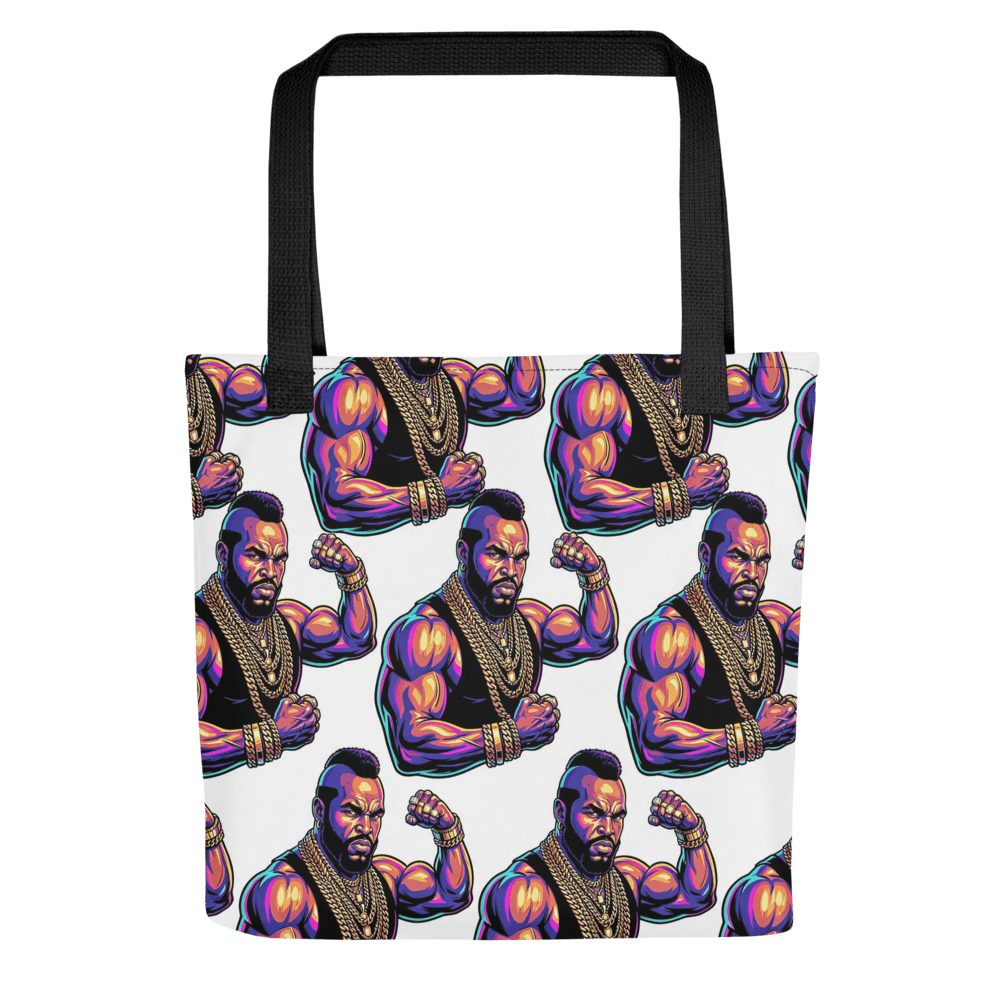
Mr T A-Team BA Baracus flexing biceps gold chains 1980s photo

The full cast: George Peppard (Hannibal Smith, the cigar-chewing planner), Dirk Benedict (Templeton “Faceman” Peck, the con artist with the dimples), and Dwight Schultz (Captain H.M. “Howling Mad” Murdock, the pilot in the institution). Mike Post and Pete Carpenter wrote the theme — a snare-march brass line that any Gen Xer can hum on cue.

The show peaked at #4 in the 1983–84 Nielsen rankings with a 24.0 rating. Mr. T was reportedly making $80,000 per episode by 1984 — the highest-paid Black actor on American television at the time. He ran 97 of 98 episodes across five seasons before NBC pulled the plug on March 8, 1987.

Watch the Original A-Team Opening

If you grew up between 1983 and 1987, the first six seconds of this clip will deliver a Pavlovian rush stronger than any commercial in television history.

The Van Was a Co-Star

The black-and-grey 1983 GMC Vandura with the slashing red stripe, red turbine hubcaps, and rooftop spoiler became one of television’s most recognizable vehicles. It was a base Vandura 2500 with a 5.7L V8 — GMC supplied multiple units, including a sunroof version for cabin shots and stunt versions without. The licensed plate read “S 967 238” and most fans can still describe the seating arrangement: Hannibal shotgun, Face center, Murdock in back, and B.A. — when sedated — also in back, because the man would not fly.

A-Team 1983 GMC Vandura van black silver red stripe BA Baracus

The flying gag is one of the more honest pieces of writing on ’80s network TV. B.A.’s pteromerhanophobia gets the team into trouble episode after episode, and the running joke is that the only way to put him on a plane is to drug his milk. Most action shows would have written the fear out by season two. The A-Team kept it for five years because it made B.A. human.

The Mohawk Was a History Lesson

Mr T 80s pop art portrait illustration mohawk Mandinka warrior

The hairstyle was not borrowed from a punk band. Mr. T saw a photo of a Mandinka warrior in a 1977 issue of National Geographic and adopted the cut as a deliberate statement about West African heritage. The Mandinka are a Mandé people of roughly 15 million spread across Mali, Senegal, Guinea, and Gambia, and the close-cropped sides with a tall central crest was a traditional warrior style centuries before any Manhattan barber called it a “mohawk.”

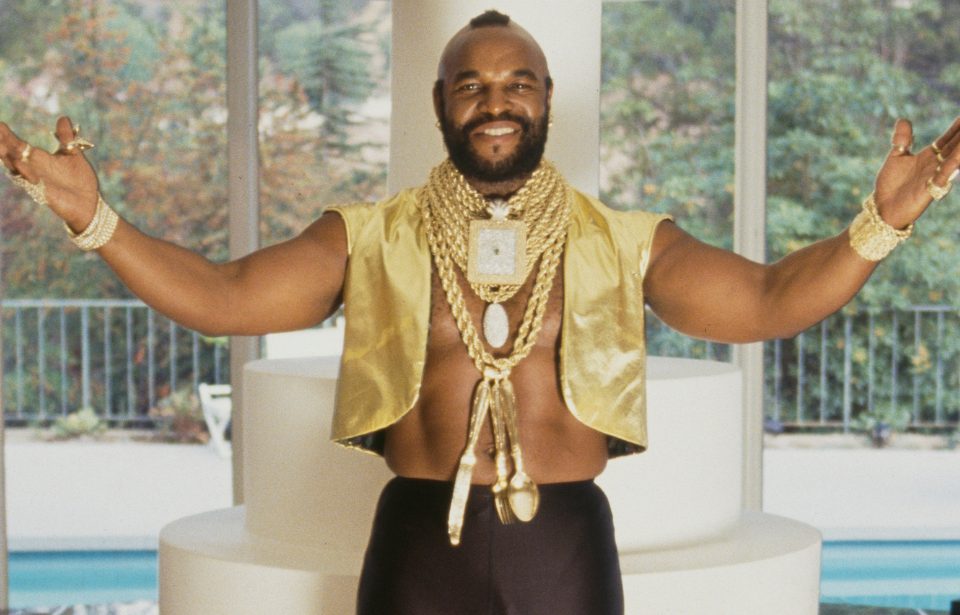
The gold was the same kind of intentional. The chains started practical — drunks at Dingbats would leave jewelry on the floor, and Mr. T started wearing the lost pieces conspicuously so the owners could spot and reclaim them. By the time he hit television he had built the look into something heavier. He explained it bluntly: the chains were a reminder of the iron his ancestors wore when they were brought to America in chains. He stopped wearing nearly all of his gold after Hurricane Katrina in 2005, saying it felt wrong to flash $300,000 of jewelry while Gulf Coast families had lost everything.

Mr T 1980s portrait gold rings wristband BA Baracus

WrestleMania I and the Christmas at the White House

Two events in the first half of the decade cemented Mr. T as something bigger than an actor. The first was the most photographed first-lady moment of the Reagan years: in December 1983, Nancy Reagan invited Mr. T to the White House Christmas press tour because he had been touring American schools telling kids to stay off drugs, which dovetailed with her “Just Say No” campaign. He showed up dressed as Santa Claus. The First Lady sat on his lap and kissed the top of his head. It was photographed, wired by UPI, and printed on every front page in the country the next morning.

Mr T at Paasrace 1984 black and white period photo A-Team

The second was March 31, 1985, at Madison Square Garden. WrestleMania I — the first one, the foundational one, the show that turned Vince McMahon’s regional federation into a national entertainment company — closed with Hulk Hogan and Mr. T teaming up to beat “Rowdy” Roddy Piper and “Mr. Wonderful” Paul Orndorff. Muhammad Ali was the special guest referee. Liberace was the timekeeper. Billy Martin announced. The whole thing should not have worked, and it worked because Mr. T was there and television cameras could not look away from him.

The Cartoon, the Cereal, the Lunchbox Economy

Mr T animated NBC Saturday morning cartoon 1983 Ruby-Spears

The animated Mister T debuted on NBC on September 17, 1983. Ruby-Spears Enterprises produced 30 episodes across three seasons. The premise: Mr. T coaches a gymnastics team of teenagers (Jeff, Woody, Robin, Kim, and Robin’s little brother Spike) who travel the world solving mysteries. Every episode opened with a live-action segment of the real Mr. T explaining the moral and closed with him narrating the takeaway. Phil LaMarr made his voice-acting debut on the show.

Quaker Oats licensed his face for Mr. T Cereal, a sugar-frosted corn product shaped like the letter T, on shelves from 1984 to about 1993. Galoob produced a 12-inch Mr. T action figure that ranked among the best-selling toys of 1984. There was a board game, a coloring book, a Hulk Hogan crossover doll set, and a wrestling figure with replaceable plastic chains. At the peak of the licensing wave he was on more lunchboxes than any other live-action character of the year.

Cancer, Faith, and the Quiet Years

In 1995, at age 43, Mr. T was diagnosed with cutaneous T-cell lymphoma — a rare form of skin cancer also called mycosis fungoides. He underwent treatment for six years and was declared cancer-free in 2001. The line he gave reporters about the diagnosis is the kind of thing a screenwriter would not have the nerve to invent: “Can you imagine that? Cancer with my name on it.”

He became a devout born-again Christian during the illness and was ordained as a deacon. The persona softened on screen but never broke. Cameos in Spy Hard, Inspector Gadget, Cloverfield, a long-running Snickers commercial campaign, a season on Dancing With the Stars in 2017, and a string of reality projects where he played the version of himself the public always wanted: stern, encouraging, intensely sincere.

Why Mr T Still Hits Different

Most ’80s tough-guy icons read badly today. The decade was thick with cartoonish meatheads whose entire personality was a frown and a one-liner, and a lot of them have aged into camp at best. Mr. T didn’t. The reason is that the persona was never a put-on. He really was a former bodyguard who lifted weights, drank milk, and went to church. He really did tour schools telling kids to stay off drugs. The chains, the haircut, the catchphrase — all of it was wrapped around a person who meant what he said.

If you want the same energy in your living room, the Miami Vice retrospective covers the other NBC show that ate the decade, and our piece on why 80s nostalgia still rules digs into why Gen X keeps coming back to these icons. The A-Team and the Vice are the Hannibal-and-Crockett poles of ’80s NBC swagger — strategy and style, both in absurd outfits.

The catchphrase outlived the show, the show outlived the network’s golden age, and Laurence Tureaud outlived the cancer diagnosis. There are very few ’80s figures who can claim all three. 80s fashion came back, the gold rope chain came back, the mohawk has cycled through punk, hip-hop, and back into mainstream barbershops. The only thing missing is a Mr. T sequel — and frankly, the man already did the work.

Sources

  1. Mr. T — Wikipedia — biography, name change, military service, cancer diagnosis
  2. Mr. T | Biography, Films, & Facts — Britannica — career timeline and A-Team details
  3. The A-Team — Wikipedia — series facts, Nielsen ratings, cast, GMC Vandura
  4. Rocky III — Wikipedia — casting story, 1,200 contenders, “I pity the fool” origin
  5. B.A. Baracus — Wikipedia — character details, “Bad Attitude” meaning, milk gag
  6. Mister T animated series — Wikipedia — Ruby-Spears, Phil LaMarr debut, 30 episodes
  7. WrestleMania I — Wikipedia — March 31, 1985, Madison Square Garden, Muhammad Ali referee
  8. Washington Post — Mr. T as Santa with Nancy Reagan, 1983
  9. The Vintage News — Mr. T’s Iconic Image and Mandinka heritage
  10. The Vintage News — The meaning of Mr. T’s gold chains

Similar Posts

Leave a Reply

Your email address will not be published. Required fields are marked *