On This Day: July 31, 1991 — Bush and Gorbachev End the Nuclear Nightmare
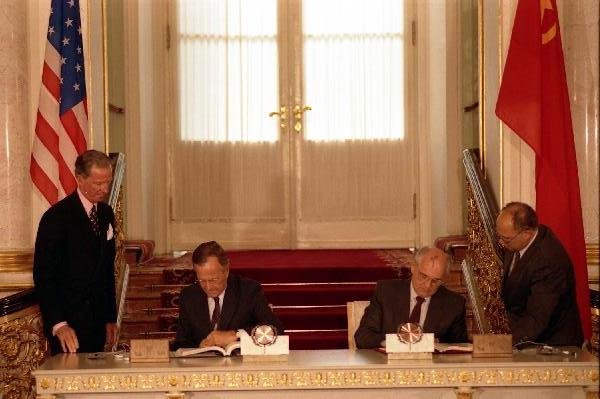
It was July 31, 1991, and the world was holding its breath. In the gilded halls of the Kremlin, two men sat down at a long table and did something nobody had thought possible a decade earlier: they agreed to actually get rid of the nukes.
Not all of them. Not even most of them. But enough to matter. Enough to mean something. The Strategic Arms Reduction Treaty — START I — was the most sweeping nuclear arms agreement in history, and the moment George H.W. Bush and Mikhail Gorbachev put pen to paper that sweltering Moscow summer, the Cold War inched a little closer to being over.
Nine Years in the Making
The “START” in START I literally stood for Strategic Arms Reduction Talks, and those talks had been grinding along since 1982. Ronald Reagan kicked them off, got distracted by the Iran-Contra mess, and handed the project to Bush. A decade of negotiations, thousands of pages of technical documents, verification protocols, throw-weight limits, and sub-limits on sub-limits — the treaty itself ran to 700 pages. Seven hundred pages.
The Retro Almanac
A monthly roundup of "on this day" highlights from that month, decades back — plus first dibs on new retro merch drops. No spam, just the good stuff.
But strip away the bureaucratic language and what you had was genuinely historic. Both sides agreed to cut their deployed strategic nuclear warheads down to 6,000 each. Both sides agreed to limit delivery vehicles — the missiles, bombers, and submarines that carry the warheads — to 1,600. And for the first time ever, both sides agreed to on-site inspections. You could actually check that the other guys were keeping their word.
The Infrastructure of Fear
If you grew up in the 1980s, you understood — somewhere in the back of your mind, the place you tried not to visit too often — that the world could end. Not metaphorically. Not eventually. Actually end. This week. Tonight. Because a computer glitch registered a flock of geese as an incoming missile strike (that actually happened, multiple times).
At peak Cold War madness, the United States alone had over 12,000 deployed strategic nuclear warheads. The Soviet Union had even more. Each one of those warheads was pointed somewhere. Buried in silos under the Great Plains, loaded onto submarines prowling the ocean depths, strapped beneath the wings of B-52s flying around-the-clock airborne alert missions — the whole apparatus existed for one purpose. Mutually Assured Destruction. MAD, they called it. And they were not kidding.
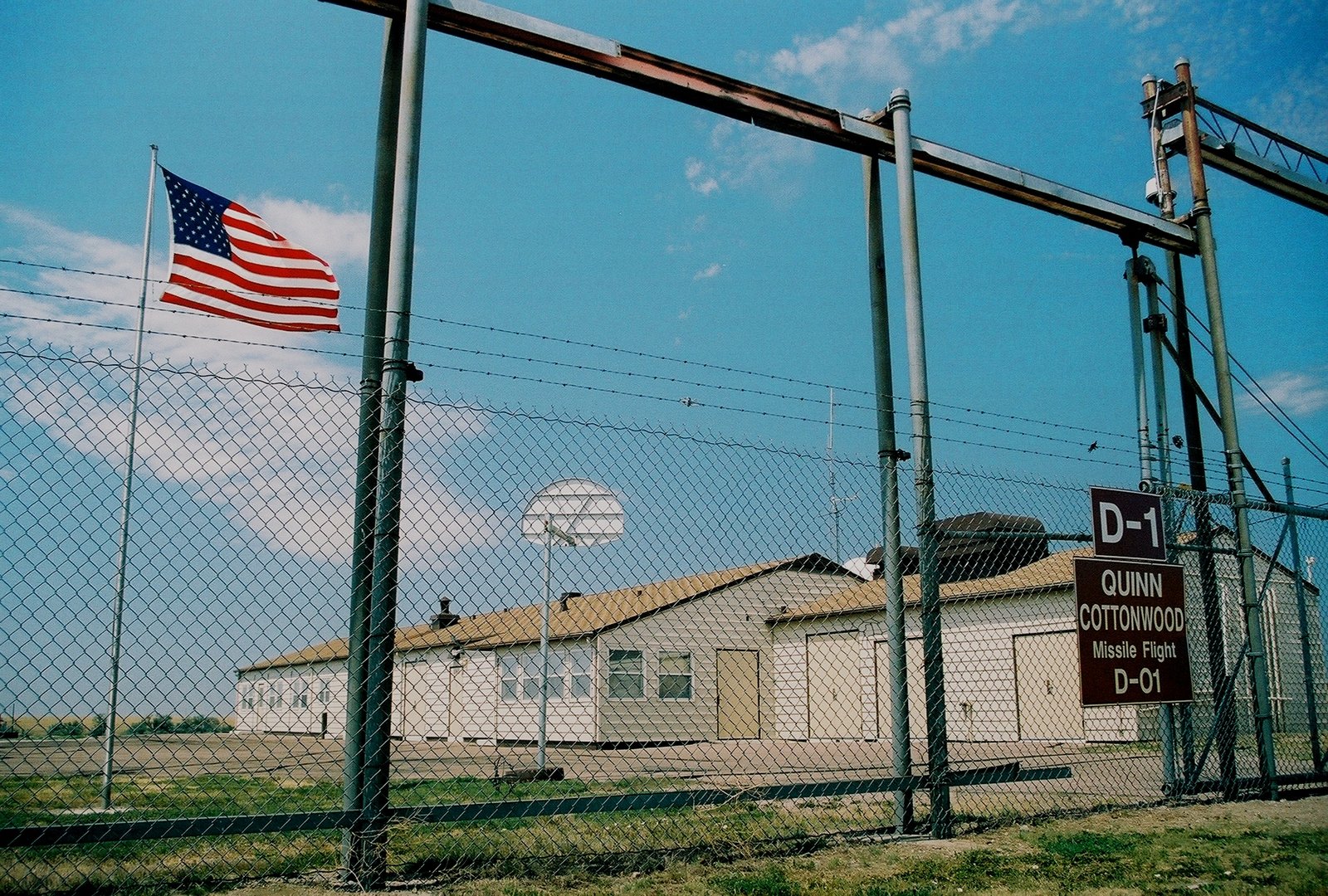
Those concrete launch control centers — buried 35 feet underground, hardened against nuclear blast, manned around the clock by two-person crews who had to turn their keys simultaneously — those places were real. They stretched across the Great Plains of South Dakota, Montana, Missouri, Wyoming. The fields looked peaceful enough. The missiles underneath were anything but.
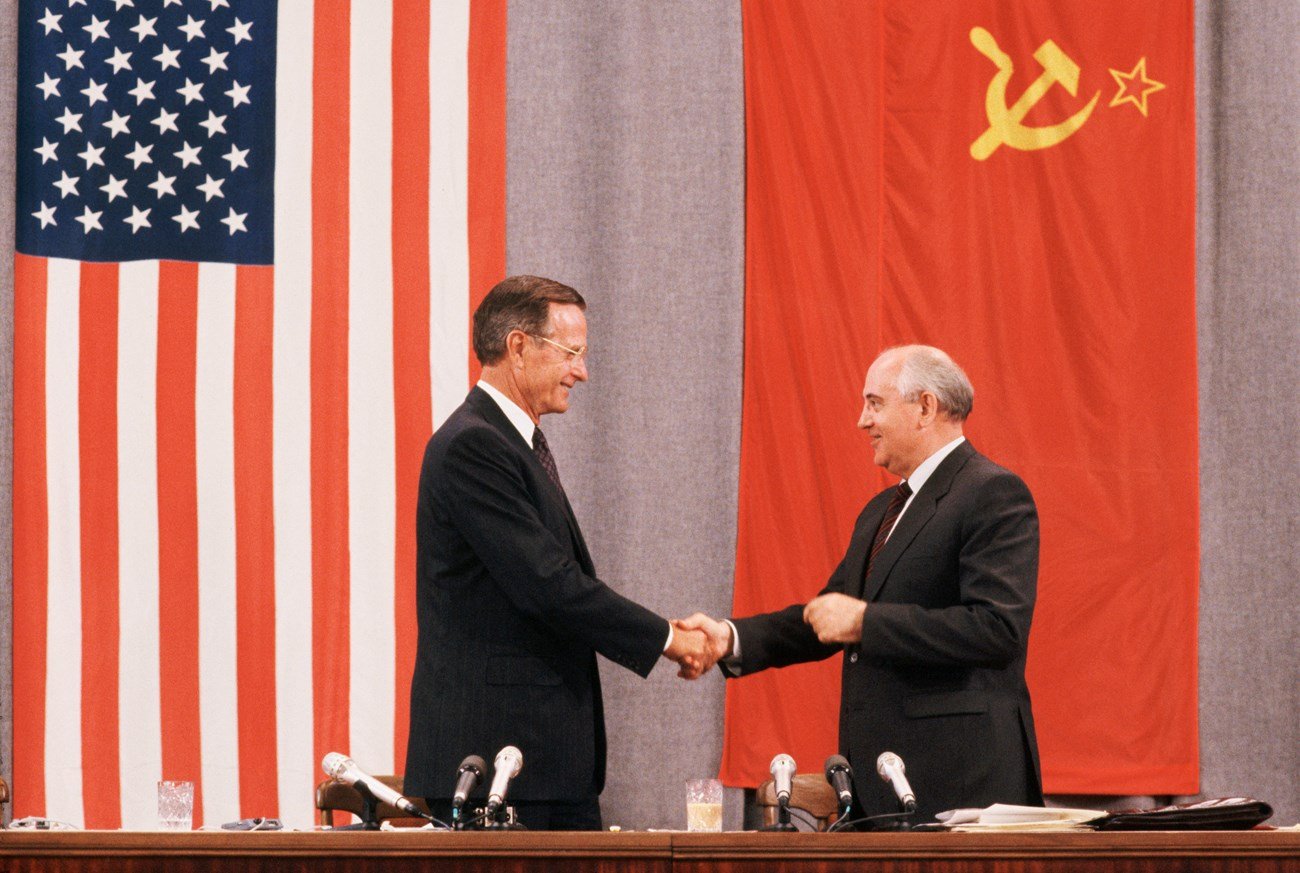
At the signing ceremony, Gorbachev called the nuclear standoff “the infrastructure of fear that has ruled the world.” That phrase lands differently when you remember what the 1980s actually felt like. The Day After was the most-watched TV movie in history. Kids had nuclear war nightmares. Teachers had to explain what a mushroom cloud was to eight-year-olds.
The Silos Come Down
Once START I was ratified and implemented, something remarkable happened. Those Minuteman missile silos started disappearing. The treaty required that the silos be demolished in a verifiable way — they blew the doors off with explosives, ejecting 100-ton blast doors just enough to prove to Russian inspectors that the silo was genuinely out of commission. Then they filled the hole with concrete and walked away.
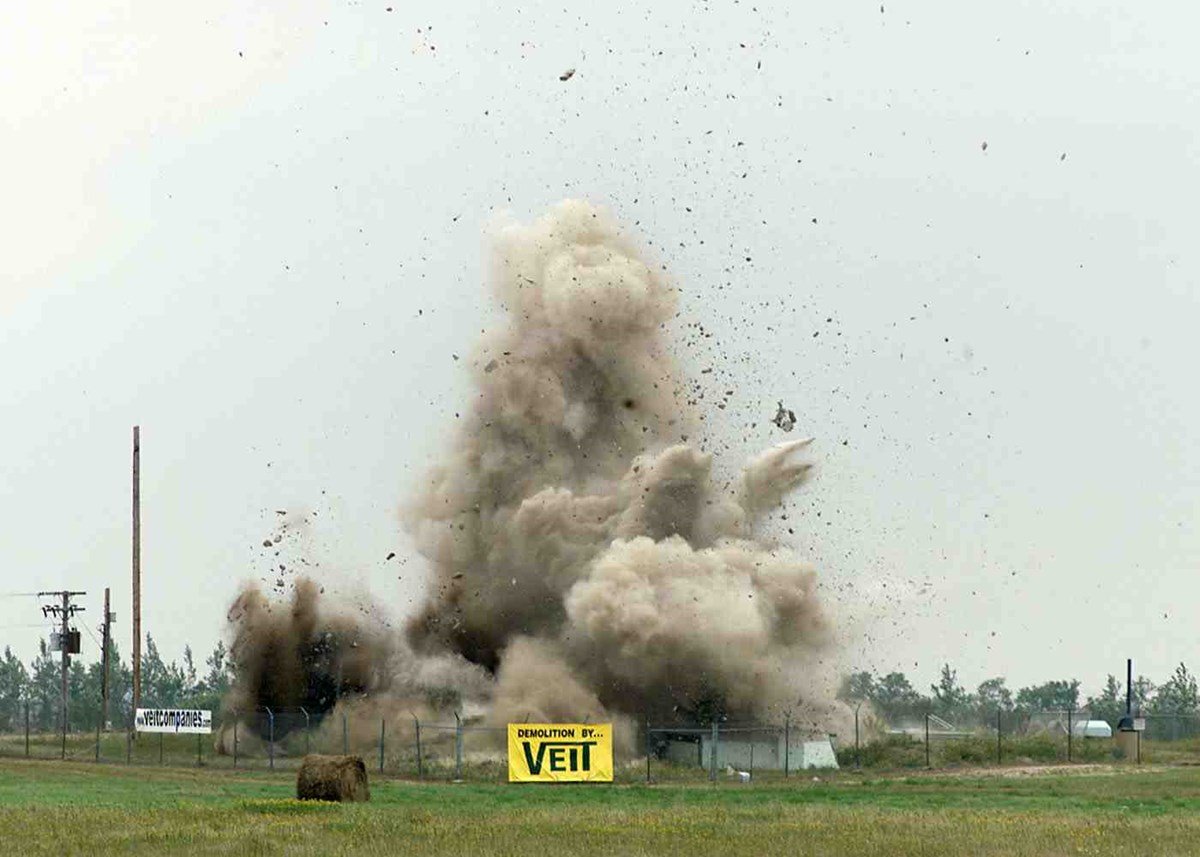
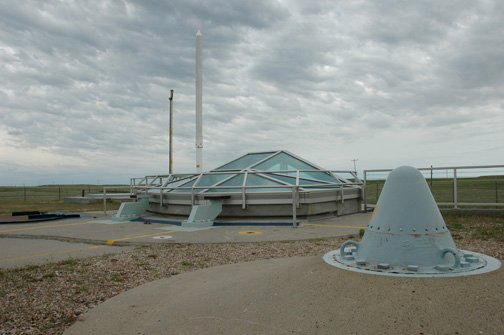
Between 1993 and 1997, 449 Minuteman II silos were emptied and demolished. The landscape that had quietly held the end of the world for thirty years was returned to wheat fields and pasture. One silo — Delta-09 in South Dakota — was preserved as a museum. You can stand over a glass viewing window and look down at a real Minuteman II missile, sitting in its silo, just as it did when it was pointed at Moscow. The warhead is gone. The context is not.
The Timing Was Everything
Here is what makes July 31, 1991 especially wild in hindsight: the Soviet Union had less than five months to live. On December 25, 1991, Gorbachev would resign. On December 26, the USSR would formally dissolve. The country that signed START I ceased to exist before the treaty was even ratified.
That created a legal headache of historic proportions. Four newly independent former Soviet republics — Russia, Ukraine, Belarus, and Kazakhstan — had nuclear weapons on their soil. The Lisbon Protocol of 1992 sorted it out, designating Russia as the sole nuclear successor state while the others agreed to denuclearize. Ukraine, which briefly became the world’s third-largest nuclear power, gave up its entire arsenal.
The Treaty That Made START Possible
START didn’t come out of nowhere. Four years before Bush and Gorbachev sat down in Moscow, Reagan and Gorbachev had signed the Intermediate-Range Nuclear Forces Treaty in the East Room of the White House — December 8, 1987. That treaty eliminated an entire class of missiles: all ground-launched ballistic and cruise missiles with ranges between 500 and 5,500 kilometers. Gone. Destroyed on both sides. Over 2,600 missiles total.
The INF Treaty was the proof of concept. It showed that two superpowers with radically different worldviews could negotiate in good faith, verify compliance through inspections, and actually follow through on destroying weapons they’d spent billions building. Without INF, it’s hard to imagine START ever getting done. Reagan, who had called the Soviet Union an evil empire in 1983, was the same man signing treaties with Gorbachev four years later. That shift — from confrontation to negotiation — was its own kind of history.
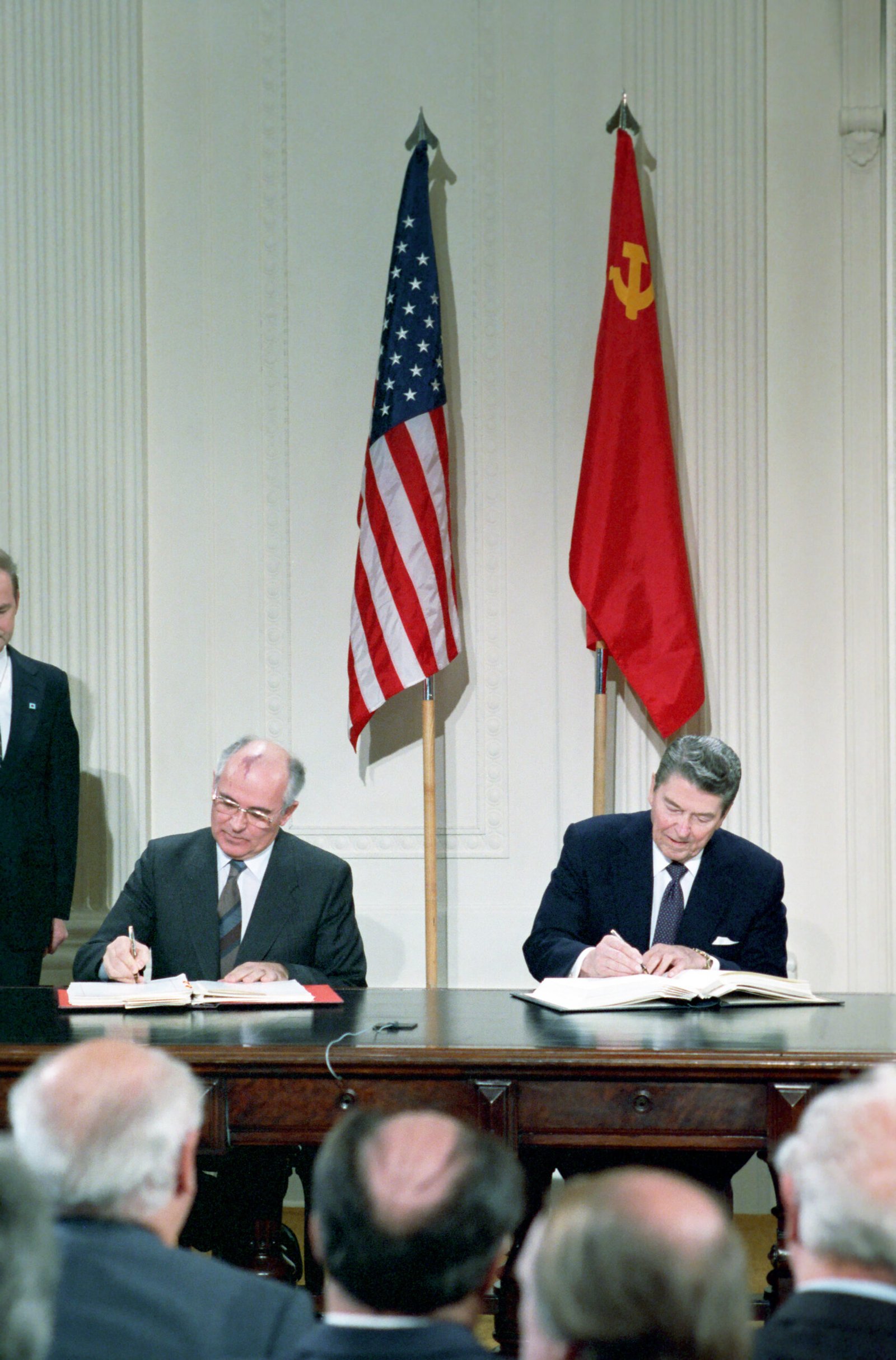
The inspectors who fanned out across both countries under the INF verification regime built relationships and procedures that carried directly into START I. American inspectors stood in Soviet missile bases in Kazakhstan. Soviet inspectors toured American facilities in Utah. Both sides had every incentive to cheat, and both sides didn’t — partly because the verification procedures made cheating too visible to be worth the diplomatic cost, and partly because the political will to make it work was genuinely present on both sides in those years.
What Happened After: The Verification Gap
START I expired in December 2009 and was replaced by New START, signed in April 2010 by Barack Obama and Dmitry Medvedev in Prague. New START continued the core framework: limits on deployed strategic warheads (now capped at 1,550 each), limits on delivery vehicles (800 total launchers), and on-site inspections. The treaty was extended in 2021 for five years, to February 2026.
That five-year extension has now expired. As of early 2026, the United States and Russia no longer have an active nuclear arms control treaty with verification provisions. The inspection regime that started with the INF Treaty in 1987 — the physical on-site checks, the data exchanges, the notification protocols — is currently in suspension. What that means long-term remains to be seen, but arms control experts have been clear: verification doesn’t just limit weapons, it reduces the paranoia that drives arms races in the first place. When you can’t check, you plan for the worst.
Which makes what Bush and Gorbachev accomplished on July 31, 1991 look even more remarkable in hindsight. They built something — a framework, a set of habits, a working relationship between inspectors on both sides — that held for three and a half decades. That doesn’t happen by accident. It happens when two leaders decide, whatever else is happening, that this particular problem is worth solving.
The generation that grew up under the shadow of nuclear war got to watch that happen in real time. They saw the silos emptied, the treaties signed, the inspectors shake hands across old enemy lines. For everyone born after 1991, it’s just history. Which is either reassuring or alarming, depending on which direction you happen to be looking right now.
Why It Still Matters
START I was fully implemented by December 2001. When the dust settled, roughly 80 percent of all strategic nuclear weapons that existed at the height of the Cold War had been eliminated. Eighty percent. The math on that is staggering when you think about what the starting number was.
The treaty spawned successors: START II, the Moscow Treaty, New START — the framework of nuclear arms control that shaped the post-Cold War world. Each one built on the verification regime and the trust-but-verify approach that Bush and Gorbachev established in that Kremlin ceremony on July 31, 1991.
In the summer of 1991, the Cold War generation got to exhale, just a little. The diplomats had done something the generals said could not be done. Two superpowers, longtime enemies, had sat down and agreed to make the world measurably, verifiably, documentably less likely to end in a flash of light and a cloud of ash.
For a generation that grew up ducking under desks and watching movies about nuclear winter, that was not nothing. That was everything.
Love the retro era? Browse our shop for vintage finds, retro clothing, and 80s/90s nostalgia gear.
The Retro Almanac
A monthly roundup of "on this day" highlights from that month, decades back — plus first dibs on new retro merch drops. No spam, just the good stuff.