On This Day: August 6, 1991 — Tim Berners-Lee Launched the World Wide Web
If you were a kid or teenager in 1991, your experience of “the internet” probably meant something very different from today. You might have been dialing into a BBS — a Bulletin Board System — at 2400 baud, downloading ASCII art one agonizing line at a time, hoping your parents didn’t pick up the phone and blow your connection. Or maybe you were lurking on Usenet newsgroups, the Wild West of digital discourse where arguments raged and files were traded in uuencoded chunks. Email was a luxury. The idea that ordinary people might one day browse a visual, interconnected global web of information? That sounded like science fiction.
On August 6, 1991, that fiction became fact — though almost nobody noticed at the time.
Before the Web, There Was the ‘Net — Sort Of
Here’s the thing most people get wrong: the internet and the World Wide Web are not the same thing. In 1991, the internet already existed. It had been around since the late 1960s as ARPANET, the U.S. Defense Department’s research network. By the late ’80s and early ’90s, universities, government agencies, and some savvy techies had access to email, FTP file transfers, and Usenet newsgroups. But navigating it all required knowing arcane commands. There was no point-and-click, no hyperlinks, no pictures. It was all text, all the time — and you needed to know exactly what you were looking for.
The Retro Almanac
A monthly roundup of "on this day" highlights from that month, decades back — plus first dibs on new retro merch drops. No spam, just the good stuff.
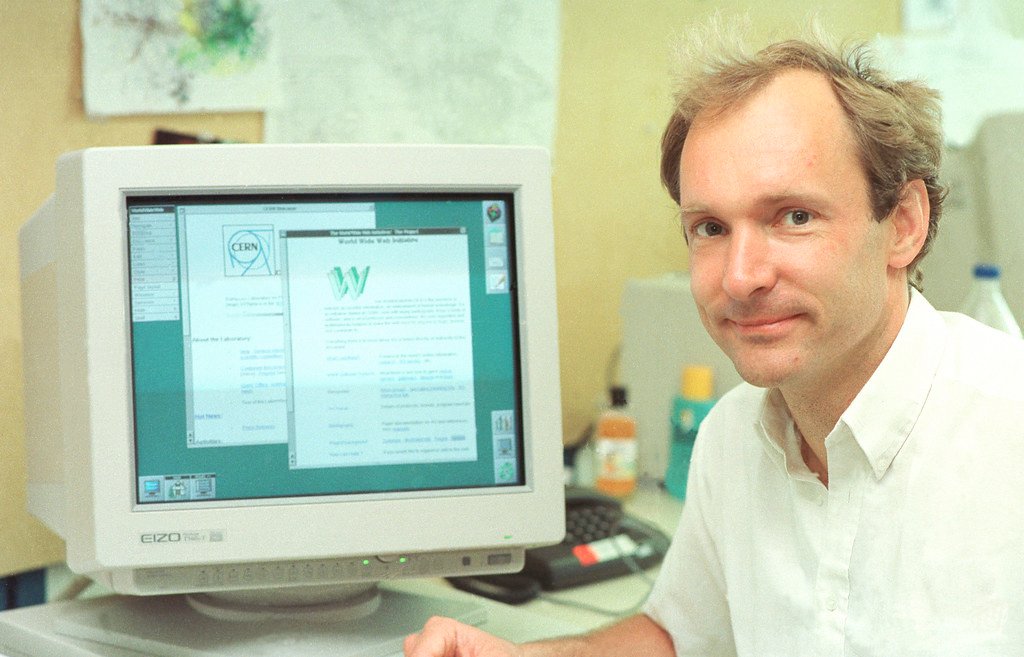
For the average person — the kid watching Terminator 2 in a multiplex, listening to Nirvana on a CD Walkman, recording Beverly Hills, 90210 on VHS — the internet was a foreign country they’d never visit. What changed all of that was a 35-year-old British physicist working in a basement office at a particle physics lab in Switzerland.
The Proposal Nobody Took Seriously
In March 1989, Tim Berners-Lee wrote a memo to his boss at CERN — the European Organization for Nuclear Research — titled “Information Management: A Proposal.” His boss, Mike Sendall, famously scrawled “Vague but exciting” across the cover and handed it back. That memo proposed a system for sharing information across CERN’s sprawling, chaotic network of computers.
The problem Berners-Lee was trying to solve was deeply practical: CERN employed thousands of researchers from dozens of countries, and information constantly got lost in the shuffle. People left, institutional knowledge vanished. Documents existed in incompatible formats on incompatible machines. Berners-Lee’s insight was to combine three existing technologies — hypertext (the ability to link documents together), the internet (the underlying network infrastructure), and a standardized addressing system — into something new.
HTML, HTTP, URLs — and a NeXT Computer
By the end of 1990, working largely alone and on his own initiative, Berners-Lee had invented the core technologies that still power every website you visit today:
- HTML (HyperText Markup Language) — the formatting language for web pages
- HTTP (HyperText Transfer Protocol) — the rules for how browsers and servers communicate
- URLs (Uniform Resource Locators) — the addressing system that gives every page a unique web address
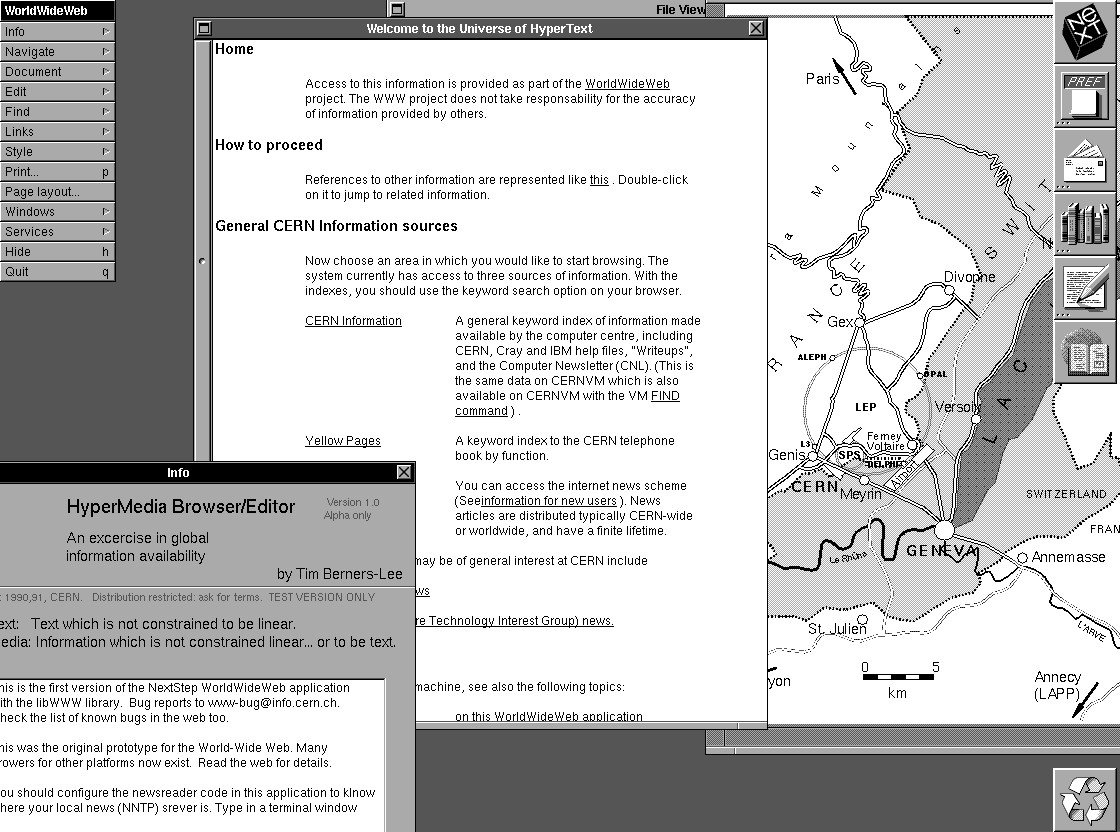
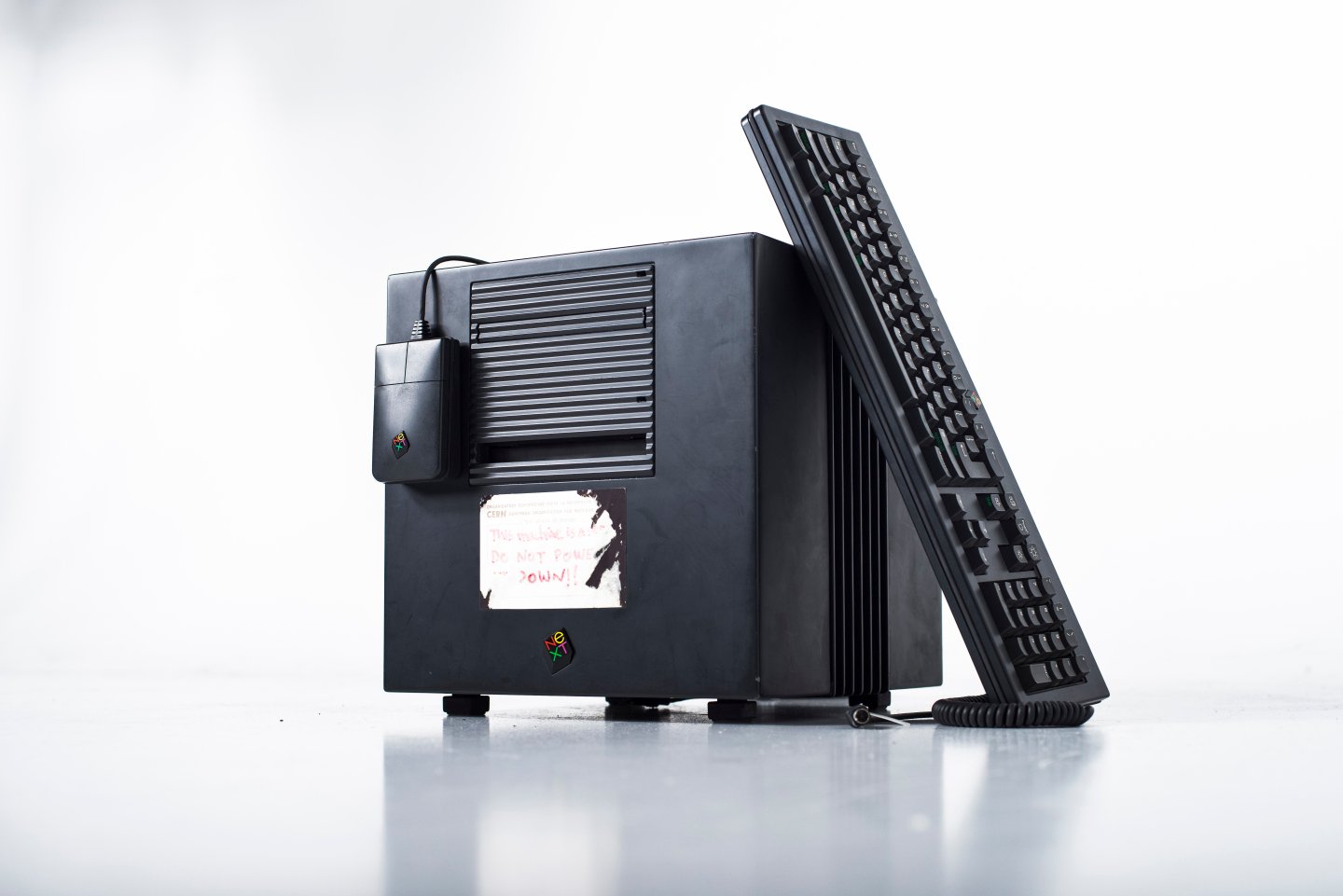
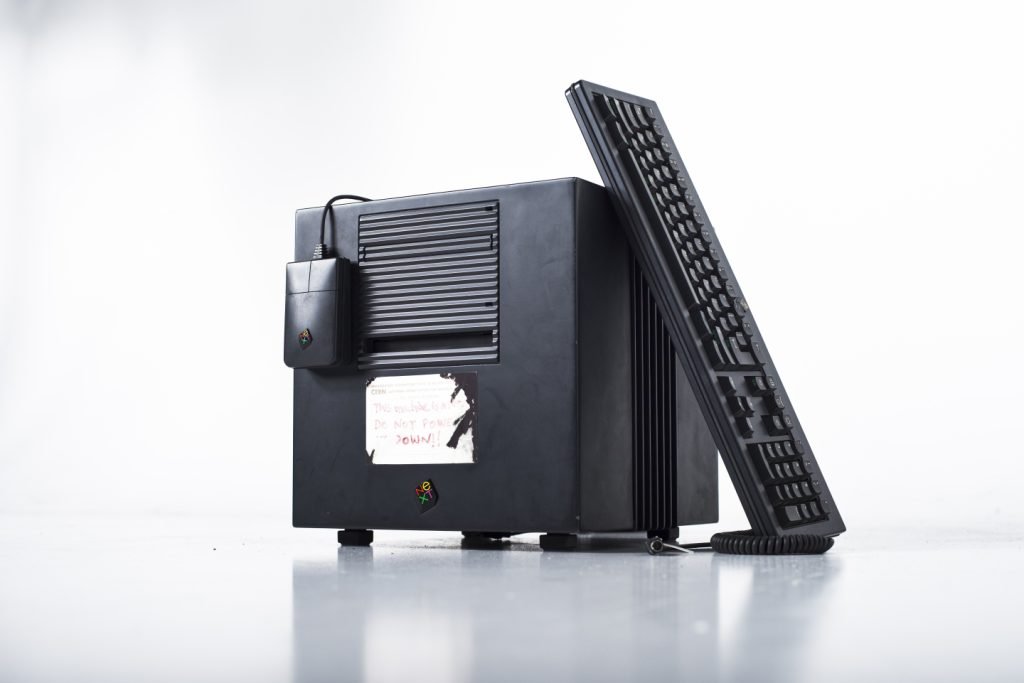
He built the first web browser — called “WorldWideWeb” — and the first web server on a sleek black NeXT workstation. The NeXT was Steve Jobs’s post-Apple computer company, the machine he built after being ousted from Apple in 1985. It was powerful, elegant, and expensive — not something your average household would own. But for research institutions like CERN, it was cutting-edge.
That NeXT box, with a handwritten paper label warning staff not to switch it off, became the first web server in history. Its address: info.cern.ch.
August 6, 1991: The Day the Web Went Public
On this day in 1991, Berners-Lee posted a message to the alt.hypertext Usenet newsgroup — the same kind of text-based internet forum where people argued about Star Trek and swapped software tips. His post described the World Wide Web project and gave instructions for how to download the software from CERN’s servers. It was modest, technical, and matter-of-fact. There was no press release. No product launch. No Steve Jobs in a black turtleneck saying “one more thing.”
The first website — hosted at what is now http://info.cern.ch/hypertext/WWW/TheProject.html — was a plain page of text. No images, no color, no flashy design. It described what the Web was, how it worked, and how to get access. That was it. And yet it was the opening chapter of a revolution.
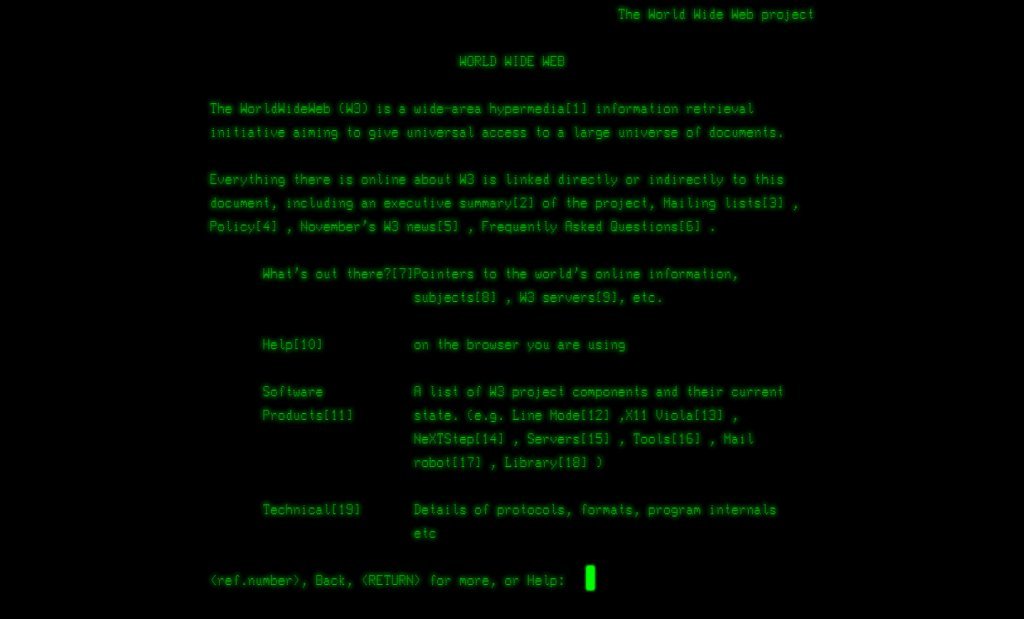
What the First Browser Looked Like
The original WorldWideWeb browser — later renamed Nexus to avoid confusion with the Web itself — ran only on NeXT machines. But Berners-Lee and colleague Nicola Pellow quickly developed a “line-mode browser” that could run on any computer. It was text-only, navigated with typed commands, and looked nothing like what we’d recognize today.
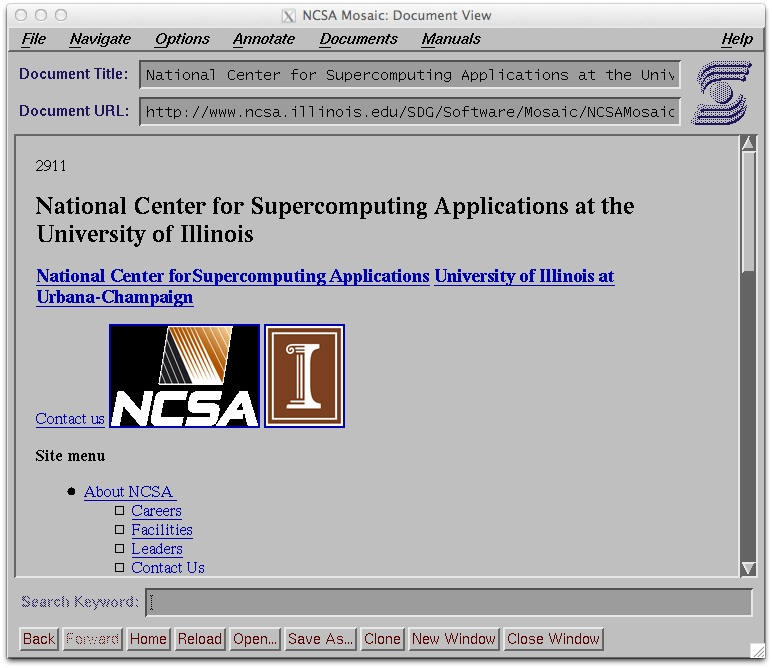
The browser that truly opened the Web to the masses came in 1993: NCSA Mosaic. Developed by Marc Andreessen and Eric Bina at the University of Illinois, Mosaic could display images inline with text — a revelation. Suddenly the Web wasn’t just for scientists. By 1994 and 1995, the web browser was going mainstream, and the dot-com era was warming up its engines.
The Man Who Could Have Been a Billionaire
Here’s a fact that never stops being staggering: Tim Berners-Lee gave the Web away for free.
On April 30, 1993, CERN placed the World Wide Web software in the public domain, free for anyone to use without royalty or restriction. Berners-Lee could have patented the Web, licensed it, and become one of the wealthiest people on earth. He chose not to. He later said that if the Web had been proprietary, it would never have worked — its power lay precisely in being open and universal.
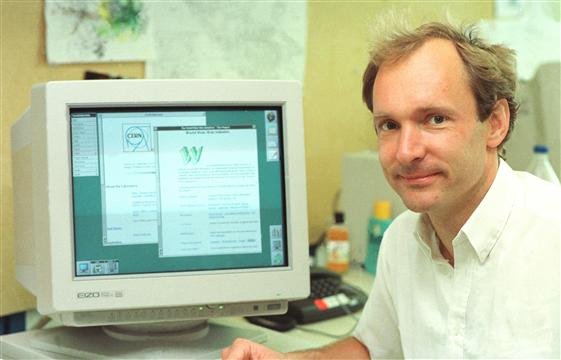
In 1994, he left CERN to found the World Wide Web Consortium (W3C) at MIT, the standards body that continues to guide the Web’s development to this day. He has spent his career arguing for an open, accessible, privacy-respecting web — and growing increasingly concerned about what it has become.
How the Web Changed Everything by 1995
For Gen X kids who remember the pre-web era, the speed of the transformation is hard to overstate. In 1991, you dialed into a BBS to read text messages. By 1994, you might have been exploring early websites — novelties with blinking text and primitive animated GIFs. By 1995, Amazon was selling books online, eBay was auctioning Pez dispensers, and Netscape’s IPO kicked off the dot-com gold rush. Five years. The world was unrecognizable.
The first websites were hand-coded HTML, slow to load over 14.4k modems, often garish, always fascinating. Surfing the web felt like exploring an undiscovered continent. Every link was an adventure. There was no Google to find things — you navigated by word of mouth, printed “cool sites” lists in magazines, or followed chains of hyperlinks into rabbit holes that could last hours. It was weird and exciting and nothing like the algorithmic, social-media-dominated, attention-economy web of today.
And it all started with one quiet Usenet post on August 6, 1991.
The Web Today — and What Berners-Lee Thinks of It
Berners-Lee hasn’t been entirely happy with how his invention evolved. The Web he imagined was democratic and decentralized. What emerged — dominated by a handful of tech giants, saturated with surveillance capitalism, weaponized for disinformation — troubles him deeply. In 2018, on the Web’s 29th anniversary, he wrote an open letter calling for a “Contract for the Web” to protect online rights and rebuild trust.
He’s been working on a project called Solid, a decentralized framework to give users control over their own data — essentially trying to rebuild the open, user-controlled web he originally envisioned, one technical standard at a time.
The irony is that the man who could have owned the internet — who gave away one of the most valuable technologies in human history — is still out there, fighting to keep it free and open. That’s the kind of story you couldn’t make up.
August 6, 1991. A quiet Tuesday at a physics lab in Switzerland. A message posted to a niche internet newsgroup. A plain black computer humming in a cluttered office. And the world, without knowing it, had just changed forever.
Love the retro era? Browse our shop for vintage finds, retro clothing, and 80s/90s nostalgia gear.
The Retro Almanac
A monthly roundup of "on this day" highlights from that month, decades back — plus first dibs on new retro merch drops. No spam, just the good stuff.