On This Day: August 9, 1988 — Wayne Gretzky Was Traded and Canada Never Forgave Them
The call came in August. Peter Pocklington, the Edmonton Oilers’ owner, was drowning in bad business ventures — collapsing real estate, a crumbling meat-packing empire, debts he couldn’t cover with oil revenues or charm. His solution was the one asset he held that someone else badly wanted: Wayne Gretzky, age 27, the most dominant athlete in the history of his sport.
Pocklington phoned Bruce McNall, the Kings’ flamboyant owner, and named his price. McNall said yes. Then — and this detail matters — Pocklington required one more thing before the deal closed. Gretzky had to call him personally and formally request the trade. That call was Pocklington’s insurance policy, his way of making sure history would say the player asked to leave, not that the owner sold him for cash. Gretzky made the call. He later described it as one of the hardest moments of his life.
The Numbers Behind the Legend
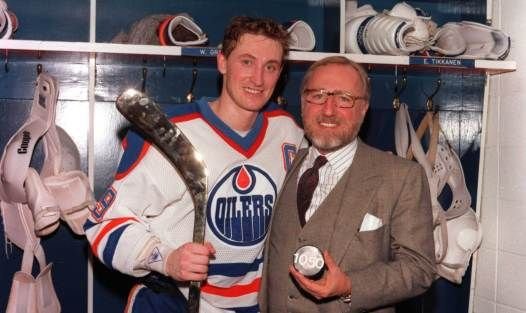
To understand the full weight of what happened on August 9, 1988, you have to know what Gretzky had already done. In 696 regular-season games with Edmonton, he had accumulated 1,669 points. Gordie Howe — the standard of greatness against which every hockey player had been measured for forty years — needed 1,767 games to reach 1,851 points. Gretzky was on pace to break that record in his early thirties. He was 27.
The Retro Almanac
A monthly roundup of "on this day" highlights from that month, decades back — plus first dibs on new retro merch drops. No spam, just the good stuff.
He had won four Stanley Cups in five seasons. He had taken home eight consecutive Hart Trophies as the NHL’s most valuable player. Seven consecutive Art Ross Trophies as the league’s leading scorer. He held 43 NHL records outright. In the 1985-86 season, he recorded 215 points — the highest single-season total in league history, a record that still stands by a margin of 65 points. No other player has come close to 200.
The Oilers without Gretzky were not the Oilers. They were just another team. That was not hyperbole — it was arithmetic.
The Trade Details
The official transaction, announced August 9, 1988:
To Los Angeles: Wayne Gretzky, center Mike Krushelnyski, defenseman Marty McSorley.
To Edmonton: Center Jimmy Carson, left wing Martin Gelinas, first-round draft picks in 1989, 1991, and 1993, plus $15 million USD.
Carson was 19 and had just scored 55 goals as a rookie — legitimate value. Gelinas was a high-end prospect. The draft picks eventually produced quality players. On paper, Edmonton got a haul. In every other sense, they got nothing that compared to what they gave away. The Oilers would win one more Cup in 1990 without Gretzky, then spent the next two decades in mediocrity.
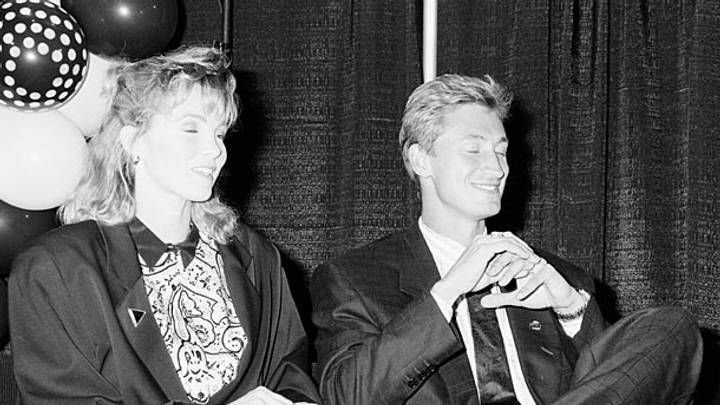
Gretzky insisted, publicly and consistently, that the move was his choice — that he wanted to be with his new wife Janet Jones in California, where her acting career was based. Privately, teammates and insiders always suspected Pocklington drove the deal and that the “request” was theater. The truth probably involves both: Gretzky accepted a situation that was being forced on him and chose to control the narrative of his own departure.
The Press Conference That Broke a Country
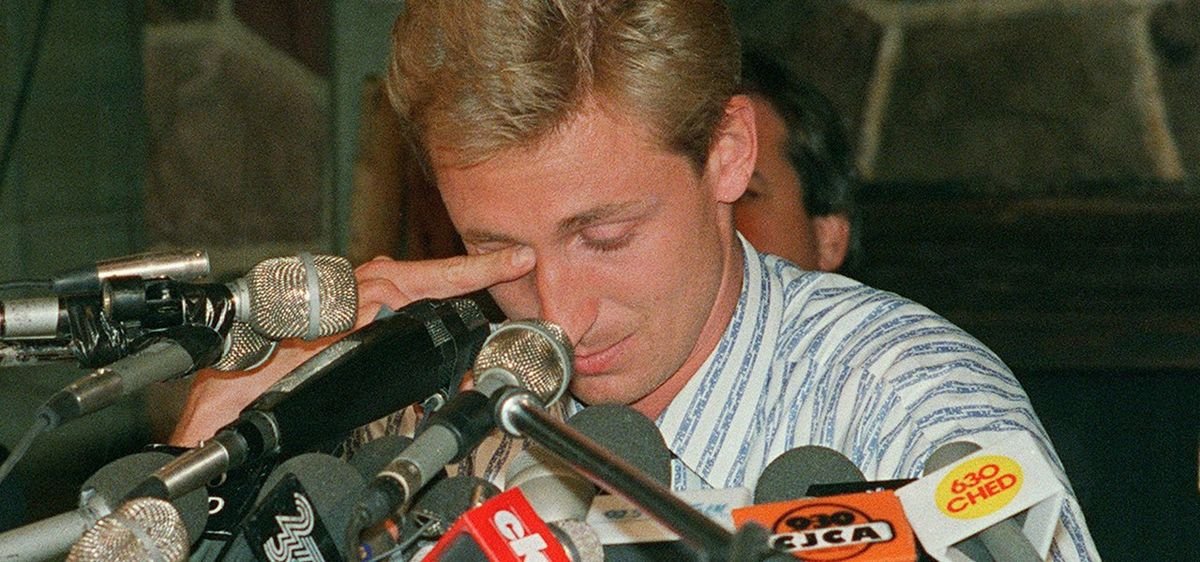
The press conference was held at the Molson House in Edmonton. Gretzky stepped to the bank of microphones, composed, and started to speak. Then he wasn’t. “I promised Mess I wouldn’t do this,” he said — Mess being Mark Messier, his closest friend and Oilers linemate — and his voice cracked. He wiped tears with the back of his hand, stepped back from the microphones, and stood there for a long moment unable to speak.
The photo from that moment became iconic: Gretzky young and blond and perfect, head bowed, hand pressed to his eye, surrounded by microphones bearing call signs from every Canadian radio station. It ran on the front page of every newspaper in the country the next morning.
The full press conference — August 9, 1988.
Blame the Bride
Within hours of the announcement, Canadians had found a villain beyond Pocklington: Janet Jones. She was American, she was an actress, she wanted to live in Los Angeles, and she had married Gretzky on July 16 — less than four weeks before the trade. The tabloid math was irresistible. She pulled Wayne south. She was the reason Canada was losing its greatest treasure.
It was unfair and it was largely wrong, but the anger had to land somewhere, and the owner was less photogenic. Jones handled it with more grace than the situation deserved. Gretzky never publicly blamed Pocklington in anything other than carefully diplomatic terms. Both of them knew what had actually happened.
A Country in Shock
The Edmonton Oilers’ office received more than 1,500 calls in the hours after the announcement, almost all of them angry. Fans threatened to cancel season tickets. Boycotts targeted Pocklington’s business interests — his Gainers meat-packing plants, his car dealerships. In one widely photographed scene, a crowd burned Pocklington in effigy outside the Oilers’ arena.
The issue reached Parliament. NDP House Leader Nelson Riis stood up in the House of Commons and proposed that Wayne Gretzky be declared a national treasure — legally, formally, in the same category as the Canadian Shield and the CN Tower — and thus prohibited from being exported. The motion didn’t pass, but the sentiment behind it was genuine. Liberal leader John Turner compared the trade to Prime Minister Mulroney’s unpopular free trade agreement with the United States, a deal many Canadians believed was selling the country’s soul to American interests. The Gretzky trade and the free trade debate ran together in the national consciousness through the fall of 1988.
In Edmonton, even thirty years later, people remember where they were when they heard.
Hollywood on Ice
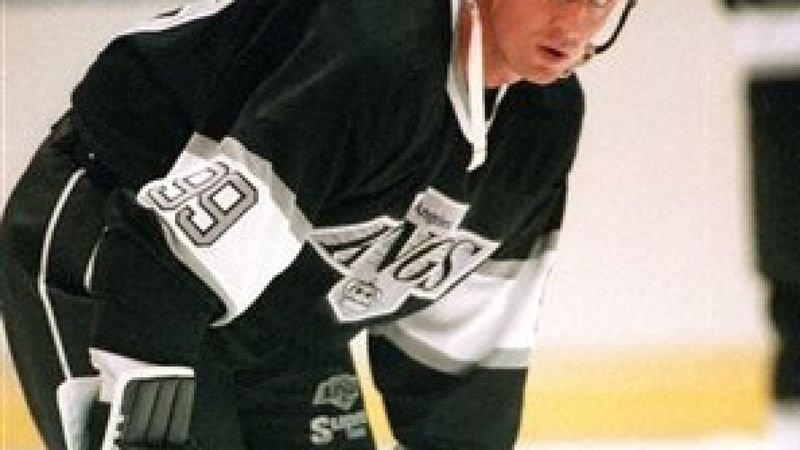
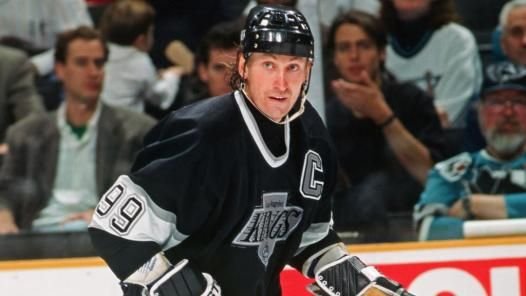
The Kings had been a middling franchise playing in a city that cared far more about basketball, baseball, and sunshine than hockey. Then Gretzky arrived, and everything changed within a single season. The Forum in Inglewood started selling out. Jack Nicholson became a fixture at rinkside. Goldie Hawn, Kurt Russell, Michael J. Fox — celebrities who wouldn’t have known a power play from a penalty shot were suddenly regulars. LA became hockey.
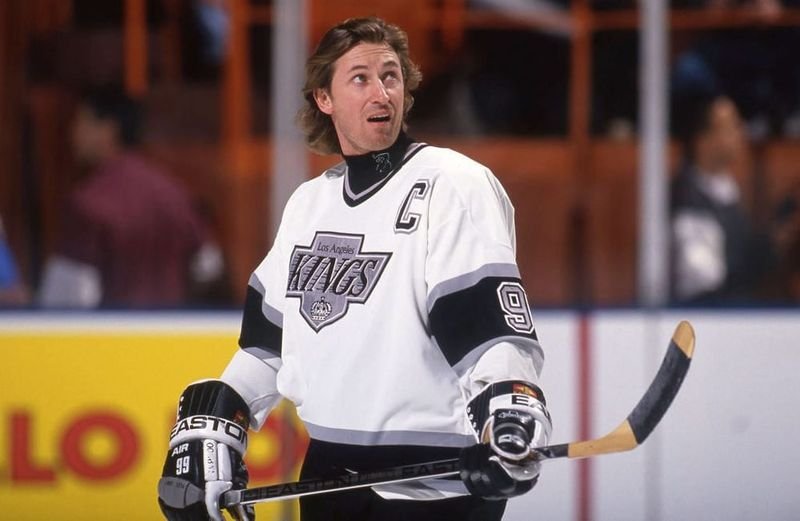
Season ticket sales doubled. The Kings’ road games became events. When they played in other cities, fans who had never watched an NHL game bought tickets specifically to see number 99. Gretzky scored 40 goals and 92 assists in his first LA season — 132 points — and made the Kings relevant overnight. Bruce McNall, who had borrowed heavily to fund his half of the deal, later admitted he had no idea how fast the investment would pay off.
The Record That Put the Trade in Perspective
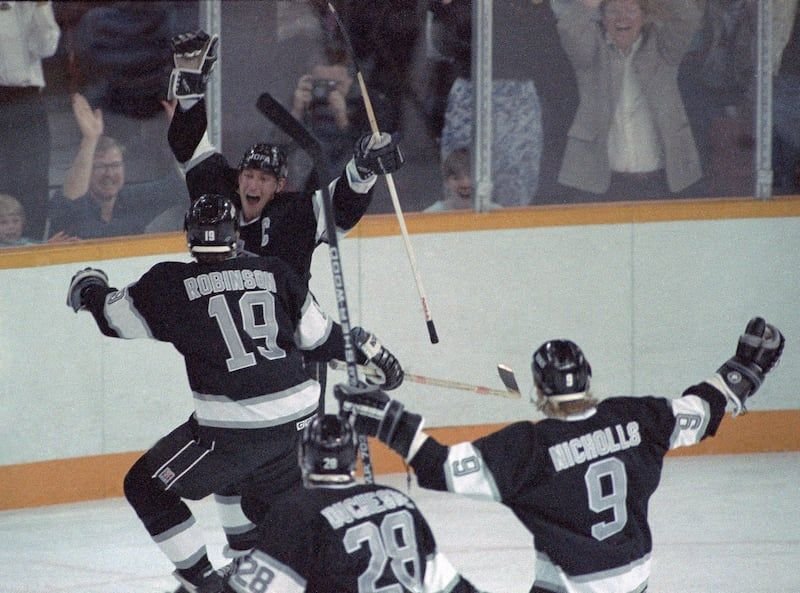
On October 15, 1989 — just fourteen months after the trade — the Kings played a regular-season game in Edmonton against the Oilers. Gretzky entered with 1,849 points, two short of Gordie Howe’s seemingly untouchable all-time NHL record of 1,851. With five minutes left in the third period and the Kings trailing 4-3, he tied Howe’s record with an assist. Then, with 53 seconds remaining, he scored to tie the game. The Kings won 5-4 in overtime on another Gretzky goal.
The Northlands Coliseum in Edmonton gave him a standing ovation. His former teammates embraced him. Gordie Howe, who was there for the ceremony at center ice, shook his hand. It was the single most pointed rebuttal possible to the narrative that the trade had diminished Gretzky: he broke the greatest record in hockey history in the arena where he used to play, against the team that had sold him.
The 1993 Cup Run
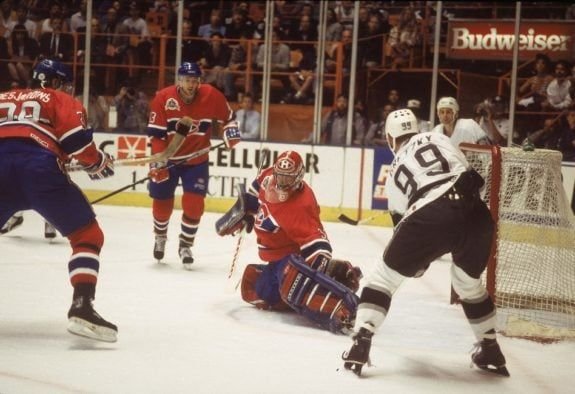
The highest point of Gretzky’s Kings tenure came in 1993, when LA made a run to the Stanley Cup Finals against the Montreal Canadiens. The Kings eliminated the Oilers in the second round — Gretzky scored his 100th career playoff goal in that series — and then the Leafs in Game 7 of the conference finals. They faced Montreal and Patrick Roy, who was arguably the greatest postseason goaltender who ever played. The Kings lost the series four games to one. It remains the closest the franchise has come to a championship.
Gretzky played for the Kings through 1996. He finished with 918 goals and 2,857 points — numbers so far beyond anything anyone else has ever done that the NHL retired his number 99 league-wide in 2000, the only player in any North American major sport to have a number retired by an entire league.
What the Trade Actually Did
The conventional verdict on “The Trade” is that it was a betrayal — Pocklington selling a national icon for financial reasons he couldn’t admit publicly. That part is true. But the trade also did something nobody planned: it broke hockey out of its northern stronghold and turned it into a genuinely continental sport.
The NHL expanded aggressively through the 1990s in direct response to the Kings’ success: San Jose, Tampa Bay, Miami, Anaheim, Dallas, Nashville, Atlanta. None of those markets would have been viable without proof that hockey could work below the snow line. All of that proof came from what one 27-year-old did in Los Angeles after August 9, 1988.
Peter Pocklington sold Gretzky to save his business, and inadvertently built the modern NHL. Wayne Gretzky cried at a press conference, moved to California, and changed the geography of the sport. The New York Rangers ended their 54-year Cup drought in 1994 in a league that had been remade by the trade. Sports had always produced moments that defined eras — but few trades had ever changed the actual shape of a sport.
In Edmonton, they still call it The Trade. No further explanation needed. Somewhere in that simple shorthand is everything: the grief, the pride, the sense that something irreplaceable passed through their city and didn’t come back. August 9, 1988 was the day hockey got bigger and Edmonton got smaller, and the town never quite decided whether that was worth it.
Love the retro era? Browse our shop for vintage finds, retro clothing, and 80s/90s nostalgia gear.
Sources
- Hockey’s “Great One” Gets Traded — History.com — August 9, 1988 trade announcement and background.
- Wayne Gretzky Traded to Kings 28 Years Ago — NHL.com — Official NHL retrospective with trade details.
- The Gretzky Trade — Canada Eh x — Detailed account of Pocklington’s financial motivations and Canadian reaction.
- The Trade That Changed Hockey Forever — CBS News — Analysis of the trade’s long-term impact on NHL expansion.
- Gretzky Passes Howe, Becomes NHL All-Time Scoring Leader — NHL.com — October 15, 1989 points record details.
- The Wayne Gretzky Trade: What the World Was Like on August 9, 1988 — Sports Illustrated
The Retro Almanac
A monthly roundup of "on this day" highlights from that month, decades back — plus first dibs on new retro merch drops. No spam, just the good stuff.