On This Day: September 26, 1981 — Nolan Ryan Throws His Record 5th No-Hitter
Ryan was 34 years old, three years past when most power pitchers start losing the fastball that made them famous, and he did not have it that Saturday night. He needed 65 pitches to get through the first three innings. He walked the leadoff man in back-to-back frames. He uncorked a wild pitch that let Steve Garvey take third with nobody out. NBC had the game on national television as its Saturday Game of the Week, and for three innings it looked like a broadcast about a struggling veteran trying to survive a lineup that could hit.
Six Years Chasing His Own Ghost
Ryan had tied Sandy Koufax’s record of four career no-hitters back in 1975, in his final season throwing them for the California Angels. He signed with Houston as a free agent in December 1979 — the first million-dollar-a-year contract in baseball history — and for six years the fifth no-hitter never came. He threw seven one-hitters in that stretch, close enough to taste it every time and never close it out. “At my age, I thought I wouldn’t get it,” Ryan admitted afterward. “I don’t have the stamina I used to have.”
The Retro Almanac
A monthly roundup of "on this day" highlights from that month, decades back — plus first dibs on new retro merch drops. No spam, just the good stuff.
That admission matters more than it sounds like it should. Ryan built his entire reputation on a fastball that touched 100 miles per hour when radar guns were still a novelty. By 1981 he was 34, and the version of Ryan that hit Detroit and Minnesota and Baltimore in the early 1970s wasn’t walking through that clubhouse door anymore. What happened at the Astrodome that September night was a different pitcher entirely, and in some ways a harder trick to pull off.
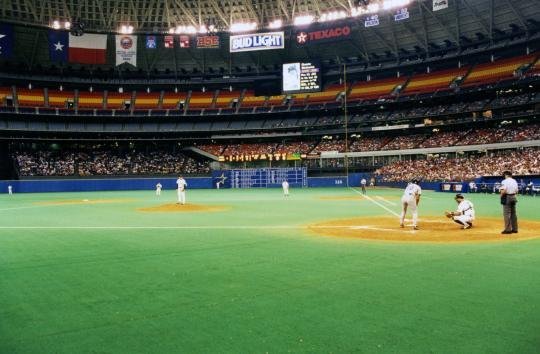
Houston fans had waited a long time for a moment like this. The Astrodome opened in 1965 billed as the Eighth Wonder of the World, and for most of its first sixteen seasons the team playing inside it was a mid-table club with a losing record more often than not. By 1981, that was starting to change — Houston had won its first division title the year before — and Ryan’s contract was part of why. Signing the game’s most famous fastball to play under the dome had been as much a statement about the franchise’s ambitions as it was a baseball decision.
Bad Fastball, Good Curveball
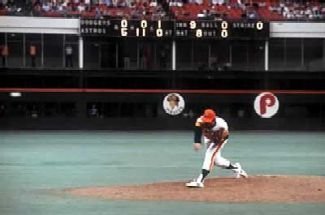
Pitching coach Mel Wright caught the problem in the fourth inning: Ryan was over-striding, rushing his delivery, and it was costing him the one pitch he’d built a career on. Ryan shortened up. From that point forward he retired 19 consecutive Dodgers, and he did it almost entirely on his curveball. “I really didn’t feel like I had good velocity today,” Ryan said after the game, “but I got ahead on my curve balls. You can’t win with one pitch. It doesn’t matter how fast you can throw, but with a curve they had to think about the breaking ball.”
The Dodgers lineup he shut down wasn’t a soft one, either. Steve Garvey, Dusty Baker, Pedro Guerrero, Ron Cey’s replacement at third in Guerrero, Mike Scioscia behind the plate — this was a team that would win the World Series the following October. Tommy Lasorda, the Dodgers manager, didn’t have much choice but to tip his cap afterward. “He had a curve like Koufax and Herb Score today,” Lasorda said. “He was just tremendous.”
One Real Scare
The no-hitter had exactly one moment where it nearly ended. In the seventh inning, Scioscia drove a ball deep to right-center, and Houston right fielder Terry Puhl ran it down just in front of the warning track. Beyond that, the closest thing to drama was self-inflicted — three walks, a wild pitch, an error behind him in the third that briefly loaded a base. No Dodger reached second base on a hit, because no Dodger reached base on a hit at all. Los Angeles finished the game 0-for-27 at the plate.
Houston’s offense, meanwhile, did just enough. Alan Ashby’s two-run single in the third put the Astros up 2-0, and the bullpen-battered Dodgers coughed up three more runs in the eighth on hits from Craig Reynolds, Phil Garner, and Jose Cruz. Ryan himself went 1-for-2 at the plate and laid down a sacrifice bunt — a reminder that National League pitchers in 1981 were still expected to help their own cause.
Three Outs From History
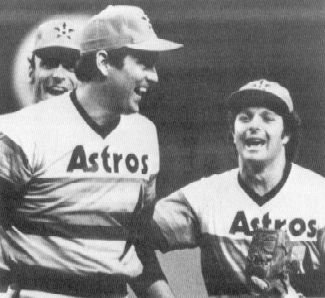
The ninth inning went fast, which is unusual for a no-hitter — most tighten up and stretch out as the crowd gets louder. Reggie Smith, pinch-hitting for Davey Lopes, struck out on three pitches. Ken Landreaux grounded out to first. That left Dusty Baker, who grounded out to third baseman Art Howe to end it. Baker was characteristically blunt about his role in the whole thing afterward: “I don’t like having my name on the scorecard in a game that made history for Nolan Ryan.”
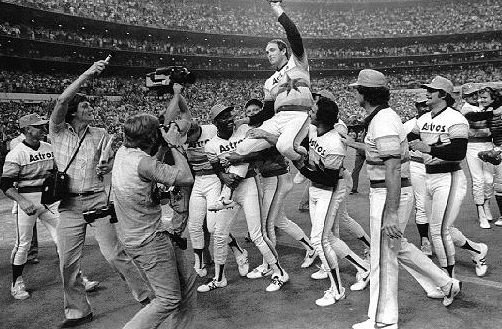
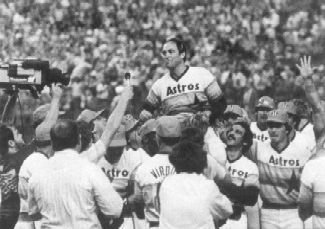
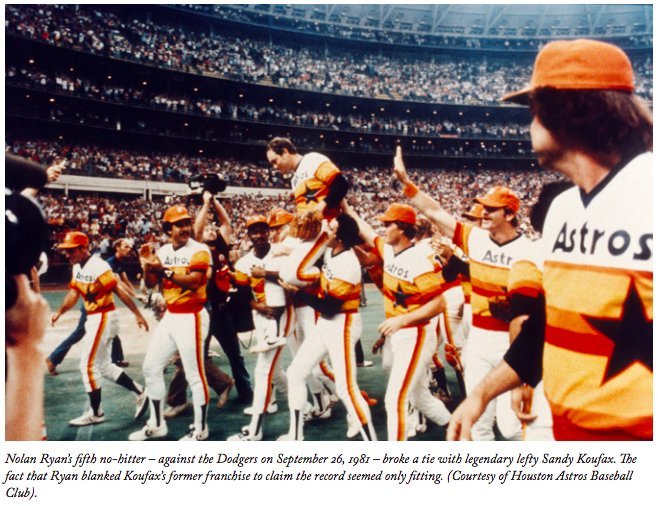
What followed was pure 1981 baseball theater — Ryan mobbed on the mound, then hoisted onto his teammates’ shoulders and carried toward the dugout while 32,115 fans at the Astrodome made as much noise as a domed stadium could hold. It’s the image that ran in newspapers across the country the next morning, and it’s the one that’s stuck for 45 years since.
Why This One Meant More Than the Other Four
Ryan was unusually direct about ranking his own no-hitters, and he put this one first without much hesitation. “This is by far the most important of my no-hitters,” he said. “I went into the game feeling like I had to do a good job, and this turned into one of the biggest games of the year. My others were with ballclubs that weren’t doing well, and I was still young and trying to get established.” 1981 was the strike year — the season split into two halves after a 50-day players’ strike wiped out roughly a third of the schedule — and Houston needed every game down the stretch to hold off Cincinnati for the second-half NL West title. Ryan’s no-hitter pushed that lead to a game and a half with eight to play. The Astros closed it out and advanced to the first National League Division Series in history, a five-game round created specifically because of the split-season format, where they drew a rematch with the same Dodgers team Ryan had just no-hit. Houston lost that series in five games, and Los Angeles went on to win the World Series. Small consolation for Ryan, who also finished the year leading the National League with a microscopic 1.69 ERA.
The no-hitter wasn’t even the last chapter of that particular rivalry. Ten days later, in Game 1 of the NLDS, Alan Ashby — the same catcher who’d driven in two runs behind Ryan on September 26 — hit a walk-off home run against the Dodgers to preserve a two-hit shutout. Houston’s pitching staff spent October 1981 making the Dodgers’ lineup look ordinary; they just couldn’t quite finish the job.
A Record Nobody Has Come Within Two Of
Ryan wasn’t done. He’d throw a sixth no-hitter in 1990 and a seventh in 1991, both with the Texas Rangers, well into his 40s — a number that still reads like a typo. Justin Verlander and Max Scherzer are the closest active challengers with three apiece, which tells you how far off the pace everyone else really is. Forty-five years after that Saturday night at the Astrodome, five no-hitters would still be a career-defining, Hall-of-Fame-cementing achievement on its own. For Ryan it was just the moment he passed Koufax on the way to a number nobody else has sniffed since.
Baseball history has plenty of records that get chipped at every few seasons. This isn’t one of them. Ryan’s seven no-hitters sit alone at the top of a list where second place is a distant memory, and September 26, 1981 was the night that gap started to open for good.
The Astrodome itself is long gone as a working ballpark — the Astros moved out after the 1999 season, and the building has sat mostly empty since, a fenced-off relic next to the stadium that replaced it. But the photographs from that night still circulate every time Ryan’s name comes up: the pitcher who couldn’t find his fastball for three innings, carried off the same turf on his teammates’ shoulders less than two hours later. It’s a very Gen X kind of sports memory — grainy, over the shoulder of a cameraman with a shag mic, no instant replay app to check the details against. You either remember watching it on NBC that Saturday, or you’ve seen the same handful of photos everyone else has.
For more baseball history from the era, see our coverage of Jose Canseco joining the 40-40 club and Pete Rose breaking the all-time hits record.
Love the retro era? Browse our shop for vintage finds, retro clothing, and 80s/90s nostalgia gear.
Sources
- SABR — September 26, 1981: Nolan Ryan Breaks Koufax’s Mark With Fifth No-Hitter — Full game recap and box score analysis
- National Baseball Hall of Fame — Nolan Ryan’s Fifth No-Hitter — Player and manager quotes from the game
- AstrosDaily.com — Big Days in Astros History: September 26, 1981 — Wire report, box score, and play-by-play
- SABR — Alan Ashby’s Walk-Off Homer in 1981 NLDS Opener — The Astros-Dodgers rematch ten days later
The Retro Almanac
A monthly roundup of "on this day" highlights from that month, decades back — plus first dibs on new retro merch drops. No spam, just the good stuff.