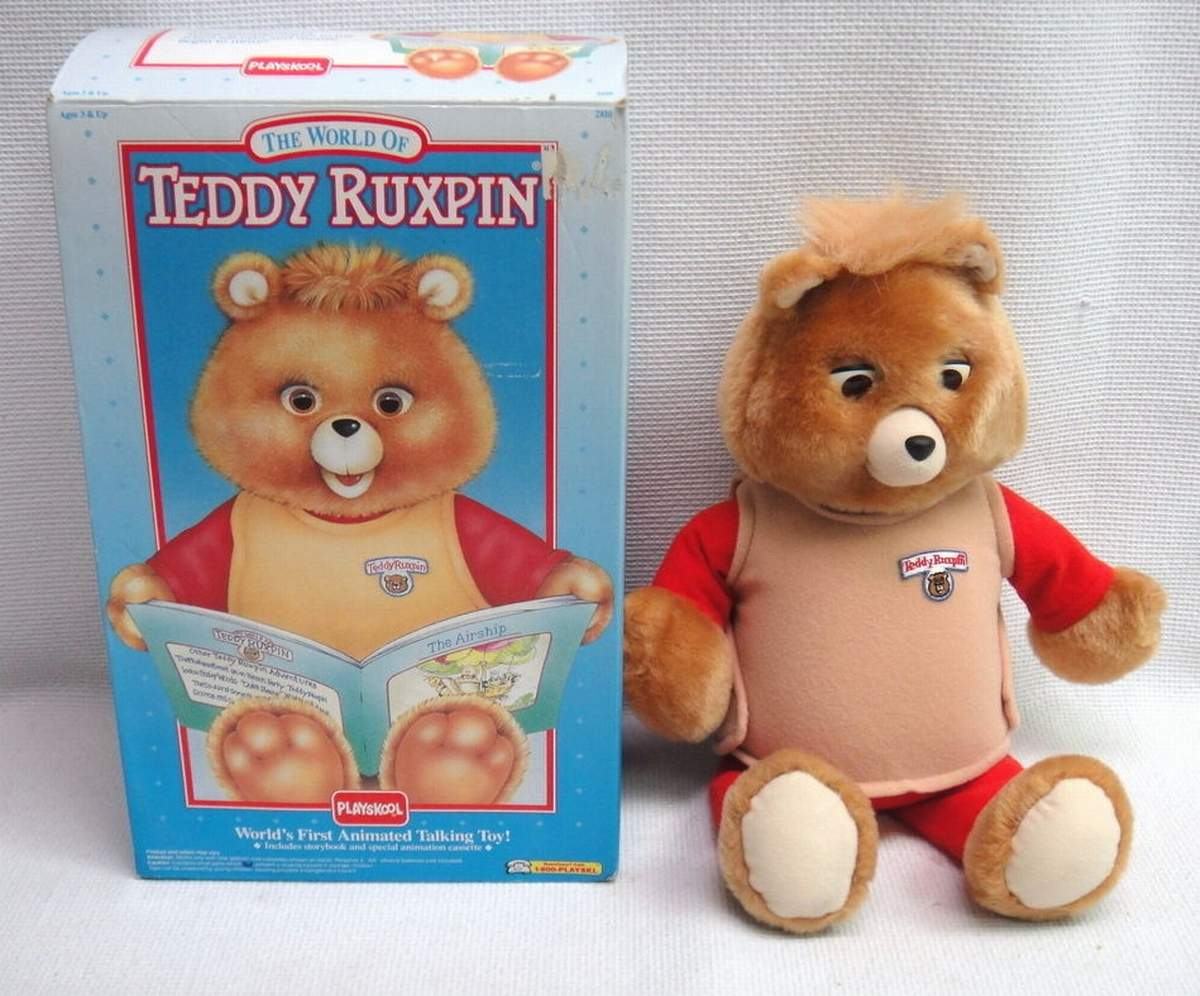
Teddy Ruxpin: 9 Wild Facts About the 80s Talking Bear
In the last 30 days of 1985, Worlds of Wonder shipped 41,000 Teddy Ruxpin bears — and could not make them fast enough. By the end of his first year on shelves, the talking bear had generated $93 million in sales. Parents fistfought over the last one on the shelf. One mother, Mary Brady, hit twelve different toy stores hunting for a working unit and took a shopping cart to the shin in the scrum. Then, almost as fast as he arrived, the bear helped bankrupt the company that built him.
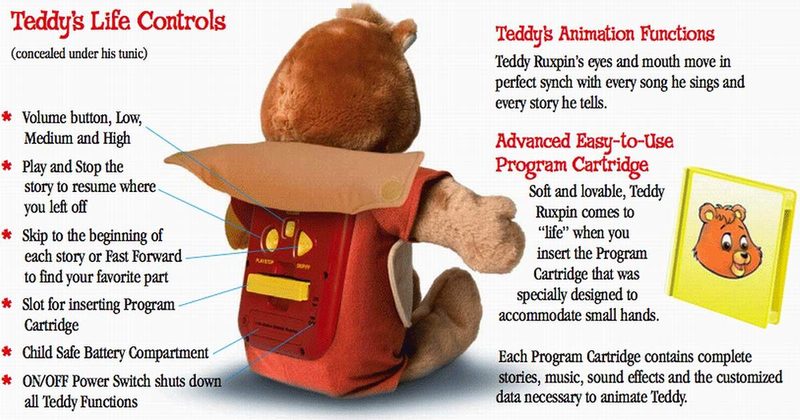
Teddy’s “life controls” and cassette slot were hidden under the vest on his back.
The Retro Almanac
A monthly roundup of "on this day" highlights from that month, decades back — plus first dibs on new retro merch drops. No spam, just the good stuff.
What Made Teddy Ruxpin Different From Every Other Toy
Before Teddy Ruxpin, a talking toy meant a pull-string and four canned phrases. Chatty Cathy said the same eleven things until the string wore out. Teddy Ruxpin did something no toy had done at scale: his face moved while he spoke. His eyes blinked and rolled, his mouth opened and closed, and it all lined up with a full-length story he read aloud. To a kid in 1985, it looked like magic. To the toy industry, it looked like the future.
The box called him the “World’s First Animated Talking Toy,” and for once the marketing was basically true. He didn’t just play a recording — he performed it. That single trick is why he outsold Cabbage Patch Kids the year he launched, and why nearly every plush-with-a-personality toy that followed owes him something.
How Teddy Ruxpin Actually Worked
The whole illusion ran on a standard audio cassette. Teddy used a two-track stereo tape in a very un-stereo way: the left track carried the story and songs you actually heard, and the right track carried a stream of control data your ears never picked up. That hidden track told three small servo motors when to open his mouth, drop his jaw, and move his eyes. Sync the two tracks and the bear appeared to be reading the book propped in his lap.
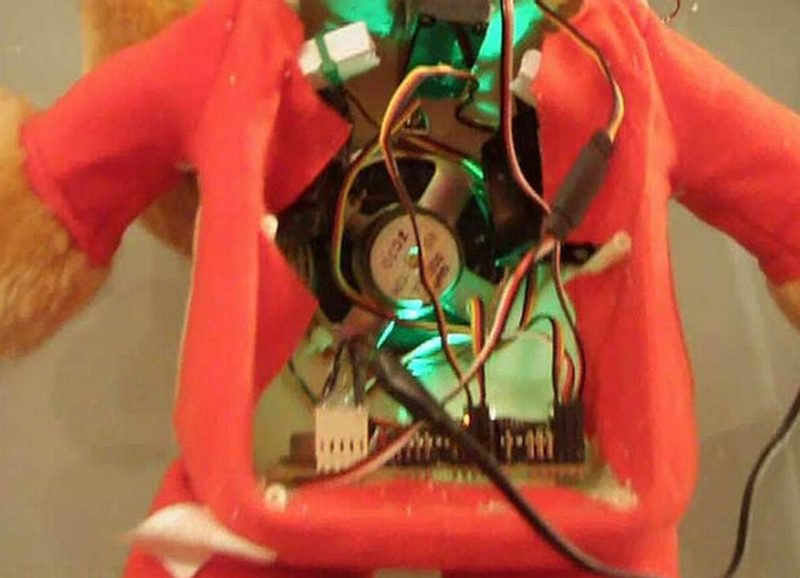
Open the vest and the “lovable” bear was a nest of wires, gears, and a cassette motor.
That engineering came at a cost you could feel. Hugging Teddy Ruxpin, one writer put it, was “like squeezing a lightly padded lunchbox” — the electronics filled most of his torso. Later models swapped the cassette for a digital ROM cartridge and dropped the motor count from three to two, then eventually to one, to cut cost and weight. The controls themselves lived in his back, concealed under a vest: volume, play, stop, and a slot for the tape.
The Disney Animator Who Dreamed Him Up
Teddy Ruxpin wasn’t invented by a toy company. He was invented by Ken Forsse, a former Disney man who had built animatronics for rides like It’s a Small World and the Jungle Cruise. Forsse spent years chasing one idea: a self-contained animatronic character a child could hold, not a figure bolted to a theme-park boat. He formed his own studio, Alchemy II, in 1982 to make it real, and early sketches nearly made the character a monkey — a nod to the space-race chimps — before he settled on a bear.
The Disney DNA shows. Teddy’s expressions have a softness and timing that cheaper imitators never nailed. Forsse understood that the trick wasn’t making a machine talk — it was making a machine feel like it meant what it said.
Here Is the Part Nobody Remembers: He Isn’t a Bear
In the toy’s own storyline, Teddy Ruxpin isn’t a teddy bear at all. He’s an “Illiop” — a bear-like creature from a fictional world called Grundo. His best friend, Grubby, is an “Octopede,” a caterpillar-ish thing with eight legs from a place called Octogania. The stories followed the two of them adventuring across the Land of Grundo, dodging a scheming villain named Tweeg.
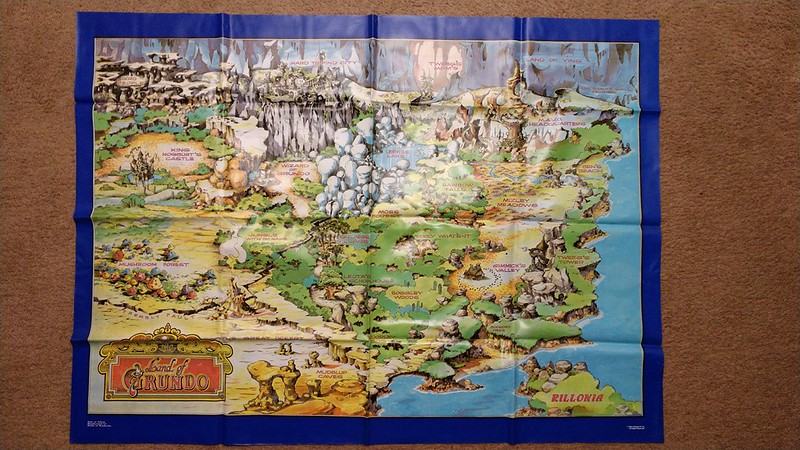
The Land of Grundo came with its own illustrated map — Leekee Lake, Mizley Meadows, and King Nogburt’s Castle included.
This is why old fans get weirdly protective about it. Call Teddy a bear in the wrong crowd and someone will correct you. Worlds of Wonder built a whole mythology around the toy — a map, a cast of characters, and later a run of story cassettes — which is a big reason kids stayed hooked long enough to beg for the next $12.95 tape.
The $93 Million Craze
Teddy Ruxpin hit shelves in September 1985 at roughly $60 to $70 — a genuinely expensive toy, north of $170 in today’s money. It didn’t matter. He was the number-one toy of both 1985 and 1986. By 1987 more than 1.4 million bears had sold, on the way to over 8 million lifetime. Toy stores rationed him. Scalpers marked him up. The book-and-cassette add-ons eventually grew to around 60 titles, and every one was another sale on top of the bear.
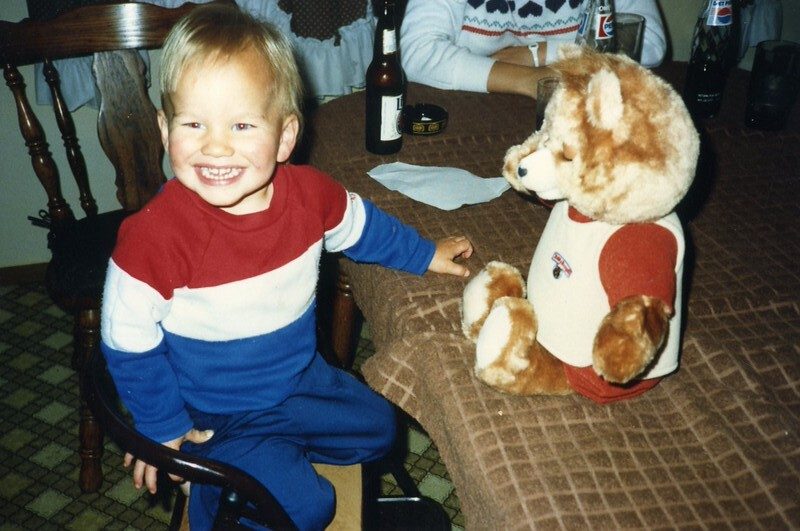
For millions of kids, Teddy Ruxpin was the big-ticket gift of Christmas 1985 and 1986.
The demand had a dark comedy to it. When roughly 35,000 defective bears came back after the 1985 holidays, Worlds of Wonder joked that the broken units were being sent to “Grundo Hospital” — keeping the fiction alive even while dealing with a return pile. If you owned a lava lamp or a View-Master as a kid, you remember the era’s toys as simple. Teddy Ruxpin was the opposite: a small computer wearing fur.
Grubby, the Cartoon, and Saturday Mornings
A hit toy in the 1980s needed a cartoon, and Teddy got one. DIC Entertainment produced 65 episodes of The Adventures of Teddy Ruxpin, which ran across 1986 and 1987 with Phil Baron voicing Teddy and Will Ryan as Grubby. The show did what the tapes did, only bigger — it turned a talking toy into a franchise with a world, a villain, and a theme song kids could sing.
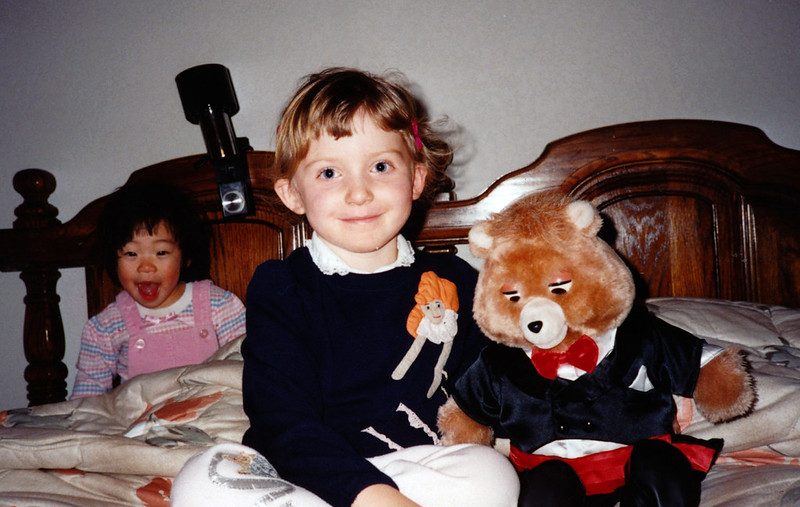
Worlds of Wonder sold outfits too — tuxedos, sleepwear, and seasonal costumes for the bear.
Worlds of Wonder leaned hard into the ecosystem. There were outfits — a tuxedo, a nightshirt, a Santa suit — plus the Grubby companion toy that plugged into Teddy so the two could “talk” to each other. Teddy even moonlighted as a fire-safety spokesbear, teaching kids to stop, drop, and roll. The bear was everywhere, which is exactly the setup for what came next.
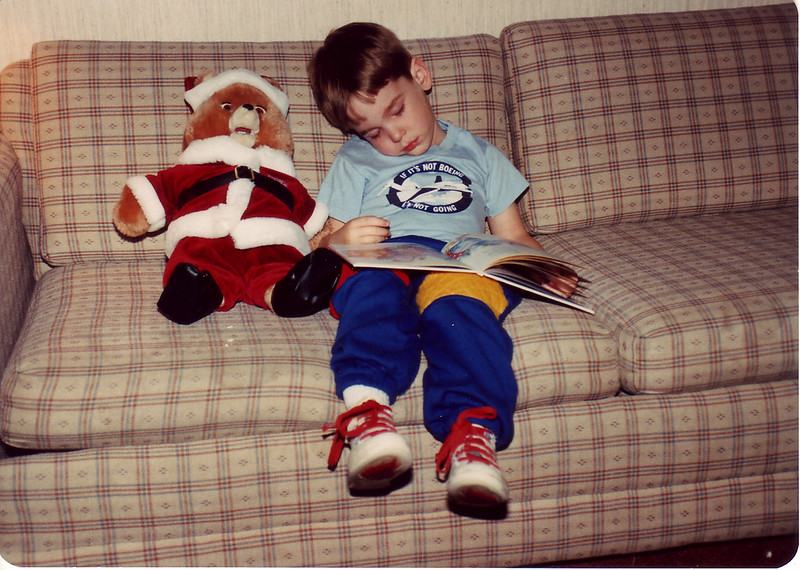
The storybook-and-cassette format was the whole point — Teddy “read” along page by page.
How Worlds of Wonder Crashed
Here’s the mild-but-honest take: Teddy Ruxpin didn’t fail because kids stopped loving him. He failed because the company around him ran the play too hard. Founded by ex-Atari executives, Worlds of Wonder scaled like a Silicon Valley startup — fast, expensive, and betting everything on the hits staying hot forever.
Two things broke it. First, imitators flooded the shelves: Rappin’ Rabbit, Blabber Bear, animatronic Mickey and Snoopy, and a wave of talking animals that split the market Teddy created. Second, the company badly misjudged inventory, then tried to dump unsold bears at $30 — and even at half price, they sat. Worlds of Wonder filed for Chapter 11 bankruptcy right before the 1987 holiday season and was liquidated by 1991. The toy that made $93 million in year one couldn’t save the people who built it.
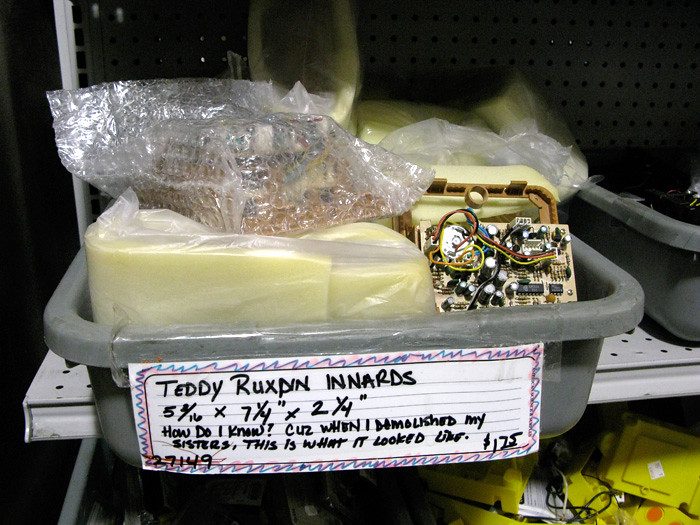
A flea-market bin of “Teddy Ruxpin innards” — the foam torso and circuit board that made the magic.
Where Teddy Ruxpin Went After the Fall
The bear kept getting resurrected. Playskool (under Hasbro) made him from 1991 to 1996. Yes! Entertainment took a turn in 1998. BackPack Toys revived him with a digital-cartridge version from 2005 to 2010, and Wicked Cool Toys produced an LCD-eyed update from 2017 to 2019. None recaptured the original mania, partly because a talking screen no longer felt like the future the way a moving-mouthed bear did in 1985.
The nostalgia never left, though. Vintage bears in working condition trade briskly online, teardown videos rack up views, and as of 2025 a live-action Teddy Ruxpin film was in development with Amazon MGM Studios and Seven Bucks Productions. Not bad for a creature from a place called Octogania. If you grew up rewinding tapes for him, you probably also spent hours on an Etch A Sketch or twisting a Rubik’s Cube — but none of those looked you in the eye and told you a bedtime story.
Watch a 1986 Teddy Ruxpin Commercial
This original spot captures exactly how Worlds of Wonder sold the dream — a bear that came to life when you pressed play.
Teddy Ruxpin FAQ
How much did Teddy Ruxpin cost in 1985? Around $60 to $70 at launch — an expensive toy for the time, roughly $170 in today’s dollars once you adjust for inflation.
Is Teddy Ruxpin a bear? Not in the story. He’s an “Illiop,” a bear-like creature from the fictional Land of Grundo. In real life he’s a plush toy, but fans take the Illiop detail seriously.
How did Teddy Ruxpin move his mouth? A cassette tape carried the audio on one track and hidden control signals on the other. Those signals drove small servo motors that moved his eyes and mouth in time with the story.
Are old Teddy Ruxpin toys worth anything? Working original 1985 Worlds of Wonder units with the box and a cassette or two are the most collectible. Loose, non-working bears are common and cheap, so condition and completeness drive the price.
Sources
- Teddy Ruxpin — Wikipedia — release date, technology, sales figures, and manufacturer timeline.
- A Bear Necessity: The Story of Teddy Ruxpin — Mental Floss — Ken Forsse’s background, first-year sales, and the Worlds of Wonder collapse.
- Teddy Ruxpin — V&A Collections — museum record for the Alchemy II animated talking toy.
The Retro Almanac
A monthly roundup of "on this day" highlights from that month, decades back — plus first dibs on new retro merch drops. No spam, just the good stuff.