Pogo Ball: The 80s Toy That Beat Everything But Barbie
In the summer of 1987, Hasbro sold roughly 3 million Pogo Bals for around $35 million — a number that put a toy nobody in America had heard of a year earlier behind only two of the biggest brands in the business. It bounced, it bruised shins, and within a few years it basically vanished. The story of how it got there, and why it almost didn’t, is weirder than the toy itself.

Hasbro’s 1987 trade catalog page selling retailers on the “latest craze of the 80’s.”
The Retro Almanac
A monthly roundup of "on this day" highlights from that month, decades back — plus first dibs on new retro merch drops. No spam, just the good stuff.
How a Pogo Ball Actually Works
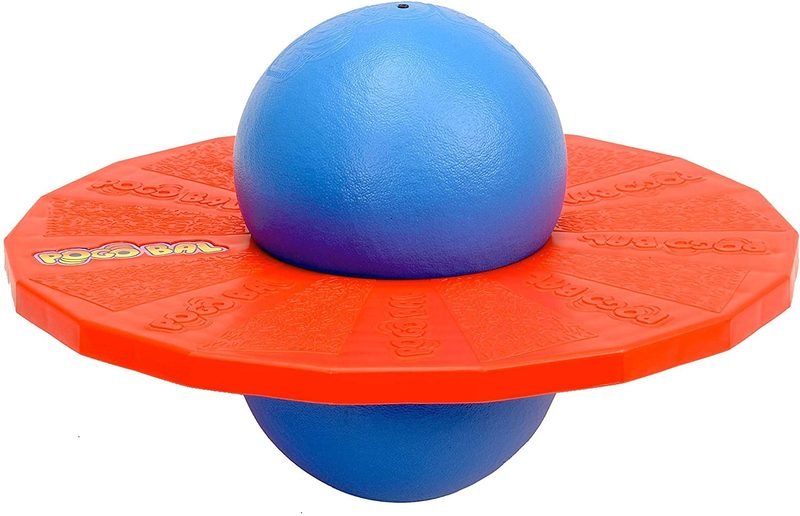
The mechanics are almost insultingly simple — simpler, even, than the wobble-weighted physics that kept a Weebles toy upright a decade earlier. A seamless rubber ball, pinched into a figure-eight shape, sits locked inside a sturdy plastic disc. You step onto the disc, press the tops of your feet against the ball’s lower half, and shift your weight forward to bounce. There’s no stick, no spring, no moving parts to break — just air pressure and whatever balance you can muster. Hasbro’s own catalog copy undersold it as “a fun, exciting skill and action toy,” which is corporate-speak for “you will fall down a lot before this works.”

A Belgian Invention That Sat Dormant for Seventeen Years
The Pogo Ball wasn’t a product of 80s toy-lab excess — it was already old by the time Hasbro touched it. Belgian engineers Raphael J. Van Der Cleyen and Wilfried F. Ribbens patented the design in May 1969, and licensed it to a Belgian manufacturer, Les Usines Fabelty, which took full ownership in 1970. Then the whole thing stalled: Fabelty went insolvent in November 1972 without ever producing the toy in the United States, even though a U.S. patent was granted a few months later, in February 1973.
The design didn’t actually die — it just moved. Once the European patents expired in 1985, the toy resurfaced across Europe under the name Lolobal and became a legitimate fad there first. Hasbro noticed, went after U.S. rights in May 1986, and had the toy on American shelves by that November under a new name built for a Christmas push: POGO BAL.
That gap matters more than it looks like on paper. A toy invented the same year as the Moon landing spent most of the 1970s and early 80s sitting unused in a filing cabinet because one Belgian manufacturer went bankrupt before it could ship a single unit to the country that would eventually make it a household name. Without that European revival in the mid-80s proving there was still demand, Hasbro likely never gets the signal to go after it at all — the Pogo Bal almost became a footnote in patent-office records instead of a toy anyone remembers.
Hasbro’s Christmas Gamble Paid Off Bigger Than Anyone Expected
Launching a toy in November to catch the holiday season is standard playbook stuff. What wasn’t standard was what happened the following summer. By July 1987, trade reporting had the Pogo Bal as the third bestselling toy in the country, trailing only Barbie and G.I. Joe: A Real American Hero — two franchises with decades of brand equity behind them, beaten almost to the top by a rubber ball on a disc that cost Hasbro nothing to invent. Retail prices ran $11 to $18, and that summer alone accounted for roughly 3 million units sold and about $35 million in revenue.
The timing mattered as much as the toy. Spring 1987 shipments hit stores right as school let out, giving kids a full summer to turn driveways and cul-de-sacs into practice courses before the back-to-school keep-up-appearances pressure set in. A toy that costs under $20, requires zero batteries, and turns into a genuine skill-based social currency among 10-year-olds is close to a perfect viral loop for 1987, decades before anyone used that phrase for a toy.
Yes, People Really Did Hurt Themselves on This Thing
Hasbro’s marketing showed kids gliding across Renaissance-tiled palaces in matching primary colors. Reality looked more like a kid in a driveway, arms windmilling, heading straight for a parked bike. Collectors and former owners who’ve written about the toy since describe nearly crashing into walls, armchairs, and greenhouses, and at least one account of a roommate almost breaking a wrist trying to show off. Blisters from the friction between sneaker and plastic disc were common enough to be a running joke among kids who actually stuck with it long enough to get good.
That difficulty curve is probably underrated as part of the toy’s appeal, not a flaw in it. A toy that’s mildly dangerous and genuinely hard to master gives kids something to show off once they land it — the same social mechanic that made skateboarding and yo-yos sticky long after their respective fads should have faded. The Pogo Ball just never had a pro circuit to extend its shelf life the way those did.
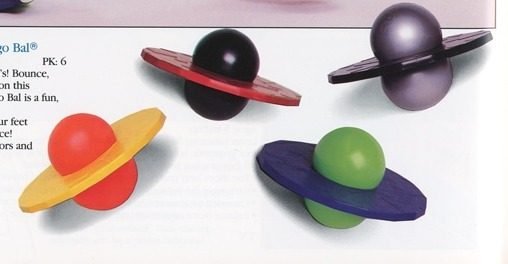
The Pogo Bal shipped in at least four color combinations, styled like little Saturns.
The Same Toy Has Had About Six Different Names
Few toys have been rebranded as many times as this one. Depending on the decade and the country, you’d have bought it as:
- Pogo Bal — Hasbro’s official U.S. spelling, 1986–early 1990s
- Lolobal / Lolo Ball — the name it carried through its European fad years
- Springbal — an earlier European branding tied to the original Belgian patent
- Disc-O and Pogoba — smaller regional variants
- Pogo-It — Little Tikes’ 2017 motion-sensor reboot
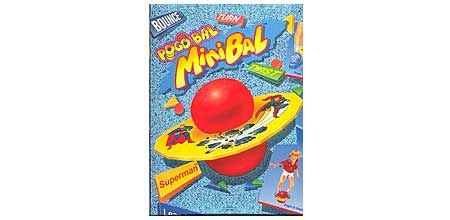
Hasbro also licensed the toy out for branded tie-ins, including a smaller “Pogo Bal Mini Bal” sold with a Superman decal slapped on the box — proof that in 1988, there was no toy too simple to get a superhero crossover edition.
Why It Vanished Right Before the 90s Extreme Sports Boom
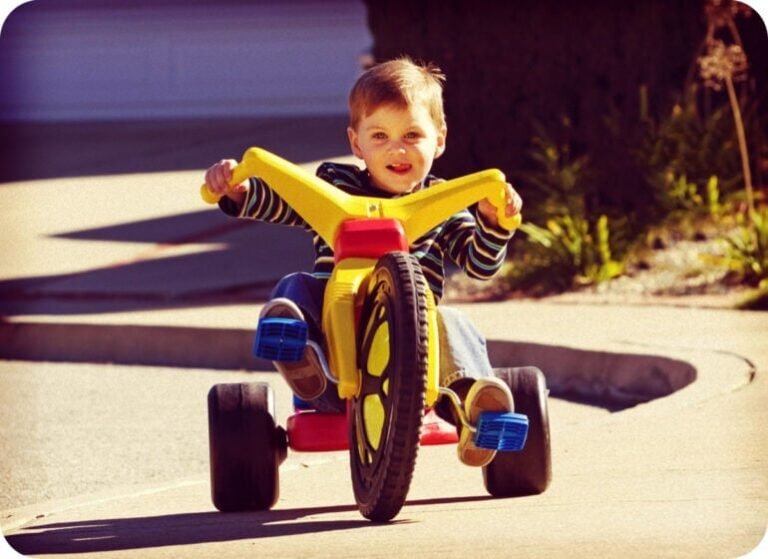
Hasbro kept the Pogo Bal in production into the early 1990s, but the fad had already cooled by the time the decade’s actual breakout trend arrived: extreme sports. Rollerblades, street luge, BMX bikes that had already graduated from kiddie ride-ons like the Big Wheel, and skate culture all built entire media ecosystems — X Games, dedicated magazines, pro sponsorships — around exactly the kind of balance-and-risk appeal the Pogo Bal had stumbled into years earlier. The toy just missed the wave by a few years, and once it was gone, nobody built the infrastructure to bring it back as a “sport” instead of a fad.
That’s arguably the real lesson in its decline. Hasbro treated the Pogo Bal the way it treated most toy fads of the era — ride it hard for two or three Christmases, then move budget to the next thing — rather than investing in it as a long-term activity brand the way companies eventually did with skateboards and BMX bikes.
The Pogo Ball Is Back, and It Has LED Lights Now
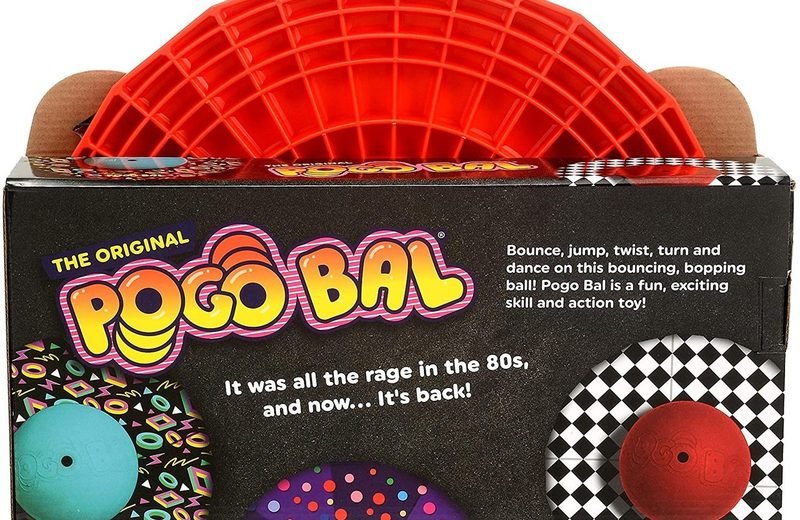
The toy didn’t stay dead — much like the View-Master got a VR-headset reboot decades after its original run. Little Tikes released an updated version called Pogo-It in 2017, adding motion-sensor game modes and LED lighting to the same basic figure-eight-ball concept, aimed at kids who’d never heard of the original. Separately, a company called License 2 Play has been reselling “The Original Pogo Bal” in classic colorways — red-and-blue, yellow, teal — complete with a hand pump, marketed in Canada and the U.S. with box copy that reads almost exactly like Hasbro’s did in 1987: “It was all the rage in the 80s, and now… it’s back.”

The Strong National Museum of Play in Rochester, New York even holds an original Hasbro trade catalog page for the Pogo Bal in its Stephen and Diane Olin Toy Catalog Collection, filing it alongside the rest of toy history as what its own writeup calls “a modernized version of the pogo stick” — which, bruised shins aside, is exactly what it was.
Original 1980s units in decent condition now turn up regularly on resale and auction sites, usually priced as nostalgia pieces rather than functional toys — the rubber on a 35-plus-year-old ball isn’t something you want to trust your ankles to. The modern reissues solve that problem the boring way, with fresh rubber and a pump included in the box, which is probably the single biggest quality-of-life upgrade the Pogo Bal has gotten in almost forty years.
FAQ
Who invented the Pogo Ball?
Belgian engineers Raphael J. Van Der Cleyen and Wilfried F. Ribbens patented the design in May 1969. Hasbro licensed U.S. rights nearly two decades later and launched it as “Pogo Bal” in November 1986.
Is the Pogo Ball still made today?
Yes. Little Tikes sells a modernized version called Pogo-It with motion sensors and LED lights, and License 2 Play sells “The Original Pogo Bal” in classic retro colorways with a hand pump included.
What was the Pogo Ball called in other countries?
Across Europe it was marketed as the Lolobal or Lolo Ball before Hasbro brought it to America. Earlier regional names tied to the original patent included Springbal, Disc-O, and Pogoba.
How popular was the Pogo Ball in the 1980s?
Very. By mid-1987 it ranked as the third bestselling toy in the United States behind only Barbie and G.I. Joe, with roughly 3 million units sold and about $35 million in sales that summer alone.
Sources
- Pogo Ball — Wikipedia — patent history, inventors, and Hasbro production timeline.
- The Pogo Bal Paradigm — The Strong National Museum of Play — museum archive on the Hasbro trade catalog and toy description.
- Pogo Bal Commercial, Circa 1987 — We Are the Mutants — analysis of the original Hasbro TV commercial and its place in 1987 sales rankings.
The Retro Almanac
A monthly roundup of "on this day" highlights from that month, decades back — plus first dibs on new retro merch drops. No spam, just the good stuff.