The PEPCON Disaster: Inside the Day Henderson, Nevada Exploded
The PEPCON disaster on May 4, 1988 was the most powerful civilian explosion in American history — a rocket-fuel chemical plant in Henderson, Nevada that vaporized itself, leveled the marshmallow factory next door, cracked windows at McCarran International Airport seven miles away, and shoved a 1,000-foot mushroom cloud over Las Vegas while a Boeing 737 was on final approach. For a few hours, retirees who remembered the Nevada Test Site genuinely wondered if the Cold War had finally gone hot. It hadn’t. A welder’s spark had.
PEPCON Disaster: What Happened on May 4, 1988
The PEPCON disaster unfolded over roughly 30 minutes between 11:30 a.m. and noon Pacific time inside the Pacific Engineering & Production Company of Nevada, a sprawling chemical complex on the western edge of Henderson. Maintenance crews were repairing wind-damaged outbuildings with cutting torches. The structure they were working on sat too close to fiberglass containers holding ammonium perchlorate — the white, salt-like oxidizer that gives Space Shuttle solid rocket boosters their kick.
By 11:53 a.m., a roughly 4,000-pound batch detonated. Four minutes later, at 11:57 a.m., the catastrophic second blast erased what was left of the plant. The U.S. Geological Survey clocked the larger explosion at magnitude 3.5. Lawrence Livermore National Laboratory’s analysis later estimated the yield at 0.25 kiloton of TNT — about one-sixtieth of Hiroshima, and perfectly comparable to a small tactical nuclear weapon. The PEPCON disaster killed two people, injured 372, and racked up roughly $100 million in damage in 1988 dollars (closer to $260 million today).
The Welder, the Wind Damage, and the 11:30 A.M. Fire
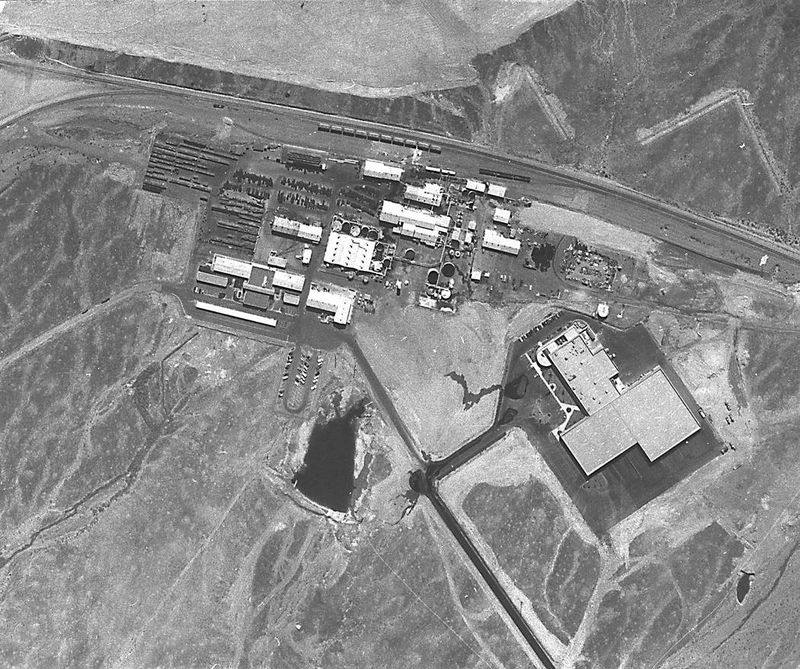
Aerial view of the PEPCON facility before the May 1988 blasts. The plant produced ammonium perchlorate for the U.S. solid-rocket industry.
The official Clark County Fire Department investigation pinned the cause on a stray spark from a welder’s torch that ignited the structure they were repairing. Workers initially attacked the flames with garden hoses — a perfectly reasonable instinct that became briefly terrifying once someone remembered the drums lining the wall. Ammonium perchlorate is technically classified as an oxidizer rather than an explosive, but pile up enough of it next to a fire and a propane line and you get the same result.
The first detonation around 11:51 a.m. was almost a courtesy. It was loud enough to evacuate everyone who could still walk, but small enough to leave most of the plant standing for the next few minutes. The Henderson fire chief, who’d arrived ahead of his trucks, was hit by the shockwave so hard it temporarily blinded him and shattered his car windows. Behind him, hundreds of PEPCON employees were already streaming out into the desert on foot. Then came 11:57.
Why PEPCON Was Stockpiling Six Million Pounds of Rocket Fuel

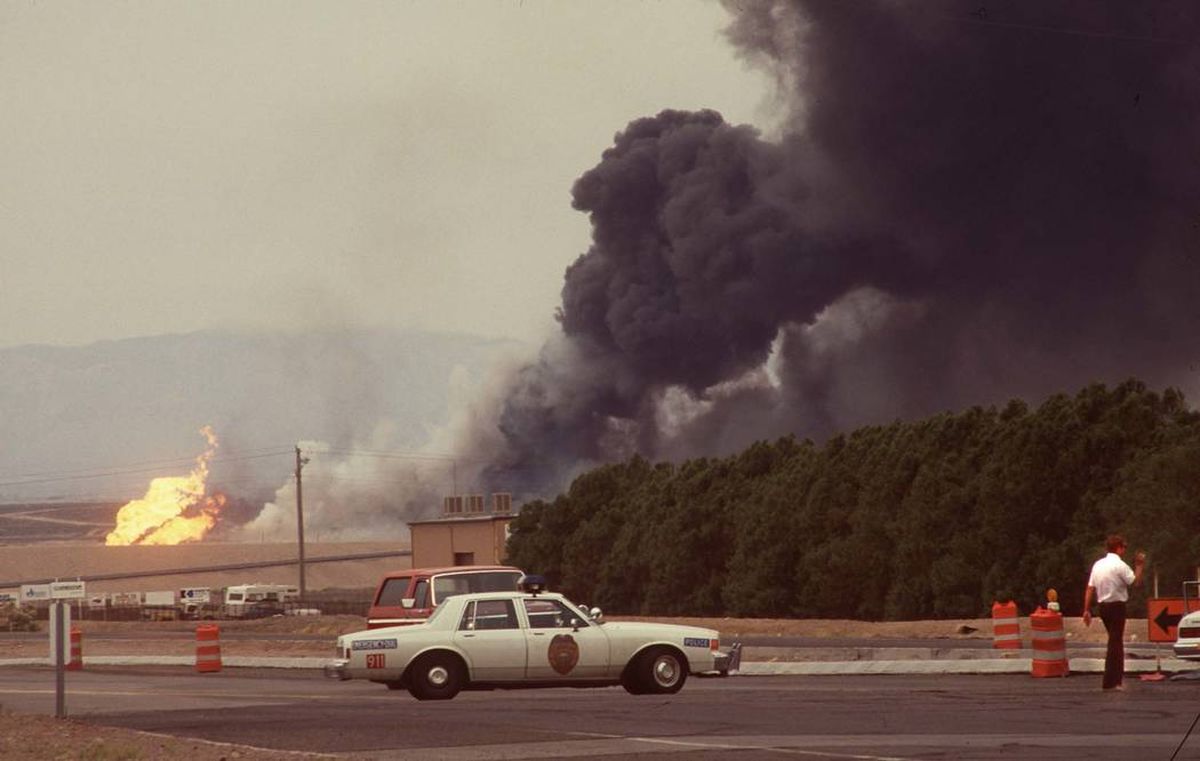
Period footage still showing the explosion plume from the PEPCON disaster as it climbed above Henderson, Nevada.
This is the part of the PEPCON disaster story that always gets undersold. By 1988, only two American companies made ammonium perchlorate at industrial scale, and both of them sat on the edge of Henderson — PEPCON and Kerr-McGee. Together they supplied essentially the entire U.S. military and aerospace solid-rocket pipeline: Minuteman ICBMs, Trident submarine missiles, the Patriot, the Titan IV, and most importantly the Space Shuttle.
Then, on January 28, 1986, the Space Shuttle Challenger broke apart 73 seconds after launch. The fleet was grounded. Orders dried up. But PEPCON had already produced thousands of tons of perchlorate against the long lead times of the rocket business, and it had nowhere to ship it. So they stored it. By May 4, 1988, the plant was sitting on roughly 4,500 tons — somewhere between four and six million pounds — of high-energy oxidizer waiting for the Shuttle program to come back online. (For more on how the same era’s NASA setbacks were forcing impossible decisions, see our piece on how NASA saved the Solar Max satellite in 1984, two years before Challenger changed everything.)
The Mushroom Cloud That Made Las Vegas Think the Cold War Just Started

The roughly 1,000-foot mushroom cloud was visible from 100 miles away and fooled long-time residents into thinking a nuclear test had gone wrong.
Henderson is 26 miles from the Nevada Test Site, where the U.S. detonated 928 nuclear devices between 1951 and 1992. Older locals had spent the 1950s watching above-ground tests from their backyards — they knew what a mushroom cloud looked like. So when one rolled up over the western horizon at noon on a Wednesday, with no announcement, the first frantic phone calls to local TV stations were not about a chemical plant. They were about World War III.
The cloud climbed roughly 1,000 feet and was reportedly visible from 100 miles away in every direction. The shockwave hit McCarran International Airport seven miles north hard enough to crack windows, push doors open, and buffet a Boeing 737 already on final approach to Runway 25L. Seismographs as far away as Colorado registered the blast. For the next four hours, hospital trauma centers across the Las Vegas Valley operated under disaster protocol — partly because of the injuries, partly because nobody yet knew whether the gigantic plume drifting east was toxic.
Two Lives Lost — and the Marshmallow Factory Next Door

Aerial view of the PEPCON disaster aftermath. The site was scoured down to bare desert. Notice the cleared footprint where buildings once stood.
The two PEPCON disaster fatalities were both staff who could not get out. Roy Westerfield, the company controller, stayed at his desk to call 911 for the fire that killed him; his body was never recovered from the blast zone. Bruce Halker (sometimes spelled Haulker), a plant manager who used a wheelchair, could not clear the secondary blast in time. Their names are listed on the Henderson Historical Society’s permanent memorial to the event.
Next door — and “next door” in industrial Henderson meant a few hundred yards — sat the Kidd & Company marshmallow plant. Yes, a marshmallow plant. The compression wave from the second blast crushed it like a soda can. By a small miracle, most of Kidd’s employees had already evacuated after seeing PEPCON smoke. The marshmallow factory was rebuilt within a year. PEPCON was not. The story of fluffy white candy and rocket fuel flattened in the same shockwave became one of the strangest two-line summaries in late-80s news.
The 372 Injuries, the $100 Million Bill, and the Boeing 737 on Final Approach

A paramedic catches his breath at the command post hours after the PEPCON disaster. Medical units triaged 372 injuries that day.
The injury list from the PEPCON disaster reads like a textbook on what shockwaves do to a residential neighborhood. Roughly 100 victims were transported by EMS; another 200 to 300 walked or drove themselves to hospitals. Fifteen firefighters were hurt on scene. The vast majority of the 372 injuries were lacerations from flying glass and falling ceiling tiles in homes, schools, and businesses up to three miles away.
The damage tally was staggering for the era. About 22,000 homes within three miles of the plant sustained an average of $5,000 in structural damage each. Total property damage outside the plant came to roughly $74 million; inside the fence, the plant itself was a $25 million-plus loss. PEPCON’s parent company filed for bankruptcy within months. The Boeing 737 on approach to McCarran landed safely. The pilot reportedly told tower control he thought he’d been hit by clear-air turbulence.
What Replaced the PEPCON Plant in Henderson

The land where the PEPCON plant once stood, photographed decades later. The blast left scars on the desert that took years to heal.
PEPCON did not rebuild on the same spot. The company relocated its perchlorate operations to a remote desert site in Cedar City, Utah, where any future incident would, in theory, only inconvenience tumbleweeds. The original Henderson footprint — about 100 acres of cratered, chemically-saturated soil at the corner of Gibson and Warm Springs Roads — sat empty for years while environmental remediation crews worked through the contamination.
Today the site is unrecognizable. It has been redeveloped into commercial and institutional uses, including the Touro University Nevada medical school, Ocean Spray Cranberries’ Henderson processing facility, and Graham Packaging plants. Henderson itself, which had a population of roughly 70,000 in 1988, has since exploded (sorry) past 320,000 residents, making it the second-largest city in Nevada. The PEPCON disaster is the single biggest reason Henderson’s modern industrial zoning code keeps high-energy chemical storage so far from residential development.
Why the PEPCON Disaster Still Matters in 2026

Henderson, Nevada continues to mark the anniversary of the PEPCON disaster. The blast permanently changed how the city zones industrial chemicals.
The PEPCON disaster reshaped American chemical safety regulation in ways that quietly touch every Amazon warehouse, propellant plant, and battery storage site built since. Lawrence Livermore National Laboratory’s 1989 forensic report became the template for how investigators reconstruct mass-detonation events without intact wreckage to study. The Bureau of Alcohol, Tobacco and Firearms revised its storage tables for class-1 oxidizers. Insurance underwriters started asking very different questions about how much of any one chemical was sitting in any one building at any one time.
And the cultural footprint is bigger than the physics. PEPCON happened during a stretch of mid-to-late-80s American disasters — Challenger in 1986, Chernobyl three months after that, the Exxon Valdez less than a year after PEPCON — that hard-coded a particular kind of dread into Gen X. The mushroom cloud over Henderson was the moment a lot of Las Vegans realized that the dangerous stuff wasn’t necessarily out at the test site. Sometimes it was the chemical plant down the road, doing exactly what it had been doing for years, until one welder, one windy week, and one stockpile of rocket fuel met at the wrong time.
If you want a deeper dive into how the decade keeps reaching forward into the present, our piece on why 80s nostalgia hits harder than any other decade covers the same generational anchor points — and you can pair this story with our retrospective on the first Mir space station crew launch from 1986 for the parallel space-race context that gives the PEPCON disaster its full meaning.
Watch: The PEPCON Disaster on Video
The footage of the second blast was filmed by Dennis Todd, a subcontractor who happened to be working on a TV transmission tower on Black Mountain that morning. He had a clear line of sight to the plant. NBC flew the tape to Burbank within hours. This Fascinating Horror short documentary uses the original Todd footage and walks through the timeline of the PEPCON disaster step by step:
Sources
- PEPCON disaster — Wikipedia — Comprehensive timeline, casualty list, and damage figures.
- The PEPCON Explosion — Clark County Fire Department — Official Clark County investigation summary.
- Analysis of the accidental explosion at Pepcon, Henderson, Nevada, May 4, 1988 — Lawrence Livermore National Laboratory / OSTI — Federal blast yield and forensic analysis.
- 30 years ago, massive PEPCON explosion rocked Las Vegas Valley — Las Vegas Review-Journal — Local 30-year retrospective with archival photography.
- Pepcon explosion, 25 years later — Henderson Historical Society — Local memorial and survivor accounts.
- The PEPCON Disaster — Damn Interesting — Long-form narrative reconstruction of the explosion sequence.