View-Master: 9 Wild Facts About the 3D Reel Toy
Roughly 1.5 billion View-Master reels have been produced since 1939, and if you grew up anytime between the moon landing and the Walkman, you clicked through a good chunk of them yourself. The red viewer lived in the toy box next to the Simon game and the crayons, and the ritual never changed: hold it to a lamp, thumb the lever, and watch a flat cartoon suddenly have depth. Here are nine facts about the little 3D machine that most kids never knew while they were wearing one out.
1. A piano repairman invented the View-Master
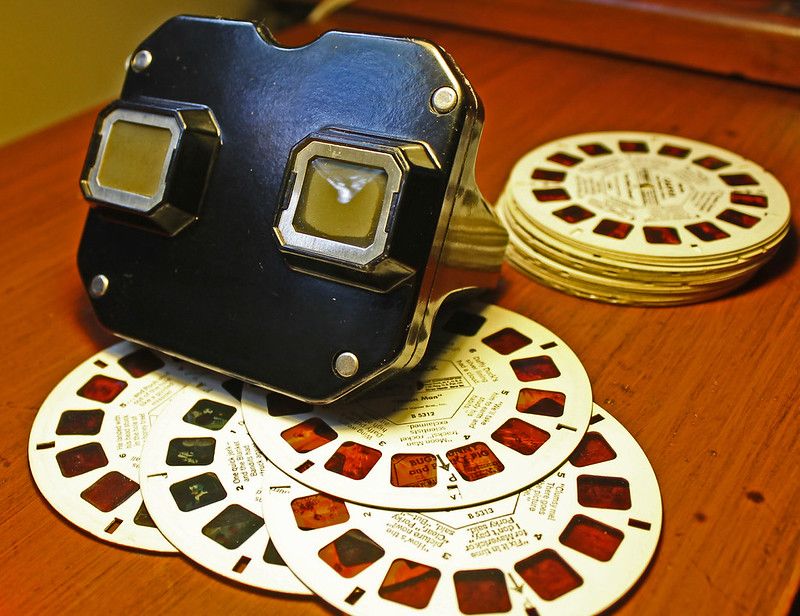
The View-Master wasn’t dreamed up by a toy company. It was invented by William Gruber, a player-piano technician trained by the German firm Welte & Sons who happened to be an obsessive amateur photographer living in Portland, Oregon. Gruber had been experimenting with mounting pairs of small Kodachrome slides — the color film Kodak had only released in 1935 — so both eyes saw a slightly different angle. The result tricked the brain into seeing three dimensions, the same principle Victorian parlor stereoscopes had used with big cardboard cards fifty years earlier. Gruber just shrank the whole idea down to something that fit in one hand.
The Retro Almanac
A monthly roundup of "on this day" highlights from that month, decades back — plus first dibs on new retro merch drops. No spam, just the good stuff.
2. It debuted at the 1939 World’s Fair — stamped “Patent Applied For”
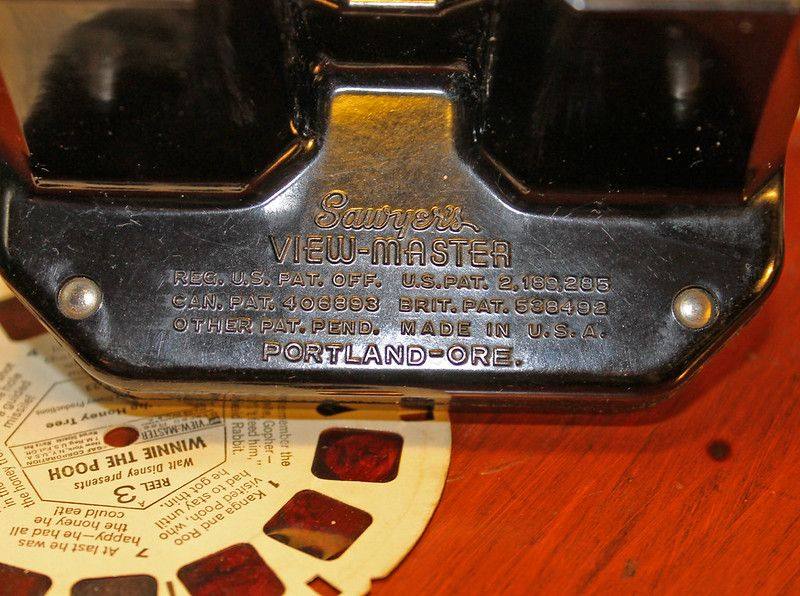
Gruber crossed paths with Harold Graves, an executive at Sawyer’s, a Portland company that was the nation’s largest producer of scenic postcards in the 1920s. Sawyer’s saw where this was going: a 3D viewer paired with reels of scenic photos was a postcard you could sell over and over. The View-Master made its public debut at the 1939 New York World’s Fair, the units marked “Patent Applied For.” The first sales counters weren’t in toy stores at all — they were at photo shops, stationery counters, and scenic attractions like the Grand Canyon.
3. It was built for adults, not kids
Here’s the part that surprises people: for its first decade, the View-Master was marketed to grown-ups as a classy alternative to buying a stack of souvenir postcards. Early reels were scenic — national parks, city skylines, world landmarks. The pitch was tourism and armchair travel, not playtime. A vacationing couple would bring home a reel of Yellowstone the way you might buy a fridge magnet today. The toy-store version we picture — Mickey Mouse, Spider-Man, Winnie the Pooh — didn’t take over until the 1950s. That adult-first origin is why so many early reels feel oddly grown-up: waterfalls, cathedrals, foreign capitals, and Route 66 roadside attractions, all shot on location by Sawyer’s own photographers. The company treated those reels like a publishing catalog, not a toy line, eventually issuing more than 4,300 different titles across every subject you can imagine.

4. The U.S. military bought millions of reels for WWII training
When the War Department needed a cheap, portable way to drill soldiers on aircraft silhouettes, ship identification, and range estimation, someone realized the View-Master already did exactly that — in 3D, no projector or electricity required. Between 1942 and the end of the war in 1945, the United States military purchased 100,000 viewers and nearly six million reels. A toy that had barely existed for three years was suddenly standard issue. That government contract is a big reason Sawyer’s survived the lean war years to become the household name it did.
5. Disney is what turned it into a childhood staple
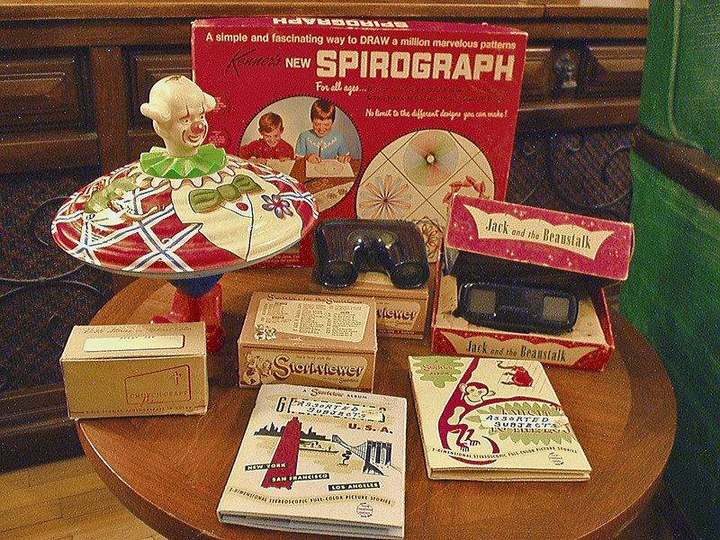
In 1951 Sawyer’s bought out its main rival, Tru-Vue — and the real prize wasn’t the competitor, it was the paperwork. Tru-Vue held licensing rights to Walt Disney Studios properties. Suddenly Sawyer’s could put Mickey, Donald, Cinderella, and by 1955 the brand-new Disneyland itself onto reels. That was the pivot. The scenic-postcard business quietly took a back seat, and the View-Master became a toy — a way for a kid to hold a piece of a movie or a theme park to their face. Every licensed cartoon and TV show that followed rode that same track.
6. In 1962 it swapped Bakelite for plastic and got the look you remember
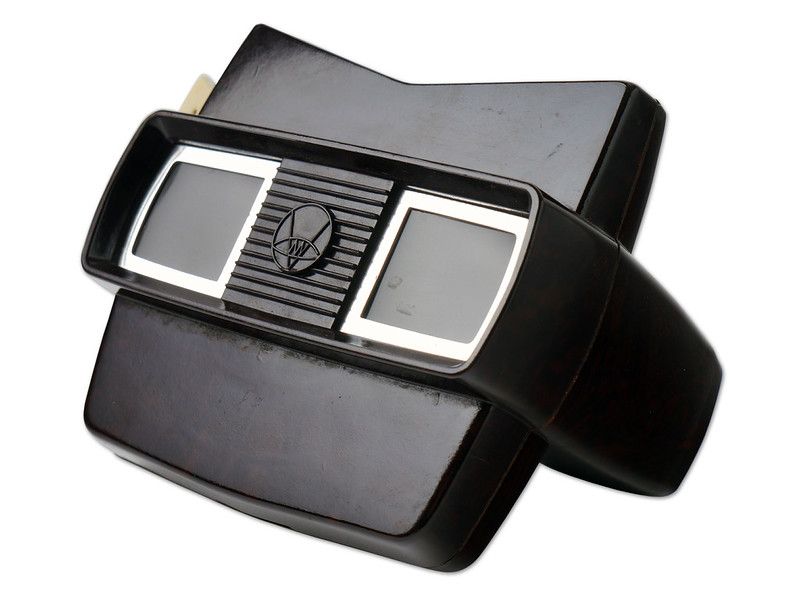
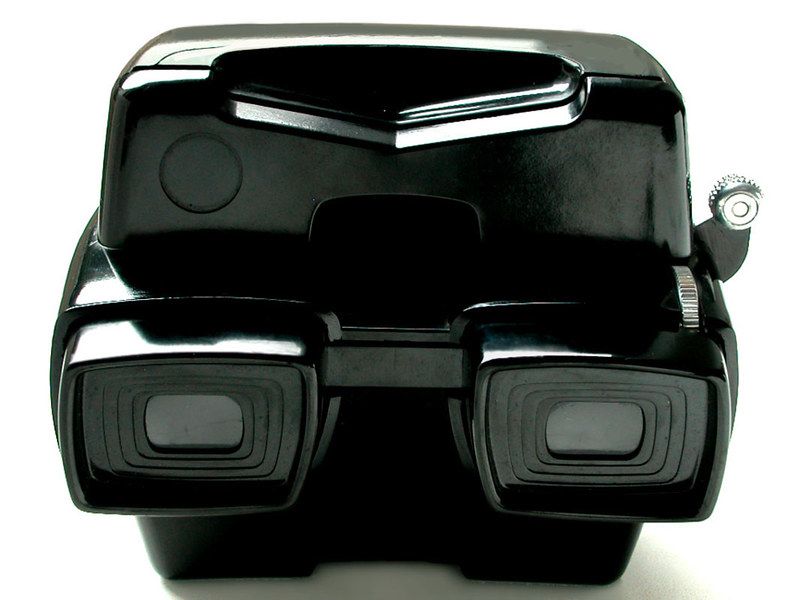
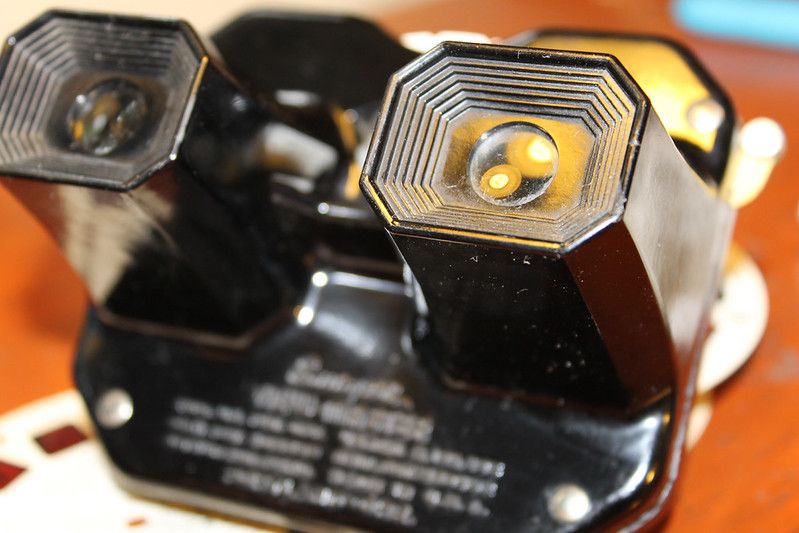
The earliest viewers were heavy Bakelite in that serious dark-brown, almost formal finish. In 1962 Sawyer’s introduced lighter thermoplastic versions, starting with the Model G. This is the era that produced the shapes most Gen X kids picture — including the candy-red viewer that became the toy’s signature. The switch to molded plastic made the viewer cheaper, lighter, and drop-proof enough to survive an actual childhood. If your memory of a View-Master is bright red and nearly weightless, you’re remembering a post-1962 model.
7. GAF ran the show through the 70s — with celebrity ads
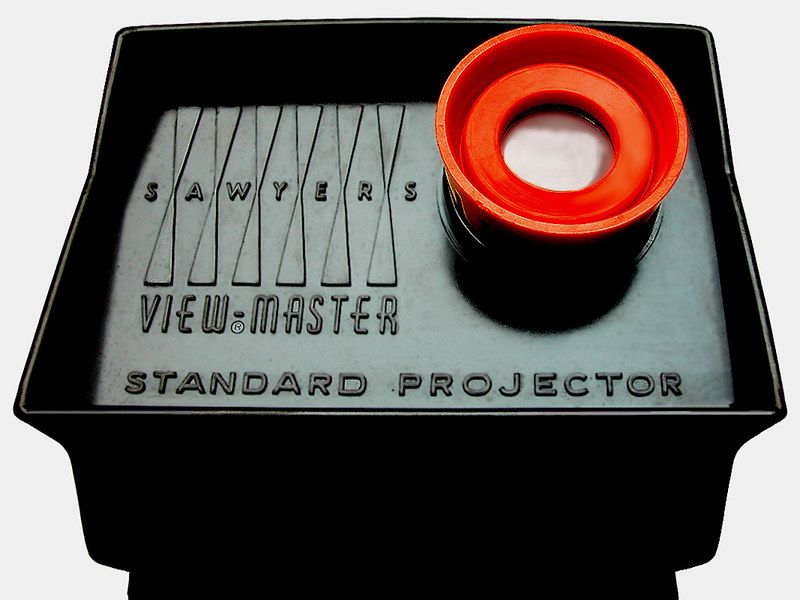
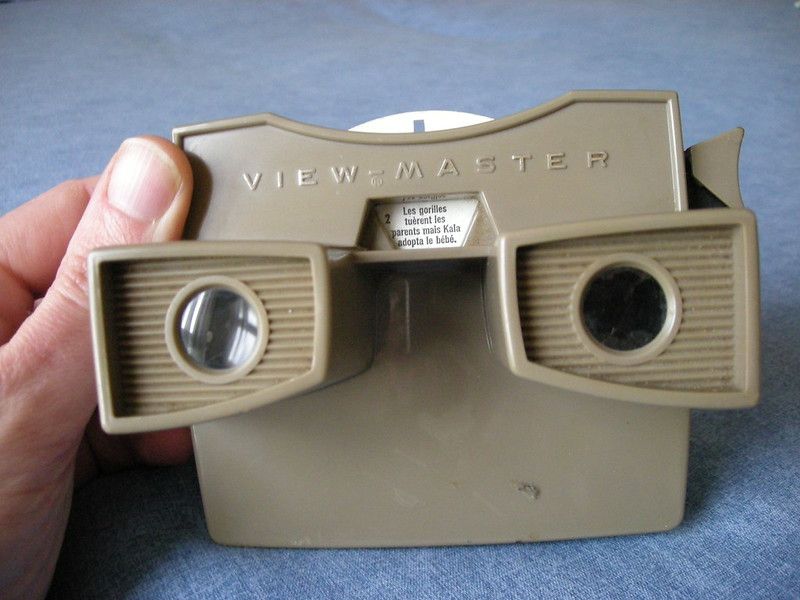
In 1966 a chemical and film giant, General Aniline & Film (GAF), bought Sawyer’s and ran the View-Master brand from 1966 to 1981. This was the peak nostalgia window: Saturday-morning commercials, the boxy GAF-branded viewers, and TV-star pitchmen selling the thing to parents. GAF leaned hard into licensed reels — cartoons, sitcoms, and movie tie-ins — and it’s the GAF era most people are actually remembering when they say “View-Master.” If you owned one before the Walkman showed up, odds are it said GAF on it somewhere.
8. There was a Talking View-Master that played sound
From 1970 until around 1997, GAF and its successors sold the Talking View-Master, which built a tiny record-like audio track into the reel package so a narrator or character voice played along with the pictures. Fairy-tale reels would read you the story; cartoon reels added sound effects and dialogue. It was the kind of upgrade that felt like magic in 1974 and slightly baffling once cassette tapes and TV made narrated toys ordinary. It’s also a reminder that the View-Master kept trying new tricks long after most people assumed it had peaked.
9. Mattel and Google rebooted it as a VR headset in 2015
The View-Master brand bounced through a string of owners — Arnold Thaler’s investor group in 1981, a merger with Ideal in 1984, Tyco Toys in 1989, and finally Mattel in 1997 when Tyco merged in. Then, in February 2015, Mattel and Google announced the View-Master Virtual Reality Viewer, a plastic headset built around Google Cardboard that dropped a smartphone where the reels used to go. The old click-lever was gone, but the pitch was identical to Gruber’s 1939 idea: hold a stereo image to each eye and let your brain build the third dimension. Nearly eighty years later, the trick still worked.
How the View-Master actually created 3D
The magic was never electronic — it was pure optics. Each reel carried seven stereo pairs, which is 14 separate Kodachrome transparencies, and every pair was shot from two lenses spaced about as far apart as human eyes. When you looked through the viewer, the left lens fed one image to your left eye and the right lens fed the slightly-different one to your right eye. Your brain did what it does with real life: merged the two views and read the offset as depth. That’s the same binocular trick behind modern VR and 3D movies, running on nothing but cardboard, film, and a spring-loaded lever.
Frequently Asked Questions
Is the View-Master still made?
The classic reel viewer was discontinued as its main product line, but the brand lives on under Mattel/Fisher-Price, and the 2015 View-Master VR headset was its most recent major release. Vintage viewers and reels are easy to find secondhand, and the standard reels still fit any classic viewer regardless of decade.
How many pictures are on a View-Master reel?
Fourteen film transparencies arranged as seven stereo pairs. You click the lever to advance from one pair to the next, so a single reel gives you seven distinct 3D scenes.
Are old View-Master reels worth anything?
Common cartoon and scenic reels are cheap, but rare early Sawyer’s reels, complete boxed sets, and unusual licensed subjects can fetch real money from collectors. Condition and completeness matter more than age — a mint boxed three-reel packet beats a loose scratched single every time.
Who invented the View-Master?
William Gruber, a Portland piano technician and amateur photographer, invented it in the late 1930s and partnered with the Sawyer’s postcard company to launch it at the 1939 New York World’s Fair.
The View-Master outlasted the postcard, the drive-in reel, the Bakelite it was born in, and most of the companies that owned it. If you want more toy-box time machines, click through our takes on the Nintendo Game Boy and the boombox that ran on D batteries and pure attitude — same era, same itch. And if you’ve still got a red viewer in a drawer somewhere, go hold it to a lamp. It still works.
Sources
- View-Master — Wikipedia — invention, Sawyer’s/GAF/Mattel ownership timeline, WWII military purchases, reel specs, VR reboot.
- Focusing on View-Master: History & Value — Antique Trader — Gruber and Graves partnership, model progression, collector notes.
- The History of the View-Master — Hackaday — stereoscope optics and the technical lineage from Victorian viewers.
Browse retro and vintage-inspired apparel at the RetroRadical shop →
The Retro Almanac
A monthly roundup of "on this day" highlights from that month, decades back — plus first dibs on new retro merch drops. No spam, just the good stuff.