On This Day: October 28, 1989 — Janet Jackson’s Rhythm Nation 1814 Hits #1
Janet Jackson had already proven she could do it alone. Two years earlier, Control had turned the “forgotten Jackson” into a solo superstar, racking up five Top 5 singles and finally stepping out from her famous family’s shadow. The pressure for the follow-up was enormous. What do you do after Control? Janet and her production team — Jimmy Jam and Terry Lewis — didn’t play it safe. They made an album about police brutality, drug addiction, illiteracy, and racism, built it around a militaristic dance anthem, and gave it the strangest title of her career: Janet Jackson’s Rhythm Nation 1814.
On October 28, 1989, that gamble paid off in the biggest way possible. Rhythm Nation 1814 hit number one on the Billboard 200, the first of four consecutive weeks at the top. It wasn’t just a commercial win — it confirmed that Janet Jackson wasn’t a one-album fluke. She was about to become one of the defining pop stars of the decade to come.
The Retro Almanac
A monthly roundup of "on this day" highlights from that month, decades back — plus first dibs on new retro merch drops. No spam, just the good stuff.
The Album Nobody Expected
By 1989, Janet Jackson had every reason to chase the easy follow-up. Control sold over four million copies and turned her into an MTV fixture. Record labels love a sequel — give the people Control 2 and watch the money roll in. Instead, Janet, Jimmy Jam, and Terry Lewis locked themselves away in Minneapolis and made something stranger and angrier.
Rhythm Nation 1814 opens with a spoken “Pledge,” framing the record as a mission statement for a generation sick of division. The title track calls for unity “with music by our side, to break the color lines.” “State of the World” addresses homelessness and poverty. “Livin’ in a World (They Didn’t Make)” was written for kids affected by violence and was later dedicated to the victims of a California elementary school shooting that happened during the album’s creation. This was dance music with a conscience, years before “message album” became a marketing buzzword.
It wasn’t all protest and politics, either. “Miss You Much” became Janet’s first single to debut at number one on the Hot 100. “Escapade” and “Black Cat” — the latter a hard rock detour Janet wrote entirely on her own — gave the record range most pop albums never attempt. By the time “Rhythm Nation” itself became a single, the album had already generated a run of chart-topping hits that made its eventual rise to number one feel less like a surprise and more like an inevitability.
The Uniform Heard Around the World
If one image defines Rhythm Nation 1814, it’s the album cover: Janet in stark black and white, face half-lit, wearing a military-style cap and jacket studded with silver hardware. Photographers Constance Hansen and Russell Peacock — the duo known as Guzman — shot it on an 8×10 Polaroid camera, and the stripped-down, high-contrast look became as iconic as anything on the record itself.
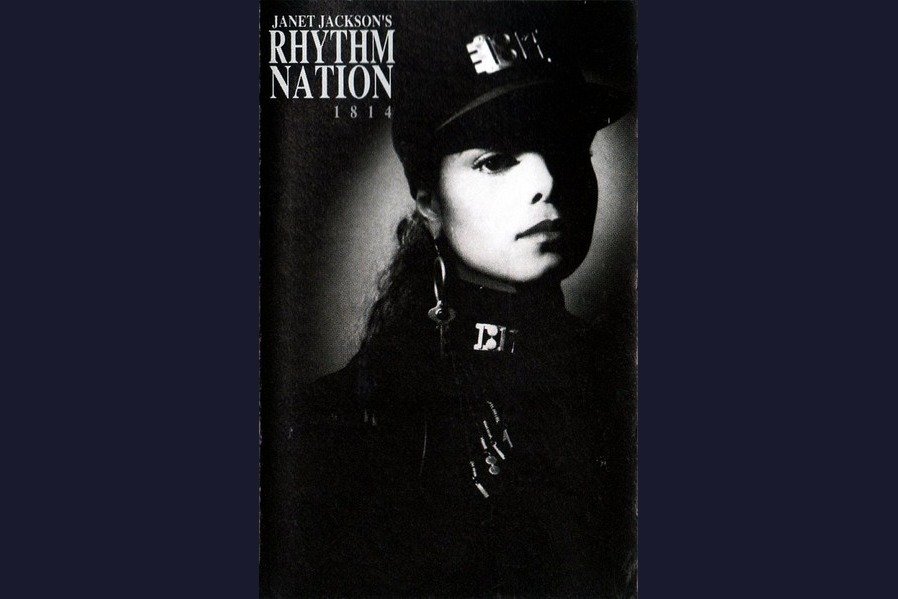
The uniform carried into the “Rhythm Nation” music video, a black-and-white short film shot in a dystopian warehouse where Janet and her dancers moved in unison, dressed identically regardless of gender. The choreography — sharp, militaristic, perfectly synchronized — became one of the most imitated routines of the era and won Best Choreography at the 1990 MTV Video Music Awards, where Janet also received the Video Vanguard Award. The costume itself was eventually preserved alongside her handwritten lyrics for “Rhythm Nation” as part of the Rock and Roll Hall of Fame’s collection.
Love the retro era? Browse our shop for vintage finds, retro clothing, and 80s/90s nostalgia gear.
Four Weeks at Number One
Rhythm Nation 1814 had debuted modestly at number 28 on the Billboard 200 after its September 19, 1989 release — a slow climb that reflected how much work it took to turn an album this unconventional into a mainstream smash. Six weeks later, on October 28, it reached number one, where it stayed for four straight weeks.
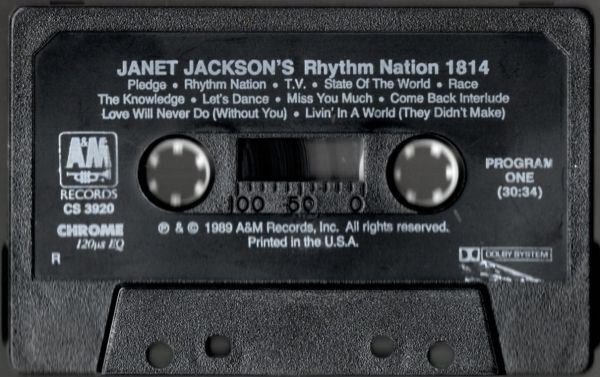
The album went on to produce seven Top 5 singles on the Hot 100 — the only album in Billboard history to do so — and became the first album to generate number-one hits across three different calendar years (1989, 1990, and 1991). It would eventually sell over six million copies in the US alone, earn Janet a Grammy nomination for Album of the Year, and win her the Grammy for Best Long Form Music Video for the 30-minute Rhythm Nation 1814 film.
More than any chart statistic, though, Rhythm Nation 1814‘s legacy is in how many artists it shaped. Its blend of social commentary, tightly drilled choreography, and genre-hopping production became a blueprint that pop acts have been following for three decades — right down to the uniform jackets and warehouse sets that still show up in music videos today. On October 28, 1989, it became official: Janet Jackson wasn’t following in anyone’s footsteps. Everyone else was about to start following hers.
The Retro Almanac
A monthly roundup of "on this day" highlights from that month, decades back — plus first dibs on new retro merch drops. No spam, just the good stuff.