Speak & Spell: The 1978 Toy That Started the Digital Age
In June of 1978, on a folding table at the Consumer Electronics Show in Chicago, a small yellow slab of plastic with a red faceplate said the word “cylinder” out loud, and a generation of toy buyers leaned in. It was the first Speak & Spell, the first consumer product anywhere to talk without a tape, a record, or a hidden ventriloquist. Texas Instruments had spent four years and a famously skinny $25,000 R&D budget figuring out how to put a human voice on a single silicon chip — and the moment they pressed that key, the entire idea of an “electronic toy” changed shape.
The Speak & Spell is the answer to a question most people forget to ask: what was the first machine that talked at you in your own house? Not a radio playing a person, not a record spinning a recording — an actual computer building speech from scratch, on the floor of your bedroom, run on four C batteries.
The Retro Almanac
A monthly roundup of "on this day" highlights from that month, decades back — plus first dibs on new retro merch drops. No spam, just the good stuff.
The $25,000 Bet That Built a Voice
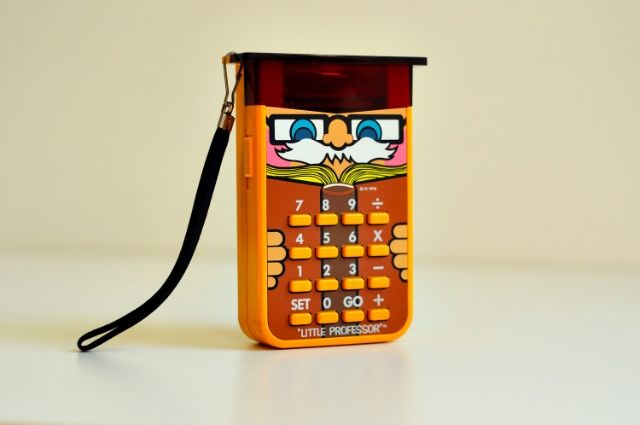
The Speak & Spell story doesn’t start with a toy. It starts with a frustrated TI engineer named Paul Breedlove, who in 1976 watched the Little Professor — TI’s first electronic learning calculator — sell out of every store it touched. Breedlove pitched a follow-up that would say the word a kid was supposed to spell, instead of just blinking it on a display. He got $25,000 to prove it could be done, which in mid-70s R&D dollars was somewhere between a lunch budget and an insult.
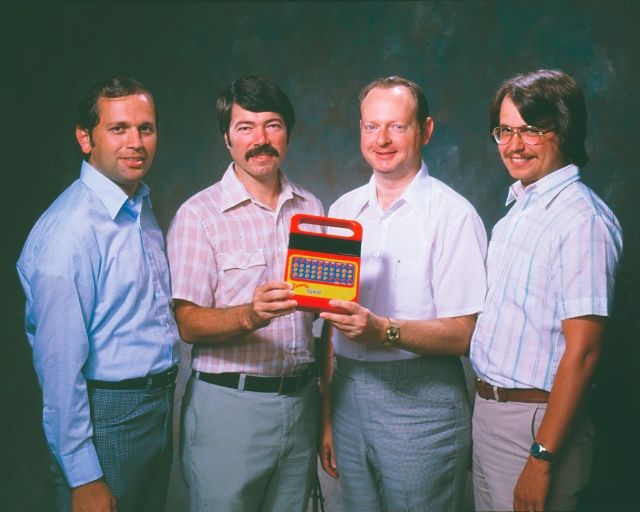
What he had on his side was Richard Wiggins, a TI speech scientist who had been quietly working on linear predictive coding (LPC) — a math trick that models a human voice as a stream of filter coefficients rather than a sound wave. Wiggins, Breedlove, Larry Brantingham, and Gene Frantz are the four names on the patent that came out of that lab. In December 1976, Wiggins demonstrated the concept to the team in TI’s Dallas research building, and the Speak & Spell project went from “weird side bet” to a real product on the calendar.
TI’s executives were not all believers. The internal pitch was a tough sell — speech synthesis had been a million-dollar-lab thing five years earlier, and now four guys wanted to put it on a kids’ toy at a $50 retail price. The team had to argue that the same chip that taught spelling could later end up in cars, elevators, and arcade cabinets. They were right about every single one of those, but in 1977 it sounded like science fiction.
How a Yellow Plastic Slab Beat the Cassette Tape
Before the Speak & Spell, every talking toy on the market was just a recording. Mattel’s See ‘n Say used a tiny record spun by a pull-string. Mrs. Beasley dolls hid a miniature record player inside the body. Even the first wave of “computerized” learning toys piggybacked on cassette tapes or eight-tracks. They wore out, they jammed, and they could only ever say what was physically pressed into them at the factory.
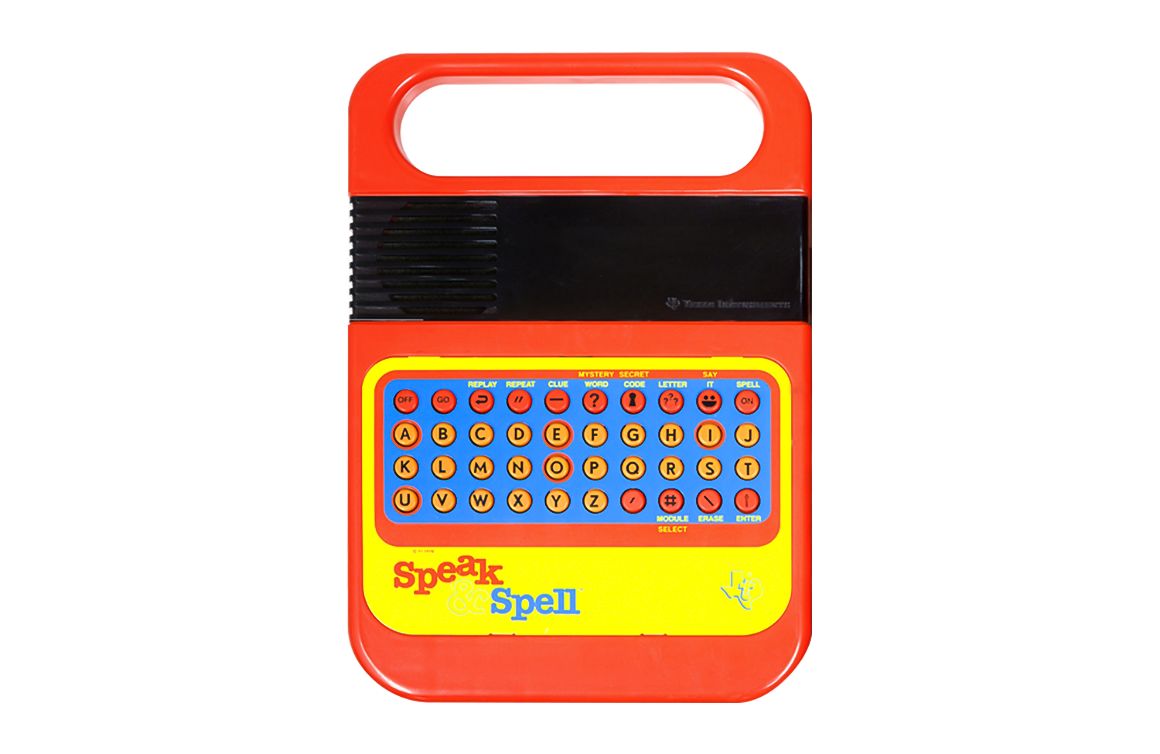
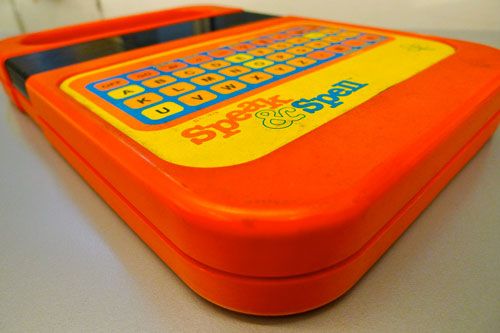
The first Speak & Spell did something genuinely strange. There was no tape inside, no moving parts beyond a speaker cone and a keyboard. The plastic shell — sometimes remembered as yellow, sometimes orange, often a clash of both with a red faceplate — was 10 inches wide and an inch and a half deep, with a carrying handle that doubled as a roll bar when a four-year-old chucked it across the kitchen. The blue vacuum fluorescent display glowed like the dashboard of a Camaro. Press a letter and the speaker would calmly tell you whether you’d spelled “fortunately” right, in that flat, slightly demonic synthetic voice nobody who heard it has ever forgotten.
That voice is the part that lodged in our memories. It wasn’t quite human. It wasn’t quite robot. It sat in a creepy little valley nobody had heard before, partly because no consumer product had ever produced a voice from a mathematical model rather than a recording. Kids learned to spell, parents learned that this thing did not skip or hiss like the cassette version of Hooked on Phonics, and TI learned it could ship a quarter-million units before Christmas 1978.
The Chip That Did the Talking
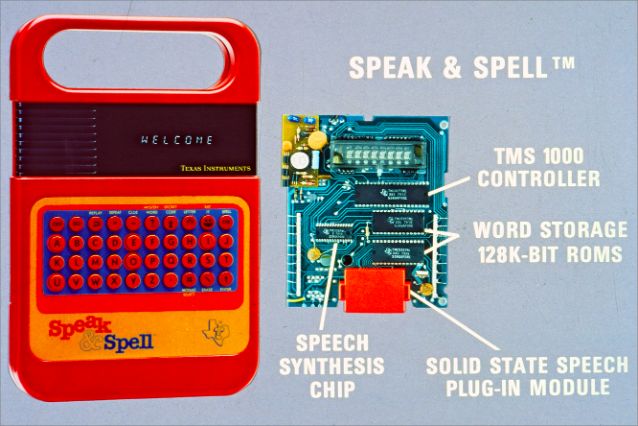
The brain of the original Speak & Spell was a single integrated circuit officially named the TMC0280 — quickly rebranded the TMS5100 once it went into broader production. It was the first single-chip digital signal processor ever sold commercially, and the IEEE named it a Milestone in 2009 for exactly that reason. Inside that little 28-pin slab of silicon was a 10th-order linear predictive coding decoder, a glottal chirp source for vowels, a white-noise source for consonants, an adjustable lattice filter, and a digital-to-analog converter — every block needed to turn a string of numbers into a recognizable English word.
The clever trick was compression. Storing actual audio of every word the toy could say would have required hundreds of kilobytes of ROM, which in 1978 was the size of a paperback book and the price of a car payment. LPC let TI store a word in roughly a kilobyte by encoding only the parameters the chip needed to resynthesize the voice in real time. The dictionary ROM was a 128-kilobit chip — the largest mask ROM commercially available at the time — and TI hired voice actor Stan Smith to read a stunt-double version of every word in the library, which the LPC encoder then crunched down into the tiny coefficient stream the chip would replay.
The truth is the Speak & Spell wasn’t really an “educational toy” disguised as a computer — it was a computer disguised as a toy. The same speech-chip family ended up in dashboards, in elevators, in pinball machines (Williams used a cousin chip in Gorgar, the first talking pinball table), and in the arcade. If you ever heard Pac-Man’s death sound, Q*bert’s grumble, or the bad guys yelling at you in Berzerk, you were listening to descendants of the silicon that made the Speak & Spell talk. It’s not a coincidence that the golden age of 80s arcade games rolled in at exactly the moment TI’s speech chips became cheap enough to bolt into a coin-op cabinet.
Three Toys, One Brain: The Spell, Read, and Math Family
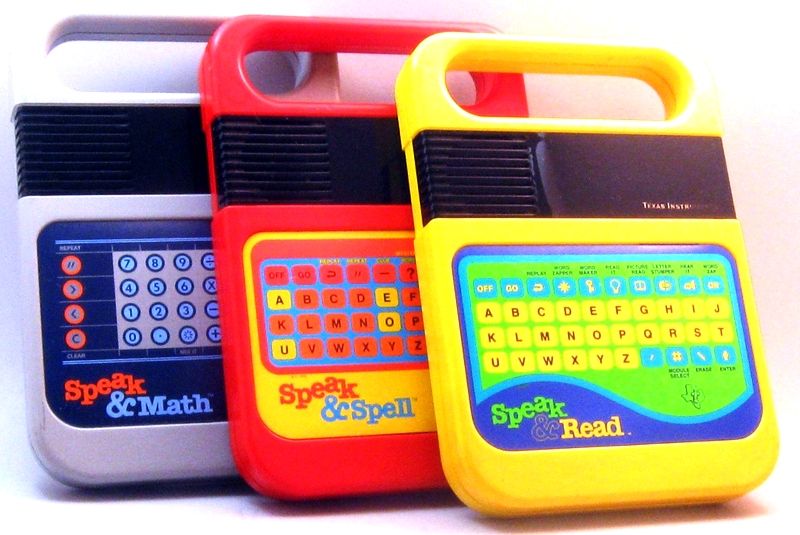
By 1980 the Speak & Spell had a green sibling — the Speak & Read, aimed at younger kids working on phonics and short stories — and a grey one, the Speak & Math, built for arithmetic drills. Inside, all three were close cousins. TI essentially kept the same chipset and case mold and rotated the dictionary ROM and the printed faceplate. The Speak & Read still used cartridges; the Speak & Math dropped them in favor of a built-in five-game library with three difficulty levels.
The cartridge system on the original Speak & Spell deserves its own museum plaque. Pop the battery compartment open and you’d find a slot that took plug-in ROM modules — Vowel Power, Pre-K, Mighty Verbs, Story Maker — each one a fresh dictionary’s worth of vocabulary. That’s not a small thing. The Speak & Spell was one of the first handheld electronic devices with a screen and swappable game cartridges, predating Mattel’s Auto Race, Nintendo’s Game & Watch, and certainly the Game Boy by years. Anyone who tells you cartridge-based handhelds started with Nintendo never met a kid in 1978 swapping Super Stumpers for Vowel Power on the kitchen floor.
The Speak & Spell sat at one end of a longer TI bet on educational electronics. The Little Professor (1976) was the proof of concept — a math drill calculator with no speech that flew off shelves so fast TI ran out of stock by Christmas. The Dataman, the Speak & Read, the Spelling B, even the My Friend Mandy doll were all part of TI’s push into the home learning aisle. The Speak & Spell just happened to be the one that landed in pop culture.
How E.T. Made the Speak & Spell Immortal
The reason your aunt remembers the Speak & Spell, even if she never owned one, is a 1982 movie about a stranded alien with a glowing finger. In Steven Spielberg’s E.T. the Extra-Terrestrial, the title character builds his “phone home” rig out of a circular saw blade, a coffee can, an umbrella lined with tin foil, and — at the heart of the whole contraption — a Speak & Spell. Elliott’s older brother Michael grabs it off a shelf as the most obviously alien-looking electronic in the house. The toy then becomes the part that actually does the broadcasting.
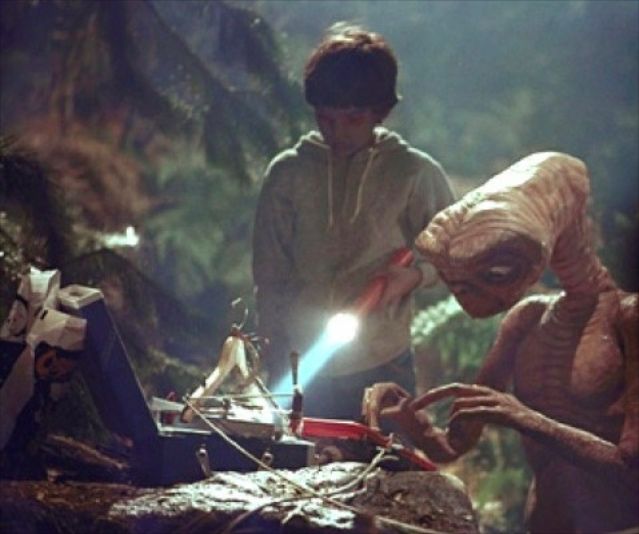
That was a $619-million box office endorsement nobody at TI saw coming. E.T. was the highest-grossing film of the 1980s, full stop, and the Speak & Spell got a few seconds of unmissable screen time as the brain of an interstellar phone. Sales of the toy ticked up. The cultural shorthand of “talking yellow toy = future tech” got carved in for good. To this day, if you Google “ET phone home prop,” the Speak & Spell shows up before the umbrella does.
The toy also became a quiet character in the broader Spielberg-era story about kids and machines. Knight Rider debuted with KITT in 1982. WarGames in 1983 had a kid hacking a Pentagon mainframe. The Last Starfighter in 1984 made an arcade cabinet a recruitment tool. Sitting underneath all of it was a generation that had grown up with a Speak & Spell on the carpet, and never quite stopped expecting their machines to talk back. The same nostalgia powers the wider story of 80s technology that bled into everything from Walkmans to home computers.
When Musicians Cracked It Open
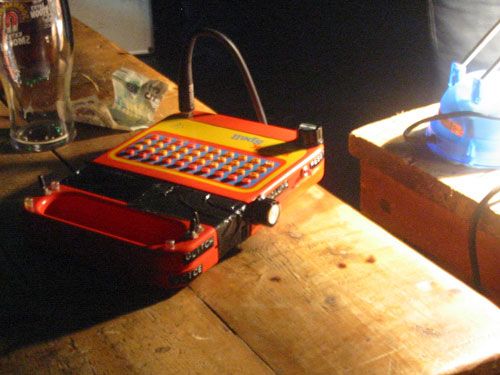
The other place the Speak & Spell went was into a recording studio. In 1981, four scrappy synth-pop kids from Basildon, Essex put out their debut album and named it Speak & Spell. The band was Depeche Mode, and the title was a tip of the cap to a toy they’d actually been playing through their gear. The album peaked at number 10 on the UK charts. The Speak & Spell name was on a million record sleeves a year later.
From there it got weirder. A New York instrument-builder named Reed Ghazala — the man who coined the phrase “circuit bending” — figured out that if you opened a Speak & Spell and started touching the circuit board with a damp finger or a copper wire, the chip would output sounds the engineers at TI never dreamed of. Garbled syllables, dive-bombing pitches, glitchy aliens screaming at the wrong frequency. Ghazala called his modified Speak & Spells “Incantors” and turned them into proper musical instruments with brass body contacts and pitch-bend dials.
The Speak & Spell ended up on Pink Floyd’s “Keep Talking” in 1994 — where Stephen Hawking’s voice synthesizer met its plastic ancestor — and on Beck records, and on a generation of bedroom-electronica releases. The toy became a piece of musical hardware on the same shelf as the TR-808 and the SP-1200. None of which Paul Breedlove was thinking about when he wrote a memo asking for $25,000 to build a spelling tutor.
What Killed the Original, and What It Came Back As
The original Speak & Spell ran almost untouched from 1978 until 1980, when TI redesigned the case and shrank the keyboard. In 1982 the Speak & Spell Compact arrived — a smaller, screenless variant. In 1989 the Super Speak & Spell ditched the blue vacuum fluorescent display for an LCD, swapped in a QWERTY keyboard, moved the handle to the bottom, and painted the whole thing red. Three more redesigns followed by 1992, and then the line quietly retired as PCs and CD-ROM software ate the educational toy market.
The Speak & Spell never really died, though. IEEE Spectrum inducted it into the Consumer Electronics Hall of Fame. The Smithsonian and The Henry Ford both keep examples in their collections. A faithful reissue hit Target shelves in 2019 — same yellow shell, same red faceplate, same handle, with the original LPC voice samples preserved in modern silicon. The reissue sold out before Christmas. It still talks.
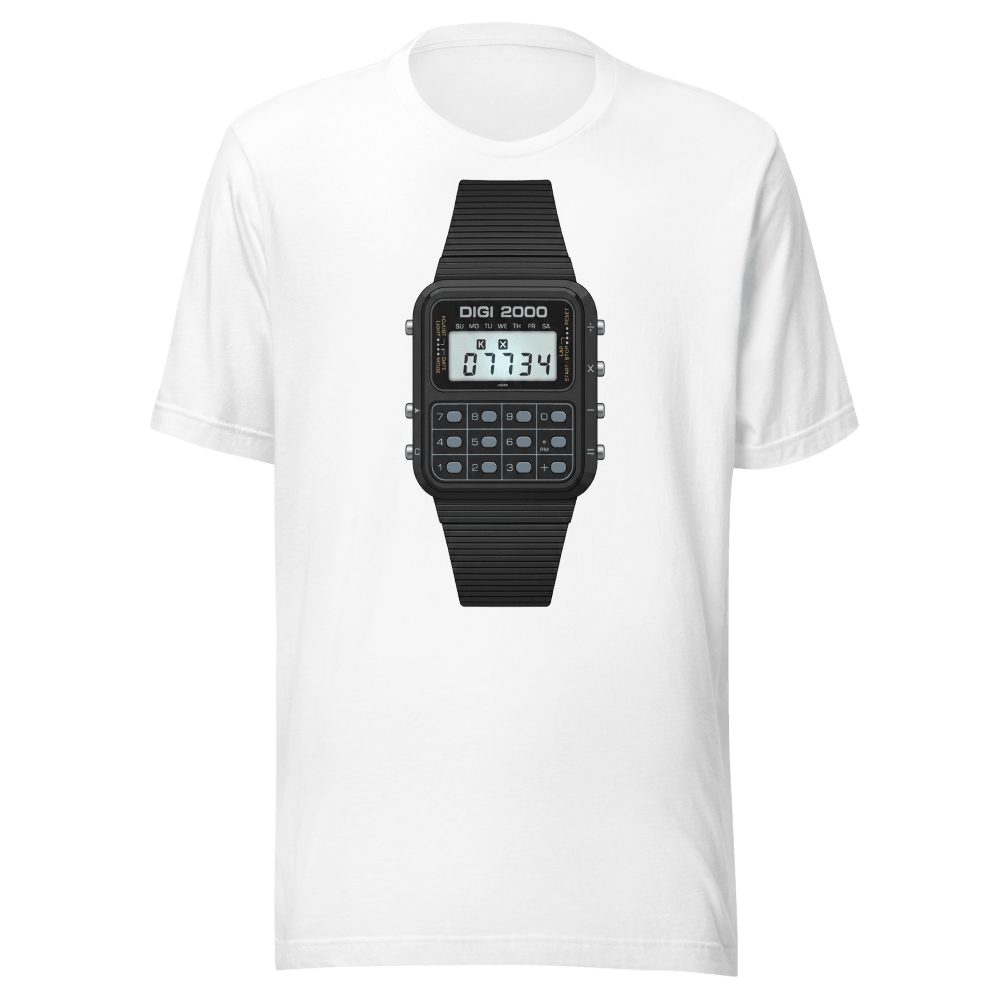
The honest take is that nothing else on the toy aisle from 1978 left a fingerprint this wide. Atari’s 2600 changed gaming. The Sony Walkman changed how we listened to music. The Casio calculator watch changed how we wore tech on our wrists. But the Speak & Spell did something none of those did — it taught a generation of kids that a computer could talk to you, that learning could come out of a speaker, and that a piece of plastic on the floor could be smarter than the adults in the room. Every voice assistant you’ve yelled at in the last decade — every Siri, every Alexa, every Google Home — owes a chip-level debt to the silicon in that yellow toy.
If you still have one in a closet, working battery contacts and all, hang onto it. The 1978 originals routinely cross $150 on eBay in clean condition, and boxed examples with the early “no-screw” case have cracked $400. That’s not bad for a $50 toy that nobody at TI thought would sell.
Sources
- IEEE Spectrum — The Consumer Electronics Hall of Fame: Texas Instruments’ Speak & Spell — Engineering history of the toy and the TMS5100 chip.
- IEEE ETHW Milestone — Speak & Spell, First DSP IC for Speech Generation — Official 2009 IEEE Milestone citation.
- Tedium — Speak & Spell History: Texas Instruments’ Greatest Product — Deep dive on the 1978 launch and TI’s speech research lineage.
- Hack Education — Speak & Spell: A History — Educational technology angle and connection to the Little Professor.
- The Henry Ford Museum — Speak & Spell artifact entry (1978–1985) — Museum collection notes and provenance.
- Toy Tales — Speak & Spell from Texas Instruments (1978) — Cartridge module library and pricing context.
- Wikipedia — Speak & Spell (toy) — Model timeline through Compact and Super Speak & Spell variants.
- Big Mess o’ Wires — Inside Vintage Electronic Toys: How Speak & Spell Works — Teardown photos of the original circuit board and chips.
Browse retro and vintage-inspired apparel at the RetroRadical shop →
The Retro Almanac
A monthly roundup of "on this day" highlights from that month, decades back — plus first dibs on new retro merch drops. No spam, just the good stuff.