Nelson Mandela Inauguration: 5 Powerful Moments in 1994
The Nelson Mandela inauguration on May 10, 1994 turned a country built on segregation into a constitutional democracy in the span of a single morning. Inside the amphitheatre at the Union Buildings in Pretoria, a 75-year-old man who had spent 27 years in apartheid prisons placed his hand on a Bible and was sworn in as the first black president of South Africa. More than 4,000 guests, 45 heads of state, and an estimated television audience of one billion watched the moment a country crossed over.
This is the story of that day — the small details, the staggering symbolism, and the five moments from the inauguration ceremony that still hit Gen X right in the chest more than thirty years later.
Nelson Mandela Inauguration Day: 5 Moments That Defined May 10, 1994
Most history books summarize the day in a single sentence. But the inauguration of Nelson Mandela was not a single event — it was a careful sequence of acts, each one designed to bury one South Africa and birth another. Here are the five moments that landed hardest.
1. The Arrival at the Union Buildings
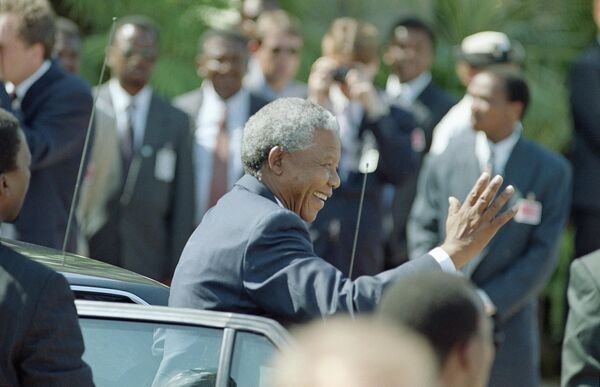
The Union Buildings in Pretoria had been the symbolic stronghold of white minority rule for 80 years. The sandstone amphitheatre had hosted every National Party prime minister since 1910. When Mandela’s motorcade pulled up on the morning of May 10, 1994, the cameras caught the surreal optics — South African Defence Force generals, the same men who had hunted ANC fighters for decades, standing at attention to receive the man their predecessors had jailed. The crowd on the lawns below the amphitheatre was estimated at 100,000. Many had walked overnight from townships outside Pretoria to be there.
2. The Imbongi (Praise Singer) Opens the Ceremony

Before any anthem, before any oath, an imbongi — a traditional Xhosa praise singer in animal-skin regalia — strode forward and chanted Mandela’s clan name and lineage in iziXhosa. It was the first time a pre-colonial African ceremony had ever opened a state event in the Union Buildings. For viewers raised on the imagery of apartheid news broadcasts, the moment was a thunderclap: the language and clothing that had been pushed to the margins of public life walked straight into the seat of government and was given the first word.
3. The Oath of Office

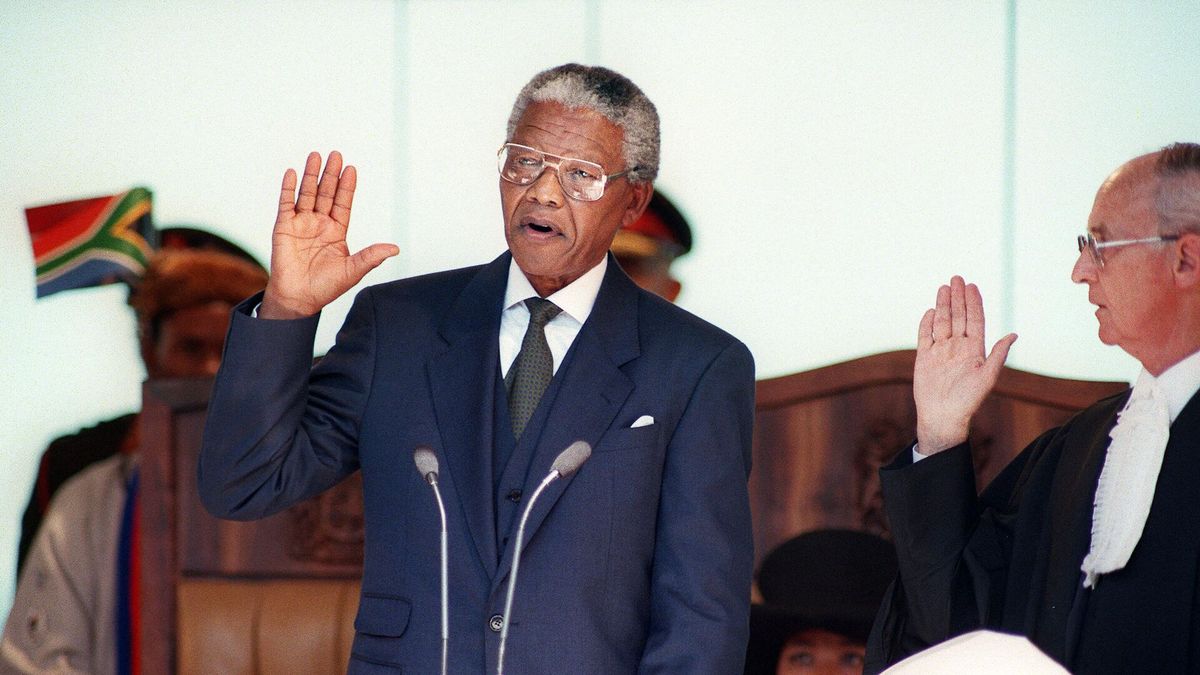
Chief Justice Michael Corbett administered the oath at 12:17 p.m. local time. Mandela, in a dark suit and a small ANC ribbon, recited the words that legally ended white minority rule: “I, Nelson Rolihlahla Mandela, do hereby swear to be faithful to the Republic of South Africa, and do solemnly and sincerely promise at all times to promote that which will advance, and to oppose all that may harm, the Republic.” His voice did not shake. He had rehearsed the line in a Robben Island cell while breaking limestone for a living.
4. The New Flag and Two Anthems

The most cinematic minute of the ceremony was the anthems. The military band played Die Stem, the Afrikaner national song, and then segued without pause into Nkosi Sikelel’ iAfrika, the liberation anthem that had been banned for decades. As the band crossed between the two melodies, the new six-color South African flag — blue, red, green, gold, black, and white — unfurled above the amphitheatre. The country had been singing two anthems in two halves of the same nation. For the first time, both rang out from the same stage.
5. The Embrace with Archbishop Desmond Tutu

After the oath, Mandela stepped down to embrace Archbishop Desmond Tutu, the Anglican cleric who had named the new country a “Rainbow Nation.” Tutu, in his purple cassock, lifted his hands skyward and shouted, “We are free!” The hug between the politician and the priest became one of the defining images of the day — two men who had spent the 1980s being denounced by Pretoria as terrorists and rabble-rousers, now standing on the building from which their persecution had been planned.
The Inauguration Speech That Set the Tone

The Mandela inauguration speech ran 1,400 words and lasted just over twelve minutes. It contained no triumphalism, no settling of scores, and no mention of revenge. The most quoted passage came near the middle:
“The time for the healing of the wounds has come. The moment to bridge the chasms that divide us has come. The time to build is upon us. We have, at last, achieved our political emancipation. We pledge ourselves to liberate all our people from the continuing bondage of poverty, deprivation, suffering, gender and other discrimination. Never, never and never again shall it be that this beautiful land will again experience the oppression of one by another.”
“Never, never, and never again” became the line every South African schoolchild memorized. You can still find the full ceremony on the SABC News archive — the whole thing is on YouTube and worth watching once a year:
How South Africa Got Its First Black President

To understand why the world stopped on May 10, 1994, you have to remember what came before it. Apartheid was not a vague notion of segregation — it was a system codified in 1948 and tightened through 70+ separate laws. The Population Registration Act sorted every person into a racial category at birth. The Group Areas Act forced black, coloured, and Indian South Africans out of urban neighborhoods. The pass laws required black citizens to carry identity documents at all times. Marriage across racial lines was a criminal offense.
The unraveling took most of the 1980s and the early 1990s. International sanctions cut off South African gold and arms exports. The 1985 township uprisings exposed the regime’s brittleness on global television. F.W. de Klerk, who succeeded P.W. Botha in 1989, began legalizing banned organizations and unbanned the ANC, the PAC, and the Communist Party in February 1990. Mandela walked free from Victor Verster Prison nine days later. We covered the next big domino — the all-white referendum that gave de Klerk a mandate to keep negotiating — in our piece on the 1992 South Africa apartheid referendum.
The Election That Set Up the Inauguration

South Africa’s first non-racial election ran from April 26 to April 29, 1994. Voters stood in lines that stretched for miles. Black South Africans over the age of 75 were voting for the first time in their lives. The ANC took 62.65% of the vote, the National Party (de Klerk’s party) came second at 20.39%, and Inkatha came third at 10.54%. Under the interim constitution, any party with more than 5% got a seat in the cabinet — a deliberately power-sharing setup designed to keep the transition peaceful. Mandela was sworn in as president; de Klerk and Thabo Mbeki became his two deputy presidents.
The World That Watched
Forty-five heads of state attended the Mandela inauguration, including Hillary Clinton (representing the United States), Cuba’s Fidel Castro, the U.K.’s Prince Philip, Israel’s Chaim Herzog, the PLO’s Yasser Arafat, Benazir Bhutto of Pakistan, and dozens of African leaders. Six South African Air Force fighter jets — the same ones that had once trained over Angola — performed a ceremonial flyover trailing the new flag’s six colors. CNN, BBC, and SABC carried the ceremony live. The U.S. networks broke into regular programming. For Gen X viewers, May 10, 1994 sits next to the fall of the Berlin Wall and the release of Mandela himself as one of the few “I remember exactly where I was” moments of the decade. Other defining May moments from that era include the 1984 Olympics boycott and the 1980 Iranian Embassy siege, but Mandela’s inauguration is the one that almost everyone says they watched in real time.
The Lunch, the Concert, and the Rainbow

After the ceremony, Mandela hosted a state lunch for 800 dignitaries at the Presidency. The menu deliberately blended traditional African and European cuisine. In the afternoon, he addressed a crowd of around 100,000 at the Union Buildings lawns and introduced de Klerk and Mbeki as deputy presidents, lifting their joined hands. That evening came the inauguration concert — a free, sprawling open-air show featuring Hugh Masekela, Miriam Makeba, Letta Mbulu, Ladysmith Black Mambazo, and Brenda Fassie. Mandela danced. De Klerk danced. The footage of those two men — the prisoner and the prison-keeper — laughing and swaying together was beamed around the planet. It is the closing image you should remember when anyone tries to tell you the 1990s were a cynical decade.
Why May 10, 1994 Still Matters
The Mandela inauguration is one of the rare modern political events that delivered exactly what its choreography promised. It was not a coup, not a partition, and not a civil war. It was a transfer of power negotiated across a table by two men who, only six years earlier, had been on opposite sides of a state of emergency. The South Africa that emerged on May 10 was imperfect — economic apartheid persisted, and still does — but the political door had been kicked open and could not be re-shut. The Truth and Reconciliation Commission would follow in 1996. The 1995 Rugby World Cup, with Mandela in a Springbok jersey, would follow a year after that. None of those moments could have happened without the morning at Union Buildings.
If you grew up in the 80s and 90s, you watched the world rearrange itself in real time — the Wall came down, the USSR dissolved, apartheid ended. Mandela’s inauguration is the one that aged best. Watch the speech once a year, especially when the news is bleak. Few political moments hold up this well three decades later.
Sources
- HISTORY.com — Nelson Mandela, South Africa’s first Black president, is inaugurated — Network history outlet’s day-in-history entry
- South African History Online — Nelson Mandela is inaugurated as South Africa’s first black president — National South African historical archive
- Nelson Mandela Foundation — The Presidential Years: Inauguration — Official Mandela Foundation account of the day
- South African Government — Inauguration speech transcript — Full text of the May 10, 1994 inaugural address
- Encyclopaedia Britannica — Nelson Mandela biography — Authoritative biographical entry
- United Nations — Nelson Mandela’s Life & His Statements — UN’s record of Mandela’s global statements and legacy