On This Day: November 4, 1988 — They Live Opens in Theaters
On November 4, 1988, a professional wrestler with no real acting résumé put on a cheap pair of black sunglasses, looked up at a Los Angeles street, and saw the truth: the whole world was being run by skull-faced aliens hiding behind every billboard, magazine cover, and dollar bill. The movie was They Live, John Carpenter’s B-movie-with-a-brain, and it opened in theaters that day to debut at #1 at the North American box office. Nobody involved expected it to become one of the most quoted, most memed, most politically relevant horror films of the next four decades.
From a Six-Page Comic to a $4 Million Movie
The story started small: a short 1986 comic strip called “Nada,” drawn by artist Bill Wray, which itself was adapted from Ray Nelson’s 1963 short story “Eight O’Clock in the Morning.” Carpenter, fresh off a run of studio disappointments, saw the comic and recognized something he wanted to say. It was the back half of the Reagan era — trickle-down economics, yuppie excess, homelessness rising in every major city — and Carpenter wanted to make a movie about a country sleepwalking through its own exploitation.
He wrote the screenplay himself under the pseudonym “Frank Armitage” — also the name eventually given to Keith David’s character in the finished film — and shot it for roughly $4 million, a shoestring budget even by late-80s standards. Much of it was filmed on location in downtown Los Angeles, using real storefronts, newsstands, and alleys instead of built sets, which gives the movie its grimy, lived-in look. Universal Pictures treated it as a minor genre release, slotting it into a crowded November without much fanfare — nobody at the studio was predicting the film would still be generating think-pieces four decades later.
The Retro Almanac
A monthly roundup of "on this day" highlights from that month, decades back — plus first dibs on new retro merch drops. No spam, just the good stuff.
Casting a Wrestler as the Lead
The lead role of the drifter “Nada” went to “Rowdy” Roddy Piper, the WWF villain famous for smashing a coconut over Jimmy Snuka’s head during a Piper’s Pit segment four years earlier. Carpenter had seen Piper on wrestling TV and liked his physical presence and his everyman toughness — exactly what a laid-off construction worker turned drifter needed. Meg Foster, with her famously pale, unnerving eyes, was cast as Holly Thompson, a TV executive whose loyalties stay ambiguous until the film’s final minutes. Keith David, who Carpenter had directed a year earlier in The Thing, took the role of Frank, a fellow construction worker who doesn’t want to know what Nada has discovered.
The Sunglasses That Explain Everything
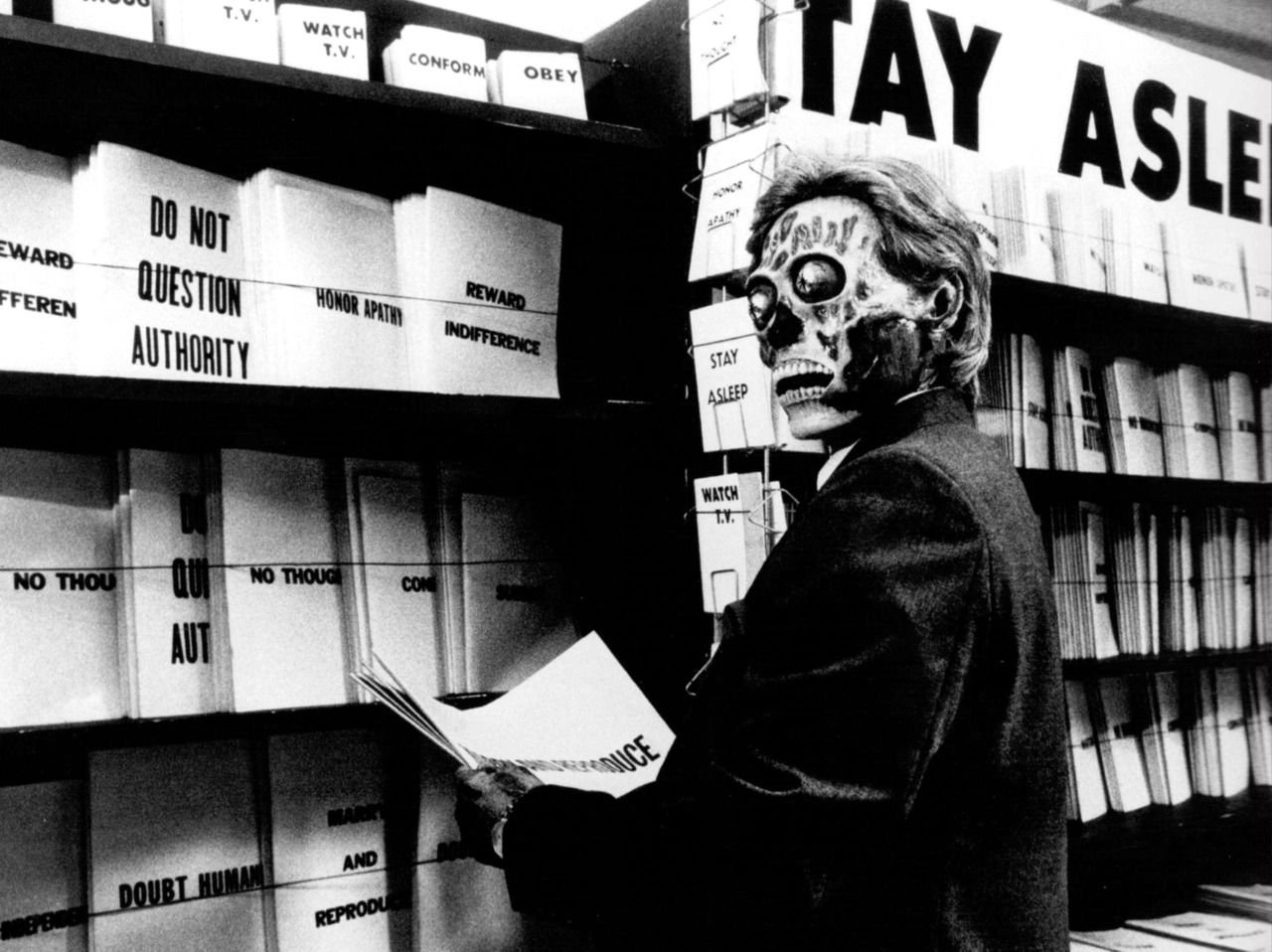
The entire premise hinges on one object: a pair of plain black Wayfarer-style sunglasses that let the wearer see the world in stark black and white — and see through it. Billboards that look like vacation ads actually say “MARRY AND REPRODUCE.” Cash register drawers read “THIS IS YOUR GOD.” Magazine racks and bookstore shelves scream “OBEY,” “CONFORM,” “DO NOT QUESTION AUTHORITY,” and “STAY ASLEEP.” And scattered through the crowd, invisible to the naked eye, are the ghoul-faced aliens who’ve been running the planet all along, disguised as the ruling class.
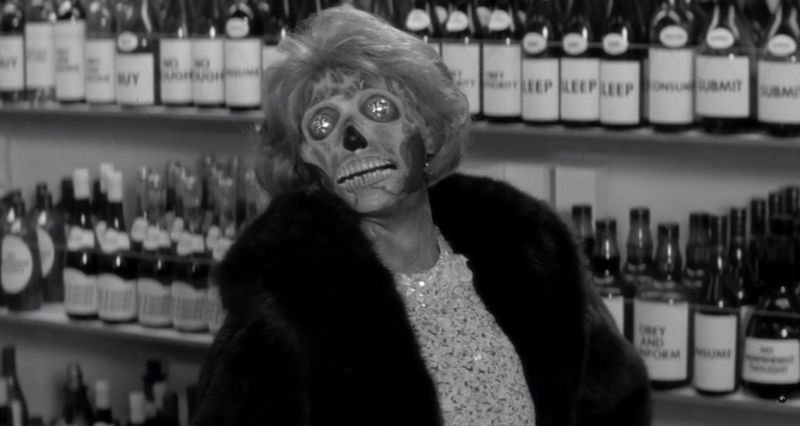
It’s a blunt metaphor — Carpenter has never pretended otherwise, calling the film an attack on Reagan-era consumerism in interview after interview — but the bluntness is the point. One of the film’s quietest, creepiest moments has nothing to do with billboards at all: an elderly woman in a fur coat, shopping calmly in a liquor store, turns out to be one of them, her skull-like face hidden in plain sight among the bottles on the shelf behind her.
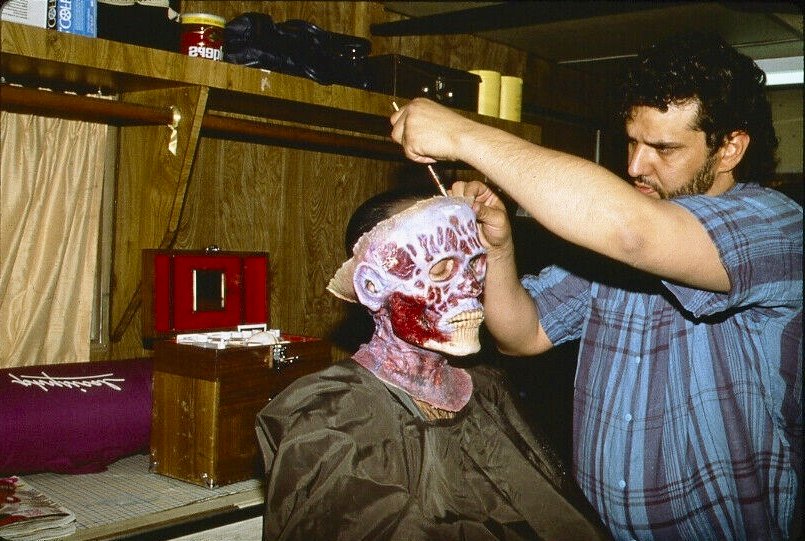
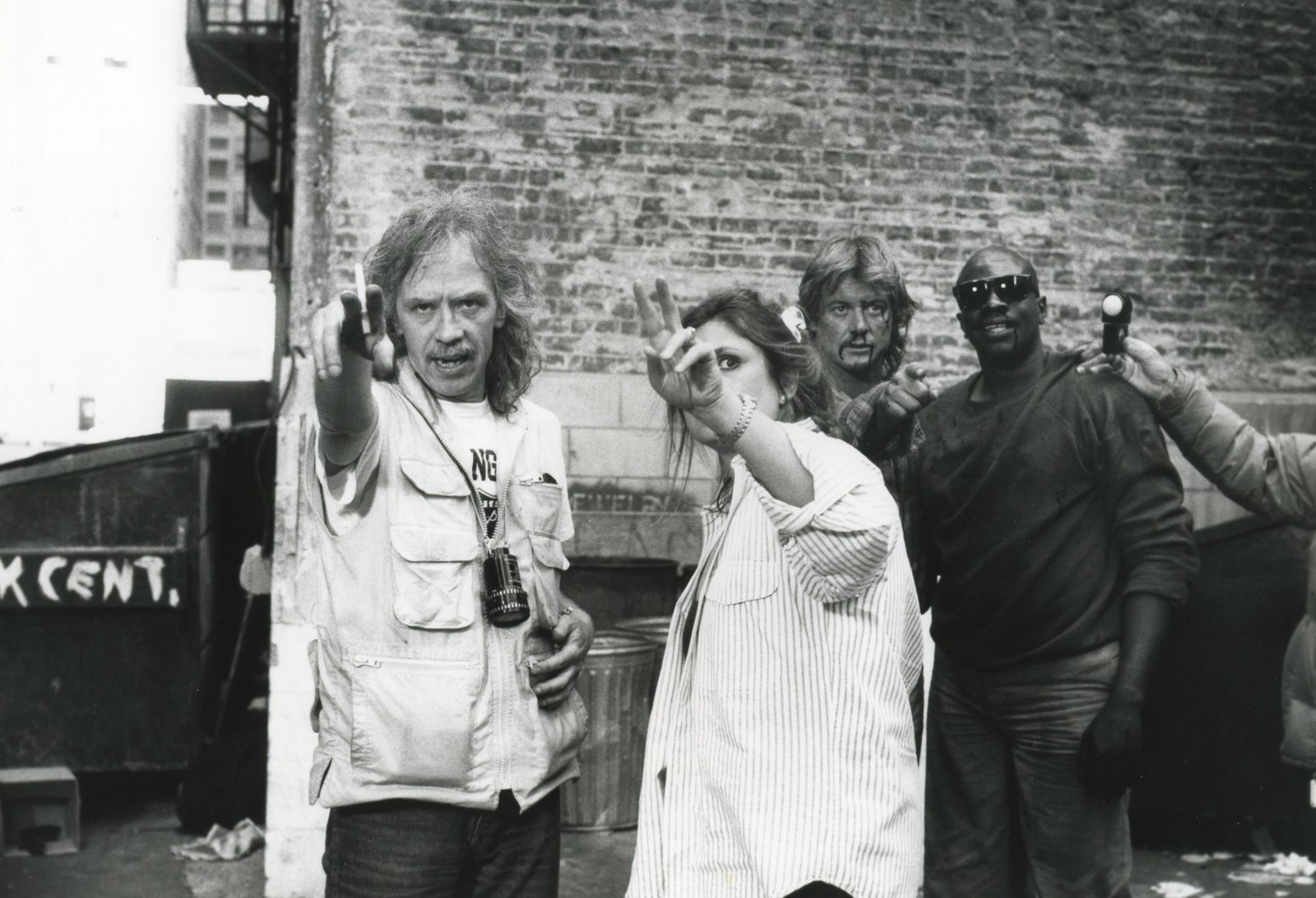
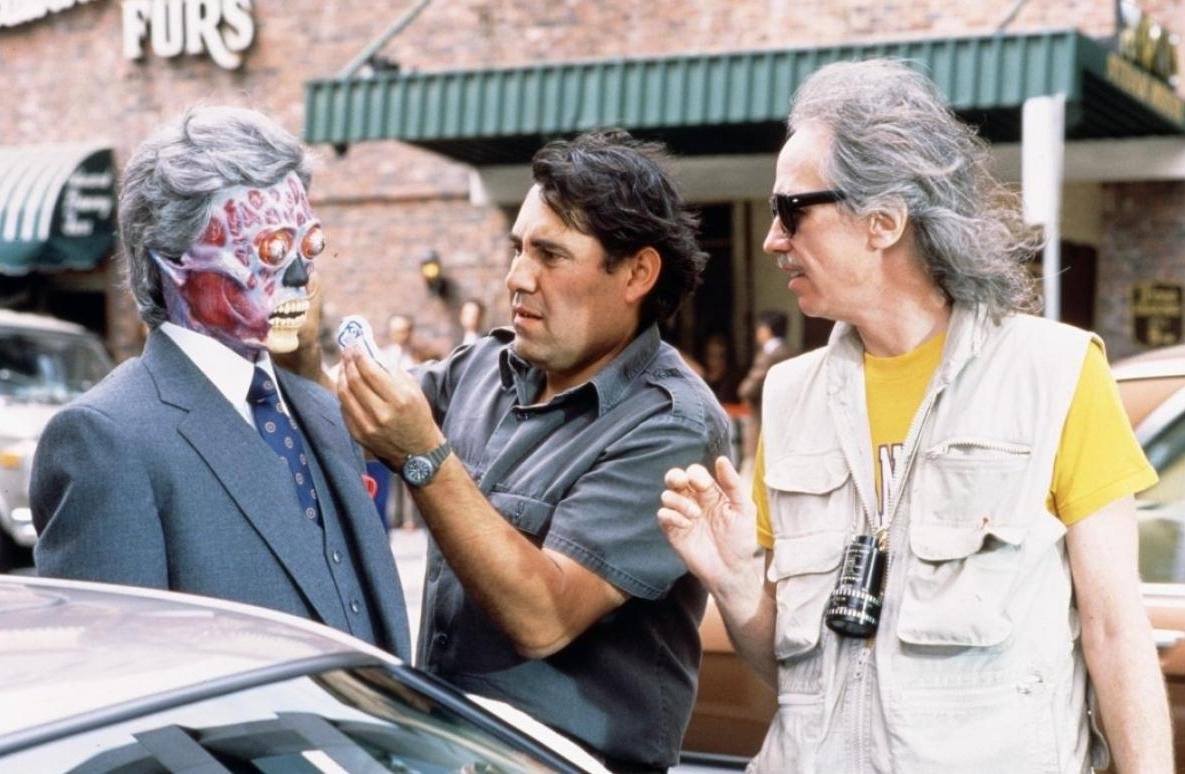
The makeup effects team, credited on-screen to Frank Carrisosa with prosthetics by Michael Mills, built the alien design around gaunt, hollow-eyed skulls that still manage to look unsettling almost 40 years later — all practical prosthetics and contact lenses, zero CGI. Carpenter has said the ghoulish look owes a real debt to his wife and associate producer, Sandy King, who helped shape the final design.
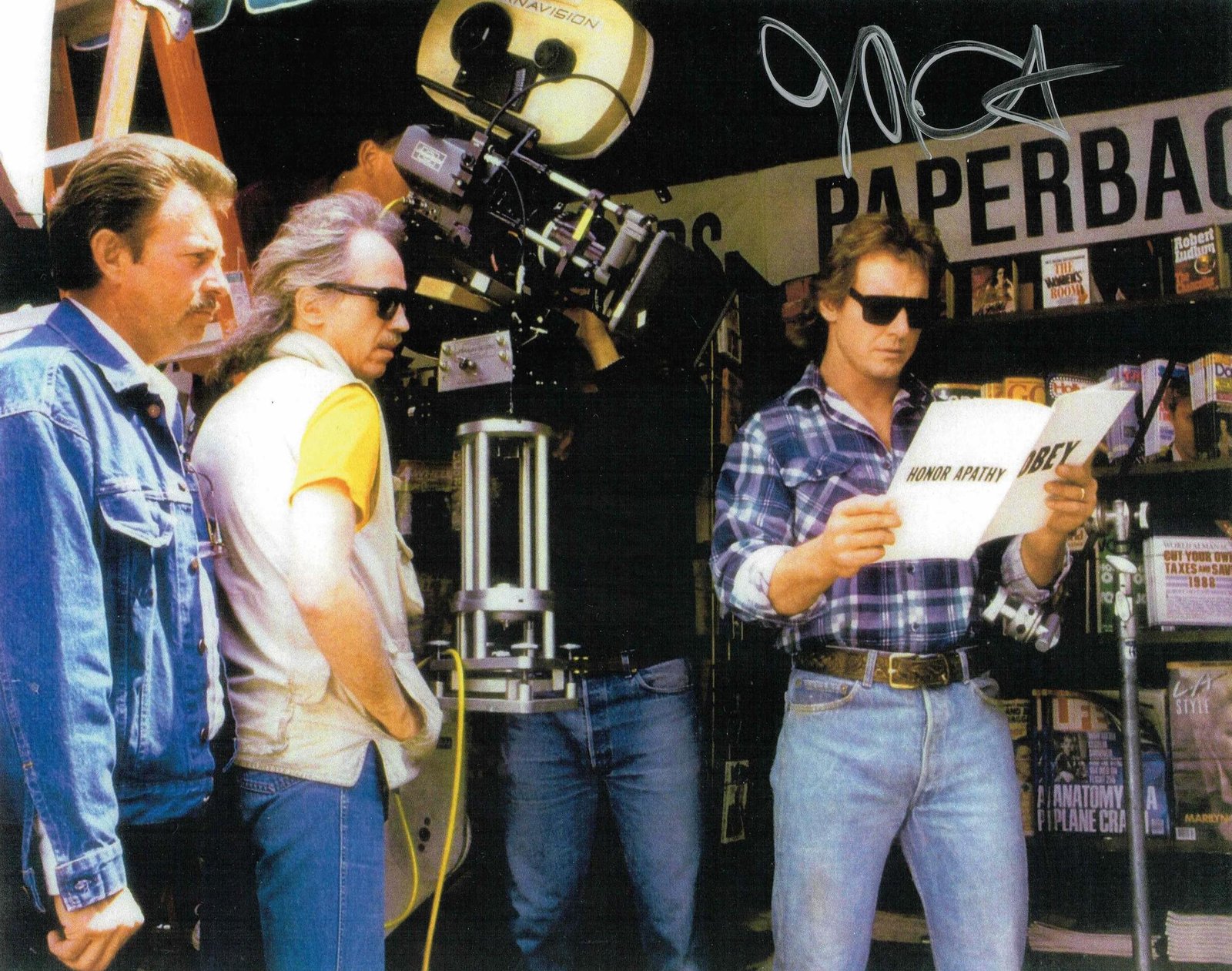
The gag works just as well in miniature. In one of the film’s most quoted small scenes, Nada discovers the ruse at a newsstand, flipping through a tabloid that suddenly reads “OBEY” in plain block letters while a bystander looks on, completely unaware.
Six Minutes, One Alley, No Mercy
If you’ve seen exactly one clip from They Live without having seen the movie, it’s almost certainly the alley fight. Nada tries to force his friend Frank to put on the sunglasses and see the truth; Frank refuses, and the two men beat the hell out of each other for what plays out as nearly six minutes of screen time — bone-crunching, overlong, and absurd on purpose.

The fight was scripted to run around 20 seconds. Piper and David, both in genuinely great shape and both committed to realism, kept extending it in rehearsal, trading real punches and real throws for weeks before filming ever started. Carpenter let it run long in the final cut because it worked — the longer it goes, the more it says about how hard it is to get anyone to simply open their eyes. Decades later, action choreographers still cite it as one of the best screen fights ever shot.
“I Have Come Here to Chew Bubblegum”
Piper, who had zero film experience going in, delivered the line that outlived the movie itself. Walking into a bank with a shotgun, he announces: “I have come here to chew bubblegum and kick ass… and I’m all out of bubblegum.” It wasn’t in Carpenter’s original script — Piper ad-libbed it on set, drawing from wrestling promo instincts, and Carpenter kept the take. Piper himself later admitted in interviews that he couldn’t fully explain where it came from in the moment. It’s since been quoted in video games including Duke Nukem 3D, sampled in songs, referenced in shows from Dazed and Confused to The IT Crowd, and printed on more T-shirts than almost any other line in horror-movie history.
Watch the Original Trailer
A Flop That Became Required Viewing
They Live made back its budget but wasn’t a major hit, and critics at the time were split — some dismissed it as B-movie schlock with a wrestler in the lead, others saw exactly what Carpenter was going for. It took years, then decades, for its reputation to catch up to its ambitions. The “OBEY” imagery became a direct influence on street artist Shepard Fairey, whose “OBEY Giant” sticker campaign borrowed the film’s command-word aesthetic wholesale and turned it into one of the most recognizable logos in street art. Political commentators across the spectrum have claimed the film as their own ever since, each insisting Carpenter’s aliens represent whichever establishment they personally distrust — which, in fairness, is exactly the kind of ambiguity a genuinely good satire produces. Nearly every election cycle since the 2010s, some corner of the internet has rediscovered a frame of the “OBEY” bookstore scene and declared the movie “more relevant than ever,” a cycle that’s repeated so often it’s become its own running joke among Carpenter fans. Fairey eventually built an entire streetwear label, Obey Clothing, directly off the back of that borrowed vocabulary, turning a prop sunglasses gag from a $4 million horror movie into a recognizable global brand.
Even the sunglasses themselves became collector’s items. They were never anything exotic on screen — just plain, unbranded black-frame shades picked by the prop department — which is part of why they worked so well as a visual joke. Faithful replicas now circulate among prop collectors and horror conventions, and the design shows up every October as one of the more recognizable budget Halloween costumes: construction jacket, mullet wig, and a pair of cheap black Wayfarers, no further explanation needed.
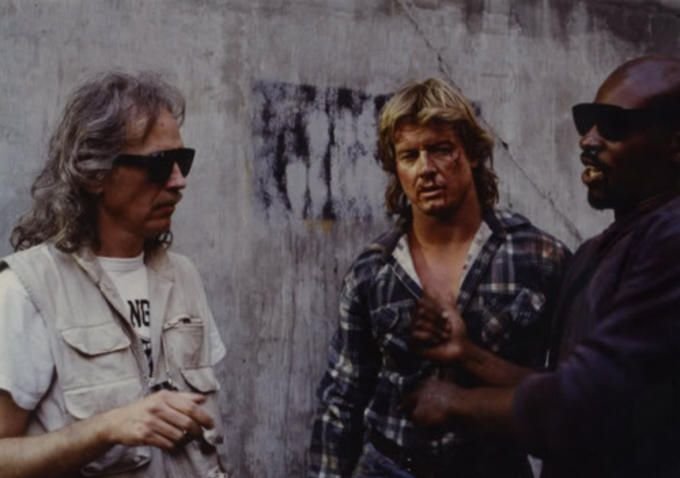
Piper passed away in 2015, but his performance as Nada — equal parts punch-drunk and righteously furious — only grew more beloved in the years after. Home video has been kind to the film’s reputation: special-edition Blu-ray releases loaded with commentary tracks and retrospective documentaries introduced it to a generation that missed the original run entirely, and it now sits at a Certified Fresh 86% on Rotten Tomatoes with an 80% audience score — a far cry from its mixed reception on opening weekend. Carpenter, who also co-composed the film’s synth score with longtime collaborator Alan Howarth, has called it one of his personal favorites among his own filmography, which says something coming from the director of Halloween and The Thing.
Carpenter himself has stayed consistent about what he meant with the film: it’s about class, about media noise drowning out reality, and about how comfortable it is to just keep scrolling past the signs. He’s said in interviews that he wrote it quickly, almost angrily, and that the anger is still the thing people respond to decades later — not the aliens, not the practical effects, but the simple dare to put on a pair of glasses and actually look at what’s in front of you. Nearly 40 years after it opened at #1 on a random November weekend, that part hasn’t aged a day.
Love the retro era? Browse our shop for vintage finds, retro clothing, and 80s/90s nostalgia gear.
The Retro Almanac
A monthly roundup of "on this day" highlights from that month, decades back — plus first dibs on new retro merch drops. No spam, just the good stuff.